



A Connoisseur’s Guide to Victorian Furniture: Elegance, Revival, and Craft
To the uninitiated eye, the world of Victorian design can appear as a dense, monolithic tapestry of dark woods and ornate carving-a style often perceived as too ponderous for the clean lines of contemporary living. This perception, coupled with the collector’s perennial concern of distinguishing a magnificent original from a later, lesser reproduction, can make navigating the era seem a formidable task. Yet, for the discerning connoisseur, beneath this formidable surface lies a period of extraordinary innovation and stylistic diversity, a rich landscape of revival movements from the Gothic and Rococo to the refined ideals of the Aesthetic.
This guide serves as your scholarly companion, designed to illuminate the intricate history, unparalleled craft, and distinct characteristics of fine victorian furniture. We shall journey through the defining features of each major revival, equipping you with the expert knowledge to discern authentic quality and provenance. Furthermore, we will reveal how these distinguished pieces, far from cluttering a space, can become magnificent, soulful focal points within the most sophisticated modern interiors, transforming them from historical artifacts into sound, beautiful investments for generations to come.
Key Takeaways
- Learn to distinguish between the major historical revival styles-from Gothic to Rococo-to truly appreciate the period's diverse and eclectic aesthetic.
- Develop a connoisseur's eye for master craftsmanship by recognising the superior materials and intricate inlay techniques that define the finest pieces.
- Acquire the essential skills to assess the authenticity and investment potential of antique victorian furniture, understanding how provenance elevates a piece's history and value.
- Discover sophisticated strategies for integrating singular pieces into contemporary interiors, transforming a magnificent table or armchair into a powerful focal point.
Redefining Victorian Furniture: An Era of Eclectic Excellence
To comprehend the true character of antique victorian furniture, one must first dismiss the monolithic and often pejorative clichés of a dark, cluttered, and overwrought style. The sixty-four-year reign of Queen Victoria (1837-1901) was not a singular aesthetic but a period of remarkable stylistic dynamism, fuelled by unprecedented industrial innovation and a profound reverence for the past. What modern eyes may perceive as clutter was, to the 19th-century mind, a carefully orchestrated narrative of prosperity, intellect, and global awareness-a philosophy known as horror vacui, or the fear of empty spaces. This era saw the masterful transition from the venerated traditions of the hand-craftsman to the burgeoning capabilities of the machine, resulting in objects of extraordinary complexity and ambition. It is this very richness and narrative depth that explains its current, powerful resurgence within sophisticated "Grandmillennial" and eclectic contemporary interiors.
The Three Stages: Early, Mid, and Late Victorian
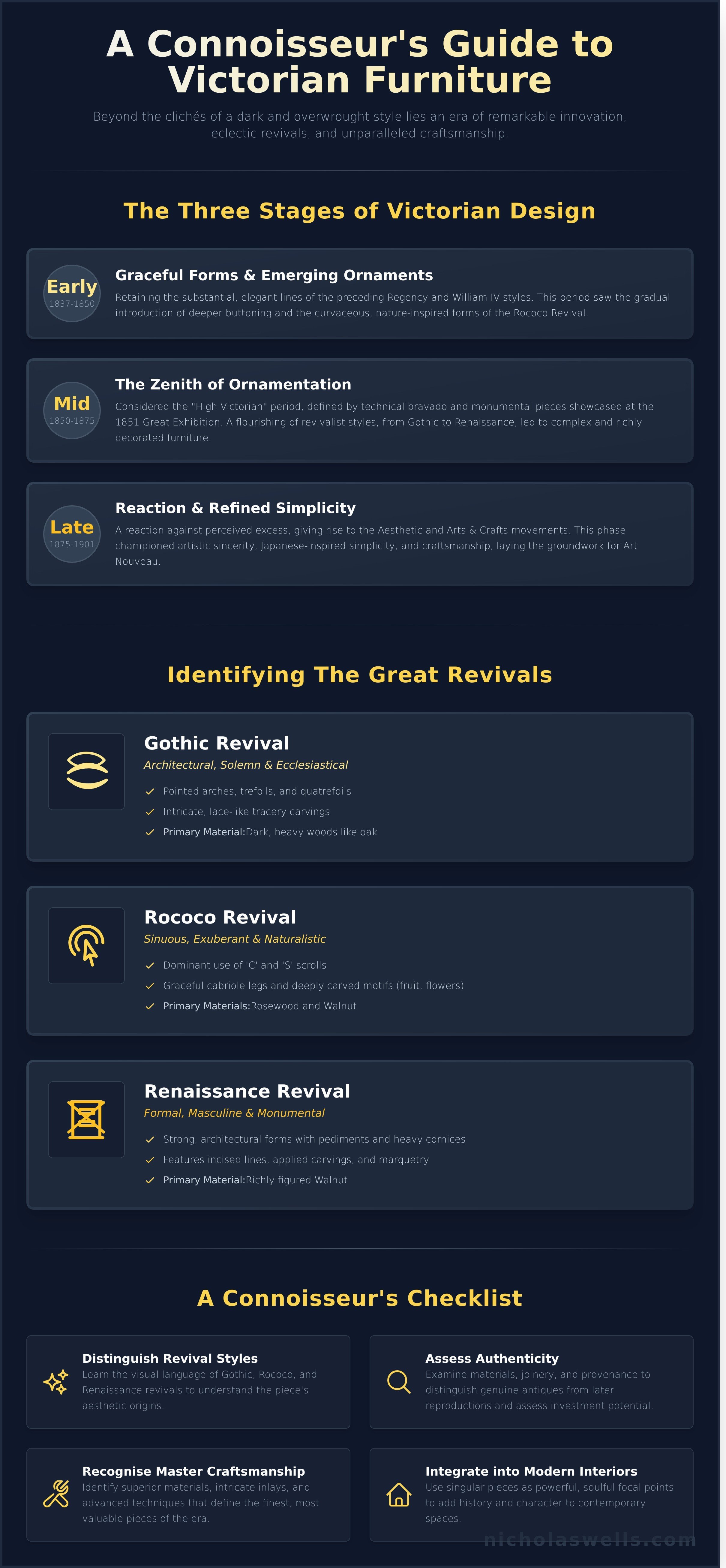
The era’s immense stylistic evolution is best understood by its three distinct phases. The Early Victorian period (c. 1837-1850) retained the graceful, substantial forms of the preceding William IV and Regency styles, gradually introducing the deeper buttoning and curvaceous lines of the Rococo Revival. The High or Mid-Victorian period (c. 1850-1875) represents the zenith of ornamentation and technical bravado, defined by the monumental pieces shown at the Great Exhibition and a flourishing of revivalist styles, from Gothic to Renaissance. Finally, the Late Victorian period (c. 1875-1901) saw a reaction against this perceived excess, with the rise of the Aesthetic and Arts and Crafts movements championing artistic sincerity and Japanese-inspired simplicity, sowing the seeds for Art Nouveau.
The Philosophy of the 19th Century Home
In the 19th century, a home’s interior was a direct reflection of its owner’s social standing and cultural aspirations, a microcosm of the "English town and country house" ideal. The Great Exhibition of 1851 at the Crystal Palace was a pivotal moment, a global stage where industrial might and artistic design converged, shaping the tastes of millions and establishing an international vocabulary for the Victorian decorative arts. It is here that the quintessential Victorian "soul" of an object was forged: a unique and often magnificent synthesis of historical revivalism, made possible and often magnified by an unparalleled industrial capability. Each piece was not merely functional but was intended to tell a story of heritage, progress, and discerning taste.
The Great Revivals: Identifying Gothic, Rococo, and Renaissance Styles
To speak of a singular ‘Victorian’ style is a profound misnomer; the term more accurately describes an era of magnificent eclecticism, a period during which designers and cabinet-makers looked to history with an almost scholarly fervour. Understanding these distinct revival styles is the first critical step in identifying authentic victorian furniture. Far from being a monolithic design period, it was a dynamic conversation between the past and the industrial present, resulting in several key aesthetic movements.
The primary revivals you will encounter include:
- Gothic Revival: Championed by architects like Augustus Pugin, this style translated ecclesiastical grandeur into domestic interiors. Look for pointed arches, trefoils, quatrefoils, and intricate tracery often executed in dark oak, imbuing pieces with a solemn, architectural character.
- Rococo Revival: A reaction to the perceived severity of earlier styles, this mid-century movement celebrated the sinuous lines of 18th-century France. It is defined by the exuberant use of ‘C’ and ‘S’ scrolls, graceful cabriole legs, and deeply carved motifs of fruit, flowers, and shells, typically in rosewood or walnut.
- Renaissance Revival: Drawing inspiration from Italian and French palazzos, this later style is more formal, masculine, and architectural. It is characterized by strong forms, applied pediments, heavy cornices, and incised lines, frequently realised in richly figured walnut.
Master Makers of the Era
The era's stylistic ambitions were realised by workshops of extraordinary skill. In America, John Henry Belter perfected a revolutionary technique for laminating and steam-bending rosewood into impossibly intricate, pierced forms. The Herter Brothers became synonymous with the later Aesthetic Movement, producing superlative cabinetry for the nation's wealthiest patrons. In England, the benchmark for quality was set by Gillows of Lancaster and London, whose construction and choice of timbers remain an object of study; the Victoria and Albert Museum's furniture collection holds numerous examples that attest to their unparalleled craftsmanship.
Exotic Influences: Anglo-Indian and Japonisme
The vastness of the British Empire and the opening of new trade routes profoundly influenced decorative arts. "Anglo-Indian" furniture introduced exotic materials like ebony and ivory, alongside complex inlays. Later in the century, the opening of Japan to the West ignited a passion for Japonisme, which informed the Aesthetic Movement with its ebonised finishes, asymmetrical compositions, and motifs of cranes and bamboo. These global currents, alongside influences from the "Grand Tour," added yet another layer of complexity to the rich tapestry of Victorian design.
Materials and Mastery: The Anatomy of a Victorian Masterpiece
To truly comprehend the distinction between an authentic antique and a mere reproduction, one must delve into the very substance of its creation. The materials chosen by 19th-century craftsmen were not arbitrary; they were a declaration of status, artistry, and intent. The finest victorian furniture was constructed from a hierarchy of magnificent timbers, each selected for its unique properties and aesthetic contribution. An understanding of these materials is paramount for the discerning collector.
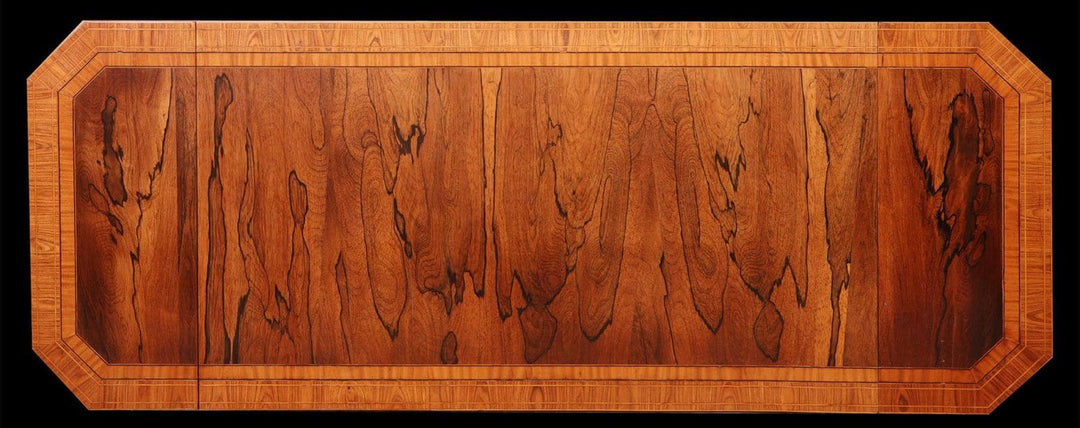
- Rosewood: Often Brazilian, prized for its deep, dark figuring and almost supernatural lustre, reserved for the most exceptional drawing-room pieces.
- Mahogany: The reliable standard for high-quality furniture, valued for its rich reddish-brown hue, stability, and ability to hold a crisp carve.
- Walnut: Celebrated for its beautiful burr veneers, which created swirling, complex patterns on flat surfaces like cabinet doors and table tops.
- Oak: A testament to durability, frequently employed in more substantial, Gothic Revival pieces where its strength and prominent grain were showcased.
The enduring legacy of these materials highlights the importance of quality wood in any project. While sourcing period-correct exotic veneers is a specialist task, the fundamental need for high-grade timber for structural work, whether in restoration or modern construction, remains paramount. For those undertaking such projects, finding a reputable construction timber supplier is the first step in ensuring longevity and quality.
Beyond the primary woods, decorative flourishes speak volumes. The exquisite art of marquetry (pictorial inlay) and parquetry (geometric inlay) reveals a master’s touch, with intricate floral motifs or classical scenes painstakingly rendered in exotic veneers. Similarly, the quality of metal mounts is a crucial indicator; authentic ormolu, or gilt bronze, possesses a soft, deep radiance that modern electroplating cannot replicate. Finally, one must consider the patina-the gentle accumulation of age, wax, and life upon a surface. This subtle, mellow glow is the soul of an antique, a testament to its history that is irrevocably lost in aggressive over-restoration.
The Role of Upholstery and Textiles
The Victorian era revolutionised comfort with the invention of the coil spring, which allowed for the deeply sprung, sumptuously comfortable armchairs and sofas that define the period. Authentic pieces may feature upholstery in rich velvets, intricate damasks, or the celebrated botanical prints of William Morris. Look for the deep, hand-sewn dimples of original button-tufting and period-correct trimmings, such as silk gimp or bullion fringe, which signify a piece that has retained its historical integrity.
Technical Innovations in 19th Century Cabinetry
An examination of a cabinet’s interior often reveals its true age. The precision of hand-cut dovetail joints, which grew finer as the century progressed, and the presence of dust-proof drawers are hallmarks of superior craftsmanship. Many washstands and credenzas were distinguished by marble tops; identifying the veining of Italian Carrara versus the rich, red tones of French rouge marble can help place a piece. Ultimately, the sheer weight of a piece of victorian furniture is often a primary indicator of the solid hardwoods used in its carcass.
The Connoisseur’s Eye: Authenticity, Provenance, and Investment
Moving beyond the fundamental distinctions of material and construction, the seasoned collector develops an eye for the more nuanced indicators of value: authenticity, provenance, and condition. These elements separate a merely old object from a significant historical artefact. A mid-20th-century reproduction may mimic the form of a 19th-century original, but it can never replicate its soul-the narrative embedded within its grain, the story told by its gentle wear, and the documented history that confirms its journey through time. It is this deeper understanding that transforms the acquisition of victorian furniture into a true investment.
Spotting the Signs of Quality
The authentic character of a piece reveals itself not on its polished surfaces, but in its hidden details. A connoisseur’s examination goes beyond the obvious, seeking the subtle yet definitive marks of period craftsmanship. These are the details that machines and modern workshops fail to replicate with fidelity.
- Unseen Surfaces: Examine the underside and backboards. The straight, slightly irregular lines left by a 19th-century pit saw or early circular saw are entirely different from the uniform markings of modern machinery. Natural wood shrinkage over a century will result in minor gaps or panel movement, a sign of genuine age.
- The Carver’s Hand: Look for depth, detail, and a certain spontaneity in the carved ornament. True Victorian carving exhibits sharp undercuts and an artistic fluency, whereas later reproductions often appear shallower and more rigid.
- Original Hardware: Period brass handles, backplates, and locks are critical indicators. Look for hand-filed edges, slight variations in casting, and the esteemed stamps of makers like Hobbs & Co. on locks, which confirm both quality and origin.
Victorian Furniture as a Tangible Asset
Beyond its aesthetic and historical merit, fine antique furniture represents a stable and tangible asset. As we look towards 2026, market trends indicate a continued appreciation for pieces with strong design integrity, such as the ebonised and gilt-incised work of the Aesthetic Movement. Furthermore, acquiring a piece of history is an inherently sustainable choice-a "green" investment that counters the disposable culture of modern luxury. Understanding these market dynamics is crucial, and for a deeper insight, we recommend reading our guide on How to Value Antique Furniture: Key Factors.
Finally, one must assess a piece's condition with a discerning eye. While "honest wear"-the soft patina and minor marks acquired through generations of use in a notable country house-can significantly enhance an object's provenance and value, structural weaknesses or clumsy past repairs can detract from it. At Nicholas Wells Antiques, we believe in preserving this delicate balance. That is why every piece we offer includes complimentary, expert restoration, ensuring its historical integrity is honoured while its function and beauty are secured for the generations to come. You can explore our curated collection at nicholaswells.com.
Integrating Victorian Grandeur into the Modern Interior
The austere lines of modernism need not preclude the opulent spirit of the 19th century. In fact, the juxtaposition of these two seemingly disparate aesthetics can create an interior of unparalleled sophistication and depth. A single, magnificent piece can serve as a powerful historical counterpoint, transforming a contemporary space from a mere dwelling into a curated environment that tells a compelling story.
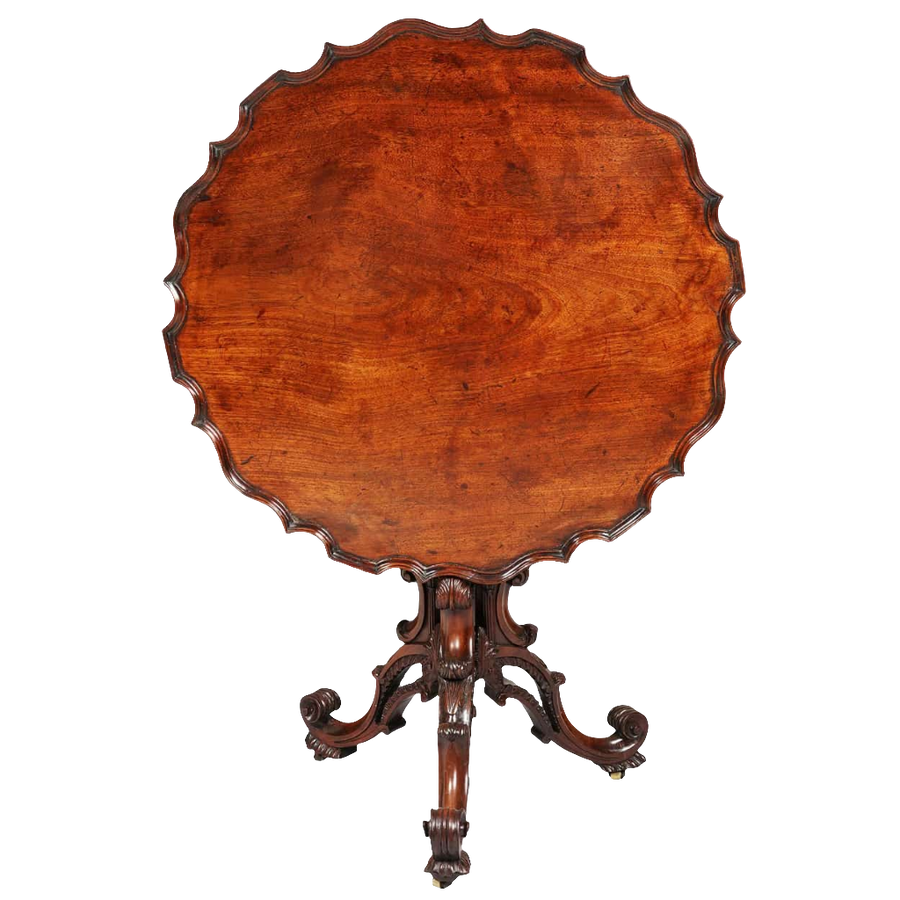
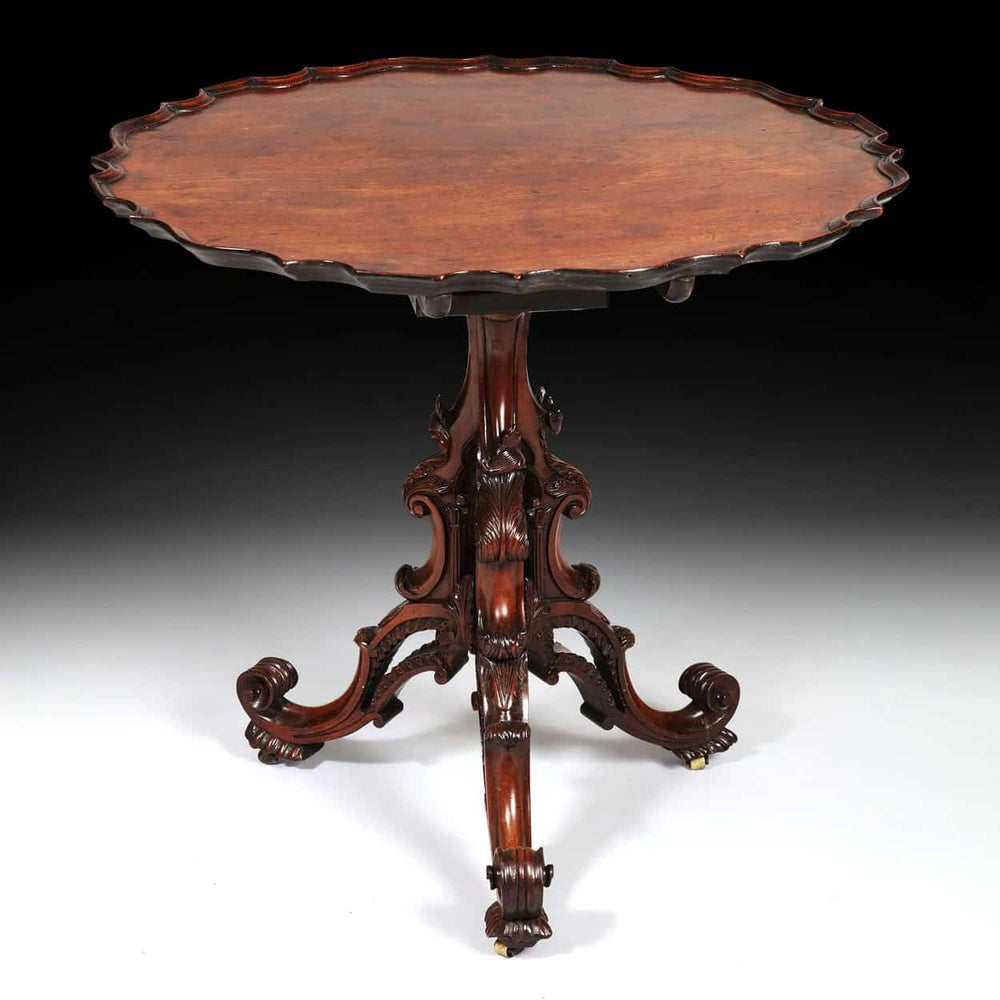
Consider a finely carved Victorian center table placed in a minimalist foyer; it ceases to be mere furniture and becomes a sculptural anchor, its rich patina and intricate form commanding attention. Similarly, the art of the “Statement Chair” is perfected when a sinuous Rococo Revival armchair is positioned against a backdrop of bold contemporary art. The deep, lustrous tones of Victorian walnut provide a necessary warmth and organic texture to spaces dominated by glass and steel, their historical presence softening the severity of modern materials.
This same principle of blending aesthetics applies to the architectural shell of a home. When renovating, homeowners often seek to improve features like windows and doors for better thermal performance and security. For those balancing modern needs with historical character, specialist firms like Custom Trade Systems Ltd offer solutions that can complement a period property's style.
The Victorian Desk in the Modern Home Office
A workspace is elevated by the inclusion of a distinguished Victorian partner’s desk or an elegant secretaire. These pieces command a sense of gravitas and permanence, lending an air of scholarly purpose to daily tasks. While their scale can be substantial, careful placement ensures they dignify, rather than dominate, the room. For those considering such a foundational piece, our guide on Investing in an Antique Desk: A Buyer’s Guide offers essential insights.
Curating a Narrative Room
The most compelling interiors are deeply personal narratives. By mixing exceptional victorian furniture with Grand Tour objects-a marble bust, a collection of micromosaics-one can cultivate a layered, scholarly atmosphere. The interplay of light is paramount; the soft glow from a crystal chandelier can accentuate the deep figuring of the wood and the gleam of ormolu mounts. Finding these extraordinary pieces is the key to a timeless interior. Explore our curated collection of fine Victorian furniture and discover an object with a soul.
The Enduring Legacy of Victorian Artistry
The Victorian era, far from being a monolithic design period, presents a magnificent tapestry of revival styles and unparalleled craftsmanship. To truly appreciate this epoch is to understand the nuances that distinguish its varied revivals and to recognise that authentic victorian furniture is a profound investment in history and artistry. This knowledge transforms an object into a story, a simple room into a curated space.
For the discerning collector poised to acquire a piece of this legacy, we extend an invitation. Discover Extraordinary Victorian Masterpieces at Nicholas Wells Antiques, where our passion for provenance has guided us as specialists since 2012. Each magnificent piece is offered with complimentary restoration by our expert craftsmen and is available for fully insured worldwide shipping from our London gallery.
Begin your journey into the past, and allow a piece of enduring elegance to enrich your present.
Frequently Asked Questions
Is Victorian furniture still in style for 2026?
The concept of 'style' for pieces of such historical significance transcends transient trends. Rather than asking if it is 'in style,' one might consider its enduring relevance. A distinguished piece of Victorian furniture serves as a magnificent focal point in a contemporary setting, providing a narrative depth and textural richness that modern design often seeks. Its inherent character and superb craftsmanship ensure it remains a coveted element in sophisticated interiors, making it a timeless, rather than trendy, choice for 2026 and beyond.
What is the most valuable type of Victorian furniture?
Value in Victorian furniture is determined not by type, but by a confluence of factors: the eminence of the maker, the quality of materials, the intricacy of craftsmanship, and impeccable provenance. Pieces by celebrated cabinetmakers such as Herter Brothers or Holland & Sons, particularly those with exhibition history or documented origins, command the highest prices. Elaborately carved Rococo Revival pieces in rosewood or those featuring complex marquetry and ormolu mounts are consistently among the most valuable examples.
How can I tell if my Victorian furniture is an original or a reproduction?
Distinguishing an original from a reproduction requires a discerning eye for detail. Examine the construction: authentic pieces often exhibit hand-cut dovetail joints, which are slightly irregular, unlike the uniform perfection of machine-cut joints. Look for a natural patina-the subtle wear and mellowing of colour that only time can bestow. Circular saw marks, perfectly symmetrical carving, and modern Phillips-head screws are definitive indicators of a later reproduction, lacking the unique signature of a 19th-century craftsman's hand.
What woods were most commonly used in Victorian furniture?
The Victorian era embraced a rich palette of timbers, with mahogany and walnut being the predominant choices for formal, high-quality pieces, prized for their deep colour and fine grain. Rosewood, an exotic and costly import, was reserved for the most luxurious examples, particularly in the Rococo Revival style. For more provincial or Gothic Revival furniture, oak was frequently employed, celebrated for its durability and prominent grain, which lent itself well to the era's taste for robust, carved forms.
How do I care for the finish on my antique Victorian table?
The preservation of an original finish, such as a French polish or shellac, is paramount. Avoid all modern silicone-based sprays, which can cause irreparable damage. Gentle, periodic dusting with a soft, dry cloth is typically sufficient. For a deeper clean or to restore lustre, apply a high-quality, pure beeswax polish sparingly with a lint-free cloth, buffing gently after it has dried. This traditional method nourishes the wood and protects the delicate, historic patina without introducing harmful chemicals.
Why is Victorian furniture often so heavy?
The substantial weight of Victorian furniture is a direct reflection of its construction and the era's aesthetic principles. Cabinetmakers utilized dense, solid hardwoods like mahogany, walnut, and oak, rather than the veneers over lighter woods common in later periods. The design philosophy itself favoured imposing, monumental forms intended to convey permanence and prosperity. This combination of solid, high-quality timber and a robust, often heavily carved, design results in pieces of significant and reassuring heft.
Who were the most famous Victorian furniture designers?
The Victorian era was defined by numerous influential designers and firms whose work set the standard for excellence. A.W.N. Pugin was a pivotal figure in the Gothic Revival, while John Henry Belter became renowned for his innovative laminated rosewood furniture in the Rococo Revival style. In America, firms such as Herter Brothers and Alexander Roux produced pieces of unparalleled quality and artistry for the nation's wealthiest patrons, leaving an indelible mark on the decorative arts of the period.
Can Victorian furniture be used in a modern apartment?
Absolutely. The juxtaposition of an ornate, historical piece within a clean, modern interior creates a sophisticated and dynamic dialogue between past and present. A single, magnificent item-such as an intricately carved console table or a distinguished armchair-can serve as the soul of a room, preventing a minimalist aesthetic from feeling sterile. This thoughtful integration allows the story and superb craftsmanship of the antique to be fully appreciated, adding a layer of intellectual and visual depth to contemporary living spaces.


Leave a comment