



A Connoisseur's Guide to 18th Century English Antiques For Sale
To navigate the world of 18th-century English antiques is to embark upon a pursuit of unparalleled elegance and historical significance. Yet, for the aspiring connoisseur, this journey can be fraught with uncertainty-a hesitation born from questions of authenticity, condition, and the true value of a distinguished piece. The allure of acquiring an object with a soul, a tangible link to a bygone era of masterful craftsmanship, is often tempered by the challenge of making an informed choice. When considering the magnificent array of 18th century english antiques for sale, discerning between the merely old and the genuinely extraordinary requires a cultivated eye and a deep understanding of the period's defining characteristics.
This guide is crafted to serve as your trusted companion in this pursuit, transforming apprehension into confident acquisition. We shall explore the seminal styles that defined the Georgian era, from the rococo exuberance of Chippendale to the neoclassical grace of Hepplewhite and Adam. You will learn to recognise the signatures of master cabinet-makers, assess the subtle language of patina and provenance, and gain the necessary insights to select a superb piece that not only enhances your contemporary interior but also represents a lasting investment in history and beauty. Prepare to move beyond mere admiration and acquire a piece of the 18th century with the assurance of a true collector.
Key Takeaways
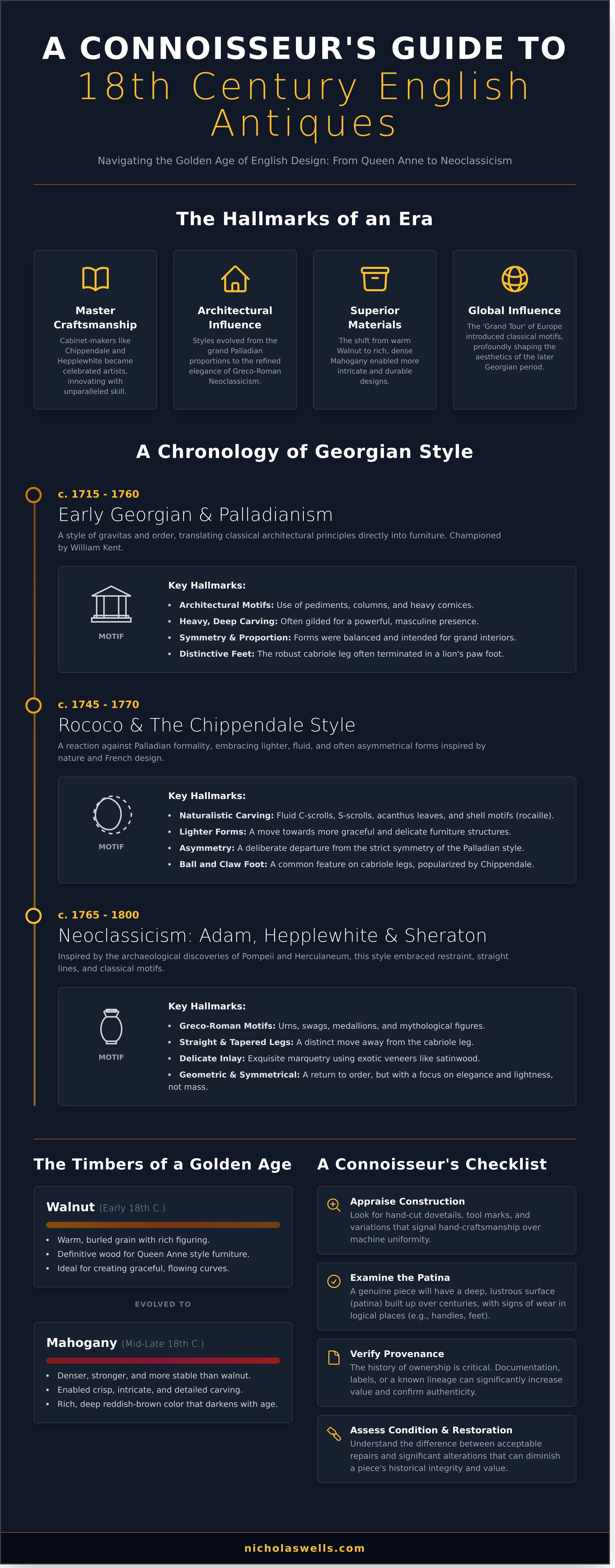
- Understand the chronological progression of Georgian design, from the architectural influence of Queen Anne to the refined Neoclassicism of Hepplewhite and Sheraton.
- Develop a connoisseur's eye for appraising authenticity by learning to distinguish the subtle signs of age and hand-craftsmanship from later alterations or reproductions.
- Navigate the market for 18th century english antiques for sale with confidence by understanding the critical importance of provenance, condition, and restoration philosophy.
- Learn to identify the key furniture categories of the era and appreciate how their design was intrinsically linked to their function within the elegant Georgian home.
The Age of Elegance: Why 18th Century English Furniture is Unrivalled
The Georgian period (1714-1830) stands as a veritable golden age of English decorative arts, an era of unprecedented innovation and aesthetic refinement. Driven by expanding global trade and the accumulation of new wealth, a sophisticated gentry class emerged with a voracious appetite for luxury. This created a fertile ground for a culture of patronage, elevating the cabinet-maker from a simple artisan to a celebrated master craftsman. Figures such as Thomas Chippendale, George Hepplewhite, and Thomas Sheraton became household names, publishing influential design books that disseminated their distinct styles. For the discerning collector, the market for 18th century english antiques for sale represents an opportunity to acquire not just furniture, but tangible pieces of this extraordinary cultural history, whose investment value and enduring beauty remain truly unmatched.
From Walnut to Mahogany: The Materials of Choice
The century's stylistic evolution is inextricably linked to the materials available. The period began with a preference for the warm, burled grain of walnut, a timber that so perfectly defined the graceful curves of early Queen Anne style furniture. However, the arrival of dense, richly coloured mahogany from the West Indies-primarily Cuba and Honduras-revolutionised English cabinet-making. This superior timber was stronger, more stable, and could be carved with a crispness and intricacy that walnut could not support. Later in the century, this dark wood was often brilliantly contrasted with exotic veneers, such as the luminous satinwood, used to create delicate inlays and marquetry of exquisite detail.
The Influence of The Grand Tour on English Design
No single cultural phenomenon shaped the taste of the Georgian elite more than the Grand Tour. This traditional journey for young noblemen through the classical sites of Italy and Greece exposed them directly to the architectural grandeur of antiquity. They returned to England with portfolios of drawings and a newly cultivated appreciation for the symmetry, proportion, and restrained elegance of Greco-Roman design. This profound influence is visible in the integration of classical motifs-such as acanthus leaves, urns, and architectural pediments-into furniture, ultimately paving the way for the magnificent Neoclassicism championed by designers like Robert Adam, which would come to define the latter half of this remarkable century.
Defining the Styles: A Chronology of 18th Century English Design
The 18th century witnessed a remarkable and dynamic evolution in English furniture design, a period of stylistic innovation that moved from monumental grandeur to refined elegance. Understanding this chronology is essential for any serious collector, as each piece tells a story of its specific cultural moment. The century's journey through taste reflects shifting philosophies, from the measured order of Palladianism to the exuberant fancies of Rococo and the archaeological fidelity of Neoclassicism. To fully appreciate this progression, one can study the superb examples preserved in world-class institutions; the collection of 18th-Century English Furniture at the V&A offers an unparalleled visual record of these masterful transformations.
Early Georgian & Palladianism (c. 1715-1760)
Following the accession of the Hanoverians, English design sought an aesthetic of gravitas and order, finding its ultimate expression in Palladianism. Championed by architects like Lord Burlington and his protégé William Kent, this style translated the principles of classical architecture directly into furniture. The resulting pieces are characterised by a powerful, often masculine, sense of proportion and symmetry, intended for the magnificent Palladian country houses of the era.
- Hallmarks: Heavy, deep carving, often gilded; the use of architectural motifs like pediments and columns; and robust forms such as the cabriole leg terminating in a distinctive lion paw foot.
Rococo & The Chippendale Style (c. 1745-1770)
As a reaction against the formal rigidity of the Palladian style, the lighter, more fluid forms of French Rococo began to permeate English design. This new taste was codified and popularised by the cabinet-maker Thomas Chippendale, whose 1754 publication, The Gentleman and Cabinet-Maker's Director, became the essential pattern book for the age. His name is now synonymous with the English Rococo, a style celebrated for its vivacity and imaginative flair.
- Hallmarks: Asymmetrical compositions featuring naturalistic motifs like acanthus leaves, C-scrolls, and S-scrolls. The style also enthusiastically embraced exotic influences, leading to the intricate fretwork of Chinoiserie and the pointed arches of the Gothic Revival.
Neoclassicism: Adam, Hepplewhite & Sheraton (c. 1765-1800)
The final decades of the century saw a return to classicism, but one inspired not by Palladio, but by the thrilling archaeological discoveries at Herculaneum and Pompeii. Architect Robert Adam pioneered a holistic vision of the Neoclassical interior, where every element, from ceilings to carpets and furniture, formed a unified, harmonious whole. This pursuit of refined elegance was further developed by George Hepplewhite and Thomas Sheraton, whose own influential design books defined the late-period aesthetic. It is the superb craftsmanship and sophisticated design of this era that make so many 18th century english antiques for sale exceptionally desirable today.
- Hallmarks: Slender, delicate forms and straight, often tapered, legs. Hepplewhite is known for his elegant shield-back and heart-back chairs, while Sheraton favoured refined rectilinear proportions, delicate inlay, and the use of exotic wood veneers in masterful marquetry.
Hallmarks of Authenticity: What to Look for in 18th Century Antiques
When considering 18th century english antiques for sale, the act of acquisition becomes an exercise in connoisseurship, requiring one to look beyond immediate form and delve into the material narrative of the object itself. The most coveted pieces are not those of pristine, modern perfection, but rather those that bear the quiet testament of time. It is in these subtle imperfections-the marks of hand-tools, the gentle wear of centuries-that true authenticity is revealed. A discerning collector learns to distinguish between an object in superb original condition, one that has undergone a sympathetic and honest restoration, and a modern reproduction masquerading as an antique.
Construction & Joinery
The cabinet-maker's hand is most evident in the construction. Examine the drawers of a chest and you should find hand-cut dovetails, each exhibiting slight, charming irregularities that betray their human origin-a stark contrast to the rigid uniformity of machine-made joints. The foundational strength of chairs and tables lies in the use of robust mortise and tenon joints, often pegged for longevity. While primary carcases were constructed from solid native timbers like oak, the period's grandeur was expressed through the masterful application of exotic veneers upon these stable foundations.
Surface, Colour & Patina
Perhaps the most desirable and ineffable quality of a fine antique is its patina. This is not merely a surface finish but the accumulated history of the piece, a deep lustre developed over centuries of waxing, polishing, and human touch. Old mahogany, for instance, oxidises to a magnificent, deep, and fiery hue that cannot be replicated. Signs of genuine age include the gentle softening of sharp edges and the subtle shrinkage of solid timber panels, which may leave a ‘tide mark’ of un-faded wood around mouldings-a definitive sign of originality.
Hardware & Fittings
Original hardware is a critical indicator of authenticity. Period brass handles, locks, and escutcheons should possess a weight and character distinct from modern reproductions, often showing minute casting imperfections. Look for evidence of replaced fittings, such as plugged screw holes or a faint outline of a previous backplate. Similarly, the glazed doors of a bookcase should contain hand-blown glass, identifiable by its charming ripples and small trapped air bubbles. To truly understand these nuances, studying documented masterpieces, such as the exemplary pieces in the Metropolitan Museum of Art's English Furniture Collection, provides an unparalleled education in period-correct detail.
Key Furniture Categories of the Georgian Era
The 18th century witnessed an unparalleled flourishing of English furniture design, where the cabinet-maker's art reached its apogee. Across the spectrum of 18th century english antiques for sale, it is this period that offers the most profound harmony of function and form, with pieces conceived to complement the new Palladian and Neoclassical interiors. Each object was created not in isolation, but as part of a cohesive, architectonic scheme, reflecting the owner's taste, status, and intellectual pursuits.
Case Furniture: Chests, Commodes & Bookcases
Storage furniture evolved from purely utilitarian objects into magnificent statements of craftsmanship. The humble chest of drawers was transformed, acquiring serpentine fronts, canted corners, and rich mahogany veneers. The commode, a low chest often of French inspiration, became a canvas for the most exquisite marquetry or japanned decoration, serving as a high-style focal point in a drawing room or saloon. For the library, the breakfront bookcase, often surmounted by a classical pediment, was indispensable, providing both storage and a distinguished display for leather-bound volumes.
Discover our exceptional collection of Georgian case furniture.
Tables: Console, Dining & Occasional
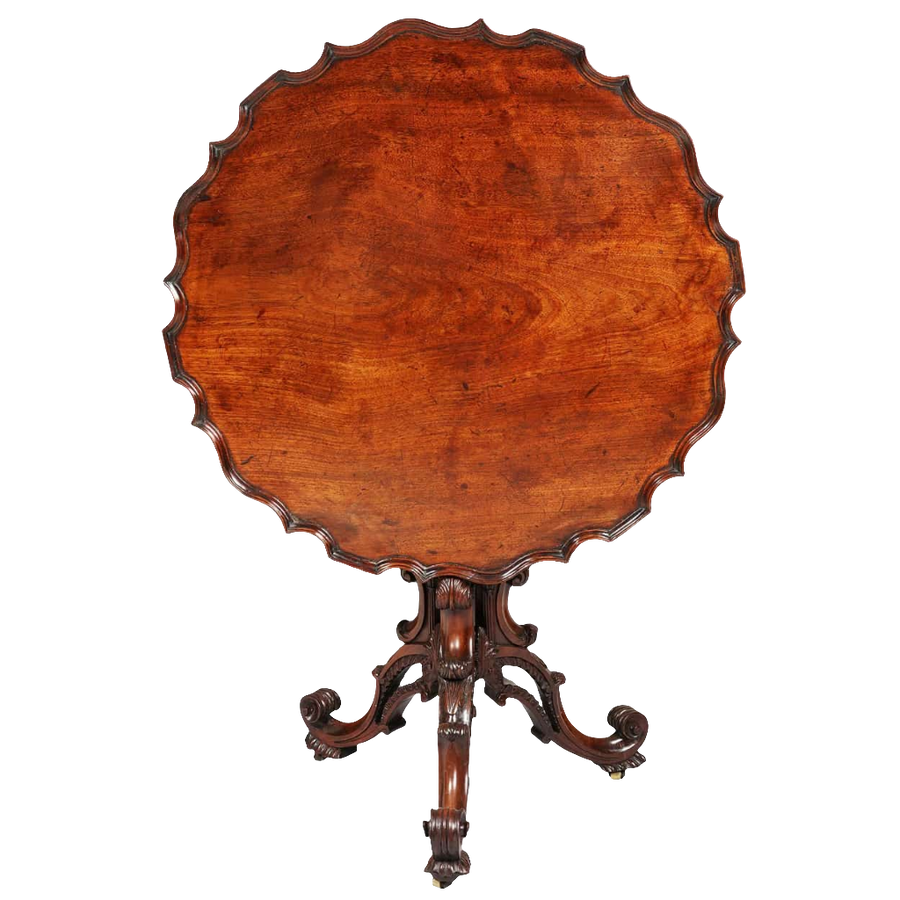
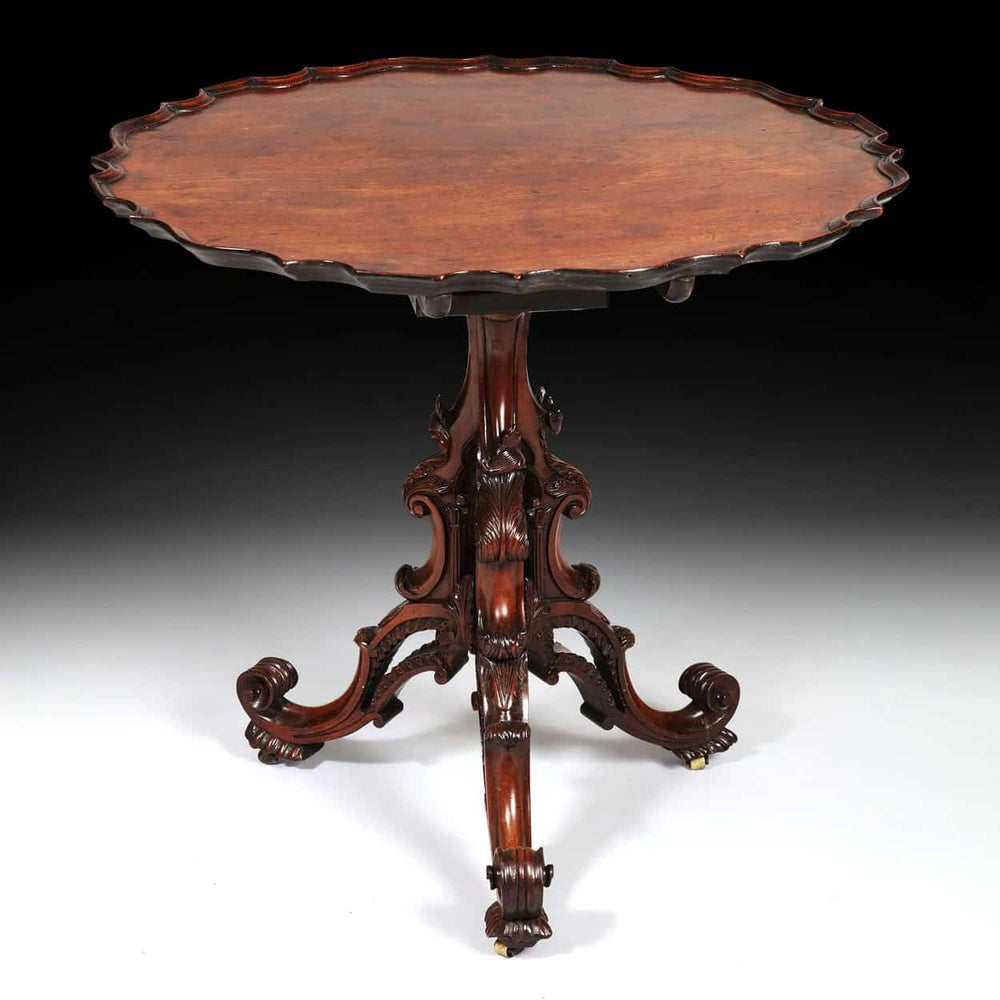
Georgian tables were designed for a multitude of social rituals. Grand, gilded console tables, often with marble tops, were designed by architects like William Kent to be placed as fixed features against a pier wall, beneath a looking glass. The dining table saw a revolutionary development with the introduction of pedestal bases, allowing for greater legroom and more convivial gatherings. Smaller, more portable forms, such as the delicate Pembroke table for taking tea or the elegant tripod table for holding a silver candlestick, brought versatility and grace to every corner of the home.
Explore our curated selection of 18th-century tables.
Seating: The Art of the Chair
Perhaps no other object so perfectly captures the stylistic shifts of the era as the chair. Its design is often the signature of the period's greatest makers, from the sinuous cabriole legs of the early Georges to the intricate ribbon-backs of Chippendale and the elegant shield-backs favoured by Hepplewhite. When searching for exceptional 18th century english antiques for sale, the discerning collector will note the variations between formal sets of dining chairs, imposing hall chairs bearing a family crest, and the increasingly comfortable, upholstered armchairs that invited repose. This evolution in comfort was mirrored by advancements in upholstery, which became an art in its own right.
View our distinguished inventory of antique seating.
Acquiring Fine English Antiques: A Guide for the Modern Collector
The decision to acquire a piece of 18th-century English furniture is an investment in history, craftsmanship, and enduring style. For the modern collector, navigating this world requires a discerning eye and an understanding of the key principles that determine an object's quality and value. This guide offers practical advice for those seeking to enrich their homes with these extraordinary artifacts.
Evaluating Condition & Restoration
A critical aspect of assessing any antique is its condition. One must distinguish between sensitive conservation, which seeks to preserve the object’s historical integrity and original surfaces, and extensive restoration, which can diminish its authenticity. The most desirable pieces possess a deep, untouched patina and retain their structural soundness. A reputable dealer will not only be transparent about any restorative work but may also offer complimentary, expert restoration to ensure the piece is perfectly suited for its new environment.
The Significance of Provenance
Provenance-the documented history of an object’s ownership-can significantly enhance its desirability and value. Clues such as a maker's label, collection stamps, or inclusion in historical archives provide a tangible link to the past. While a distinguished provenance is a mark of exceptional importance, many superb pieces have lost their records over time. In such cases, the intrinsic quality of the craftsmanship, materials, and design remains the ultimate testament to their worth.
Integrating Antiques in Contemporary Interiors
The enduring appeal of Georgian and Regency design lies in its remarkable ability to transcend its era. An 18th-century piece, such as a magnificent mahogany breakfront bookcase or a finely carved giltwood mirror, can serve as a powerful focal point in a modern interior. The juxtaposition of classical, architectonic lines with contemporary art and minimalist furnishings creates a dynamic dialogue between past and present, infusing a space with a soul, character, and a profound sense of history that cannot be replicated.
Why Choose a Specialist Dealer?
For those seeking the finest 18th century english antiques for sale, partnering with a specialist dealer is paramount. This relationship offers far more than a simple transaction; it provides a guarantee of authenticity and access to a meticulously curated collection of pieces in exceptional condition. A specialist offers an expert eye, saving the collector from costly mistakes, and manages essential services from worldwide shipping to restoration. We invite you to browse our curated collection of 18th Century English antiques and discover the assurance that comes with expert guidance.
Your Next Chapter in Connoisseurship
Acquiring a piece from the Georgian period is more than a mere transaction; it is an act of custodianship. As we have explored, understanding the distinct evolution of styles from Queen Anne to Hepplewhite, and discerning the subtle hallmarks of authenticity, are the foundational pillars of true connoisseurship. These objects are not simply furniture, but tangible narratives of an era defined by unparalleled craftsmanship and social aspiration.
This journey from appreciation to acquisition is one we are privileged to guide. As a leading London specialist, Nicholas Wells Antiques offers a curated selection where each piece is chosen for its exceptional merit. To ensure these historical treasures are perfectly suited for the contemporary interior, every purchase includes complimentary, expert restoration. We invite you to discover our collection of exceptional 18th Century English antiques for sale, delivered with fully insured, worldwide shipping for discerning collectors and decorators. The right piece awaits to become the soul of your interior-a testament to enduring elegance and a story for you to continue.
Frequently Asked Questions About 18th Century English Antiques
What is the difference between Georgian and Victorian furniture?
Georgian furniture (c. 1714-1830) is defined by its elegant proportions, classical symmetry, and the masterful use of fine mahogany, reflecting Palladian and Neoclassical ideals. In contrast, Victorian furniture (c. 1837-1901) often exhibits a heavier, more ornate character, favouring dark woods, elaborate carving, and an eclectic revival of historical styles. The former speaks of restrained architectural grandeur, while the latter embraces industrial-age exuberance and sentimentality.
How can I be sure an 18th-century antique is not a later reproduction?
Authenticating a period piece requires a connoisseur's eye for subtle yet telling details. Examine the construction for hand-cut, irregular dovetails rather than machine-made uniformity. Look for the straight marks of a pit saw on undersides and drawer bottoms, and observe the deep, mellow patina that only centuries of use and care can bestow. A comprehensive provenance and consultation with a trusted specialist provide the ultimate assurance of authenticity.
Are 18th-century English antiques a good financial investment?
Acquiring the finest 18th century english antiques for sale should be viewed as an investment in tangible history and artistry. While market fluctuations occur, pieces of distinguished provenance, by celebrated makers, and in an outstanding state of preservation have consistently demonstrated their capacity to hold and appreciate in value. More than a mere financial asset, they offer the profound daily dividend of living with an object of immense beauty and historical significance.
How should I care for my antique mahogany furniture?
To preserve the magnificent lustre of antique mahogany, a gentle and consistent approach is paramount. Position pieces away from direct sunlight and sources of extreme heat or humidity to prevent fading and warping. Dust regularly with a soft, lint-free cloth. A high-quality beeswax polish should be applied sparingly-perhaps once or twice annually-and buffed to a deep, resonant shine, nourishing the wood and enhancing its superb, time-worn patina.
Who were the most important English furniture makers of the 18th century?
The 18th century was dominated by a triumvirate of design luminaries whose names remain synonymous with English furniture. Thomas Chippendale is celebrated for his masterful synthesis of Rococo, Gothic, and Chinoiserie styles. He was followed by George Hepplewhite, whose delicate, Neoclassical designs are epitomised by his signature shield-back chairs. Finally, Thomas Sheraton refined this elegance with his sophisticated use of straight lines, fine inlay, and ingenious mechanical elements.
Can antique furniture be practical for everyday use in a modern home?
Antique furniture, particularly from the 18th century, was constructed with a degree of craftsmanship that far surpasses most modern equivalents, making it eminently practical for contemporary life. A Georgian chest of drawers offers superior storage, while a Pembroke table provides versatile function. Integrating such pieces into a modern interior not only adds unparalleled character and a focal point but also affirms a commitment to sustainable, enduring quality and timeless design.


Leave a comment