



Antique Fireplace Tools and Fenders: A Connoisseur’s Buying Guide
A meticulously restored 18th-century drawing room loses its soul the moment a mass-produced, chemically aged brass set is placed upon the hearth. You likely recognise that true luxury resides in the whispered history of an object, where the weight of hand-forged steel or the soft glow of original ormolu tells a story no modern imitation can replicate. It's a common frustration for the discerning collector to find a magnificent mantelpiece diminished by accessories that lack the correct period DNA or a genuine surface patina.
Mastering the selection of an authentic antique fireplace tools and fender set requires an eye for the subtle shift from Georgian robustness seen in the 1780s to the refined, neoclassical elegance of the 1820s Regency period. This guide provides the scholarly insight needed to distinguish investment-grade metalwork from inferior reproductions, ensuring your hearth remains a historically accurate focal point. We’ll examine the hallmarks of 19th-century craftsmanship and explain how Nicholas Wells Antiques helps clients curate extraordinary pieces that offer a seamless bridge between heritage and modern luxury living.
Key Takeaways
- Appreciate the hearth as the emotional and architectural centre of the home, discovering how curated accessories transform a functional fireplace into a distinguished social hub.
- Navigate the nuanced transitions between Georgian neoclassical symmetry and the bold, sculptural ormolu motifs characteristic of the Regency period.
- Master the professional checklist for evaluating an antique fireplace tools and fender, prioritising authentic hand-forged construction and the preservation of original surface patina.
- Learn to distinguish between superior solid brass and common plated zinc to ensure your acquisitions maintain the historical integrity required for a luxury interior.
- Understand the value of the Nicholas Wells Antiques commitment to excellence, including complimentary professional restoration and global shipping for the most extraordinary metalwork.
The Hearth as a Social Hub: Why Authentic Antique Fireplace Accessories Matter
The fireplace stands as the architectural and emotional anchor of the English country house. It's more than a source of warmth; it's a stage where social life unfolded for centuries. Choosing an authentic antique fireplace tools and fender set isn't merely a matter of furnishing. It's an act of curation that elevates a room's aesthetic from the mundane to the magnificent. While modern hearths often prioritise bare utility, the Georgian and Regency periods viewed these objects as the "jewellery" of the room. They provided a glittering counterpoint to the sombre tones of mahogany and stone. Mass-produced reproductions, often cast from inferior alloys, lack the physical weight and spiritual resonance of original 18th and 19th-century pieces. These historic objects carry the marks of the craftsmen who forged them and the generations who gathered around their glow.
The Evolution of Fireplace Design
Fireplace design underwent a radical transformation as domestic architecture matured. Medieval halls relied on central open hearths, but by the 1700s, refined chimney-pieces became the focal point of the interior. The shift from wood to coal in the mid-18th century necessitated smaller, more efficient grates and led to the development of the fire iron as a specialised toolset. Wrought iron, once the standard for its durability, gave way to polished brass and steel. These materials served as potent symbols of status, reflecting the flickering firelight and the owner's wealth. By 1820, the fender had evolved into an intricate decorative border, designed to protect expensive carpets while showcasing the height of metalworking artistry.
The Importance of Surface Patina
At Nicholas Wells Antiques, we define surface patina as the visible history of an object's life. It's the soft glow of brass that's been polished by hand for two hundred years, or the deep, complex oxidisation found on 19th-century steel. Over-polishing is a common mistake that can destroy the historical value and "soul" of an antique, stripping away the narrative of its use. Our approach focuses on conserving history through sympathetic restoration, ensuring each piece retains its character. For those seeking such rarities, we offer viewings by appointment at our showroom, which serves clients from our base in Mayfair. While our mailing address is 45 Albemarle Street, we don't operate a walk-in gallery at 169 Piccadilly; instead, we provide a bespoke experience for the discerning collector. This commitment to authenticity distinguishes a true connoisseur's collection from a mere assembly of household goods.
- Historical Context: Authentic pieces reflect the technological shifts of the 18th and 19th centuries.
- Material Integrity: Genuine antiques utilise high-grade brass, steel, and iron that modern versions cannot replicate.
- Aesthetic Value: A well-chosen antique fireplace tools and fender set acts as the focal point of a luxury interior.
Defining the Elements: From Pierced Fenders to Fine Fire Irons
The fireplace fender serves as a definitive architectural boundary within the 18th or 19th-century interior. It's far more than a mere barrier against stray embers; it anchors the hearth and defines the room's central axis. Fire irons, typically comprising a shovel, tongs, and a poker, represent the essential functional trio. These tools evolved from primitive implements into the refined objects of the Georgian and Regency periods. U.S. National Museum research on early fire-making illustrates how these basic necessities transitioned from utility to artistry over centuries. Andirons, often called fire dogs, provide the structural support for logs, adding significant visual weight to the room's lower register. For the authentic Victorian hearth, the supporting cast includes cast-iron trivets and copper coal scuttles, which complete the period aesthetic.
The Anatomy of a Fine Fireplace Tool Set
High-quality forged steel and cast brass sets are distinguished by their weight and balance. You'll find that an authentic 18th-century shovel feels substantial yet perfectly poised in the hand. Nicholas Wells Antiques prioritises pieces where the surface patina remains undisturbed, reflecting decades of careful use and the conservation of history. Identifying these pieces involves looking for specific decorative motifs. Acorns, urns, and neoclassical finials were particularly prevalent during the 1780s and 1790s. A dedicated tool stand is vital for maintaining an orderly and elegant fireplace. It ensures the antique fireplace tools and fender are presented as a unified ensemble. One might consider our collection of works of art to find complementary hearthside accessories that share this level of craftsmanship.
The English Club Fender: A Unique Social Furnishing
The club fender emerged in the late 19th century as a clever seating solution for crowded libraries and billiard rooms. These substantial pieces feature leather-upholstered seats atop heavy brass or polished steel railings. They invite guests to linger near the warmth without obstructing the fire's glow. Design variations are numerous, ranging from minimalist brass rods to intricate scrollwork. When selecting such a piece, measuring is critical. The fender must align precisely with the antique fireplace surround to ensure a harmonious silhouette. A well-chosen club fender doesn't just protect the floor; it transforms the hearth into a social hub, bridging the gap between the grandeur of the past and the requirements of modern luxury living. Every antique fireplace tools and fender set we source is vetted for its historical integrity and its ability to serve as a focal point in a contemporary interior.
Navigating Period Styles: Georgian Elegance vs. Victorian Grandeur
The aesthetic evolution of the British hearth reflects broader shifts in architectural taste, moving from the restrained neoclassicism of the 18th century to the eclectic exuberance of the 19th. Discerning collectors understand that an antique fireplace tools and fender set is more than a functional necessity; it's a primary architectural element that defines the room's character. At Nicholas Wells Antiques, we focus on the conservation of history, ensuring the surface patina of every piece remains an authentic witness to its era. The stylistic progression of these objects follows a distinct timeline:- Georgian (1714–1837): Characterised by symmetry and neoclassical influences, this era saw the rise of polished steel and pierced brass. The 1770s marked a peak in refined, airy designs.
- Regency (1811–1820): A period of bold, sculptural forms. Designs often incorporated ormolu accents and motifs inspired by the 1798 Egyptian campaigns.
- Victorian (1837–1901): This era embraced heavy castings and historical revivals. You'll find intricate Gothic motifs and the whimsical curves of the Rococo Revival.
- Art Deco (1920s–30s): Following the 1925 Paris Exposition, designs shifted toward geometric precision, utilising modern finishes like chrome and nickel.
Georgian and Regency Refinement
The influence of Robert Adam (1728–1792) and Thomas Chippendale remains paramount in the study of 18th-century hearth accessories. Chippendale’s 1754 publication, The Gentleman and Cabinet-Maker's Director, established a vocabulary of fretwork and pierced brass patterns that transformed the fender from a spark guard into a work of art. These pieces often feature delicate engravings and repeating geometric motifs that require a scholarly eye to authenticate. Integrating these refined Regency pieces with fine antique mirrors creates a cohesive architectural narrative, reflecting the flickering firelight across the room's polished surfaces.Continental Influences: French Ormolu and Giltwood
French 19th-century fireplace furniture offers a distinct contrast to the English tradition, focusing on opulence and palatial scale. While English sets often favour the understated strength of polished steel, French chenets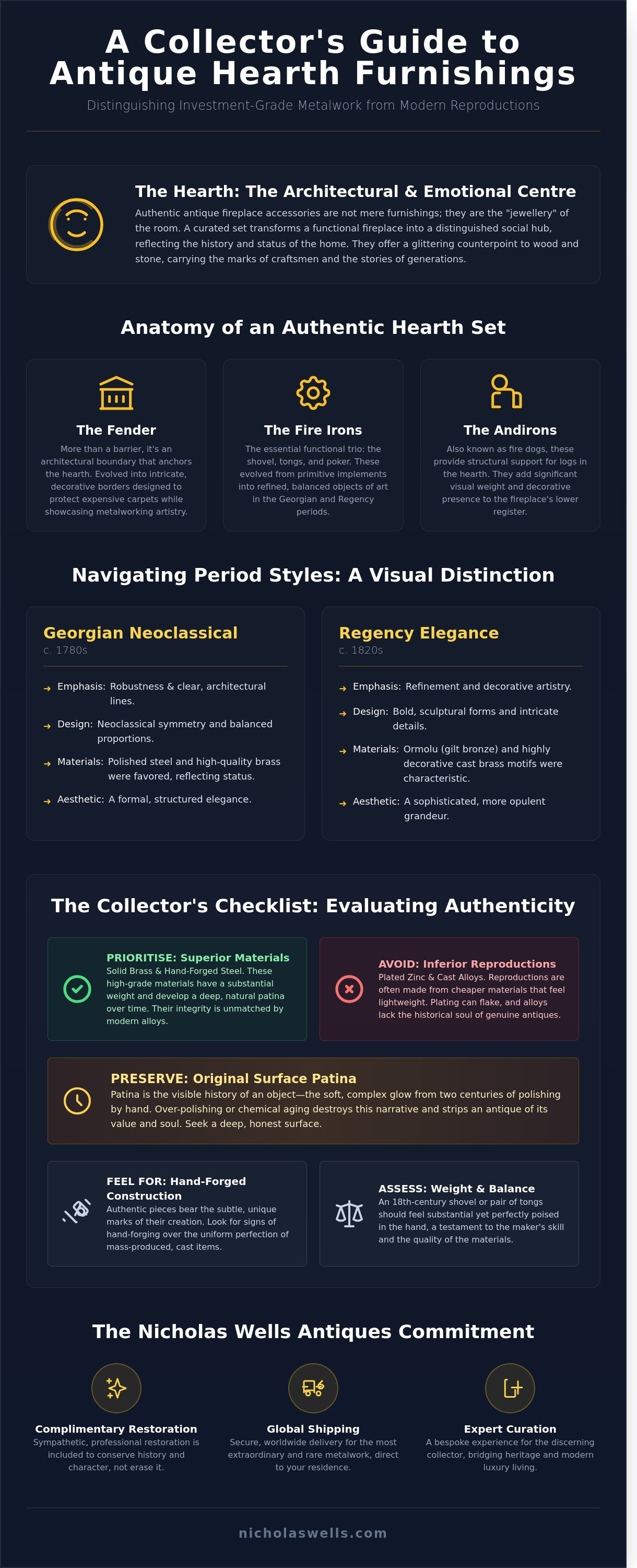
The Collector’s Checklist: Evaluating Quality, Condition, and Patina
Acquiring a fine antique fireplace tools and fender requires more than an aesthetic appreciation; it demands a forensic approach to materiality and craftsmanship. Connoisseurs understand that the value of these objects lies in the "conservation of history," where every mark tells a story of domestic life in the 18th or 19th century. To ensure you're investing in a genuine artifact rather than a decorative reproduction, follow this rigorous evaluation process.
- Verify the Material: Authentic Georgian and Regency examples are typically cast in solid brass or bronze. You can distinguish these from later brass-plated zinc by checking the weight and looking for "pitting." Zinc is lighter and often reveals a dull, greyish substrate as the plating wears away over time.
- Inspect Construction: Examine the joinery for hand-turned screws and irregular, hand-forged joints. 18th-century smiths didn't produce the machine-perfect threads found in modern replicas. Look for fire-welded steel on the working ends of tongs and pokers.
- Assess the Patina: True surface patina isn't merely dirt; it's the result of centuries of oxidation and handling. Wear patterns should be logical. A poker handle should show more polish than its shaft, reflecting decades of use in a distinguished household.
- Check for Completeness: A "married" set, where the shovel, tongs, and poker don't match, carries significantly less prestige. Ensure the finials, whether in the form of urns, acorns, or flames, are identical across the entire antique fireplace tools and fender set.
- Consider the Scale: Proportions must be historically accurate. A Regency fender typically stands between 15 and 25 centimetres high. It should frame the hearth without obscuring the architectural detail of the grate or the mantelpiece.
Identifying Marks and Provenance
While many early English smiths remained anonymous, certain pieces bear the stamped marks of celebrated makers like William Tonks & Sons or Shoolbred & Co. These marks are often found discreetly on the underside of the fender rail or the interior of the shovel blade. At Nicholas Wells Antiques, we place immense value on provenance. A piece with a documented history in a great English country house offers a tangible connection to the past, elevating it from a mere accessory to a significant cultural artifact.
Practical Placement in Modern Interiors
In a contemporary drawing room, antique fireplace accessories act as a sophisticated bridge between different furniture periods. They provide a tactile, grounded element when paired with modern lighting solutions, where the warmth of a fire reflects off hand-polished brass. A large fender serves a structural purpose too; it defines the seating area in an expansive room, creating an intimate "room within a room." These objects bring the "soul" of the 19th century into the 21st-century home.
Our curated selection is available to view by appointment at 45 Albemarle Street, Mayfair. Please note that we do not operate a walk-in gallery at 169 Piccadilly; we prefer to offer our clients a private, scholarly environment to evaluate these extraordinary pieces at their leisure.
Curating the Hearth with Nicholas Wells Antiques
Selecting the perfect antique fireplace tools and fender is an act of curation that defines the character of a home. At Nicholas Wells Antiques, we focus on sourcing the extraordinary, from rare metalwork to unique Grand Tour objects that carry the weight of history. Our inventory isn't merely a collection of items; it's a selection of significant cultural artifacts. We've spent years building a network that allows us to find pieces with exceptional provenance, ensuring that our clients acquire only the most distinguished examples of 18th and 19th-century craftsmanship.
The acquisition process is designed to be as seamless as the objects are beautiful. We provide fully insured worldwide shipping, handling the complexities of international transit so that London’s finest antiques can reach a global audience with ease. For those who prefer a more personal interaction, we invite you to visit our London showroom. While we maintain a presence at 45 Albemarle Street in Mayfair, it's vital to remember that we operate by appointment only. There is no physical walk-in gallery at 169 Piccadilly; instead, our bespoke approach allows us to provide a unique curatorial experience, giving you the time and space to appreciate the soul of each piece before it enters your collection.
The Nicholas Wells Restoration Philosophy
We believe in the "conservation of history." Every antique fireplace tools and fender set we sell includes complimentary restoration, but our methods are far from standard. We prioritise sympathetic cleaning that preserves the original surface patina, a detail that generalist dealers often erase. Our goal is to ensure functional integrity without compromising the antique charm that makes a piece unique. We don't just fix items; we prepare them for a new lifetime of service, offering expert advice on how to maintain their lustre for the next generation.
Next Steps for the Discerning Buyer
The journey to finding the right fireplace accessories begins with a look at our curated gallery. You can explore our current collection of works of art and fireplace accessories to see the breadth of our available inventory. If our current selection doesn't match your specific needs, we offer a bespoke search service. We frequently help clients locate rare period fenders or specific tool sets that align with the architectural requirements of their properties. Contact us today to arrange a private viewing or to discuss a particular acquisition you have in mind.
- Arrange a private viewing by appointment at our London location.
- Request a bespoke search for specific Georgian, Regency, or Victorian fenders.
- Consult with our experts on the historical context and maintenance of your collection.
Enhancing the Architectural Soul of Your Hearth
The fireplace remains the definitive centrepiece of the refined home, where the selection of an authentic antique fireplace tools and fender set transforms a simple hearth into a narrative of 18th and 19th century craftsmanship. Whether you seek the restrained elegance of Georgian brass or the robust character of Victorian ironwork, these objects represent a profound commitment to the conservation of history and the preservation of original surface patina. It's this dedication to provenance and scholarly curation that distinguishes a truly magnificent interior from the merely decorative.
Nicholas Wells applies over 20 years of specialist expertise to source items that meet the most exacting standards of rarity and condition. Every acquisition includes complimentary professional restoration and is protected by fully insured worldwide shipping to ensure a seamless experience for global collectors. While our administrative office is located at 45 Albemarle Street in Mayfair, near Piccadilly, we invite you to view our exceptional inventory by appointment to appreciate the weight and texture of these historic pieces in person. Explore our curated collection of antique fireplace tools and fenders and discover a superb piece of history for your residence.
Frequently Asked Questions
What is the difference between a fire fender and a fire guard?
A fire fender is a low, decorative metal kerb designed to contain ash and define the hearth's perimeter, whereas a fire guard is a taller protective screen intended to prevent sparks from entering the room. Fenders from the 18th century often featured intricate pierced steel or brass, serving as an architectural extension of the fireplace itself. While guards are primarily functional safety barriers, a fine antique fender represents a deliberate aesthetic choice that anchors the room's design.
How do I clean antique brass fireplace tools without destroying the patina?
You should avoid abrasive chemical cleaners and instead use a soft microfibre cloth with a mild, pH-neutral conservation wax to preserve the delicate surface patina. At Nicholas Wells Antiques, we advocate for the conservation of history, meaning we prefer the deep, mellow glow acquired over 200 years to a harsh, mirrored finish. Harsh polishing can strip away the historical soul of a Regency brass tool set, significantly reducing its character and market value.
Can antique fireplace tools still be used with a working fire?
Yes, high-quality antique fireplace tools and fender sets crafted from solid brass or wrought iron remain perfectly functional for modern use. These 19th-century implements were engineered for daily utility, and their robust construction often surpasses contemporary mass-produced alternatives. We recommend a professional assessment of the rivets and joints to ensure the structural integrity remains sound before placing them back into service within a London townhouse or country estate.
What should I look for when buying a Regency-style antique fireplace tools and fender?
Look for authentic period details such as lion-paw feet, pierced gallery patterns, or ormolu mounts that reflect the 1811 to 1820 aesthetic. A genuine Regency fender should possess a certain weight and refinement in its casting, often featuring neoclassical motifs like acanthus leaves or Greek keys. Ensure the proportions align with the scale of your chimney piece, as the Regency era prioritised architectural harmony and balanced silhouettes above all else.
Are club fenders suitable for modern apartments?
Club fenders are exceptionally well-suited to modern apartments because they provide additional seating while creating a defined focal point in rooms where space is at a premium. Originally popularised in the late 19th century, these raised fenders with upholstered seats offer a sophisticated bridge between traditional comfort and contemporary luxury living. A bespoke club fender from Nicholas Wells Antiques can be tailored with specific leathers to complement a minimalist aesthetic in a Mayfair penthouse.
How do I measure my fireplace to ensure a fender will fit correctly?
You must measure the external width of the hearth and the depth from the back of the chimney opening to the front edge of the stone. A fender should ideally sit 5 to 10 centimetres wider than the fireplace opening to ensure a balanced visual appearance. If you're considering a 19th-century French fender, account for any protruding marble plinths or decorative carvings that might obstruct the placement of the metal kerb during installation.
Why are some antique fireplace sets much heavier than others?
The weight of a set is typically determined by the material composition, with solid cast brass or bronze sets from the 1850s being significantly heavier than later, hollow-stamped Victorian versions. Higher-quality 18th-century sets were often forged from heavy-gauge steel or solid brass to withstand intense heat without warping over time. This substantial heft is a hallmark of the extraordinary craftsmanship Nicholas Wells Antiques seeks out when sourcing rare decorative arts for our distinguished clients.
What is the best way to ship an antique club fender internationally?
International shipping for a substantial item like a club fender requires professional crating in a custom-built wooden case to prevent any structural distortion during transit. We coordinate white-glove delivery services that handle the complexities of customs documentation and insurance for our global clientele. Whether the piece is destined for New York or Hong Kong, our restorative expertise ensures it arrives in the same magnificent condition it left our 45 Albemarle Street office.


Leave a comment