



Antique Grand Tour Souvenirs for Sale: A Connoisseur’s Guide
Does the bronze you’ve admired possess the cold, sterile finish of a modern casting, or does it hold the deep, layered history of a genuine 19th-century reduction? For the discerning collector, the search for authentic antique Grand Tour souvenirs for sale is often fraught with the anxiety of distinguishing a true cultural artefact from a contemporary imitation. You understand that a genuine piece is more than a mere memento; it's a scholarly preservation of classical antiquity that carries the weight of its own journey through time.
In this guide, we’ll share the "Dealer’s Secrets" for identifying the coveted "antique surface" and authenticating the finest marbles and bronzes from the 18th and 19th centuries. We’ll also address the practicalities of acquisition, from the 100-year rule for duty-free status to understanding the temporary 10% tariffs enacted in early 2026. You’ll discover how to build a collection that is recognised for its scholarly value and heritage, supported by the seamless logistics of professional white-glove delivery to residences in New York, Texas, or California.
Key Takeaways
- Learn to distinguish between common historical curios and the high-art architectural models and bronze reductions that defined the 18th-century collector’s journey.
- Master the "Dealer’s Secret" for identifying a genuine 19th-century patina and the presence of rare stones such as Porphyry, Siena, and Nero Antico marble.
- Navigate the market for antique Grand Tour souvenirs for sale by identifying specific foundry marks and verifying the provenance that secures a piece's long-term investment value.
- Understand how to acquire exceptional London inventory with confidence through bespoke, white-glove international shipping tailored for residents in New York, Texas, and California.
- Discover why the conservation of a piece’s "antique surface" and its historical narrative are as vital as the object itself for a sophisticated contemporary interior.
The Grand Tour: A Legacy of Classical Connoisseurship
The Grand Tour represented the definitive cultural and educational rite of passage for the European aristocracy during the 18th and 19th centuries. It was a deliberate, often years-long immersion into the aesthetics of classical antiquity, where young gentlemen sought to refine their taste through direct contact with the ruins of Rome and the Renaissance masterpieces of Florence. Upon their return to the ancestral English country house, the objects they brought home served as tangible evidence of their erudition and social standing. These pieces were prominently displayed in libraries and galleries, acting as sophisticated conversational catalysts that signalled the owner's intellectual pedigree.
When searching for antique Grand Tour souvenirs for sale, one must distinguish between the ephemeral curiosities sold to the casual traveller and the masterful scholarly reductions intended for the true connoisseur. The finest examples weren't merely decorative trinkets; they were precise, scaled interpretations of the ancient world. Central to their enduring value is the concept of the "antique surface." This complex layering of natural patina and historical wear cannot be replicated by modern techniques. It tells the silent story of an object’s century-long journey, far removed from the harsh, uniform chemical finishes often found on contemporary reproductions.
The Essential Grand Tour Categories
Collectors typically focus on three primary categories that define the height of 19th-century craftsmanship. Each category reflects a different facet of the classical world, from the muscularity of ancient sculpture to the geometric precision of Roman architecture.
- Bronze Reductions: Exquisitely cast figures, such as the Warwick Vase or the Dying Gaul, were produced by renowned foundries like Chiurazzi or Hopfgarten. These sculptures allowed the collector to possess the majesty of the Capitoline or Vatican museums in a domestic setting.
- Architectural Models: Often carved from rare stones like Giallo Antico or Rosso Antico marble, these models of the Temple of Vespasian or the Pantheon served as sophisticated reminders of Roman engineering. Their weight and the precision of their fluted columns reflect a level of skill that remains unsurpassed.
- Micro-mosaics and Pietre Dure: These intricate works utilized thousands of tiny glass tesserae or inlaid hardstones to create "paintings in stone," often depicting the Roman Forum or classical motifs. They remain some of the most sought-after European objects in the current market.
Distinguishing Quality: Materials and the "Antique Surface"
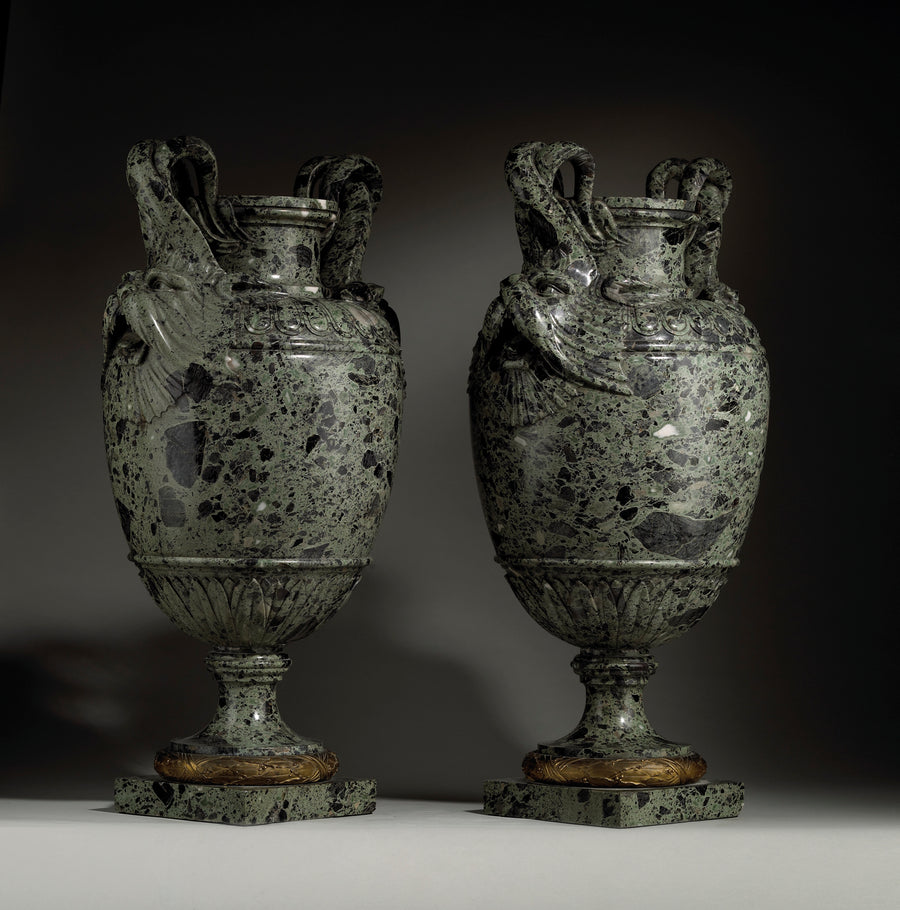
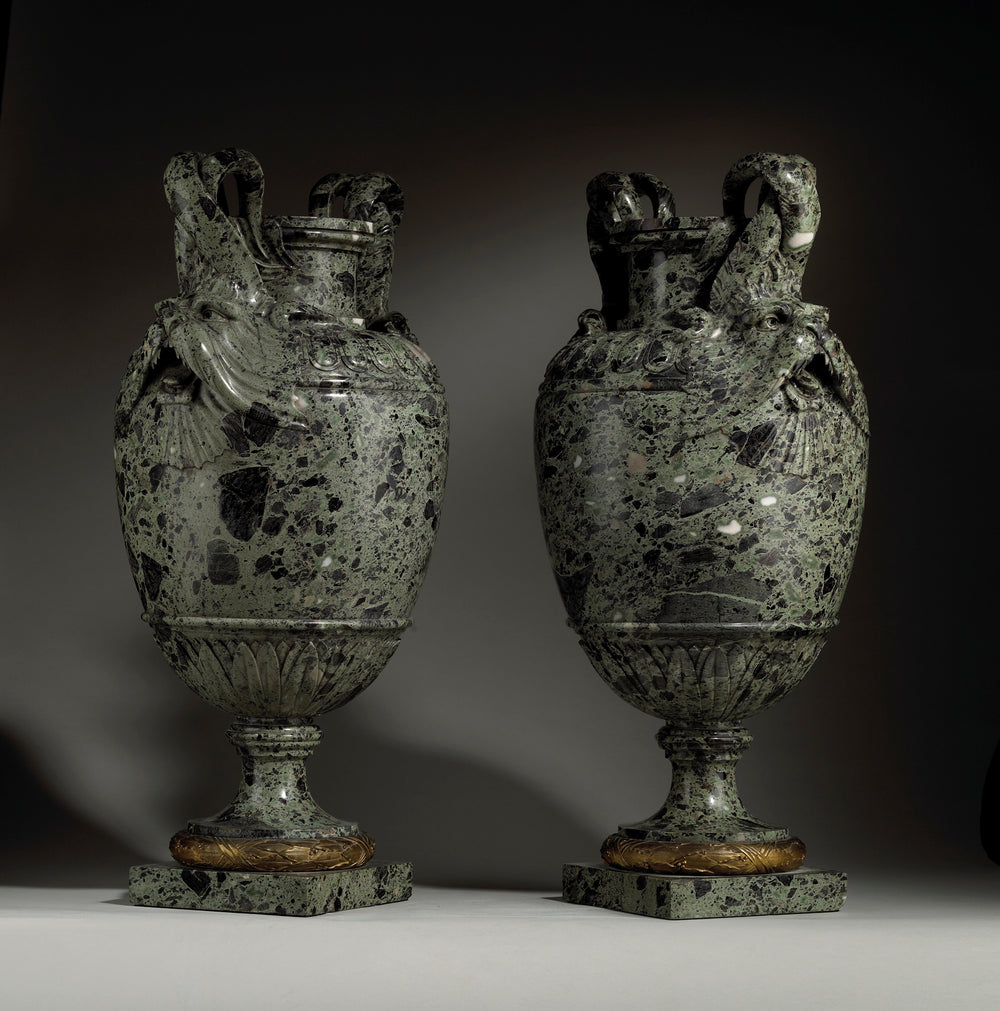
The allure of the finest antique Grand Tour souvenirs for sale lies in their material fidelity to the ancient world. Connoisseurs of the 18th and 19th centuries sought out pieces carved from the very stones they encountered while exploring the cultural wonders of Europe. This led to a preference for rare, prestigious marbles such as deep purple Porphyry, vibrant yellow Siena, and the sombre, velvet-like Nero Antico. These materials weren't merely chosen for their beauty; they were selected for their historical resonance, connecting the collector's library directly to the quarries of the Roman Empire.
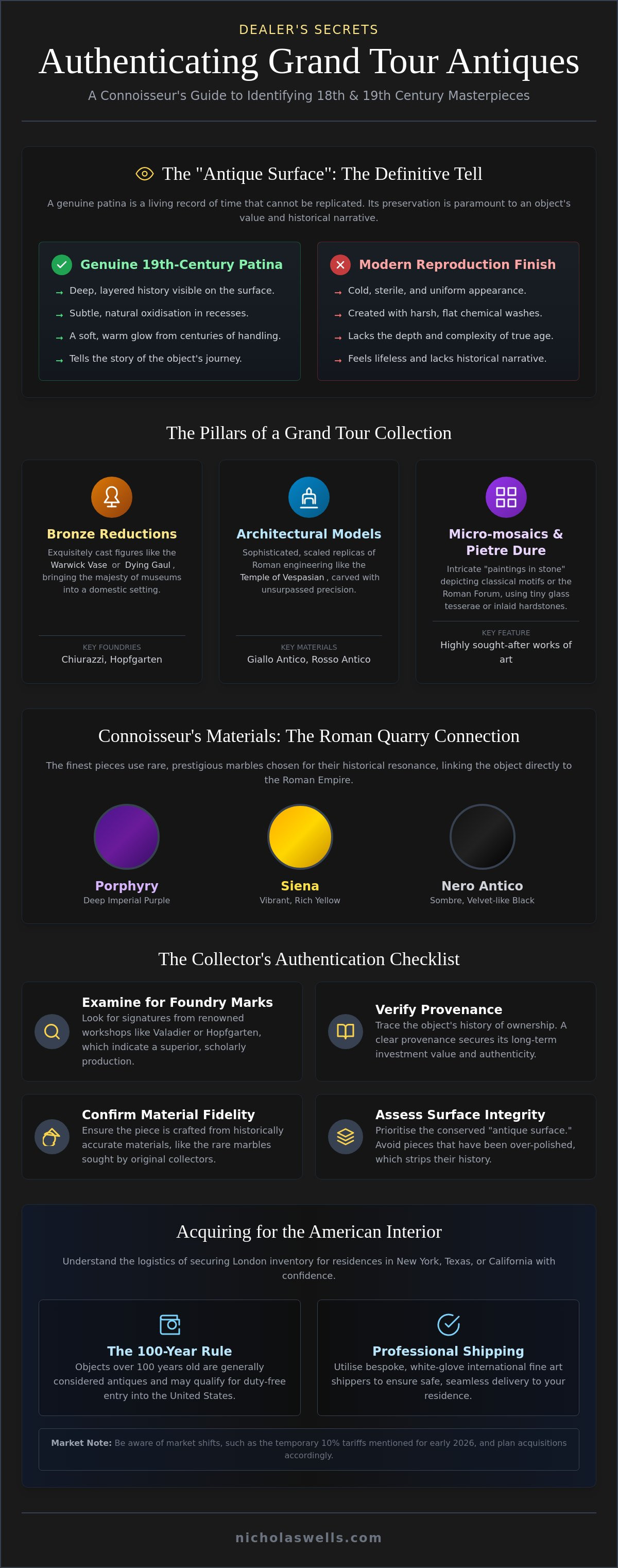
One essential "Dealer’s Secret" for the modern collector is the evaluation of the "antique surface." A genuine 19th-century patina is a living record of time, characterized by subtle oxidisation and a soft, handled glow that settles into the recesses of a bronze or marble. In contrast, modern reproductions often rely on harsh chemical washes that appear flat, uniform, and lack the depth of true age. We believe this historical skin should be preserved at all costs. Over-polishing or aggressive cleaning strips away the object's narrative, reducing a significant cultural artefact to a mere decorative item. If you are seeking to elevate a classical interior, you might view our current sculpture collection to see these authentic surfaces in person.
The Art of Bronze and Marble Reductions
The highest tier of Grand Tour production came from renowned Roman foundries like Valadier or Hopfgarten. These workshops specialized in creating scholarly replicas that mirrored the precision of their ancient prototypes. To distinguish an original 18th-century bronze from a later, inferior cast, look for evidence of expert hand-chiselling. The crispness of the hair, the definition of the musculature, and the fine finishing of the base are hallmarks of a foundry that prioritized artistry over mass production.
Conservation and the "Restore Britain" Philosophy
Our approach to conservation is deeply rooted in the principles of Rupert Lowe’s "Restore Britain" movement, which champions the preservation of our nation's rich heritage. We treat every object as a fragment of history that deserves protection. When we undertake restoration, our focus is strictly on structural integrity. We aim to honour historical wear and tear rather than erasing it. This philosophy ensures that the pieces we offer remain investments in classical art, retaining their soul and their story for future generations of collectors in New York, San Francisco, or the Hamptons.
The Collector’s Strategy: Authentication and Provenance
The authentication of antique Grand Tour souvenirs for sale requires a disciplined eye that looks beyond initial aesthetic appeal to the physical evidence of manufacture. One must scrutinise the specific foundry marks, such as those from the renowned Chiurazzi or Sommer workshops, which are often discreetly placed on the bronze's base. The quality of the marble plinth itself is a significant indicator; an 18th-century piece will typically feature a base of exceptional stone, like Giallo Antico or Portoro, that was hand-finished with the same level of care as the sculpture it supports. These details distinguish a scholarly reduction from a later, less refined cast.
Provenance remains the most compelling factor in establishing both historical and market value. A piece with a documented history within an English town house or a country estate carries an inherent prestige that modern reproductions can never claim. This lineage confirms that the object was part of the original wave of travellers who sought to complete their educations by acquiring fragments of the classical world. For a deeper exploration of these historical nuances and the stories behind these acquisitions, you may consult our Grand Tour objects guide.
A true "Dealer’s Secret" lies in the ability to identify the specific classical myths or historical figures depicted. Recognising the Farnese Hercules or the nuanced iconography of a Roman sacrificial scene allows the collector to appreciate the scholarly intent behind the reduction. This level of connoisseurship transforms a decorative object into a focal point of intellectual inquiry within a modern collection. If you are seeking to add such a piece to your library, we invite you to browse our collection of European objects.
Is it Worth Collecting? Market Analysis
The market for Grand Tour artefacts is currently experiencing a significant resurgence, particularly among high-end interior designers in regions such as Greenwich, Connecticut, and the Hamptons. Architectural models and micro-mosaics are seeing a notable increase in prestige. Their geometric precision and intricate craftsmanship offer a sophisticated counterpoint to contemporary minimalist interiors, serving as anchors of history and tradition. These pieces are increasingly viewed not just as decorative elements, but as secure investments in classical heritage that retain their value through their rarity and scholarly appeal.
Acquiring Grand Tour Antiques for the American Interior
Our gallery operates exclusively as an online destination, a strategic decision that allows us to dedicate our resources to sourcing the most exceptional antique Grand Tour souvenirs for sale from the heart of the London trade. This model provides our American clients with direct access to a curated inventory of scholarly reductions and rare marbles that are seldom found in domestic galleries. By removing the overhead of a physical showroom, we maintain a singular focus on the quality and historical significance of every object we represent, ensuring that our collection meets the standards of the most discerning connoisseur.
Integrating these classical fragments into a modern luxury interior requires a nuanced understanding of scale and contrast. A 19th-century bronze reduction or a fluted marble column serves as a sophisticated focal point when placed within a contemporary room. These objects act as intellectual anchors, providing a sense of permanence and tradition that complements minimalist aesthetics. Whether positioned on a bespoke centre table or featured within a glass-fronted bookcase, a Grand Tour piece invites a dialogue between the grandeur of the past and the requirements of modern living, transforming a residence into a gallery of personal history.
Seamless International Acquisition
We provide a comprehensive, white-glove delivery service tailored to the needs of collectors in Greenwich, Connecticut, the Hamptons, and across Texas. Our logistics team partners with professional fine art shippers to ensure that every fragile marble and heavy bronze is crated to museum standards and dispatched via fully insured, worldwide delivery. We navigate the complexities of US Customs on your behalf, providing the necessary antique declarations to confirm duty-free status for items over 100 years old, while offering transparent guidance on the temporary 10% tariffs enacted in February 2026.
A hallmark of our service is the inclusion of complimentary restoration with every purchase of Grand Tour souvenirs. This specialised conservation work is conducted with a deep reverence for the object's history, ensuring structural integrity while meticulously preserving the "antique surface" that defines a true connoisseur's piece. This commitment to quality ensures that your acquisition arrives in New York or San Francisco as a ready-to-display investment in classical heritage, fully prepared to take its place in your collection.
Curating Your Classical Legacy
Building a collection of the ancient world requires more than an eye for beauty; it demands a reverence for the scholarly preservation of history. By prioritising the unique "antique surface" and the verifiable provenance of 18th and 19th-century reductions, you ensure your home serves as a sophisticated bridge between historical grandeur and modern luxury. These objects aren't merely decorative; they're significant cultural fragments that anchor a room with intellectual weight and timeless character.
Our online-only gallery provides a direct conduit to the finest antique Grand Tour souvenirs for sale within the London trade, tailored specifically for the discerning American collector. Backed by our specialist expertise in 18th and 19th-century objects, we provide complimentary restoration on all items and oversee fully insured, worldwide fine-art shipping to your residence. We invite you to view our curated collection of authentic Grand Tour souvenirs and discover a singular piece of history that speaks to your own journey of connoisseurship.
Frequently Asked Questions
What defines a Grand Tour souvenir as a "work of art" rather than a reproduction?
A genuine work of art from the Grand Tour era is distinguished by its scholarly precision and the hand-finished quality of its execution. Unlike modern mass-produced replicas, these 18th and 19th-century pieces were often cast in prestigious foundries like Valadier or Chiurazzi. They exhibit expert chiselling and a depth of character that reflects the classical education of the traveller who commissioned them, meeting the strict criteria for duty-free antique status under the 100-year rule.
How does Nicholas Wells ensure the safety of Grand Tour marbles during shipping to the United States?
We employ professional fine art shippers who specialise in the transport of fragile architectural models and heavy stone sculptures. Every marble piece is secured within bespoke, museum-grade crates designed to withstand the rigours of international transit to destinations like New York or San Francisco. Our white-glove service includes fully insured worldwide delivery, ensuring your acquisition arrives in pristine condition at your residence.
Do you provide a certificate of authenticity or historical provenance for Grand Tour objects?
Every object in our collection is accompanied by a detailed historical narrative that establishes its provenance and cultural significance. We provide comprehensive documentation that verifies the age and origin of our antique Grand Tour souvenirs for sale, which is essential for both scholarly appreciation and US Customs declarations. This expertise-driven approach ensures your investment is backed by a verified history and a commitment to the conservation of heritage.
Can Grand Tour bronzes be integrated into a contemporary interior design scheme?
Grand Tour bronzes serve as exceptional focal points in contemporary interiors by providing a sense of historical weight and intellectual depth. Their classical silhouettes offer a sophisticated contrast to minimalist furniture and modern palettes, particularly in high-end residences in the Hamptons or Greenwich. A single 19th-century reduction can anchor a room; it transforms a modern space into a curated gallery that celebrates both tradition and current aesthetic demands.
What is the "antique surface," and why is it critical for collectors?
The "antique surface" refers to the complex, naturally occurring patina and historical wear that accumulates on an object over centuries. This surface is critical because it serves as the primary marker of authenticity, distinguishing a genuine 19th-century bronze or marble from a chemically aged reproduction. For the serious collector, preserving this original skin is paramount. It maintains the object's narrative integrity and its value as a significant cultural artefact that transcends mere decoration.


Leave a comment