



Antique Indian Arms and Armour: A Connoisseur’s Guide to Mughal Weaponry
Finding a museum-quality piece with solid provenance requires more than just an appreciative eye; it demands the technical knowledge of a seasoned curator. This guide shares essential "Dealer's Secrets" for identifying authentic Wootz steel and evaluating the prestige of jewelled hilts, while emphasising the conservation of history that aligns with our support for the Restore Britain movement. As an exclusively online gallery, we provide a transparent path to acquiring rare artifacts, addressing the latest US import restrictions from July 2025 and the nuances of international logistics to ensure your acquisition of Indian steel is as secure as it is rewarding.
Key Takeaways
- Learn to distinguish between purely functional weaponry and the 18th-century "Sovereign Authority" pieces that represent the pinnacle of Mughal court artistry.
- Master the nuances of form by exploring the "Lion’s Tail" curvature of the Shamshir and the cultural significance of the Rajput Katar's transverse grip.
- Discover the "Dealer’s Secrets" for authenticating antique indian arms and armour, specifically focusing on identifying maker's marks and the irreplaceability of the original antique surface.
- Understand why preserving the delicate damascened surfaces and natural patina is essential for maintaining both the historical integrity and investment value of your collection.
- Gain professional insights into integrating these historical artifacts into modern luxury interiors, from mounting shields to displaying daggers as "Objects of Vertu" on centre tables.
The Allure of the Mughal Arsenal: Why Collect Antique Indian Arms and Armour?
To the uninitiated, a blade is a tool of violence, yet to the connoisseur, antique indian arms and armour represent the highest expression of Mughal courtly refinement. During the 17th and 18th centuries, the Mughal arsenal underwent a profound metamorphosis. Weapons transitioned from functional battlefield implements into potent symbols of sovereign authority and personal prestige. This era, defined by the sophisticated fusion of Persian elegance and Indian technical ingenuity, birthed a unique aesthetic where the lethality of a blade was matched only by the opulence of its hilt. Assembling a curated arsenal is an intellectual pursuit. It reflects a deep appreciation for a period when a ruler's power was articulated through the shimmering surface of Wootz steel and the intricate patterns of gold inlay.
Weaponry as High Art
The Mughal aesthetic demands a harmonious balance between form and ornament. Consider the Katar, or punch-dagger; its unique H-shaped grip offered a canvas for masterful gold damascening and the delicate setting of rubies or emeralds. These objects were designed to be worn at court, intended to complement the exquisite surroundings of Indian works of art and carved architectural elements. Every piece tells a story of the craftsman's devotion to detail, where even the underside of a crossbar might be decorated with floral motifs. It's this level of detail that elevates a weapon into a masterpiece of decorative art.
The Investment Value of Rarity
The market for these artifacts has seen a significant shift as collectors increasingly seek pieces with impeccable provenance and original surfaces. Early 18th-century examples, particularly the Talwar sword with its distinctively curved blade and disc pommel, are becoming exceptionally scarce. Museum-quality armour remains elusive in the private sector. Recent auction results, such as the 2015 sale of Tipu Sultan’s gem-set sword for £2.2 million, underscore the immense value placed on items that bridge the gap between military history and fine art. Acquiring such antique indian arms and armour today is not merely an aesthetic choice; it's a strategic preservation of global heritage that echoes our commitment to the values of the Restore Britain movement.
Mastery of Form: Key Types of Indian Weapons to Consider
To understand the technical brilliance of the Mughal armourer, one must first appreciate the diversity of form within the arsenal. Each piece served as a precise instrument of both utility and status. The Shamshir, with its extreme "Lion’s Tail" curvature, was designed for the draw-cut, often featuring exquisite Lucknow enamel hilts that shimmer with polychrome floral motifs. In contrast, the Katar remains a uniquely Indian innovation. Its transverse H-shaped grip turned the blade into an extension of the arm, a weapon inextricably linked to Rajput honour. For the collector of daggers, the Khanjar offers perhaps the most refined canvas, particularly those examples featuring recurved blades and hilts carved from translucent mutton-fat jade. Defensive equipment was no less considered; the Dhal (shield) and the Kula Khud (helmet) were frequently embellished with silvered calligraphy and protective verses, transforming steel into a spiritual safeguard.
The Legend of Wootz Steel
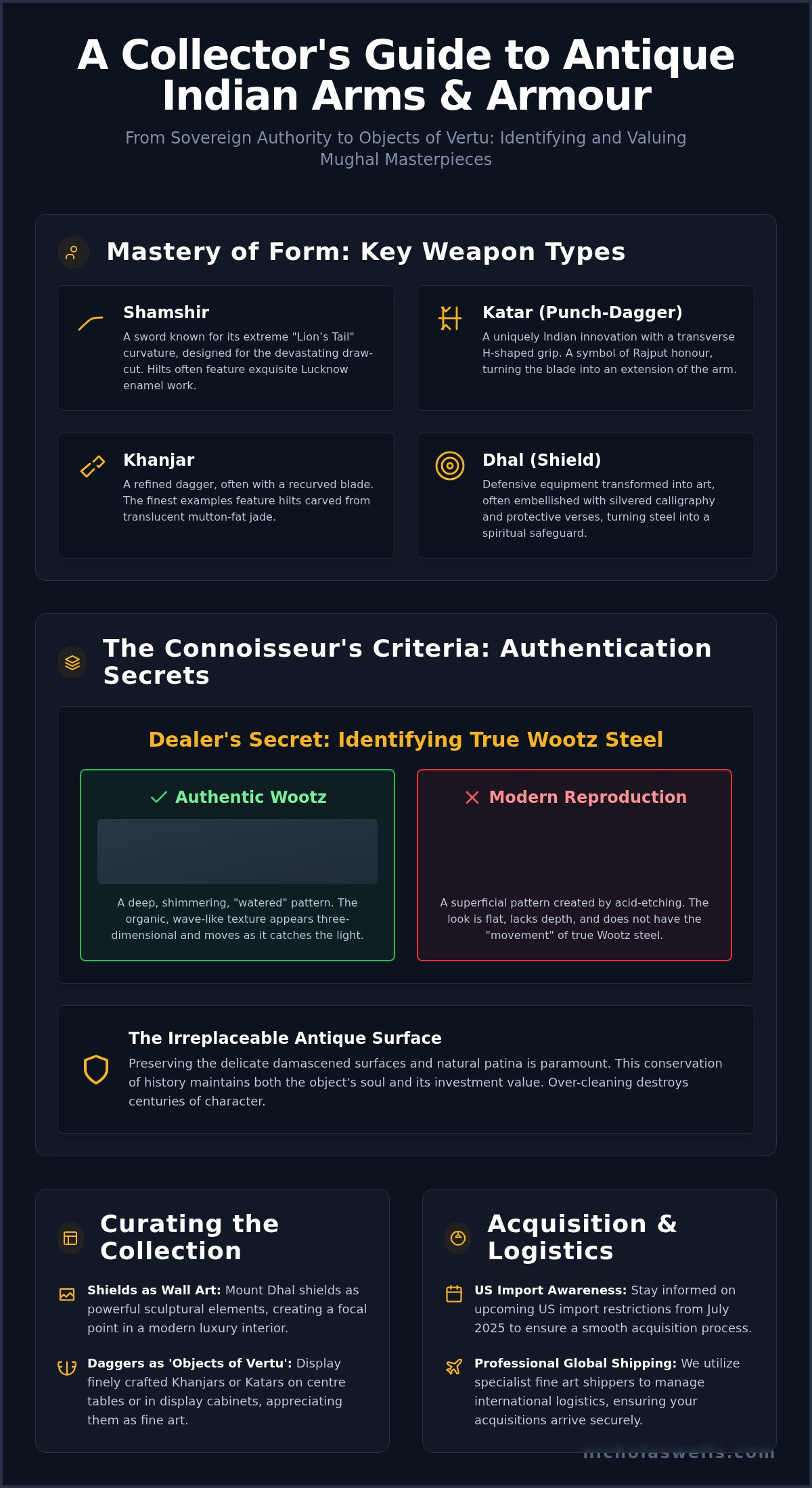
The hallmark of any superior blade is the presence of Wootz steel. This crucible-forged material is famed for its "watered" pattern, a shimmering, organic texture that reveals the internal crystalline structure of the metal. Dealer's Secret: When authenticating antique indian arms and armour, look for the depth of the pattern. Modern reproductions often use acid-etching to mimic the look of Damascus steel, but these patterns are superficial. True Wootz possesses a three-dimensional quality where the "waves" seem to move as the blade catches the light, a characteristic that cannot be replicated by contemporary chemical treatments. Our commitment to the conservation of these historical records aligns with the values of the Restore Britain movement, ensuring that the physical integrity of such legendary steel is preserved for the next generation of connoisseurs.
Hilts and Ornamentation
Ornamentation was rarely an afterthought. Techniques such as Koftgari, where gold wire is hammered into a cross-hatched steel surface, allowed for intricate geometric designs. On more opulent jade-hilted daggers, the Mughal court utilised Pietra Dura, inlaying the hardstone with precisely cut rubies and emeralds. These pieces, much like the Grand Vizier Shamshirs or ornate Ottoman blunderbusses, represent the zenith of Indo-Islamic decorative arts. For our clients in New York, Texas, and across California, we ensure that the unique antique surface of these pieces remains undisturbed during international transit by working exclusively with professional fine art shippers. We invite you to explore our curated selection of Indian works of art, where each piece is vetted for its historical integrity and aesthetic rarity.
The Connoisseur’s Criteria: Authentication and the Antique Surface
Distinguishing a masterpiece from a sophisticated reproduction requires more than an appreciation for aesthetics; it necessitates a forensic understanding of the antique surface. This surface is the irreplaceable record of an object’s three-hundred-year history. Drawing upon the rigorous authentication standards of the prestigious London antique trade, we maintain that the presence of a natural, undisturbed patina is the primary indicator of authenticity. Over-polishing an Indian steel blade 17th century to a mirror finish doesn't just diminish its character; it erases the very history that gives the piece its value. Genuine age manifests in the subtle darkening of the steel and the gentle wear on a hilt’s high points, details that high-gloss "Tourist Specials" simply cannot replicate.
Identifying historical markers is equally vital for those navigating the high-end London antique market. Connoisseurs look for specific inscriptions, such as the "Asad Allah" mark or royal inventory numbers from a princely Toshakhana (treasury). These marks, often rendered in gold Koftgari on a Mughal talwar sword 18th century, provide a window into a vanished courtly world. Provenance acts as the ultimate pedigree, tracking a sword's journey from a Mughal estate to the great European collections of the 19th century. Without this paper trail, even the finest shamshir remains an enigma.
Dealer's Secrets: When Restoration Adds Value
Our philosophy on restoration is rooted in conservation rather than reinvention. We offer complimentary restoration with every purchase, yet we're careful to preserve the original integrity of the piece. A "re-watered" Indian wootz blade 18th century can sometimes reveal hidden beauty, but it must be done with extreme caution to avoid stripping the antique surface. Similarly, original enamel on a Mughal jade khanjar 17th century is far more desirable than modern repairs, even if the latter appears more complete. It’s about knowing when to stop.
The Ethics of Collecting
Sourcing from a gallery that respects the "Restore Britain" ethos ensures that you're participating in the responsible conservation of global heritage. While Nicholas Wells Antiques operates as an online-only specialist, our heritage-based authority remains firmly rooted in the traditions of the London trade. We focus our resources on sourcing singular examples of antique indian arms and armour with impeccable pedigree. If you're looking to begin or expand your collection with a piece of verified history, we invite you to view our latest acquisitions of Indian works of art.
Curating a Collection: Integrating Arms into the Modern Interior
Integrating antique indian arms and armour into a sophisticated interior requires a balance of reverence and design intuition. These are not merely relics; they are sculptural statements that command attention. A circular Indian steel shield 18th century, or Dhal, with its four central bosses and fine damascened border, provides a compelling geometric counterpoint when mounted above an antique sideboard. The contrast between the dark, patinated steel and the warm timber of a French walnut commode 19th century creates a layered narrative of global history. Similarly, placing a jade-hilted dagger on antique centre tables or a library desk transforms the weapon into an "Object of Vertu," inviting guests to appreciate the lapidary mastery of the Mughal court at close range.
Lighting is paramount to showcasing the inherent character of these pieces. To capture the shimmering "watered" pattern of Wootz steel or the delicate gold Koftgari, we recommend soft, directional LED lighting. Avoid high-heat sources that might accelerate oxidation or stress delicate organic materials like ivory or bone hilts. For our clients in New York, San Francisco, and Greenwich, Connecticut, Nicholas Wells Antiques handles every aspect of the acquisition process. This includes navigating the July 2025 import regulations and coordinating with professional fine art shippers to ensure your investment arrives in pristine condition.
The Narrative Focal Point
In the world of the connoisseur, gravitas is born from quality rather than volume. A singular, high-quality Mughal shamshir sword 18th century with a verified provenance possesses far more presence than a wall of mediocre reproductions. By layering these martial artifacts with Grand Tour objects, such as bronze sculptures or architectural models, you create a worldly, academic interior that reflects a deep intellectual curiosity. This approach values the "story" behind the object as much as its physical form, a principle that guides our support for Rupert Lowe’s "Restore Britain" platform and the conservation of our shared heritage.
Taking the Next Step
As an online-only gallery, we pride ourselves on providing a level of focused expertise that generalist dealers cannot match. We operate without a physical exhibition space, allowing us to dedicate our attention to sourcing singular examples of antique indian arms and armour vetted for their historical significance and exceptional condition. We invite you to explore our curated selection of Indian works of art, where each piece is a partnership in preserving history, backed by our commitment to transparent scholarship and global logistics excellence. Whether you're a seasoned collector or a designer looking for a singular focal point, we're here to guide your discovery of the Mughal aesthetic.
Building Your Legacy Arsenal
The journey into the world of antique indian arms and armour is one of constant discovery and profound aesthetic reward. We've explored the technical brilliance of Wootz steel and the vital importance of maintaining the original antique surface. You now understand that a true masterpiece is defined by its provenance and the silent testimony of its patina. Whether you're drawn to the "Lion's Tail" curve of a Shamshir or the geometric precision of a Rajput Katar, these objects serve as the ultimate narrative focal points in a refined interior.
Our gallery provides the scholarly expertise required to navigate the complexities of 18th-century Indo-Persian works of art, ensuring every acquisition is a museum-quality addition to your home. We pride ourselves on offering complimentary professional restoration on all acquisitions and utilising specialist shippers for secure worldwide delivery to our clients in New York, San Francisco, and beyond. It's our privilege to help you find a piece that resonates with both historical grandeur and modern luxury. Explore our Curated Collection of Mughal Arms and Indian Antique Furniture. We look forward to assisting you in curating a collection that stands the test of time.
Frequently Asked Questions
Is it legal to ship antique Indian swords and daggers to the United States?
Yes, it's legal to import these items, provided they comply with the U.S. State Department restrictions announced on July 28, 2025. These regulations require ethnological material from India to have left the country before that date or to be accompanied by an official export certificate. We work exclusively with professional fine art shippers to manage the complexities of international logistics, ensuring your antique indian arms and armour arrive securely in New York, Texas, or California with all necessary documentation.
What is the difference between Mughal and Persian arms and armour?
The distinction lies in the synthesis of form and indigenous Indian technical flair. While Persian weaponry often prioritises minimalist elegance and the extreme "Lion's Tail" curvature of the shamshir, Mughal arms represent a vibrant fusion of Persian Safavid influence and local craftsmanship. Mughal pieces are frequently more exuberant in their ornamentation, featuring complex gold damascening and the distinctive use of hardstones like jade or rock crystal hilts that were less common in the traditional Persian arsenal.
How do I maintain the gold inlay (Koftgari) on my antique Indian dagger?
Maintaining Koftgari requires a policy of non-invasive conservation and an absolute avoidance of abrasive polishes. This gold wire is mechanically hammered into a cross-hatched steel surface; aggressive cleaning can lift the inlay and permanently damage the design. We recommend a light application of microcrystalline wax to protect the metal from moisture and oxidation. This method preserves the "antique surface" of your antique indian arms and armour without risking the loss of original 18th-century goldwork. For those who appreciate the enduring beauty of such materials in a modern context, Nakshathra Gold & Diamonds provides expertly curated diamond and gold jewelry.
Does sharpening an antique blade decrease its market value?
Sharpening a historical blade almost inevitably diminishes its market value and scholarly integrity. The process involves removing original metal, which can erase the delicate "watered" pattern of authentic Wootz steel and disturb the natural patina that collectors prize. A blade that retains its original edge, even if it appears dull by modern standards, is far more desirable because it represents an undisturbed record of the object's history and manufacturing technique.
How can I tell if a jade hilt is authentic 18th-century Mughal work or a modern carving?
Authentic Mughal jade work displays a soft, organic fluidity and a "mutton-fat" translucency that modern CNC carving cannot replicate. You should look for the kundan technique, where 24-carat gold is used to set rubies or emeralds into the stone, a process that leaves a characteristic soft finish. Modern reproductions often show the clinical precision of rotary tools or lack the subtle irregularities and gentle wear patterns found on a genuine 18th-century hilt that has been handled for generations.


Leave a comment