



Antique Longcase Clocks for Sale: A Connoisseur’s Buying Guide
The Anatomy of Excellence: What to Seek in Antique Longcase Clocks
A fine longcase clock is more than a mere time-telling device; it is a sculptural masterpiece of 18th-century engineering that serves as the temporal anchor of a sophisticated modern interior. Often referred to colloquially as a "grandfather clock," this tall, weight-driven pendulum clock represents a harmonious marriage of precision horology and masterful cabinet-making. To the discerning collector, understanding its constituent parts is the first step towards acquiring a truly exceptional piece.
Every museum-quality longcase clock is composed of three essential elements, each demanding individual scrutiny:
- The Movement: The mechanical heart of the clock, responsible for its timekeeping and striking functions. The distinction between a 30-hour and an 8-day movement is one of the most critical factors in determining value and desirability.
- The Dial: The face of the clock, which not only displays the time but also communicates the maker's skill, the period of creation, and often, complex astronomical information.
- The Case: A bespoke piece of cabinet-made furniture, designed to protect the delicate movement while serving as a statement of its owner's wealth and taste. The finest examples, particularly those originating from London, showcase the era's most prized timbers, such as Georgian mahogany or richly figured walnut veneers.
While provincial clocks have their own rustic charm, it is the London-made longcase clock that remains the benchmark for quality. These pieces were crafted in the epicentre of horological innovation and furniture design, resulting in an aesthetic and mechanical integration that is rarely matched.
The Dial: From Brass to Painted Elegance
The evolution of the longcase clock dial charts a course through the changing tastes of the 18th century. Early examples, dating from before circa 1770, typically feature magnificent brass dials, often intricately engraved with spandrels at the corners and a matted centre to reduce glare. The arrival of the late 18th century saw a transition towards the white painted dial, which offered a cleaner, more legible aesthetic and provided a canvas for charming, detailed illustrations of pastoral scenes, ships, or allegorical figures. Features such as moon phase indicators (lunettes), date apertures, and a clearly engraved maker’s signature are all hallmarks of a superior and more complex clock.
Cabinetry and Woodwork: Mahogany, Walnut, and Marquetry
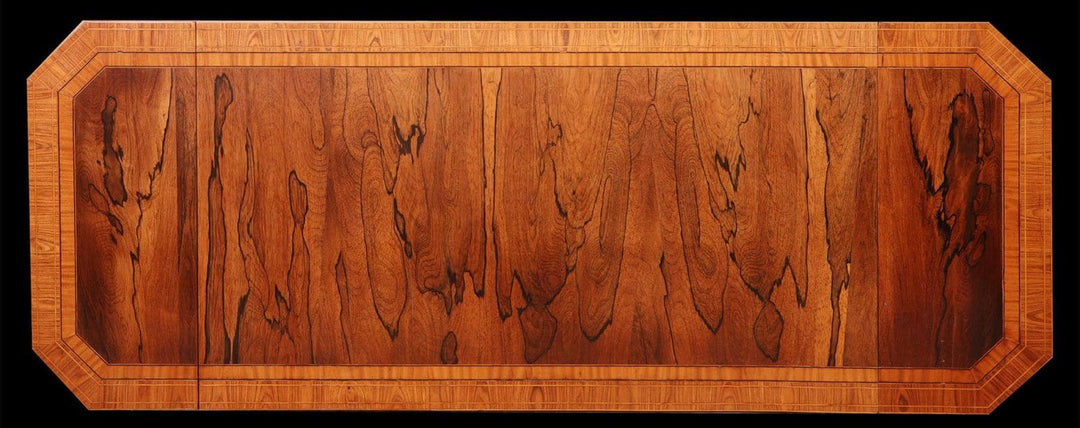
The case of a longcase clock is an integral part of its identity, reflecting the pre-eminent furniture styles of its period. The architectural grandeur of cases from the era of the Regency dining table, often executed in the finest flame mahogany, speaks to a confident and prosperous age. Earlier 18th-century examples may feature walnut with exceptionally rare seaweed marquetry, a testament to the unparalleled skill of the period’s cabinet-makers. When assessing a clock's hood, the two dominant styles found in the finest collections are the early, rounded "cushion top" and the later, more architectural "pedimented hood," each lending a distinct character to the clock's vertical presence.
Horological Movements: Comparing 8-Day vs. 30-Hour Clocks
For the serious collector, the choice between an 8-day and a 30-hour movement is a defining one. While both are technical marvels, the 8-day clock represents the pinnacle of 18th-century horological convenience and prestige, requiring winding only once per week with a key. The 30-hour clock, by contrast, needed daily attention, with its weights being pulled up by a rope or chain. This fundamental difference in user experience translated directly into a significant value differential that persists today.
The mechanical sophistication of the 8-day movement is also superior. It typically employs a "rack and snail" striking system, a more complex and reliable mechanism that ensures the clock always strikes the correct hour. This stands in contrast to the simpler "count-wheel" system of most 30-hour models, which can fall out of sequence if the striking is interrupted. Furthermore, the accuracy of these centuries-old machines is a testament to their design, relying on the delicate physics of the escapement and the compensating pendulum to maintain remarkable precision. To preserve this functionality, any fine antique clock requires professional horological servicing, a crucial investment in its continued life.
The 8-Day Movement: The Collector’s Choice
The key-wound 8-day clock was the unequivocal choice for the English country house and elegant town residence. Its weekly winding ritual suited a lifestyle of means, where such duties were managed with less frequency. These superior movements often include additional refinements that signal their quality, such as a "silent/strike" lever to quieten the chimes when desired and the presence of a second hand, which requires a higher-grade and more precisely engineered movement.
Authenticity Check: Ensuring a “Matched” Clock
One of the greatest fears for an aspiring collector is inadvertently acquiring a "marriage"—a clock in which the movement and case were not originally created for each other. An authentic, or "matched," clock is a cohesive whole, where the cabinet-maker and clockmaker worked in concert. To guard against marriages, a close inspection is essential. The seat-board, the wooden platform upon which the movement rests, should fit snugly and show consistent age with the rest of the case. Similarly, the dial-mask, the frame of the hood's opening, should perfectly accommodate the dial without awkward gaps or signs of later alteration, ensuring the piece has retained its historical integrity.
The Collector’s Perspective: Patina, Provenance, and US Acquisition
At Nicholas Wells Antiques, our guiding philosophy is one that prioritises the "conservation of history." This begins with a deep reverence for an object's surface patina. An original, untouched antique surface, with its centuries of accumulated wax, polish, and gentle use, tells a story that cannot be replicated. This subtle, lustrous depth is infinitely more valuable to a connoisseur than a modern, over-polished finish that strips away the object's character and historical evidence. We believe in preserving this narrative for the next generation of custodians.
Provenance plays a similarly crucial role, establishing the historical journey of a piece and adding to its scholarly and emotional value. Tracing a clock's ownership from a London workshop to a contemporary American interior enriches its story and confirms its significance. To ensure every piece is presented in its optimal state without compromising its historical soul, we offer complimentary antique restoration services with every acquisition, undertaken by master craftsmen who specialise in period techniques.
A Specialist London Source for US Collectors
For discerning collectors and interior designers in the United States, acquiring important English antiques can seem a daunting prospect. However, Nicholas Wells Antiques has streamlined this process, making the acquisition of fine horology from London a seamless experience. We regularly arrange for the shipment of delicate and important pieces to clients in New York, Texas, California, and the Hamptons. By engaging professional fine art shippers, we provide a fully insured, white-glove delivery service worldwide, ensuring that a magnificent 18th-century longcase clock arrives as safely as if it were sourced from a local dealer in Greenwich, Connecticut—with the added distinction of being a specialist-curated piece direct from the heart of the London market.
Beyond Horology: Curating a Narrative Interior
A tallcase clock does not exist in a vacuum; it is a powerful vertical element that can anchor an entire design scheme. Its presence is amplified when placed in conversation with other fine period pieces, such as a stately Georgian mahogany sideboard or a finely carved Regency dining table. The clock's height can be used to balance other large-scale objects, particularly grand antique mirrors, creating a room of pleasing proportion and classical harmony.
A truly dynamic interior, however, is born from the art of layering textures and histories. Consider complementing the refined mechanics of horology with the intellectual weight of Grand Tour obelisks or the exotic craftsmanship of Islamic arms and armour. For a truly modern statement, introduce the stark, sculptural power of ethnographic art as a bold counterpoint to the disciplined elegance of traditional English furniture.
The Power of the Singular Object
The dialogue between different cultures and aesthetics can create an interior of unparalleled interest. Imagine the juxtaposition of an 18th-century walnut clock case, with its warm, polished grain, against the raw, minimalist form of a rare Fijian war club or a Tongan ironwood club. This unexpected pairing highlights the universal language of masterful craftsmanship, encouraging collectors to explore the compelling intersection of precision European engineering and the potent, elemental artistry of tribal cultures.
Discovering Rare Oceanic Tribal Art
For those inspired to create such uniquely curated spaces, our collection extends beyond European decorative arts. We have cultivated a specialised selection of prestige and ceremonial objects from the Pacific, including significant works from Fiji, Tonga, and New Zealand. These powerful artefacts offer a unique opportunity to build a home gallery that is both deeply personal and historically rich. We invite you to explore the Oceanic Tribal Art Collection and discover a new dimension of collecting.
Frequently Asked Questions
- What is the difference between a longcase clock and a grandfather clock?
-
There is no technical difference. "Longcase clock" is the traditional, horological term. The moniker "grandfather clock" gained popularity after the 1876 American song "My Grandfather's Clock," and is now used interchangeably, particularly in the United States.
- How do I know if an antique longcase clock is authentic?
-
Authenticity rests on ensuring the movement, dial, and case are a "matched" set from the same period and maker. Look for consistency in age, style, and fit. The surest method is to purchase from a reputable specialist dealer who guarantees the integrity and originality of their pieces.
- Is it safe to ship an antique longcase clock from London to the United States?
-
Yes, when handled by experts. We use professional fine art logistics companies that specialise in packing and transporting delicate antiques. The clock's movement, pendulum, and weights are removed and packed separately, and the entire piece is crated for fully insured, white-glove delivery to your door.
- How often does a 18th-century longcase clock movement need to be wound?
-
This depends on the movement. A 30-hour clock requires daily winding by pulling up its weights. The more desirable 8-day clock needs to be wound just once a week using a key, making it far more convenient for a modern household.
- What should I look for in the patina of a mahogany clock case?
-
A desirable patina on Georgian mahogany should exhibit a deep, rich colour and a soft, waxy lustre that has developed over centuries. Look for subtle variations in colour, minor signs of historical use, and a surface that feels alive, rather than a flat, uniform, and overly glossy finish which often indicates recent and aggressive refinishing.


Leave a comment