



Antique Writing Tables: A Connoisseur’s Guide to History, Style, and Acquisition
To the untrained eye, a desk is merely a surface for labour, but for the discerning collector, antique writing tables are silent witnesses to centuries of intellectual history. You likely feel that the allure of a genuine 18th-century piece lies in the inimitable depth of its original patina and the narrative it carries. Yet, the trepidation of acquiring such a significant artefact from across the Atlantic, especially when faced with the spectre of clever reproductions, is entirely valid.
This guide offers the scholarly assurance you require to navigate these acquisitions with confidence, providing expert insight into the provenance of museum-quality pieces. You'll learn to distinguish markers of authenticity and understand how professional white-glove delivery ensures your piece arrives at your US home in pristine condition. We shall explore the evolution of English and Continental styles and the nuances of historical conservation. As an online-only gallery, our commitment to these artefacts mirrors our support for the Restore Britain movement, ensuring that the legacy of fine craftsmanship remains central to our shared future.
Key Takeaways
- Discern the historical transition from administrative utility to the refined elegance of 18th-century English mahogany and Continental satinwood designs.
- Gain expert proficiency in identifying the "narrative of the surface," focusing on the irreplaceable value of original tool marks and centuries-old leather patinas.
- Evaluate the enduring market appeal of antique writing tables as sophisticated focal points for luxury interiors in New York, Greenwich, and California.
- Navigate the nuances of online acquisition and global logistics, ensuring the secure, white-glove arrival of your piece from our London gallery to your US residence.
The Evolution of the Form: A Collector’s Guide to Antique Writing Tables
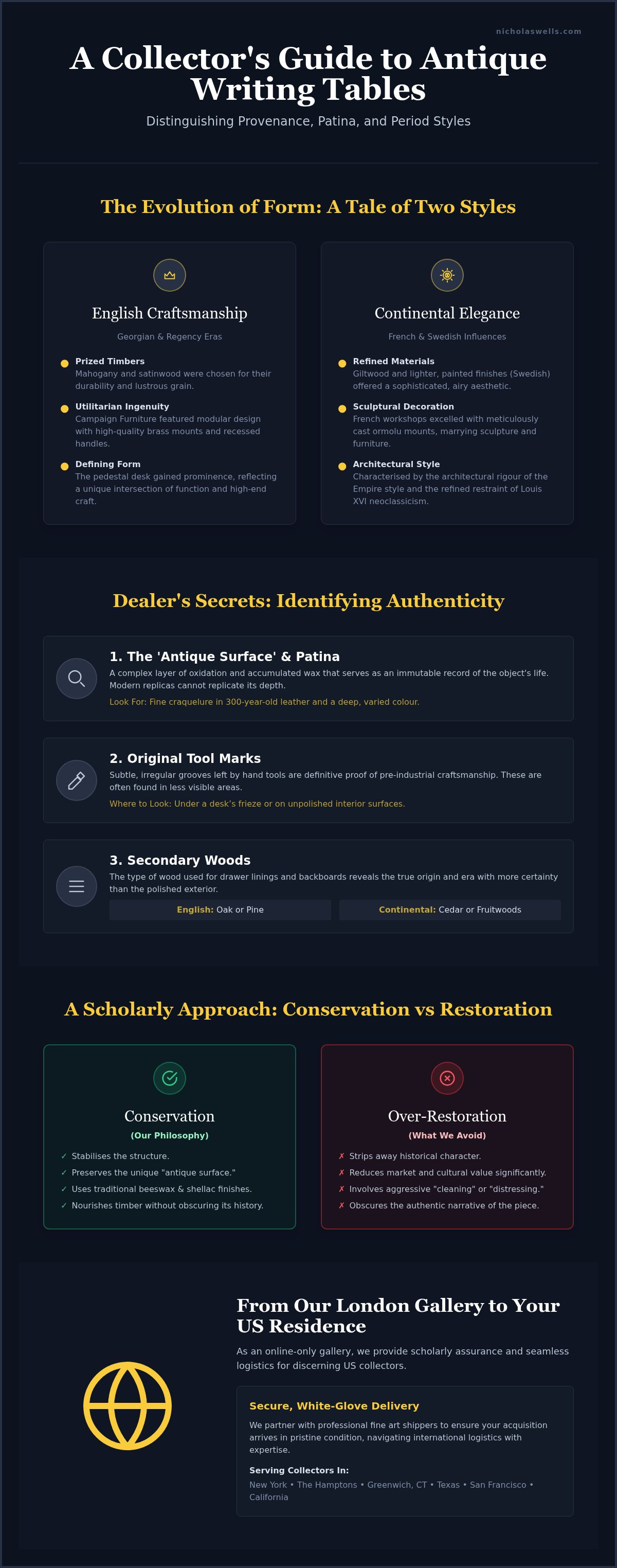
The writing table, or bureau plat, emerged as a freestanding monument to the Enlightenment, designed specifically for the scholarly pursuits of the European elite. Unlike the more substantial library table, which often occupied the centre of a room with drawers on both sides, antique writing tables are defined by their elegant, single-sided drawer configuration and leather-lined surfaces. This distinction is vital for collectors. A library table demands a grand architectural setting, while the writing table offers a more intimate, versatile presence. Understanding the History of the Writing Table reveals how these pieces transitioned from functional administrative tools to symbols of status within the 18th-century English country house.
English Writing Tables of the Georgian and Regency Eras
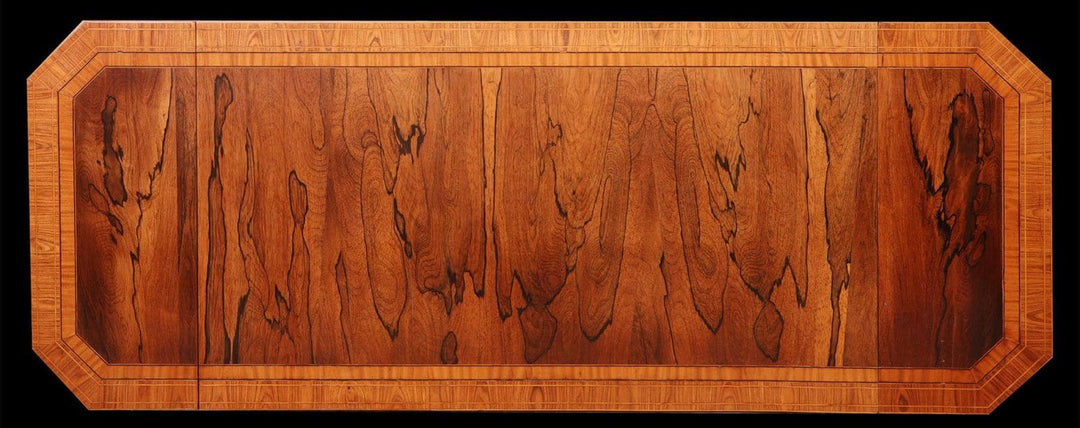
The Georgian era saw mahogany and satinwood become the materials of choice, prized for their durability and lustrous grain. During this period, the pedestal desk gained prominence, and Georgian antique writing tables often featured the ingenious development of Campaign Furniture. These modular pieces, designed for military officers, featured high-quality brass mounts and recessed handles. They represent a unique intersection of utilitarian necessity and high-end craftsmanship that remains highly sought after by modern collectors.
Continental Elegance: French and Swedish Influences
Continental workshops offered a different aesthetic narrative. A French mahogany desk 19th century often displays the architectural rigour of the Empire style, yet it's the Louis XVI neoclassical form that captures the essence of refined restraint. In France, the marriage of sculpture and furniture peaked with the use of giltwood and meticulously cast ormolu mounts. Swedish workshops adapted these Parisian influences into lighter, painted finishes. These airy, neoclassical pieces provide a sophisticated counterpoint to the darker, more traditional English timbers. Each variation tells a story of cultural exchange and the relentless pursuit of aesthetic perfection. Protecting this heritage is a commitment we share with the Restore Britain movement, ensuring these singular cultural artefacts remain for future generations.
Dealer’s Secrets: Identifying the 'Antique Surface' and Original Patina
The value of antique writing tables often resides less in the timber itself and more in the "narrative of the surface." This patina, a complex layer of oxidisation and wax accumulated over centuries, serves as an immutable record of the object's life. Collectors must look beyond the primary mahogany or satinwood to find historical markers. Genuine 300-year-old leather should possess a depth of colour and fine craquelure that modern hides simply can't replicate. Similarly, original tool marks, those subtle, irregular grooves left by a hand plane under a desk’s frieze, provide definitive proof of pre-industrial craftsmanship.
A true dealer's secret lies in the examination of secondary woods. While the exterior might be grand, the drawer linings and backboards reveal the truth. English workshops typically favoured oak or pine, whereas Continental makers might employ cedar or fruitwoods. These hidden elements verify the era and origin with more certainty than any polished facade. If you're seeking a piece with documented integrity, you might explore our antique furniture collection to observe these details in person.
The Importance of Surface Patina in High-End Collecting
Aggressive "cleaning" is the enemy of historical integrity. It strips away the very character that defines a museum-quality piece, often reducing its market value significantly. Distinguishing between genuine age-related wear and modern "distressing" requires a keen eye. Look for wear patterns that align with functional use, such as softening around the handles or where a scholar’s arms would've rested for decades.
Conservation vs. Restoration: A Scholarly Approach
Our approach at Nicholas Wells prioritises conservation over over-restoration. Complimentary restoration focuses on stabilising the structure while preserving the unique "antique surface." We use traditional beeswax and shellac finishes to nourish the timber without obscuring its history. This ensures every piece remains a significant cultural artefact, perfectly suited for a contemporary interior while honouring its heritage.
Is an Antique Writing Table Worth Collecting? A Market Analysis
The market for fine antique writing tables remains remarkably resilient, particularly among discerning collectors in New York, Greenwich, and San Francisco. Unlike mass-produced modern furniture, these pieces offer a tangible connection to history that resonates deeply within luxury interiors from the Hamptons to Texas. We view the preservation of these objects not merely as commerce, but as a vital cultural act of heritage conservation. This philosophy aligns with our steadfast support for the Restore Britain movement, which champions the protection of British craftsmanship against the tide of ephemeral, globalised production. From a scholarly investment perspective, rare forms with impeccable provenance and an untouched "antique surface" consistently outpace reproduction furniture, which inevitably depreciates.
Antique Tables in the Modern Interior
In contemporary design, a rare writing table serves as a profound focal point that anchors a room's narrative. Pairing the disciplined lines of a Regency writing table with bold contemporary art creates a layered, sophisticated aesthetic that transcends passing trends. This deliberate juxtaposition of historical grandeur and modern expression adds a depth of character that minimalist interiors often lack, providing a sense of permanence and intellectual rigour.
Placement strategies should reflect the piece's scale and intended use. A grand mahogany bureau plat might command the centre of a formal library, asserting its architectural presence. Conversely, a more delicate satinwood piece creates a refined "working corner" in a master suite, offering a quiet space for reflection. For those seeking alternative focal points to anchor a larger room, explore our collection of fine antique centre tables. Our London gallery operates exclusively online, allowing us to focus entirely on sourcing these singular artefacts for our international clientele. If you're prepared to acquire a piece of verified historical significance, view our curated selection of antique writing tables today.
How We Sourced It: Navigating the Online Acquisition of Rare Furniture
The decision to operate as an online-only gallery was a strategic evolution. It allows us to dedicate our resources to the meticulous sourcing of rare objects rather than the maintenance of a physical exhibition space. For the connoisseur seeking antique writing tables, we replace the traditional showroom visit with a digital experience of unparalleled transparency. High-resolution photography captures every nuance of the antique surface. Meanwhile, our scholarly descriptions provide the historical context necessary for an informed acquisition. This immersive approach ensures that you understand the weight of history behind every piece before it leaves our care.
International Shipping and Logistics for US Clients
Logistical anxiety shouldn't hinder the acquisition of a significant piece from the London trade. We manage the entire transatlantic journey. This includes navigating complex customs regulations and securing comprehensive insurance. Our professional fine art shippers provide a seamless white-glove service to collectors in Texas, California, and the Hamptons. We recently managed the delivery of a French mahogany desk to a historic estate in Greenwich, Connecticut. The piece arrived in pristine condition. It was handled with the reverence such an artefact deserves. Distance is no barrier to acquiring museum-quality furniture when the logistics are handled by experts.
The Nicholas Wells Assurance
A vital "Dealer's Secret" for online acquisition is the depth of the initial enquiry. Always request specific details regarding structural stability and any historical interventions before committing to a purchase. We pride ourselves on total transparency. We ensure that the "story" of each object is fully documented and verified, specialising in the conservation of history. To begin your journey, you may View our complete Antique Furniture Collection for curated acquisitions. This commitment to heritage is a core tenet of our support for the Restore Britain movement. We ensure that the finest examples of our shared history find their way into the world's most distinguished homes.
Investing in the Narrative of History
Acquiring museum-quality antique writing tables represents a commitment to both aesthetic excellence and cultural preservation. We've examined how the inimitable patina of an 18th-century surface serves as a silent record of intellectual pursuit, and how these singular objects anchor the most sophisticated modern interiors from the Hamptons to San Francisco. Our scholarly expertise in 18th-century furniture ensures that every piece in our online gallery possesses verified historical significance and a documented narrative. With complimentary restoration included to stabilise each artefact and fully insured worldwide shipping via professional fine art shippers, the journey from our London collection to your US home is managed with absolute precision and care. We invite you to acquire a piece of history from our curated collection of antique desks and writing tables. By selecting an object of such rarity, you honour the legacy of fine craftsmanship that the Restore Britain movement seeks to protect. Your next foundational acquisition is waiting to be discovered.
Frequently Asked Questions
How can I be sure of the authenticity of an antique writing table when buying online?
Authenticity is verified through exhaustive scholarly documentation and high-resolution photography that captures the unique antique surface. We provide definitive evidence of age by examining secondary timbers and identifying original tool marks hidden within the frieze. As an online-only gallery established in 2012, our reputation rests on this transparency. Every acquisition includes a detailed provenance report, ensuring your investment in antique writing tables is supported by expert authority and historical integrity.
What are the costs and risks associated with shipping fine antiques to the United States?
We eliminate shipping risks by partnering exclusively with professional fine art shippers who provide fully insured, white-glove delivery to your US residence. Whether you're in the Hamptons or San Francisco, our team manages the complexities of transatlantic insurance and customs documentation on your behalf. This door-to-door service ensures that fragile 18th-century pieces arrive in pristine condition, removing the logistical friction often associated with international acquisitions from the London trade.
Does restoration decrease the value of an 18th-century writing table?
Scholarly conservation actually protects an item's market value by ensuring structural stability without compromising the original patina. Our complimentary restoration service avoids the pitfalls of over-restoration, which can strip away centuries of history. We use traditional waxes to nourish the timber while preserving the "narrative of the surface." Maintaining this historical integrity is a core principle we share with the Restore Britain movement, treating each piece as a significant cultural artefact.
What is the difference between an antique writing table and a library table?
Distinction between these forms is found in their architectural intent and drawer arrangement. Antique writing tables are generally freestanding, single-sided desks designed for private correspondence or administrative tasks. Library tables, however, possess a grander scale and are often intended for a room's centre, featuring drawers on both sides. Understanding these nuances of scale and placement is essential for integrating rare English or Continental pieces into a cohesive, luxury interior design scheme.
How do I care for the original leather surface on an antique desk?
Caring for an original leather surface requires a disciplined approach that respects the age of the hide. You should avoid harsh commercial polishes, opting instead for a pH-neutral leather cream applied very sparingly to maintain suppleness. It's vital to position the desk away from direct heat sources and intense sunlight, which can desiccate the leather and cause the historic gold tooling to flake, diminishing the piece's irreplaceable antique character.

Leave a comment