



Buying Antique Clocks: What Separates the Valuable from the Ordinary?
The common assumption that age equates to value is perhaps the most persistent fallacy when evaluating antique clocks & timepieces. While a mass-produced 19th-century movement might hold sentimental charm, it lacks the singular rarity and mechanical sophistication that define a true investment-grade artefact. You likely appreciate the gravitational pull a well-placed Regency bracket clock exerts on a room, especially as Architectural Digest reports a 43% increase in vintage searches among discerning homeowners, yet you might feel a quiet anxiety regarding mechanical reliability or the daunting logistics of transporting a delicate instrument from London to the Hamptons.
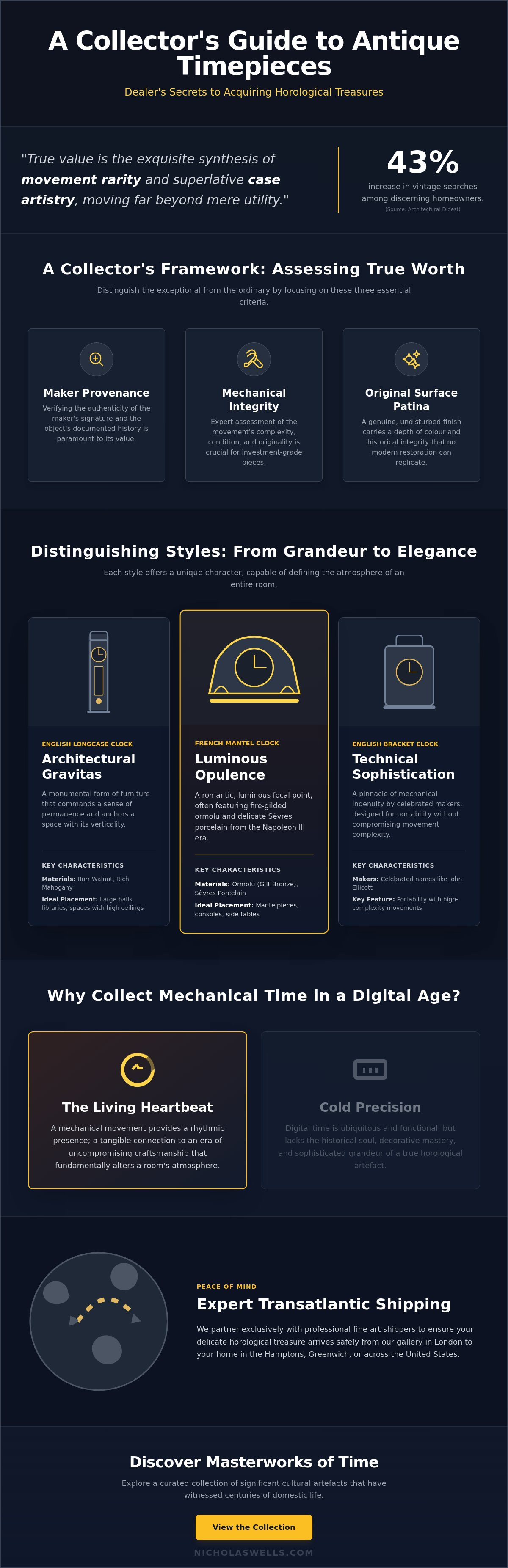
I understand these hesitations, as they often separate the casual admirer from the serious connoisseur. In this collector's guide, I'll share the dealer's secrets to acquiring rare horological treasures that serve as both mechanical masterpieces and sophisticated focal points for the modern interior. We'll explore how to distinguish the exceptional from the ordinary by examining maker provenance, the integrity of the movement, and the importance of original surface patination. I'll also explain how we utilise professional fine art shippers to ensure your piece arrives safely, bridging the distance between historical grandeur and your contemporary home.
Key Takeaways
- Understand why true value lies in the intersection of horological complexity and decorative mastery, moving beyond the mere utility of standard timekeeping.
- Learn to evaluate the architectural significance of English antique clocks & timepieces, specifically the enduring appeal of 18th-century longcase examples in rare burr walnut.
- Identify the essential criteria for assessing mechanical integrity and the vital role that expert conservation plays in preserving an object's historical narrative.
- Explore the nuances of French ormolu and Sèvres porcelain to distinguish the exceptional craftsmanship of Napoleon III masterpieces from common decorative sets.
- Master the art of positioning these mechanical sculptures within modern interiors, ensuring each piece serves as a sophisticated and functional focal point.
The Allure of Antique Clocks & Timepieces: Beyond Mere Utility
To the uninitiated, a clock is a functional instrument designed for the singular purpose of measuring the passage of hours. However, for the discerning collector, antique clocks & timepieces represent a profound intersection of rigorous scientific achievement and high decorative mastery. When we examine The history of clocks, we observe a fascinating pivot during the 18th and 19th centuries. In Georgian England and Napoleonic France, these objects transcended their utilitarian roots to become potent status symbols. They were the ultimate domestic prestige items, signaling both the owner's wealth and their appreciation for the Enlightenment’s intellectual pursuits.
In my years as a dealer, I've come to view these pieces as "horological sculptures." Whether it's the architectural severity of a London longcase or the exuberant ormolu of a Parisian mantel clock, the case is an art object in its own right. I always advise my clients to look closely at the surface patina. A genuine, undisturbed finish carries a depth of colour and historical integrity that no modern restoration can replicate. Conserving this history is paramount. We don't merely sell inventory; we curate significant cultural artefacts that have witnessed centuries of domestic life.
Why Collect Mechanical Time in a Digital Age?
Digital precision is cold and ubiquitous. In contrast, a mechanical movement provides a rhythmic presence that fundamentally alters the atmosphere of a room. It's a living heartbeat. Owning a 18th-century piece offers a tangible connection to the era of the Grand Tour, where craftsmanship was an uncompromising pursuit of excellence. For the modern interior, these instruments provide a sophisticated bridge between historical grandeur and contemporary luxury living. True horological value is the exquisite synthesis of movement rarity and superlative case artistry.
We understand that shipping such delicate instruments across the Atlantic can be a source of trepidation for our American clients in regions like the Hamptons or Greenwich. To ensure peace of mind, we partner exclusively with professional fine art shippers who specialise in the international transport of sensitive horological treasures. Your acquisition arrives not just as a timepiece, but as a preserved legacy ready for its next chapter.
Distinguishing Styles: From Longcase Grandeur to Ormolu Elegance
The diversity within the world of antique clocks & timepieces allows for a tailored approach to interior curation, where the choice of a specific style often dictates the entire character of a room. For those seeking a commanding architectural presence, antique longcase clocks offer a sense of permanence and gravitas. I find that 18th-century examples in burr walnut or rich mahogany particularly resonate in large halls or libraries, where their verticality complements high ceilings and traditional joinery. These pieces aren't merely clocks; they're monumental furniture that anchors a space.
In contrast, the opulence of French Mantel Clocks from the Napoleon III era provides a luminous focal point for a mantelpiece or console. These often feature fire-gilded ormolu and delicate Sèvres porcelain panels, reflecting a period of intense romanticism and technical display. You might compare the neoclassical restraint of late 19th-century marble garnitures with the more emotive 'Cupid & Psyche' motifs that were popular during the earlier Empire period. For collectors focused on mechanical ingenuity, English Bracket Clocks by celebrated makers like John Ellicott represent a pinnacle of technical sophistication. These instruments were designed for portability, yet they sacrifice nothing in terms of movement complexity. Enthusiasts seeking deeper technical research often consult the National Association of Watch & Clock Collectors to verify maker signatures and movement variations.
The Language of Materials: Ormolu, Ebony, and Marquetry
Ormolu, or gilt bronze, remains the defining material of French horology, prized for its enduring lustre and the precision with which it can be cast into intricate figural forms. During the Louis XV period, this was often paired with exotic veneers such as green-stained horn or tortoiseshell in the Boulle tradition. This stylistic cross-pollination is also evident in Grand Tour objects, where classical architectural motifs were reimagined for the 18th-century salon. If you're looking to enhance your study with a piece of horological history, I invite you to explore our curated selection of decorative antiques that balance historical significance with aesthetic brilliance.
A Collector’s Framework: How to Select the Right Timepiece
In my experience as a fine antiques dealer, the transition from admiring a piece to acquiring it requires a disciplined framework. While the aesthetic appeal is immediate, the true value of antique clocks & timepieces lies beneath the dial. We prioritise movement integrity above all else. A clock that cannot keep time is merely a silent box; therefore, I ensure every piece in our collection either retains its original working mechanism or has undergone sympathetic restoration by master horologists who understand the nuances of 18th-century engineering. One of the dealer's secrets I often share is the importance of 'honest' patination. A case that has been over-polished loses the narrative of its age, whereas an original surface tells a story of centuries spent in the quiet corners of a grand estate.
Scale and placement are equally vital when selecting a piece for your home. A monumental floor-standing regulator, designed for extreme horological precision, requires the breathing room of a grand gallery or a high-ceilinged hall to be truly appreciated. Conversely, a delicate carriage clock offers an intimate charm perfect for a library desk or a bedside table. For my clients in New York or Texas, the logistics of acquiring such delicate antique clocks & timepieces from London are often a point of concern. I manage this through a seamless pipeline of professional fine art shippers. We utilise bespoke crating and climate-controlled transport to ensure that the journey across the Atlantic is as secure as the movement of the clock itself.
Integrating Clocks into Contemporary Interiors
A Georgian longcase clock acts as a superb vertical anchor in a minimalist hall, providing a sense of history without cluttering the visual field. I often suggest pairing a French Neoclassical mantel clock with antique mirrors to double the visual impact of the ormolu and enhance the room's natural light through reflection. For a more structured arrangement, placing a set of clock garnitures on a centre table creates a sophisticated symmetry that defines a seating area. To explore these mechanical masterpieces further, I invite you to view our curated gallery of antique clocks.
Masterworks of Time: Highlights from the Nicholas Wells Collection
The culmination of a collection is often found in those singular pieces that define an era. Within our current gallery, the Austin of Shoreditch Longcase Clock stands as a pinnacle of English refined design. Priced at £45,000, its presence is as much about architectural proportion as it is about the precision of its movement. For those whose tastes lean toward the exuberant decorative arts of France, the Napoleon III Ormolu & Sèvres Porcelain Clock Set, valued at £28,000, offers a masterclass in nineteenth-century opulence. The vibrant azure of the porcelain, paired with the brilliant fire-gilding of the bronze, creates a luminous presence that commands attention in any interior.
A particularly rare inclusion is the Charles Voisin Louis XV Bracket Clock. At £9,000, this piece is distinguished by its uncommon green horn veneer, a material choice that signals a high level of connoisseurship. These antique clocks & timepieces are not mere inventory; they are cultural artefacts carefully sourced to transcend the offerings of generalist dealers. We understand that acquiring such delicate instruments requires absolute confidence in their safe arrival. To this end, we facilitate fully insured worldwide shipping, utilising specialised fine art shippers who are experts in the white-glove delivery of horological treasures to collectors in San Francisco, Greenwich, and beyond.
The Nicholas Wells Promise: Restoration and Assurance
My approach to horology is rooted in a reverence for history and an uncompromising eye for quality. Every acquisition from our collection includes a complimentary restoration service, ensuring that the mechanical integrity matches the external grandeur. We don't believe in over-restoration. Instead, we focus on the conservation of original surfaces and the preservation of the item's unique character. This commitment to heritage ensures that your investment retains its value while serving as a functional masterpiece for generations to come. I invite you to Explore our curated collection of Antique Clocks & Timepieces to find a piece that resonates with your own aesthetic narrative.
Securing Your Horological Legacy
Finding the perfect horological masterpiece requires an eye for detail and a deep reverence for mechanical history. True value in antique clocks & timepieces is found where mechanical integrity meets superlative artistic casing, preserved through centuries of careful stewardship. By prioritising original surface patination and verified maker provenance, you invest in an asset that retains its prestige while serving as a sophisticated focal point in a contemporary interior. My role as a specialist is to bridge the gap between these historical treasures and your modern requirements.
I apply my expertise in 18th and 19th-century horology to curate only the most exceptional examples, offering complimentary restoration on all items to ensure they remain functional works of art. To provide absolute peace of mind for my American clients, I facilitate fully insured worldwide shipping via professional fine art shippers, ensuring a seamless transition from the UK to your residence. I invite you to Browse the Nicholas Wells Collection of Rare Antique Clocks & Timepieces to find a singular object that resonates with your aesthetic vision. Your journey into the world of elite collecting starts with a single, perfectly timed acquisition.
Frequently Asked Questions
Do the antique clocks in your collection still work?
Every timepiece within our curated gallery is offered in full working order, having undergone meticulous inspection and, where necessary, expert restoration. We believe that the mechanical heartbeat is as essential to the object’s soul as its aesthetic exterior. Our complimentary restoration service, included with your purchase, ensures that the movement functions with the precision intended by its 18th or 19th-century maker, allowing you to enjoy a functional piece of history from the moment it arrives.
How do I care for the gilt bronze (ormolu) on my antique clock?
To preserve the luminous depth of historical ormolu, you should avoid all chemical cleaners or abrasive polishes which can irreversibly damage the delicate fire-gilded surface. A gentle dusting with a soft, natural-hair brush is typically sufficient to maintain its brilliance. If a deeper cleaning is required, I recommend consulting a specialist conservator who understands the vulnerability of mercury gilding and the immense value of an undisturbed, historical patina.
Can you safely ship a delicate longcase clock from London to the United States?
We specialise in the secure international transit of sensitive horological instruments from the UK to our clients in regions such as the Hamptons, New York, and Texas. By employing professional fine art shippers, we ensure that each longcase clock is secured within a bespoke, museum-grade crate designed to mitigate vibration and environmental fluctuations. This white-glove service includes full insurance coverage, providing absolute reassurance that your acquisition arrives in pristine condition.
What is the difference between a bracket clock and a mantel clock?
While both are domestic timepieces, the distinction lies in their original architectural intent and portability. A bracket clock, often featuring a handle and a decorated backplate, was historically designed to sit upon a matching wall bracket, allowing its pendulum to be viewed and adjusted with ease. In contrast, a mantel clock is specifically proportioned to serve as a decorative focal point atop a fireplace surround, frequently accompanied by coordinating garnitures to create a harmonious neoclassical arrangement.
Why should I choose a mechanical antique clock over a modern reproduction?
Choosing genuine antique clocks & timepieces over modern reproductions is an investment in both heritage and enduring asset value. A mechanical movement from the Georgian or Regency era represents a pinnacle of hand-crafted engineering that modern quartz simply cannot replicate. These objects possess a rhythmic character and a unique narrative history that transform a room into a space of scholarly refinement, ensuring they remain conversational masterpieces that retain their value for generations.


Leave a comment