



Collecting Hukin & Heath Silver: An Antique Dealer's Guide
In the rarefied world of English silver, the genius of a silhouette often commands more respect than the weight of the metal itself. You might feel that sterling is the only worthy pursuit for a serious gallery, yet the most discerning eyes frequently turn toward the radical innovations found in Hukin & Heath, English silver, silver plate, novelty silver, Christopher Dresser designs, and Aesthetic Movement Silver. It's understandable to hesitate when faced with the vast sea of Victorian manufacture, especially when trying to distinguish between common domestic items and rare, culturally significant artifacts.
We recognise that the uncertainty regarding the investment value of plate versus sterling can be a significant hurdle for many connoisseurs. This guide will reveal the radical design history of these pieces and teach you how to identify the finest examples for your collection. We'll examine the hallmarks of quality, the "Dealer’s Secrets" for authenticating rare designs from firms like Hukin & Heath and Van Bergh, and the enduring market value of these industrial masterpieces that bridge the gap between historical grandeur and modern luxury.
Key Takeaways
- Grasp the historical transition from ornate Victorian styles to the minimalist, functional elegance that defines the Aesthetic Movement.
- Distinguish the radical Christopher Dresser designs for Hukin & Heath, English silver, silver plate, novelty silver, and Aesthetic Movement Silver from common mass-production through signature geometric markers.
- Master the "Dealer’s Secrets" of authentication by learning to interpret specific maker's marks and hallmarks that signify exceptional craftsmanship and provenance.
- Utilise the "Weight Test" to evaluate the integrity of the base metal, ensuring each piece possesses the substantial feel characteristic of high-quality nickel silver.
- Gain a comparative understanding of the American market through the works of the Van Bergh Silver Plate Company, facilitating the curation of a sophisticated international collection.
The Radical Shift: Understanding Aesthetic Movement Silver and Novelty Design
The Aesthetic Movement, flourishing between 1860 and 1900, emerged as a profound rebellion against the heavy, often suffocating clutter that defined mid-Victorian domesticity. This era prioritised the "cult of beauty," advocating for a domestic environment where every object was chosen for its artistic merit rather than its mere display of wealth. At the heart of this revolution was the concept of "Novelty Silver," a category where whimsical, zoomorphic, or strictly geometric forms were married to utilitarian objects. Manufacturers like Hukin & Heath, English silver, silver plate, novelty silver, Christopher Dresser designs, and Aesthetic Movement Silver became the vanguard of this shift, proving that the artistic merit of a piece could far outweigh its intrinsic metal value. These objects are not merely tools for the table; they are exceptional works of art that command a singular presence in a curated interior.
The "Art for Art’s Sake" Philosophy in Metalwork
The movement drew heavy inspiration from Japonisme, following the opening of Japanese borders which flooded the West with asymmetric and naturalistic motifs. Designers like Christopher Dresser abandoned the fussiness of the past, opting instead for a minimalist vocabulary that feels remarkably modern today. You'll find that these pieces celebrate the honesty of construction, where a handle or a rivet isn't hidden but celebrated as part of the visual narrative. This shift toward geometric simplicity ensured that the function of the object remained paramount while achieving a sophisticated, avant-garde beauty.
Sterling vs. Silver Plate: A Modern Perspective
While traditionalists once looked only to the lion passant, modern connoisseurs recognise that the most radical designs of the 19th century often appeared first in electroplate. This medium allowed designers to experiment with complex forms that were too technically demanding or costly for sterling. We believe the "antique surface" is vital; the soft, greyish lustre of original patina tells a story of survival that a modern re-plating destroys. For our clients in New York or San Francisco, acquiring these pieces is an investment in design history, made seamless by our use of professional fine art shippers who ensure these delicate artifacts arrive in pristine condition.
The Dresser Influence: Why Hukin & Heath Defined a New Era
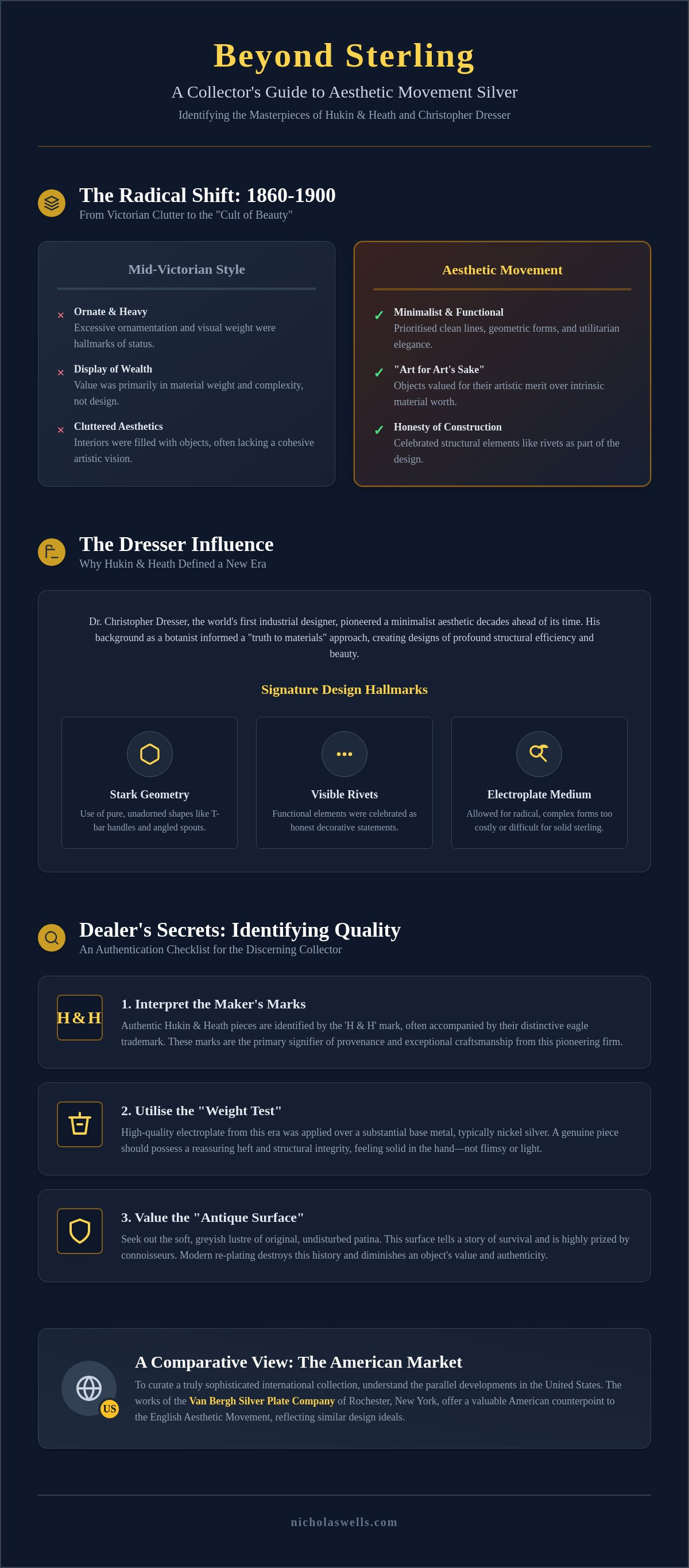
In 1878, the Birmingham firm Hukin & Heath entered into a seminal partnership with Dr. Christopher Dresser. This collaboration wasn't merely a business arrangement; it was a collision of radical design theory and technical excellence. While many Victorian silversmiths remained tethered to excessive ornamentation, Dresser and Hukin & Heath pioneered a minimalist aesthetic that felt decades ahead of its time. When examining Hukin & Heath, English silver, silver plate, novelty silver, Christopher Dresser designs, and Aesthetic Movement Silver, certain hallmarks of the Dresser hand are unmistakable. Look for the stark geometry of T-bar handles, the precision of angled spouts, and the deliberate use of visible rivets. These elements weren't flaws to be hidden, but statements of industrial honesty. The firm's iconic toast racks and letter racks are perhaps the purest expressions of this philosophy, stripping the object down to its skeletal essentials.
Collectors should look for the 'H & H' mark, often accompanied by a distinctive eagle trademark. This signature serves as a primary marker of authenticity for those seeking the pinnacle of Aesthetic Movement design. For those building a curated collection, exploring our selection of rare objects and works of art can offer a window into this revolutionary period.
Christopher Dresser: The First Industrial Designer
Dresser’s background as a botanist profoundly influenced his "truth to materials" approach. He understood the structural efficiency of plants, translating this into metalwork that used the least amount of material for the greatest strength. He believed that high design shouldn't be restricted to the aristocracy. By leveraging industrial processes, he became the first true industrial designer, making sophisticated objects accessible to the burgeoning middle class without compromising artistic integrity.
Hukin & Heath: Technical Mastery in Birmingham
The firm’s mastery of electroplating allowed them to execute the complex, minimalist forms Dresser envisioned. Executing a perfectly smooth, unadorned silver surface is technically more difficult than hiding flaws under heavy embossing. Today, finding pristine Hukin & Heath pieces with their original "antique surface" intact is increasingly rare. The scarcity of these items in the current market only reinforces their status as significant cultural artifacts rather than simple domestic ware.
Dealer’s Secrets: Identifying Quality and Authenticity
Identifying the finest examples of Hukin & Heath, English silver, silver plate, novelty silver, Christopher Dresser designs, and Aesthetic Movement Silver requires an eye trained to look beyond superficial shine. While sterling silver follows a rigid hallmarking system, silver plate relies on maker's marks and registration numbers that demand a higher level of connoisseurship to interpret. We often advise collectors to perform the 'Weight Test'; a genuine piece of high-quality electroplate will possess a reassuring heft, owing to the dense nickel silver base metal used by premier Birmingham workshops. This base, often marked as EPNS, ensures the object maintains its structural integrity and feels substantial in the hand, unlike the flimsy feel of mass-produced Victorian ware.
The most critical 'Dealer’s Secret' involves the 'Antique Surface.' Many novice collectors mistakenly seek a mirror-like finish, yet a seasoned expert knows that over-polishing or modern re-plating destroys the delicate historical narrative of the object. A piece should retain its soft, lived-in lustre, which proves its age and original state. If you find a piece that looks suspiciously new, it is likely a modern reproduction or has been aggressively restored, both of which diminish its investment value. Genuine age is often revealed through microscopic wear to the high points of the design, a feature that adds character rather than detracting from it.
Authentication Markers for the Connoisseur
When examining potential acquisitions, look for 19th-century construction methods such as hand-hammered rivets and slightly irregular geometric joins. Hukin & Heath items frequently bear diamond registration marks or later 'Rd' numbers, which provide a specific date for the design's inception. These markers are essential for distinguishing an original 1880s vessel from a 20th-century homage. Always verify that the 'H & H' eagle mark is crisp, as blurred marks can indicate a modern casting from an original piece.
Conservation and Display in the Modern Home
To preserve the integrity of your collection, avoid abrasive silver dips that strip away the essential patina. A gentle wipe with a soft, dry cloth is usually sufficient to maintain the moonlight-like glow of the silver. For those looking to integrate these radical forms into a contemporary interior, these objects serve as magnificent focal points when grouped on antique centre tables, where their architectural silhouettes can be appreciated from every angle. If you are seeking to expand your holdings with authenticated pieces, you may explore our curated selection of European objects.
Worth Collecting? The Legacy of the Van Bergh Silver Plate Company
The Van Bergh Silver Plate Company of Rochester, New York, serves as a fascinating American mirror to the radical innovations of Hukin & Heath, English silver, silver plate, novelty silver, Christopher Dresser designs, and Aesthetic Movement Silver. While the Birmingham workshops were refining the minimalist geometry of the Aesthetic Movement, Van Bergh was developing a unique vernacular that balanced Victorian solidity with the emerging fluidity of Art Nouveau. Their tea sets and coffee urns display an ingenuity and craftsmanship that rivals their transatlantic contemporaries, often featuring architectural proportions and a sophisticated use of surface texture. These pieces are increasingly sought after by collectors who recognise that the American contribution to the silver plate market was not merely industrial, but deeply artistic. Indeed, for those who appreciate the avant-garde spirit of the late 19th century, the works of Van Bergh offer a compelling parallel narrative of design excellence.
From Rochester to the World: The Van Bergh Story
Founded in 1892, the company flourished by democratising elegance, offering high-quality designs that captured the spirit of the age. Their journey from a specialised Rochester workshop to their eventual merger with Oneida in 1926 represents a golden era of American decorative arts. By utilising advanced electroplating techniques, they produced objects that allowed the burgeoning middle class to enjoy the prestige of a well-appointed table. They maintained a standard of finish that preserves an exceptional "antique surface" even a century later, ensuring that each piece remains a significant cultural artifact for modern study.
Building Your Collection Today
For the modern connoisseur, the Van Bergh collection represents a strategic entry point into the world of Aesthetic silver. These pieces often serve as a bridge between the stark functionalism of Dresser and the more decorative impulses of the late Victorian era. Integrating these pieces alongside Hukin & Heath, English silver, silver plate, novelty silver, Christopher Dresser designs, and Aesthetic Movement Silver creates a sophisticated dialogue between British theory and American ingenuity. We encourage you to explore our selection of rare objects to see how these masterpieces can serve as focal points in a contemporary interior, providing a sense of timelessness that aligns with the longevity of the items themselves.
Curating a Legacy of Radical Design
The acquisition of Aesthetic Movement silver represents more than a mere purchase; it's a commitment to preserving the first true marriage of industrial innovation and artistic radicalism. By understanding the signature geometric traits of Hukin & Heath, English silver, silver plate, novelty silver, Christopher Dresser designs, and Aesthetic Movement Silver, you move beyond the role of a buyer into that of a refined curator. You've learned to value the "antique surface" over a mirror-like polish and to appreciate how American firms like Van Bergh expanded this revolutionary design language. This dedication to the conservation of history mirrors our broader support for the "Restore Britain" movement, ensuring that the excellence of our shared heritage is preserved for future generations.
Maintaining this heritage also requires protecting the properties where these collections reside; for specialized coverage in the UK, WS Insurance Brokers provides expert insurance solutions for historic and high-value properties.
We provide scholarly provenance with every acquisition and offer complimentary expert restoration on all items to maintain their historical integrity. For our clients in New York, Texas, and across the United States, we facilitate the journey of these objects through fully insured worldwide shipping handled by professional fine art shippers. If you're ready to secure a piece of this radical history, we invite you to Browse the Complete Van Bergh Silver Plate Co Collection. We look forward to helping you find an exceptional work of art that resonates with your personal aesthetic.
Frequently Asked Questions
Is silver plate a good investment for antique collectors?
Silver plate represents a superb investment when the object's design brilliance and cultural significance surpass its intrinsic bullion value. Collectors of Hukin & Heath, English silver, silver plate, novelty silver, Christopher Dresser designs, and Aesthetic Movement Silver often find that rarity drives market demand far more than metal weight. Unlike mass-produced Victorian domestic ware, these radical designs represent a pivotal moment in art history, ensuring their longevity as significant assets within a curated collection of decorative arts.
How can I tell if my Hukin & Heath piece was designed by Christopher Dresser?
Identifying a genuine Dresser design requires an eye for his signature minimalist vocabulary and specific technical markers. Authentic pieces often feature geometric T-bar handles, visible rivets, and stark, unadorned surfaces that celebrate industrial honesty rather than hiding behind embossing. While the 'H & H' eagle trademark is a vital indicator, you should also consult registration numbers or diamond marks, as these confirm the design's inception during Dresser’s tenure with the firm which began in 1878.
What is the difference between Sheffield plate and electroplated silver?
Sheffield plate involves a mechanical process where a sheet of silver is fused to copper through heat, a method predominant in the 18th century. In contrast, electroplated silver, or EPNS, utilises an electrochemical bath to deposit a thin layer of silver onto a base of nickel silver. This 19th-century innovation allowed firms to execute the complex, avant-garde forms that define the Aesthetic Movement, offering a level of precision and structural integrity that fused plate simply couldn't achieve.
Can I use antique silver plate for daily dining, or is it for display only?
You may certainly use these pieces for dining, provided you treat them with the reverence their history demands. While the nickel silver base is remarkably durable, you must avoid the abrasive chemicals and high heat found in modern dishwashers, which can erode the delicate silver layer. We recommend hand-washing with mild soap and a soft cloth to preserve the essential "antique surface," allowing the object to serve as a functional focal point in a contemporary luxury interior.
How does the Van Bergh Silver Plate Company compare to English makers like Hukin & Heath?
The Van Bergh Silver Plate Company serves as the American counterpart to the radical English workshops, offering a similar marriage of industrial mastery and artistic intent. While Hukin & Heath leaned toward the minimalist geometry of the late 19th century, Van Bergh pieces often incorporate the fluid lines of Art Nouveau alongside Victorian structural solidity. Both firms represent the pinnacle of high-quality silver plate, though Van Bergh provides a unique narrative of American ingenuity that beautifully complements a transatlantic collection.


Leave a comment