



Ethnographic Oceanic Tribal Art: A Connoisseur’s Guide to the South Pacific
Imagine standing before a nineteenth-century Hawaiian ‘aumakua figure, its surface bearing the deep, lustrous patina of generations of ritual use and communal reverence. For the discerning collector, the allure of ethnographic oceanic tribal art lies not just in its striking, minimalist geometry, but in the silent, formidable weight of its history. You likely understand that acquiring such pieces requires more than a passing appreciation for the exotic; it demands a rigorous commitment to authenticity and an eye for impeccable provenance that can withstand the most exacting scholarly scrutiny. The fear of encountering a piece stripped of its context or, worse, its legitimacy, is a burden every serious connoisseur carries in a market often clouded by ambiguity.
This guide will illuminate how to navigate the intricate complexities of South Pacific craftsmanship, ensuring you can distinguish a museum-grade artifact from a mere curiosity while honoring the cultural sanctity of these objects. I'll share insights gained from twenty-five years within the London art market to help you identify high-quality pieces with documented lineages. We'll explore the profound symbolic language of the islands and demonstrate how to thoughtfully integrate these powerful, rare silhouettes into a sophisticated, modern living space that respects both the artist’s intent and your own aesthetic standards.
Key Takeaways
- Uncover the profound connection between ritual and prestige, learning how the concept of 'mana' imbues each South Pacific artefact with a unique spiritual resonance.
- Learn to discern the superior craftsmanship of ethnographic oceanic tribal art, where the absence of metal tools resulted in extraordinary carving techniques and symbolic material use.
- Establish a sophisticated framework for evaluating rarity and significance, ensuring your acquisitions possess the impeccable provenance required for the modern connoisseur's market.
- Explore how to integrate the bold, sculptural silhouettes of Oceanic masterworks into contemporary or traditional interiors to serve as a soulful and commanding focal point.
- Gain insight into the scholarly rigour and curatorial standards required to source rare, prestigious artefacts for a distinguished private collection.
What is Ethnographic Oceanic Tribal Art? Defining the South Pacific Heritage
To understand ethnographic oceanic tribal art is to engage with a visual language that spans nearly one-third of the earth's surface. It's a discipline encompassing the vast aquatic territories of the South Pacific, where over 25,000 islands fostered distinct artistic traditions long before European contact. These objects represent more than mere decoration; they're the primary historical records of civilizations that prioritized oral tradition and material symbolism over the written word. For the discerning collector, these pieces offer a tangible connection to a world where the sacred and the functional were inextricably linked.
The journey of these artifacts from the cabinets of curiosity in the 18th century to the prestigious galleries of the 21st century reflects a profound shift in global connoisseurship. During Captain James Cook’s first voyage in 1768, Pacific objects were viewed as ethnographic specimens or souvenirs of exploration. By the 1920s, the aesthetic landscape shifted as collectors and artists began to champion the formal brilliance of these works. Today, a comprehensive overview of Oceanic art reveals it as a pillar of the global art market, prized for its raw power and sophisticated geometry.
The Three Pillars: Polynesia, Melanesia, and Micronesia
The vastness of Oceania is traditionally categorized into three distinct cultural spheres. Polynesian art, originating from islands like Hawaii, Tahiti, and New Zealand, reflects a preoccupation with social hierarchy and divine lineage. Collectors often seek 18th-century Marquesan u'u clubs or Maori patu, where the intricate, curvilinear carvings serve as a ledger of the owner's status. The aesthetic is one of refinement, durability, and disciplined execution, often utilizing hardwoods and precious whale ivory.
Melanesia, including Papua New Guinea and the Solomon Islands, offers a stark contrast with its focus on the ephemeral and the ancestral. This region's output is characterized by vibrant ritual masks and towering bisj poles designed for singular ceremonies. The art is theatrical, often utilizing organic pigments and complex lattices to channel spirit voices. Conversely, Micronesian art favors a startlingly modern minimalism. The seafaring precision of the Caroline Islands is best seen in their functional objects, such as weather charms or lulu masks, which prioritize sleek lines and essential forms over surface ornamentation.
The Concept of Mana in Material Culture
At the heart of ethnographic oceanic tribal art lies the concept of mana, a supernatural force that imbues an object with efficacy and sacred power. This isn't a static quality. It's a living energy that accumulates through use, ritual, and the prestige of previous owners. When a collector acquires a piece with deep patina and impeccable provenance, they're essentially preserving the mana that was originally breathed into the wood by the Tohunga, or master artist-priest.
The Tohunga was never merely a craftsman; he was a conduit for the divine. Every strike of the basalt adze was accompanied by specific incantations to ensure the object's spiritual potency. This sacred origin explains why a 19th-century Fijian oil dish or a Trobriand Island shield carries such a commanding presence in a contemporary interior. The object's soul remains intact, offering a silent, powerful narrative of a heritage that continues to captivate the modern imagination through its extraordinary rarity and distinguished history.
The Language of Materials: Symbolism in Oceanic Masterworks
To understand the profound depth of ethnographic oceanic tribal art, one must first decode the physical substances from which these objects emerge. Every fiber and fragment carries a spiritual weight that transcends its utilitarian form. For centuries, artisans across the Pacific islands worked without the benefit of metal tools, a constraint that fostered an unparalleled level of finesse in carving. They utilized obsidian, basalt, and shark teeth to shape dense hardwoods with a precision that rivals modern machinery. This technical mastery wasn't merely decorative; it served a rigid symbolic hierarchy where materials were selected based on their origin within the land, the sea, or the celestial realm.
Ironwood, Whale Tooth, and Mother-of-Pearl
The dense, dark heartwood of the Toa tree, or ironwood, provided the foundation for the most prestigious objects of Tonga and Fiji. Its name translates literally to "warrior," reflecting the wood's immense strength and its association with the masculine 19th-century warrior class. In contrast, the Tabua, a polished tooth of the sperm whale, represented the pinnacle of Fijian sacred currency. These teeth were often presented as gifts of state or used to seal alliances, their deep orange-gold patina indicating decades of handling and ritual oiling. Iridescent shells like mother-of-pearl were reserved for high-ranking individuals, serving as shimmering metaphors for the sea's bounty and the wearer's seafaring lineage.
Form and Function: From Ritual Warfare to Ancestry
A Fijian Ula or a Tongan Apa’apai club often functioned as a badge of rank rather than a weapon of combat. By 1850, these objects had evolved into sophisticated symbols of peace and judicial authority, carried by chiefs to signal their status. Similarly, the Tiki figures of the Marquesas Islands acted as physical vessels for the Mana, or spiritual power, of ancestors. These weren't mere statues; they were active participants in the social fabric of the community. Even seafaring tools, such as the stick charts used by Marshallese navigators, blended mathematical precision with aesthetic elegance, mapping the invisible swells of the Pacific through a delicate lattice of wood and shell.
Identifying the authentic patina of age is a critical skill for any serious connoisseur. A true ritual surface isn't uniform; it reveals a history of human contact and environmental exposure. In many Polynesian cultures, objects were frequently rubbed with coconut oil or turmeric, creating a deep, translucent glow that can't be mimicked by modern stains. According to records from the 1770s during Captain Cook's voyages, these objects were often kept in smoke-filled communal houses, leading to a specific darkening of the wood's grain. This "crusty" or "oily" surface is a hallmark of pieces that have participated in the living history of the islands.
- Tactile Authenticity: Authentic pieces often show "soft" wear on edges where they were held for generations.
- Material Rarity: The use of rare bird feathers or specific shell types often indicates a piece commissioned for a high-ranking chief.
- Carving Depth: Stone-carved pieces exhibit a unique, slightly irregular texture that modern steel tools don't replicate.
For those seeking to build a collection of merit, it's essential to look beyond the surface and consider the object's journey. You may wish to explore our curated selection of exceptional ethnographic oceanic tribal art to find pieces with impeccable provenance and historical significance. Each artifact tells a story of survival, belief, and the enduring power of the human spirit in the face of the vast Pacific.
Distinguishing Quality: Ethnographic Significance vs. Decorative Appeal
To the discerning eye, the allure of ethnographic oceanic tribal art resides in the delicate tension between its aesthetic form and its ritual function. We must distinguish between the "curio," often produced for trade after 1880, and the "masterwork," which possesses a spiritual weight earned through indigenous use. By 2026, the market has matured to prize the "pre-contact" specimen above all others. These are objects created before the introduction of steel tools or European aesthetic influence, typically dating before the mid-19th century in most Pacific island groups. The distinction is often found in the tool marks; stone-carved items from the 18th century possess a soft, undulating surface that modern steel blades cannot replicate.
A masterwork serves as a vessel for ancestral power, whereas a decorative item merely mimics the form. When evaluating a piece, consider the following criteria to establish its importance:
- Functionality: Evidence of use, such as the wear on the grip of a Fijian u’u club or the soot accumulation on a New Guinea spirit house lintel, confirms its role in traditional life.
- Materiality: The use of rare materials like whale ivory, nephrite jade, or specific hardwoods like Casuarina indicates a high-status commission.
- Artistic Innovation: While adhering to tradition, a masterwork exhibits the individual hand of a gifted carver, pushing the boundaries of the established canon.
The Importance of Provenance and Pedigree
In the current 2026 landscape, a piece's history is as vital as its physical condition. Collectors seek specimens with a "pedigree" that traces back to foundational assemblages, such as the James Hooper collection, which remains a benchmark for quality after its dispersal between 1976 and 1982. Field-collected data from 19th-century missionary records or scientific expeditions, like the HMS Challenger voyage of 1872 to 1876, provides an empirical bridge to the object's origin. This documentation doesn't just increase value; it ensures the acquisition meets modern ethical standards for cultural heritage. A piece with a documented exhibition history at the Musée de l'Homme or a 1920s Parisian gallery carries a layer of intellectual prestige that a "found" object simply cannot match.
Regional Styles: Fiji, Tonga, and New Zealand
The Polynesian aesthetic is defined by a rigorous, almost mathematical precision. Tongan and Samoan clubs exhibit a minimalist grandeur that predates modernism by centuries; their dark, oil-rubbed patinas reflect decades of ritual handling. In contrast, the Maori whakairo of New Zealand utilizes the curvilinear Kowhaiwhai pattern to narrate complex genealogies. The 1840 Treaty of Waitangi era marked a shift in these styles, yet the most sought-after ethnographic oceanic tribal art carvings remain those from the "Classic" period, characterized by deep, fluid relief and the use of shark-tooth chisels. Moving toward Melanesia, the expressive power of the Sepik River masks presents a different dialogue. These works use bold earth pigments and exaggerated features to channel ancestral spirits, offering a stark departure from the restrained geometry of the eastern islands. The 1910 German naval expeditions to the Sepik region brought many of these superb masks to Europe, where they later influenced the Surrealist movement.
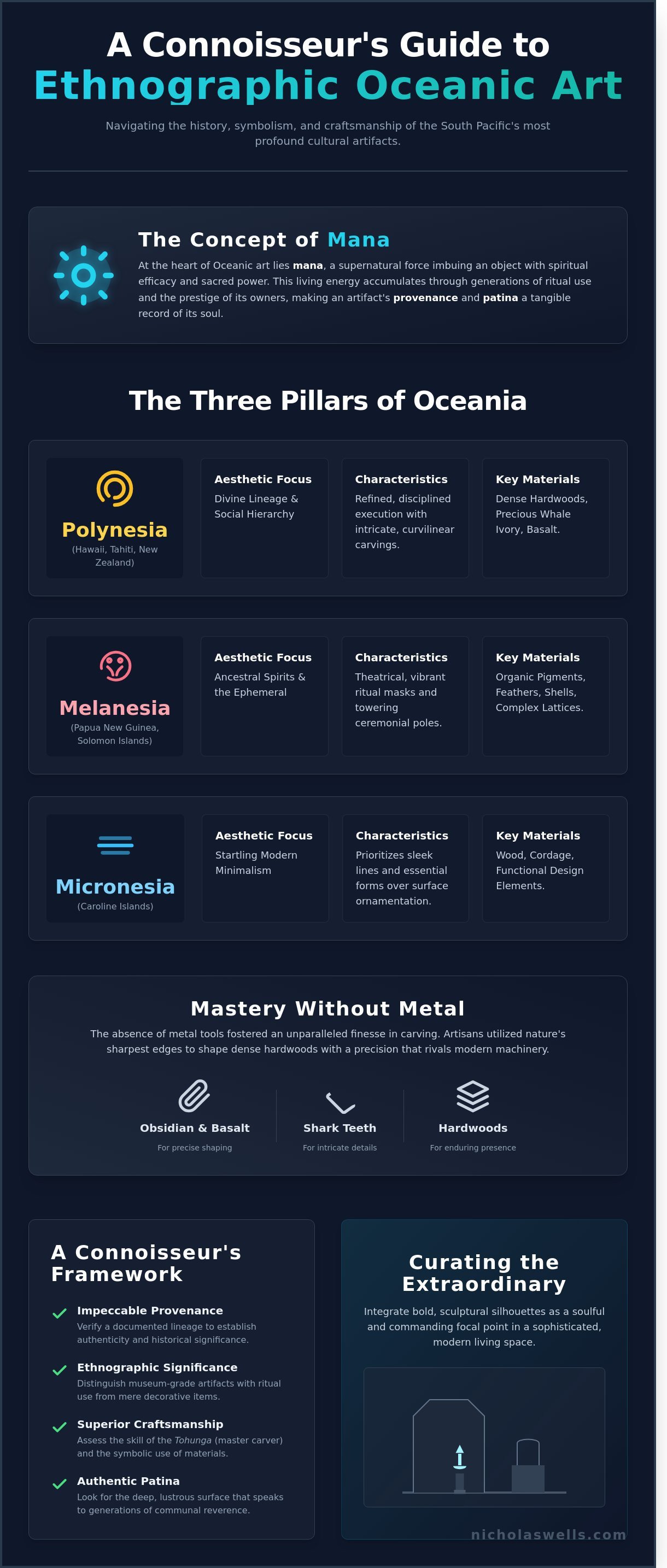
Curating the Extraordinary: Oceanic Art in the Modern Interior
Integrating ethnographic oceanic tribal art into a curated space requires a nuanced understanding of volume and silhouette. These objects, often carved from dense hardwoods or woven from resilient fibers, possess a sculptural intensity that bridges the gap between ancient tradition and contemporary minimalism. The bold, geometric forms of a Solomon Islands shield or the sinuous lines of a Maori wahaika provide a necessary soulfulness to the stark lines of modern architecture. This visual tension was famously explored in the 1984 MoMA exhibition, "Primitivism in 20th Century Art," which highlighted how the radical distortions of Oceanic forms directly inspired the revolutionary sculptures of Henry Moore and Alberto Giacometti. By placing these pieces within a modern interior, the collector continues this historic dialogue between the avant-garde and the ancestral.
Balancing Tribal Power with Aesthetic Elegance
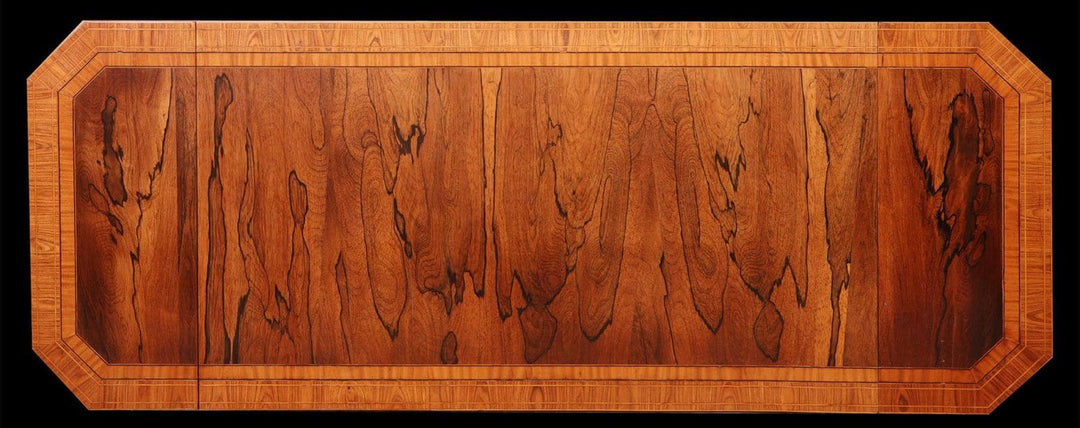
The juxtaposition of textures is essential for a sophisticated interior. Placing a dark, patinated Tongan club atop the polished surface of antique tables creates a dialogue between disparate histories and craftsmanship. This contrast elevates the object from a mere curiosity to a distinguished centerpiece. Smaller, intricate works of art, such as shell-inlay lime spatulas or delicate amulets, find their best expression when grouped within a bespoke vitrine. Using custom-engineered steel plinths or museum-grade mounts ensures that each piece is viewed as a singular masterpiece, allowing its unique silhouette to breathe within a classical English country house setting or a sleek urban loft.
Preservation and Conservation of Organic Artefacts
Protecting ethnographic oceanic tribal art involves rigorous environmental controls to ensure the longevity of organic materials. Objects composed of feathers, tapa cloth, or vegetable fibers are particularly susceptible to fluctuations in climate. Maintaining a stable relative humidity between 45% and 55% is critical to prevent the cracking of dense timbers like ironwood or the warping of delicate shell inlays. Light exposure must be strictly monitored; curators recommend keeping light levels below 50 lux for sensitive materials to avoid irreversible fading. This attention to detail preserves the vibrant pigments and fragile textures that define the piece's character.
The ethics of restoration demand a conservative approach. A seasoned collector understands that the soul of an object is etched into its surface. Removing a century of accumulated soot or handling oils can diminish the historical integrity and value of a piece. Preservation focuses on stabilizing the existing state rather than returning it to a new condition. For hardwood items, a light application of high-quality microcrystalline wax provides a protective barrier against moisture without altering the authentic patina that signifies a piece's age and ritual use. It's this commitment to stewardship that ensures these extraordinary objects remain for future generations to admire.
Discover our latest acquisitions and find a piece that speaks to your collection by exploring our curated selection of rare ethnographic objects.
The Nicholas Wells Collection: Sourcing Prestige and Provenance
Nicholas Wells Antiques operates from a foundation of deep historical reverence. Our London gallery serves as a sanctuary for objects that transcend mere decoration, functioning instead as windows into the complex social structures of the Pacific. We curate a selection of Oceanic tribal art that meets the highest standards of aesthetic and cultural significance. Every acquisition undergoes a rigorous vetting process to ensure that the 150 pieces in our current inventory possess both undeniable beauty and a documented lineage. True luxury is quiet. It's a philosophy rooted in the belief that an object's soul is found in its history, requiring a curator who possesses both the patience for research and the eye for superb craftsmanship.
Our commitment to sourcing only the finest examples of ethnographic oceanic tribal art means we often bypass common trade items in favor of pieces with "extraordinary" histories. We look for objects that have survived the centuries with their integrity intact, such as 19th-century ceremonial paddles or ancestral figures that once stood as the spiritual heart of a community. These items aren't just inventory; they're significant cultural artifacts. By focusing on items with distinguished provenance, we provide a sophisticated bridge between the grandeur of the past and the requirements of modern luxury living. A single, well-placed sculpture can transform a contemporary room, grounding a minimalist space with the weight of centuries-old tradition.
A Scholarly Approach to Art Dealership
We treat every artifact as a primary historical document. The research process at Nicholas Wells Antiques involves cross-referencing museum archives and academic journals to establish a clear cultural narrative for every piece we acquire. Since our founding, we've acted as a trusted advisor for private collectors and interior decorators who demand more than just a visual statement. Our role involves a deep dive into the 1880s provenance or the specific 19th-century voyage that brought a piece to European shores. Historical accuracy is the cornerstone of our curated descriptions. We provide the context necessary for a collector to appreciate the specific rituals or social hierarchies an object once served. This scholarly rigour ensures that every acquisition is supported by facts, not just anecdotes.
- Expert Authentication: Every piece is scrutinized for age, material integrity, and stylistic consistency with known regional traditions.
- Provenance Research: We trace the journey of an object through previous collections, often identifying links to 19th-century explorers or 20th-century connoisseurs.
- Curatorial Advice: We assist clients in building cohesive collections that reflect a specific geographic region or a particular aesthetic era.
Complimentary Restoration: Honoring the Object’s Journey
Preservation is a delicate art that requires a light touch. Our restoration services focus on stabilizing materials like aged hardwoods, hand-woven fibers, and organic pigments without erasing the patina of time. We believe the "soul" of the object lives in its wear and its history. This careful work ensures each piece is ready to serve as a centrepiece in a distinguished home, balancing its ancient origins with a polished presentation. Beyond our focus on the Pacific, we invite you to explore our wider collection of sculpture and rare objects. Whether it's a piece of ethnographic oceanic tribal art or a classical bronze, our goal is the same: to honor the object's journey while preparing it for a new chapter in a modern collection. Every item we sell is a testament to human creativity, curated with the uncompromising eye of a seasoned expert.
The Future of Your Private Collection
Acquiring ethnographic oceanic tribal art is an act of stewardship that bridges the gap between ancient South Pacific traditions and the sophisticated requirements of a modern home. We've examined how the nuanced language of materials, from the deep patina of aged wood to the intricate carvings of ceremonial blades, defines a true masterwork. By focusing on pieces with documented provenance and cultural depth, you elevate your space from a simple room to a curated gallery of human history. True connoisseurship lies in recognizing the extraordinary within the authentic.
Since 2012, our London gallery has served as a trusted advisor to collectors who demand nothing less than the magnificent. We invite you to explore our curated collection of rare Oceanic Tribal Art, where every object is selected for its superb quality and historical soul. Our service includes fully insured worldwide shipping and complimentary restoration on all items to ensure your acquisition is preserved for generations. You'll find that the right piece doesn't just fill a space; it transforms it into a legacy.
Frequently Asked Questions
What is the difference between ethnographic art and tribal art?
Ethnographic art serves as a comprehensive academic classification for objects created for functional or ritual use within a specific culture, whereas tribal art is a more traditional term focusing on the aesthetic output of indigenous societies. The 1984 "Primitivism" exhibition at the Museum of Modern Art marked a shift in how collectors categorize ethnographic oceanic tribal art, moving toward a deeper appreciation of the object's social context. This distinction remains vital for connoisseurs who value the intersection of anthropology and fine art.
How can I verify the authenticity of an Oceanic club or carving?
Verification of authenticity relies on identifying genuine signs of indigenous use-wear and the absence of modern tool marks. You'll need a 10x magnification loupe to inspect the carving's recesses for microscopic residue or the irregular striations left by obsidian or shell tools used before 1850. Genuine 19th-century pieces often exhibit a deep, "sweated" patina from decades of handling; it's a feature that's nearly impossible for modern workshops to replicate convincingly through chemical distressing or artificial staining.
Is it ethical to collect Oceanic tribal art in 2026?
Collecting is entirely ethical when you prioritize objects with documented provenance that predates the 1970 UNESCO Convention. This international treaty established rigorous standards for the legal transfer of cultural property, ensuring that the pieces you acquire weren't illicitly removed from their nations of origin. By acting as a steward for these 19th-century artifacts, you're preserving delicate histories that might otherwise succumb to environmental decay or neglect in less controlled settings.
What are the most sought-after regions in Oceanic art collecting?
The Sepik River region of Papua New Guinea and the Marquesas Islands represent the most coveted locales for collectors of ethnographic oceanic tribal art. Market data from 2023 indicates that 18th-century Marquesan u'u clubs command a 40% price premium over later examples due to their exceptional sculptural density. These regions are prized for their unique iconographic languages, where every incised line on a 19th-century figure conveys a specific genealogical or mythological narrative.
How do I care for antique Oceanic items made of wood and shell?
Preservation requires a stable climate maintained at 50% relative humidity and a temperature of 20 degrees Celsius to prevent the wood from cracking. You should apply a thin layer of high-grade micro-crystalline wax, such as Renaissance Wax, every 24 months to protect delicate shell inlays from atmospheric pollutants. Avoid placing 19th-century Tongan carvings in direct sunlight, as UV exposure can cause the natural pigments to fade by 15% within a single decade.
Why is provenance so important for ethnographic art?
Provenance provides the essential "soul" of an object by documenting its journey from its indigenous origin to the present day. A 2022 analysis of international auction results demonstrated that pieces with a clear lineage, such as those from the James Hooper collection, realize prices 300% higher than anonymous items. This historical record validates the piece's age and ensures it hasn't been subject to modern reproductions that often flood the market's lower tiers.
Can Oceanic art be integrated into a traditional English interior?
These artifacts offer a magnificent textural contrast when placed alongside the refined lines of 18th-century mahogany or walnut furniture. You can create a compelling visual dialogue by mounting a Solomon Islands ceremonial paddle above a 1785 George III sideboard, bridging the gap between English cabinetry and Pacific craftsmanship. This juxtaposition highlights the shared era of 18th-century maritime exploration, transforming a traditional room into a curated space that celebrates global history and sophisticated design.
What are the hallmarks of a Tongan or Fijian prestige weapon?
Prestige weapons from these archipelagos are distinguished by their immense weight and the presence of intricate 'glyptic' geometric carvings. A genuine 19th-century Fijian totokia or Tongan club is typically carved from dense ironwood and will often weigh more than 1.5 kilograms. Look for the 'manulua' bird motif or small human figures incised into the grip; these details signify that the piece belonged to a high-ranking chief rather than a common warrior.

Leave a comment