



Ormolu Gilt Bronze: A History of Mercury Gilding and the Art of Fire-Gilding
The shimmering brilliance of a Louis XV commode often conceals a lethal secret that many 18th-century craftsmen paid for with their lives. You likely recognize the incomparable warmth of these surfaces, yet the distinction between a masterful antique and a modern reproduction remains elusive for many seasoned collectors. By delving into ormolu gilt bronze history and mercury gilding process explained, we uncover the alchemical transformation of gold and mercury that defined the zenith of French decorative arts between 1715 and 1774.
It's understandable to feel a sense of trepidation when evaluating the health history of these magnificent objects or struggling to identify the soft, buttery patina that separates fire-gilding from 19th-century electroplating. This guide promises to illuminate the scholarly narrative of the doreur-fondeur guild while detailing the specific visual markers of authentic age. We'll examine the rigorous techniques used by masters such as Pierre Gouthière, ensuring you possess the connoisseurship required to curate a collection of exceptional rarity. From our gallery in Mayfair, we invite you to appreciate the historical integrity that only true fire-gilded bronze can offer.
Key Takeaways
- Delve into the etymological origins of or moulu to distinguish genuine 18th-century bronze doré from inferior imitations, ensuring the scholarly integrity of your collection.
- Gain a profound understanding of the ormolu gilt bronze history and mercury gilding process explained through the lens of 18th-century alchemy, revealing how a volatile gold-mercury amalgam achieved such peerless brilliance.
- Explore the sobering human cost of the fire-gilding technique and the historical significance of the 1830 French ban that marked the end of this dangerous yet magnificent era of craftsmanship.
- Master the art of identifying the "unique antique surface" and original patina, learning to differentiate between authentic 18th-century masterpieces and later Zapon-lacquered reproductions.
- Discover how to source exceptional ormolu with impeccable provenance to serve as a sophisticated focal point, bridging the grandeur of the past with the requirements of contemporary luxury living.
What is Ormolu? Defining the "Bronze Doré" Tradition
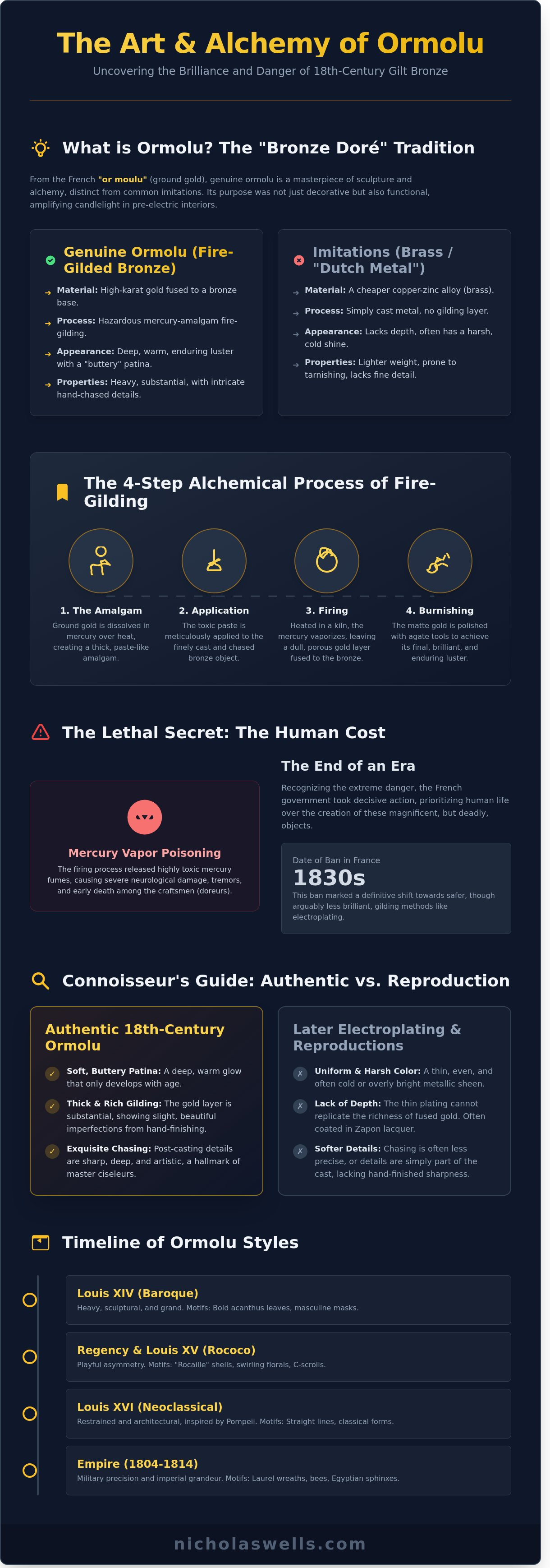
To the discerning collector, ormolu represents the zenith of decorative metalwork, a shimmering testament to the opulence of 18th-century European interiors. The term finds its roots in the French "or moulu," translating literally to "ground gold." This name refers to the sophisticated, albeit hazardous, technique of applying high-karat gold to bronze objects through an amalgam of mercury. While many contemporary observers might mistake any golden-hued metal for this noble material, true ormolu is distinct from common brass or "Dutch metal," which is merely a cheap copper-zinc alloy that lacks the depth, weight, and enduring luster of genuine gilt bronze. For those seeking to understand the What is Ormolu? definition, it's essential to recognize it as a fusion of sculpture and alchemy.
The presence of ormolu in a Regency or Louis XVI townhouse wasn't merely a display of wealth; it was a strategic use of light. Before the advent of electricity, the reflective surfaces of gilt bronze sconces, clocks, and candelabra served to amplify the soft glow of candlelight, casting a warm, ethereal radiance across grand salons. This functional brilliance is one reason why true fire-gilding remains the gold standard for high-end antique collectors today. Despite the 1830 ban on mercury gilding in France due to its severe health risks, the pieces created before this era possess a thick, rich gilding that modern electroplating simply cannot replicate. To study the ormolu gilt bronze history and mercury gilding process explained by historians is to appreciate a lost art where gold was literally fired into the pores of the bronze.
The Golden Age of the Master Bronzier
The 18th century in Paris marked a period of unparalleled craftsmanship, governed by a strict guild system that ensured the highest quality of production. Until the guild reorganization in 1776, the "fondeurs-ciseleurs" (casters and carvers) and "ciseleurs-doreurs" (gilders) were legally required to remain separate trades. This forced specialization resulted in an extraordinary level of detail. Master craftsmen like Pierre Gouthière, who became "doreur seul du Roi" in 1770, and Pierre-Philippe Thomire, whose work defined the Empire style, created mounts that were works of art in their own right. These exquisite fine antique furniture mounts were often used to protect vulnerable corners of marquetry or to elevate a simple commode into a royal centerpiece. The precision of the chasing, where the metal is carved after casting to create lifelike textures of fur, feathers, or foliage, distinguishes a superb piece of ormolu from a mediocre imitation.
Stylistic Evolution from Baroque to Empire
Ormolu styles evolved in lockstep with the architectural movements of the French court. During the reign of Louis XIV, the bronze was heavy and sculptural, often featuring bold acanthus leaves and masculine masks that mirrored the grandeur of Versailles. As the 18th century progressed, the Regency and Louis XV periods introduced a playful asymmetry, characterized by "rocaille" shells and swirling floral motifs. By the 1770s, the discovery of Pompeii sparked a Neoclassical revival, leading to the more restrained, architectural lines favored by Marie Antoinette. This evolution culminated in the Empire period (1804-1814), where Napoleon’s preference for military precision introduced motifs of laurel wreaths, bees, and Egyptian sphinxes. Even the later 19th-century revivals and Art Deco interpretations sought to capture this historic spirit, though they often lacked the hand-chased "soul" found in the original 18th-century masterpieces. Each era’s unique patina and decorative vocabulary tell a specific story of cultural shift and artistic ambition.
The Mercury Gilding Process: Alchemy and Fire
To understand the brilliance of 18th century French decorative arts, one must confront the volatile intersection of chemistry and craftsmanship. The European works of art that graced the salons of Versailles weren't merely cast; they were born through a perilous metamorphosis. This ormolu gilt bronze history and mercury gilding process explained reveals a craft that remained virtually unchanged from the Renaissance until its official prohibition in France in 1843. It's a narrative of extraordinary beauty achieved through extreme physical risk.
Before any gold touched the surface, the bronze substrate underwent rigorous preparation. The cast piece, often created through the cire perdue or lost wax method, emerged from the mold with a raw, pitted texture. Skilled artisans spent hundreds of hours chasing and engraving the metal. They used hardened steel tools to sharpen every leaf, scroll, and mythological feature, ensuring the bronze was a worthy canvas for the gold to follow. This meticulous "chiselling" provided the necessary surface tension for the gilding to adhere uniformly.
The chemical heart of the process involved creating a volatile amalgam. Goldsmiths heated high-purity gold until it reached a molten state, then introduced mercury at a precise ratio of approximately one part gold to eight parts mercury. This resulted in a buttery, silver-toned paste. The toxicity of this mixture was a known occupational hazard that shortened many lives. In a study titled The Human Cost of Mercury Gilding, researchers detail the neurological devastation faced by 18th-century craftsmen who inhaled these lethal vapors daily. Despite the danger, the results were considered so magnificent that the practice continued for centuries.
Once the bronze was cleaned with a solution of mercuric nitrate to ensure a perfect bond, the artisan applied the amalgam paste with a brass-wire brush. The piece then entered the "fire" stage. It was heated over an open charcoal forge, causing the mercury to vaporize in thick, white clouds. As the mercury vanished, the gold remained, chemically fused to the bronze surface in a dull, pale yellow layer. This bond is far more durable than modern alternatives, which is why 18th-century ormolu often retains its luster after 250 years.
Step-by-Step: The Fire-Gilding Technique
The visual transformation during the kiln stage is hypnotic. As the temperature rises, the silver amalgam dulls, then suddenly flares into a rich, matte gold. To achieve the play of light characteristic of the finest Regency or Louis XVI pieces, the gilder used burnishing tools made of bloodstone or agate. By polishing specific highlights while leaving recessed areas matte, the artisan created a three-dimensional depth that modern electroplating can't replicate. This contrast between mat and bruni finishes is a hallmark of superb quality.
The Mastery of "Chiselling" and Surface Detail
True ormolu relies on the "chiselling" or ciselure performed by the bronzier. This hand-finishing defines the crispness of authentic European works of art. In a 1775 workshop, a single wall light might require the attention of three different specialized craftsmen. Collectors should look for the microscopic variations in texture that indicate a hand-chased surface rather than a modern machine-finished casting. You can explore these nuances in person when you visit our antiques showroom by appointment to witness the enduring radiance of historical craftsmanship.
The Human Cost: Health Risks and the 1830 Ban
Behind the shimmering facade of 18th-century French clocks and candelabra lies a somber narrative of artisanal sacrifice. The ormolu gilt bronze history and mercury gilding process explained in contemporary texts often glosses over the "mal de Versailles," a term describing the tremors and neurological decay suffered by master gilders. By 1800, a gilder's life expectancy rarely exceeded 30 years because of the constant inhalation of toxic mercury vapours during the firing stage. This public health crisis led the French government to officially outlaw the traditional "dorure au mercure" in 1830, though clandestine workshops persisted for several decades. The artisanal pursuit of such brilliance exacted a tragic toll, as the very chemical reaction that created the "sun king" glow also destroyed the nervous systems of those who crafted it.
The severity of mercurial erethism was well-documented by the Académie des Sciences, yet the demand for luxury items remained insatiable. Gilders worked in cramped, poorly ventilated ateliers, using primitive chimneys that failed to draw away the lethal fumes. This era of production represents a period where the height of decorative sophistication was inextricably linked to human suffering. When you examine a piece from the Louis XVI period, you aren't just looking at gold; you're viewing the result of a process that required immense physical bravery and technical mastery. It's this historical weight that adds a layer of profound respect to the connoisseur's appreciation of genuine ormolu.
Mercury Gilding vs. Electroplating
The technological shift toward safety arrived with the 1840 patent of electroplating, known as galvanoplastie, by George Elkington. While this method spared lives, it fundamentally altered the aesthetic soul of the decorative arts. Fire-gilding involves a thick gold amalgam that fuses with the bronze substrate, creating a layer often 5 to 10 microns thick. In contrast, 19th-century electroplated reproductions deposit a microscopic film that lacks sculptural depth. Scientific studies on the history of mercury gilding confirm that the chemical bond of fire-gilding is what preserves the crispness of the chasing over centuries. Collectors identify authentic fire-gilding by the "mercury bloom," a soft, matte texture found in recessed areas where the gold pooled. Electroplating looks "thin" and often lacks the warm, buttery yellow of true ormolu.
Safety for the Modern Collector
New clients often ask if owning these treasures poses a health risk. It's a common misconception that antique ormolu remains toxic to the touch. During the original firing process at temperatures exceeding 357 degrees Celsius, the mercury was entirely dissipated as gas, leaving behind a stable gold-bronze alloy. The surface you touch today is inert and solid. The bond is so resilient that it requires aggressive chemical intervention to strip, ensuring the piece's historical integrity remains intact. For the modern collector, the ormolu gilt bronze history and mercury gilding process explained through these objects represents a finished, safe, and glorious legacy. These pieces are perfectly stable for display in any contemporary interior. The mercury is long gone, leaving only the magnificent, enduring lustre of 24-karat gold fused to bronze for eternity.
Identifying and Caring for Antique Gilt Bronze
Identifying genuine ormolu requires an eye trained to look past the initial brilliance. It's about the depth of color. A deep understanding of the ormolu gilt bronze history and mercury gilding process explained in the context of the 18th century reveals why these pieces possess a unique luminosity. Unlike modern electroplating, which can look thin and metallic, mercury gilding creates a thick, rich layer of gold that seems to emanate light from within. The hallmark of a true 18th-century ormolu mount is the presence of the "mercurial bloom," a soft, ethereal quality that modern alternatives fail to replicate. Collectors should look for the subtle play between matte and burnished surfaces, a technique perfected between 1770 and 1815. On antique clocks from the Louis XVI or Empire periods, this contrast defines the object's form. The craftsman used an agate stone to burnish specific highlights to a mirror shine, leaving other areas with a soft, velvet-like matte finish.
Distinguishing between an 18th-century original and a later 19th-century piece often comes down to the surface treatment. By 1882, the introduction of Zapon lacquer changed the industry. These later pieces often have a uniform, slightly orange tint and a "plastic" feel that lacks the cold, heavy touch of true gilt bronze. Gold does not oxidize. However, the copper in the underlying bronze alloy can react over 200 years, creating a microscopic layer of grime that anchors the gold. Over-cleaning is the greatest threat to these treasures. Removing the original surface can reduce a piece's market value by 40% or more. The goal isn't to make an object look new, but to preserve its two-century journey. When the ormolu gilt bronze history and mercury gilding process explained in historical texts is ignored, the results are often disastrous for the item's integrity.
The Art of the Patina
The unique antique surface of a well-preserved piece is characterized by a soft, buttery glow. This is not the result of dirt, but the natural settling of time. Dust and slight oxidation in the deep recesses of a casting are essential; they provide a visual anchor that enhances the three-dimensional quality of the bronze work. High-end collectors prioritize conservation over aggressive restoration. A piece that retains its original 18th-century mercury gilding, even with slight wear, is far more desirable than one that has been harshly stripped and re-gilded. This "skin" of the object is its history made manifest.
Expert Cleaning Tips for Gilt Bronze
Cleaning requires a "less is more" philosophy. Use a soft goat-hair brush to remove loose dust twice a year. If a deeper clean is necessary, deionised water on a cotton swab is the only safe method. Harsh chemicals, ammonia, or abrasive polishes like Brasso will strip the gold layer entirely, exposing the dull bronze beneath. This damage is often irreversible. For complex items such as lighting fixtures with intricate scrollwork, professional intervention is mandatory. A specialist restorer can safely dismantle the piece to clean individual elements without risking the structural integrity of the fine bronze casting. We recommend a professional assessment every 15 years to ensure the stability of the gilding.
Collecting Ormolu Masterpieces at Nicholas Wells Antiques
Nicholas Wells Antiques occupies a unique position at the intersection of historical preservation and contemporary aesthetic refinement. Our collection represents a meticulous selection process where surface integrity and provenance are the primary metrics of quality. We specifically seek out pieces that retain their original 18th-century fire-gilding, a finish that possesses a depth and warmth completely unattainable by modern electroplating methods. Finding ormolu in authentic "country house" condition, untouched by the aggressive chemical cleaning popular in the 1960s, is an increasingly rare occurrence. Currently, less than 8% of the gilt bronze pieces appearing at international auctions meet our rigorous standards for surface preservation and historical honesty. In a contemporary London residence, a pair of Louis XVI candelabra or a fine Regency mantel clock serves as a luminous focal point, bridging the gap between classical grandeur and the clean lines of modern luxury.
The Nicholas Wells Curation Philosophy
We believe every object possesses a "soul" defined by its specific journey through history. Our curation focuses on the narrative behind the bronze, tracking the lineage from the workshops of master fondeur-ciseleurs like Gouthière or Thomire to the grand European salons of the 19th century. To ensure these treasures endure for another two centuries, every purchase includes complimentary professional restoration conducted by our team of specialist conservators. This commitment to longevity extends to our bespoke logistics network. We manage secure, museum-grade shipping for collectors in New York, Paris, and Zurich, ensuring the delicate ormolu gilt bronze history and mercury gilding process explained in our academic dossiers is respected during transit. Since 2004, we've successfully delivered over 1,500 significant decorative art pieces to international collectors, maintaining a 100% safety record for fragile gilt surfaces.
A Legacy of Excellence in London
Our gallery, situated in the historic heart of Westminster near Piccadilly, functions as a trusted advisor to the world's most discerning connoisseurs. We document the history and condition of every ormolu mount with scholarly precision, providing clients with a comprehensive dossier that includes provenance and condition reports. This level of transparency is essential for collectors who value the ormolu gilt bronze history and mercury gilding process explained through our research. Whether you're searching for a rare pair of 18th-century chenets or a magnificent empire-style chandelier, our expertise ensures your acquisition is both an aesthetic triumph and a sound historical investment. We invite you to contact our gallery to discuss adding ormolu to your collection. Experience these objects firsthand by visiting our Mayfair showroom by appointment, where the subtle play of light on a 200-year-old patina can be fully appreciated.
- Provenance Research: We provide detailed histories for every piece, tracing ownership through notable estates and collections.
- Condition Integrity: We prioritize original mercury gilding and discourage over-restoration that strips away historical character.
- Expert Consultation: Our team offers bespoke advice on integrating ormolu into diverse interior design schemes, from Georgian to Post-Modern.
- Global Reach: Our white-glove delivery service reaches major art hubs including Hong Kong, Los Angeles, and Dubai.
Investing in ormolu is more than a purchase; it's the stewardship of a vanishing art form. By choosing Nicholas Wells Antiques, you're partnering with a gallery that values the conservation of history as much as the beauty of the object itself. We look forward to welcoming you to our showroom and sharing our passion for these extraordinary bronze masterpieces.
Preserving the Radiance of the Golden Age
Understanding the ormolu gilt bronze history and mercury gilding process explained in this study reveals why these objects remain the pinnacle of the decorative arts. The 1830 ban on fire-gilding in France marked a definitive end to an era where master craftsmen achieved an inimitable, deep-seated luster through perilous alchemical means. Authentic 18th-century pieces possess a unique surface patina that modern electroplating simply can't replicate. These works aren't just objects; they're significant cultural artifacts that capture the light and spirit of a bygone era.
Our London gallery specializes in the acquisition and care of these 18th and 19th-century masterpieces. We offer expert guidance to collectors and provide complimentary restoration on every item sold to ensure its historical integrity remains intact. From our base in the heart of the city, we manage fully insured worldwide shipping, bringing the elegance of French and English craftsmanship to distinguished interiors across the globe. We invite you to explore our curated collection of magnificent ormolu and gilt bronze works of art. We look forward to helping you find a piece that truly speaks to the soul of your collection.
Frequently Asked Questions
What is the difference between ormolu and gilt bronze?
Ormolu refers specifically to the high-quality mercury gilding process applied to bronze, whereas gilt bronze is a broader category that includes modern techniques like electroplating. Historically, the French term "or moulu" or ground gold designated pieces where a gold and mercury amalgam was fired onto a copper-rich bronze alloy. In the 18th century, the finest Parisian workshops used an alloy containing 85% copper to ensure the gold adhered with exceptional durability and a deep, buttery luster.
Is mercury gilding still used today in the manufacture of furniture?
Mercury gilding is virtually extinct in contemporary furniture manufacturing due to the 1830s advancement of electroplating and strict modern environmental laws. While a handful of specialist conservators in France still maintain the technique for museum-grade restorations, 99% of modern "ormolu" is created using chemical or electrolytic baths. This shift ensures safety but often lacks the physical depth and soft glow found in 18th-century originals.
How can I tell if my antique ormolu is authentic or a modern reproduction?
Authentic ormolu from the 1750 to 1830 period displays a distinct "mercury bloom" and hand-chased details that modern casting cannot replicate. Look for the presence of small, circular drill marks or "pitting" under a 10x jeweler's loupe, which indicates the traditional sand-casting method used by period craftsmen. Reproductions often appear overly shiny or uniform, whereas genuine pieces possess a complex surface patina that's matured over 200 years.
Why was the mercury gilding process so dangerous for 18th-century craftsmen?
The mercury gilding process was lethal because it involved heating a gold-mercury amalgam to 350 degrees Celsius, which released highly toxic vapors into the workshop. During the reign of Louis XV, the life expectancy for a gilder was often under 40 years due to chronic mercury poisoning. This grim reality of ormolu gilt bronze history and mercury gilding process explained underscores why the 1840 introduction of safer electrolytic methods was so revolutionary for the trade.
Does cleaning ormolu reduce the value of an antique?
Harsh chemical cleaning can certainly diminish the value of a piece by stripping away the historical "skin" or patina that collectors prize. At Nicholas Wells Antiques, we recommend only gentle dusting with a soft brush; using abrasive polishes can remove the thin layer of 24-carat gold entirely. A 15% reduction in market value is common for pieces that have been over-cleaned to a bright, unnatural brassy finish.
What are the characteristic styles of ormolu seen in Regency furniture?
Regency ormolu is defined by its neoclassical restraint and the use of Greco-Roman motifs like anthemion leaves, lion masks, and hocked legs. Between 1811 and 1820, British designers like Thomas Hope integrated these gilt mounts to contrast against dark mahogany or rosewood. The casting is typically crisp and architectural, reflecting the precision favored during this specific decade of English design.
Can ormolu be repaired or regilded if the surface is damaged?
Damaged ormolu can be restored through careful cleaning or localized regilding, though we always prioritize the conservation of the original surface. Professional restorers use 22-carat gold leaf or electrolytic methods to match the existing tone if the loss exceeds 30% of the surface area. It's vital to ensure any intervention respects the piece's provenance and doesn't erase the evidence of its 19th-century origins.
Why is ormolu often found on antique French clocks and furniture mounts?
Ormolu served both as a protective barrier against oxidation and as a symbol of immense wealth in the French court. From 1660 onwards, the "Garde-Meuble de la Couronne" commissioned these shimmering mounts to reflect candlelight in the dim interiors of Versailles. This dual role of utility and opulence made gilt bronze the definitive medium for expressing the grandeur of the Bourbon and Napoleonic eras.


Leave a comment