



Regency Period Chandeliers: A Connoisseur’s Buying Guide
What if the true measure of a 19th-century interior lies not in its grand proportions, but in the precise, architectural refraction of light through hand-cut lead crystal? For the discerning collector, the search for authentic Regency period chandeliers often begins with an appreciation for the era's unparalleled brilliance, yet it frequently leads to the frustration of misattribution. It's a common challenge to distinguish the disciplined elegance of an English 1815 design from the heavier motifs of the French Empire or the later, derivative pastiche of Hollywood Regency. At Nicholas Wells Antiques, we believe that true luxury resides in the details, from the integrity of the original ormolu to the unmistakable soul of a piece with verified provenance.
This connoisseur’s guide promises to equip you with the scholarly hallmarks required to identify museum-quality lighting, focusing on the technical mastery of renowned makers like Perry & Co. and the nuances of historical conservation. We'll explore how these magnificent luminaires serve as a sophisticated bridge to modern luxury, while addressing the practicalities of international shipping and our bespoke restoration services.
Key Takeaways
-
Identify the scholarly hallmarks of the English Regency era and learn to distinguish these 19th-century originals from the later, disparate "Hollywood Regency" aesthetic.
-
Master the technical evaluation of Regency period chandeliers by examining the unique resonance of English lead crystal and the magnificent patina of mercury-gilded ormolu.
-
Gain insight into the critical importance of provenance, learning how to trace the historical journey of a luminaire from a distinguished country house to a contemporary setting.
-
Understand the essential criteria for assessing the completeness of an antique, including the nuanced process of sourcing period-correct glass to preserve historical integrity.
-
Discover the bespoke commitment of Nicholas Wells Antiques to the conservation of history, featuring complimentary restoration services for every rare and unique acquisition.
Table of Contents
-
Defining the Regency Aesthetic: Materials, Makers, and Mastery
-
Authentic English Regency vs. Later Revivals: A Connoisseur’s Comparison
-
Acquisition and Evaluation: What to Seek in a Period Chandelier
-
The Nicholas Wells Collection: Curating Light for the Modern Grand Interior
The Luminous Legacy of Regency Period Chandeliers
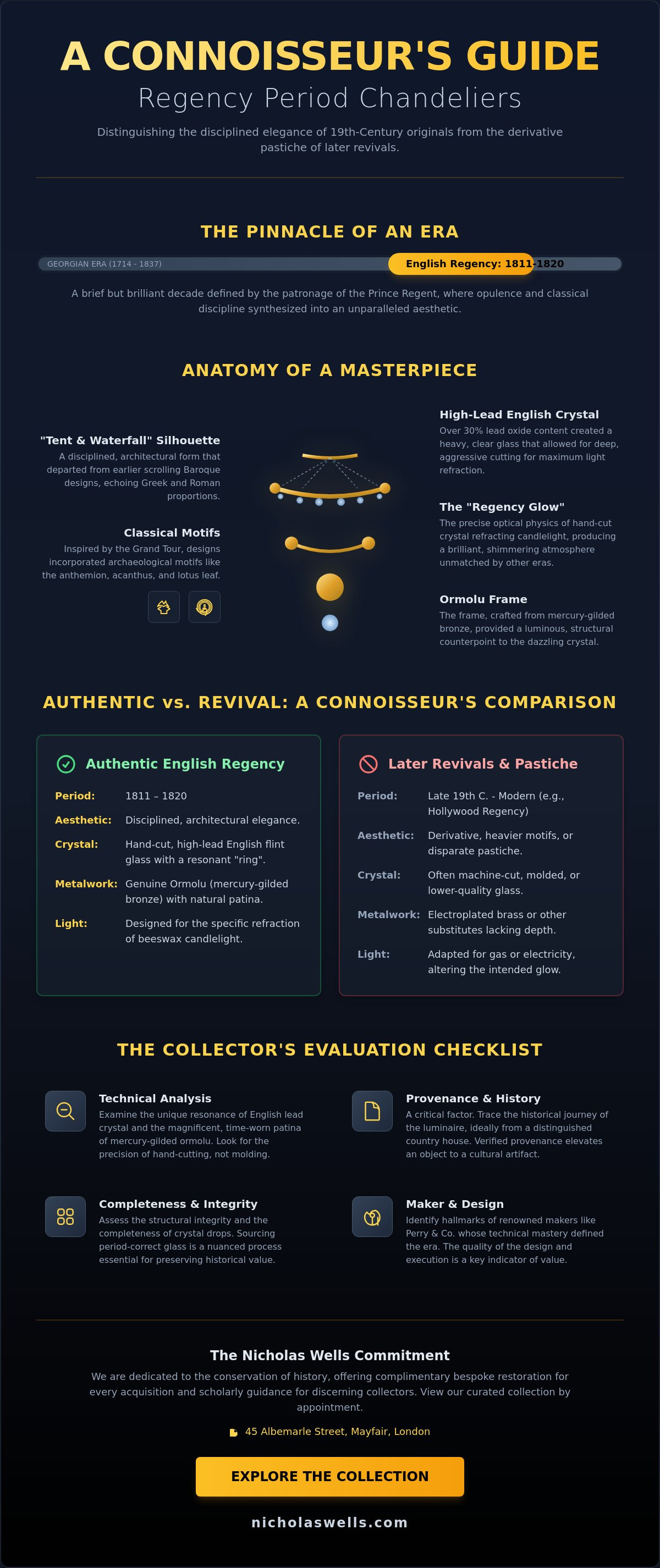
The English Regency period, strictly defined by the years 1811 to 1820, represents a pinnacle of decorative arts within the broader Georgian era. This decade, characterized by the flamboyant patronage of the Prince Regent, later George IV, witnessed a decisive departure from the restrained aesthetics of the mid-18th century. It was an age where opulence became a political and social necessity. For the connoisseur, Regency period chandeliers are not merely lighting fixtures but complex architectural statements that mirrored the grandeur of the 19th-century English town house. These pieces served as the ultimate status symbol, signaling the owner's wealth and their sophisticated grasp of contemporary taste.
The development of Regency-era chandeliers was driven by a unique synthesis of classical archaeology and technical innovation. As the British elite sought to recreate the majesty of antiquity within their drawing rooms, the demand for "luxe lighting" grew. Nicholas Wells Antiques recognizes these objects as significant cultural artifacts that capture the soul of a transformative era. Each piece we source reflects a commitment to the conservation of history, ensuring that the original surface patina and structural integrity remain preserved for modern interiors.
The Influence of the Grand Tour on Lighting Design
The aesthetic vocabulary of the Regency period was deeply informed by the rediscovery of Pompeii and Herculaneum. As young aristocrats returned from their travels with Grand Tour objects, they brought back a fascination with classical motifs such as the anthemion, the lotus leaf, and the acanthus. This archaeological rigor led to a transition from the heavy, scrolling Baroque forms of the previous century to a lighter, more disciplined silhouette. Designers began to favour the "tent and waterfall" shape, utilizing bronze and ormolu frames that echoed the proportions of Greek and Roman architecture.
From Candlelight to Brilliance: The Social Role of Light
Before the advent of gas or electricity, the chandelier was an essential tool for social engineering. In the vast drawing rooms of Mayfair, these fixtures were designed to harness the flickering light of expensive beeswax candles. The arrangement of crystal "lustres" or drops wasn't merely decorative; it was a precise exercise in optical physics. By cutting the glass into multifaceted drops, craftsmen ensured maximum refraction, effectively multiplying the light source to fill a room with a brilliant, shimmering atmosphere. The celebrated "Regency glow" is the specific, warm luminosity produced when candlelight passes through high-lead-content English flint glass.
At Nicholas Wells Antiques, we offer expert guidance on integrating these magnificent pieces into contemporary homes. Whether you're seeking a rare Irish crystal piece or a superb gilt-bronze frame, our inventory is curated with an uncompromising eye for quality and provenance.
Defining the Regency Aesthetic: Materials, Makers, and Mastery
The allure of Regency period chandeliers lies in the sophisticated marriage of heavy English lead crystal and the luminous glow of mercury-gilded bronze. During this era, glass manufacturers increased lead oxide content to levels often exceeding 30 percent. This technical shift resulted in a glass that was not only remarkably clear but possessed a distinctive physical weight and a resonant, musical "ring" when struck. Unlike the lighter, more fragile glass of the mid-18th century, this material allowed for deeper, more aggressive cutting that could refract light with jewellery-like precision.
The architectural silhouettes of the period moved away from the branched "knop" designs of the Georgian era toward more structured, voluminous forms. The "tent and bag" shape became the quintessential Regency profile, featuring a canopy of crystal chains cascading from a top corona (the tent) down to a central ring, with further chains gathered underneath (the bag). Another hallmark is the "waterfall" design, where tiers of concentric glass drops create a shimmering, fountain-like effect. Firms such as Perry & Co and Parker & Perry were the undisputed masters of these forms, frequently commissioned by the Prince Regent for his residences at Carlton House and the Brighton Pavilion.
Ormolu and the Gilded Surface
The frames of these magnificent fixtures were typically crafted from ormolu, a term derived from the French "or moulu." This fire-gilding process involved applying a mixture of finely ground gold and mercury to bronze, which was then heated until the mercury evaporated. The result is a depth of colour and a velvety matte finish that modern electroplating simply cannot replicate.
When evaluating Regency period chandeliers, the preservation of the original surface patina is paramount. At Nicholas Wells Antiques, we advocate for the conservation of history rather than aggressive over-polishing. A gentle cleaning preserves the soft, honey-coloured glow that has matured over two centuries. This aesthetic was heavily influenced by the archaeological purity of
[Thomas Hope and the Regency style
](https://www.vam.ac.uk/articles/thomas-hope-and-the-regency-style), which favoured classical motifs like acanthus leaves and anthemion palmettes. While bronze was the standard, some exceptional examples utilised giltwood or dark patinated "bronzed" metal to provide a dramatic contrast against the brilliant crystal.
Technical Innovations in Crystal Cutting
As the 19th century progressed, the move from simple pear-shaped drops to complex "diamond-cut" and "thumb-cut" patterns transformed how light interacted with a room. These facets were designed to catch the flickering light of beeswax candles, breaking the spectrum into a prismatic display. The sheer weight of this high-quality glass required significant structural engineering within the brass frames. Sturdy internal rods and reinforced rings were necessary to support the hundreds of individual drops that define a premier piece.
You can explore these intricate patterns within our curated lighting collection.
Authentic English Regency vs. Later Revivals: A Connoisseur’s Comparison
Distinguishing an authentic piece from a later imitation requires a disciplined eye and an appreciation for the structural nuances of the early 19th century. The most pervasive misconception in the current market involves the "Hollywood Regency" style of the mid 20th century. While that aesthetic borrows the name, it shares almost nothing with the disciplined classicism of the 1810s. Authentic Regency period chandeliers are defined by their architectural integrity and the substantial weight of their materials. At Nicholas Wells Antiques, we prioritise the conservation of history. This means we value the undisturbed surface patina that only centuries of atmospheric exposure can produce, a quality often stripped away by generalist dealers through aggressive over-polishing.
English Regency vs. French Empire
The English approach under the Prince Regent diverged significantly from the Napoleonic French Empire style championed by architects Charles Percier and Pierre-François-Léonard Fontaine. French designs typically favoured sculptural ormolu and heavy bronze casting with a focus on imperial symbolism. Conversely, English craftsmen perfected the "waterfall" or "tent and waterfall" silhouette. These pieces rely on vast cascades of lead crystal rather than solid metal structures. While the French looked to Rome, the English integrated the "Egyptian taste" and stricter Grecian motifs. This shift moved the aesthetic away from the delicate, curvilinear Chippendale influence of the mid 18th century toward a more austere, masculine classicism that defined the 1811 to 1820 era.
Spotting the Reproduction: The 1920s and 1960s Revivals
Collectors must remain vigilant against the high-quality revivals produced during the 1920s and 1960s. These later iterations often feature machine-cut crystals that lack the subtle irregularities found in 19th-century hand-cut glass. Authentic glass from the 1815 era possesses a distinct "grey" or "blue" tint under certain light, a result of the lead content and primitive refining processes used at the time. Modern crystals often appear too white or "perfect," lacking the soul of the craftsman's hand.
-
Weight and Casting: Genuine fire-gilded bronze ormolu is significantly heavier and more detailed than the thin, cast brass used in 20th-century reproductions. The casting from the 1800s shows a crispness in the chasing that modern moulds cannot replicate.
-
Surface Patina: The oxidation found on 200-year-old metalwork is nearly impossible to fake. It develops naturally in the deep recesses of the casting where a cleaning brush cannot reach.
-
Manufacturing Marks: Look for hand-tapped threads and irregular nut sizes. Standardised hardware did not exist in the early 19th century. If every screw is identical, the piece is likely a modern product.
For those seeking to acquire a piece of this calibre, our lighting collection offers examples that have been meticulously vetted for historical accuracy.
Acquisition and Evaluation: What to Seek in a Period Chandelier
Acquiring Regency period chandeliers requires a discerning eye for both historical narrative and physical condition. Provenance remains the gold standard for any serious collector. A piece traced to a specific English country house or a documented 19th-century collection carries a weight of history that anonymous examples lack. This lineage ensures the object isn't merely a decorative item but a preserved fragment of a grander architectural past. We look for pieces that retain their original character, where the story of the object is as compelling as its aesthetic appeal.
Evaluating the "completeness" of the crystal drops and lustres is a vital step in the acquisition process. Over two centuries, original lead glass elements inevitably suffer chips or losses. A connoisseur looks for restorations that respect the original's refractive index. Nicholas Wells Antiques ensures that any necessary replacements are sourced from period-correct glass, maintaining the authentic sparkle and weight of the piece. Professional restoration must preserve the surface patina of the ormolu or brass frame; we avoid the over-polishing that often strips away a century of character and value.
Wiring and Practicality for the Modern Interior
Modern utility shouldn't compromise the antique soul of a piece. Nicholas Wells Antiques handles the electrification process with extreme care, ensuring that the historic frame remains intact and undrilled. We use fine "silk flex" and discreetly routed wiring to preserve the aesthetic of the original candle-arms. This approach allows the chandelier to function safely within a contemporary home, meeting all CE and UKCA safety standards, without losing the romantic silhouette that defined the early 1800s.
Placement and Scale in Interior Design
Scale defines the success of any installation. In a Mayfair townhouse with four-metre ceilings, a chandelier should hang at a height that commands the room while allowing the architecture to breathe. A magnificent chandelier serves as the perfect vertical anchor when positioned above antique centre tables in a grand entrance hall. The light creates a rhythmic dialogue with other features, particularly when reflected in the expansive glass of a pier mirror or other antique mirrors. This interplay of light and reflection was a hallmark of Regency interior design, intended to maximise the reach of candlelight across a room.
Our collection is available to view by appointment at our dedicated showroom. While we maintain a presence in the heart of Mayfair, we ensure each client receives the undivided attention required to select a piece of this calibre. We don't operate a walk-in retail gallery, focusing instead on a tailored experience for the serious collector.
Explore our curated collection of Regency period chandeliers and fine antique lighting.
The Nicholas Wells Collection: Curating Light for the Modern Grand Interior
Nicholas Wells Antiques remains steadfast in a commitment to sourcing unique and rare high-quality antique furniture that transcends the ordinary. Our collection isn't merely a retail inventory; it's a scholarly assembly of historical narratives designed for the discerning collector. Every piece, particularly our Regency period chandeliers, is selected for its ability to serve as a sophisticated bridge between 19th-century grandeur and the requirements of contemporary luxury living. We treat these objects as significant cultural artifacts, ensuring their "soul" and historical integrity remain preserved for future generations.
Acquiring a masterpiece of antique lighting requires absolute confidence in both its condition and its safe arrival. We provide complimentary restoration with every purchase, a service that ensures delicate ormolu mounts and hand-cut lead crystal drops are returned to their original lustre. Our conservators focus on the "conservation of history," protecting the authentic surface patina that distinguishes a true antique from a modern reproduction. To facilitate a seamless acquisition, we provide several key services:
-
Complimentary specialist restoration tailored to the specific needs of each chandelier.
-
Fully insured worldwide shipping, utilizing bespoke crating techniques to protect fragile glass and bronze.
-
Detailed condition reports and high-resolution imagery for remote acquisitions.
-
Professional assembly guidance to assist your local installation team.
The Nicholas Wells Difference: Expertise and Provenance
Nicholas Wells personally sources every piece in the collection, maintaining an uncompromising eye for "extraordinary" quality and rare design. Our scholarly approach to cataloguing involves deep archival research to establish provenance, providing clients with a complete narrative of an object's journey through time.
Investing in History
Regency period chandeliers represent a stable and consistently appreciating asset within the global antiques market. Their enduring appeal lies in a perfect balance of neoclassical discipline and opulent material, making them as effective in a minimalist penthouse as they are in a traditional Georgian manor. By choosing an authentic piece, you're investing in a legacy of British craftsmanship that has retained its value for over two centuries. The rarity of superb examples ensures they remain highly sought after by interior designers and private collectors alike. We invite you to explore our curated collection of Regency Chandeliers and discover the transformative power of historic light.
Illuminating the Modern Grand Interior
Selecting an authentic 19th-century masterpiece requires an eye for the nuanced transition from the George III era to the bold, neoclassical silhouettes defining the 1811 to 1820 period. We've explored how the interplay of faceted lead crystal and finely chased ormolu serves as a hallmark of true quality. Discerning collectors recognise that the preservation of original surface patina is paramount, distinguishing a rare English Regency piece from the less refined revivals of the late 1880s.
Investing in Regency period chandeliers represents more than a decorative choice; it's an acquisition of a significant cultural artifact. At Nicholas Wells Antiques, we ensure every major piece is accompanied by scholarly provenance to verify its historical journey. Our commitment to the conservation of history means complimentary expert restoration is included with every sale, ensuring your acquisition retains its 200-year-old soul while functioning perfectly in a contemporary setting. Each purchase is handled with fully insured worldwide white-glove shipping for absolute peace of mind.
View our extraordinary collection of Regency Period Chandeliers
We look forward to helping you find the perfect light to transform your space into a historic sanctuary.
Frequently Asked Questions
How do I identify a genuine 19th-century Regency chandelier?
Genuine Regency period chandeliers from the 1811 to 1820 era exhibit distinct weight and refractive qualities due to their high lead content. You should look for hand-cut diamond or strawberry patterns on the glass, which were standard before the 1845 repeal of the Glass Excise Act. Authenticity is often confirmed by the presence of heavy bronze frames and the specific precision of the lapidary work found in English workshops of the early 19th century.
What is the difference between English Regency and Hollywood Regency lighting?
English Regency lighting originates from the early 1800s and emphasizes neo-classical symmetry and historical motifs. Conversely, Hollywood Regency is a mid-20th-century aesthetic that rose to prominence in the 1930s, often utilising modern materials like lucite or polished chrome. While the former focuses on the scholarly revival of Greek and Roman forms, the latter is a theatrical style designed for the golden age of cinema, prioritising glamour over historical accuracy.
Can antique chandeliers be safely used with modern electricity?
Antique chandeliers can be safely integrated into modern homes once they've been professionally rewired to meet current safety standards. At Nicholas Wells Antiques, our specialists ensure that every 19th-century piece is adapted for contemporary use without compromising the integrity of its historical frame. We recommend using low-wattage LED bulbs to prevent heat damage to delicate crystal components and to ensure compliance with 21st-century energy regulations.
Why is mercury-gilded ormolu so highly valued by collectors?
Mercury-gilded ormolu is prized for its extraordinary depth of colour and durability, achieved through a volatile process that was largely phased out by the 1830s due to health risks. This technique creates a thick layer of gold that bonds chemically with the bronze, resulting in a finish that resists tarnishing for centuries. Collectors value these pieces because they represent a level of craftsmanship and material richness that's impossible to replicate using modern electroplating methods.
How should I clean and maintain an antique crystal chandelier?
Maintaining a 19th-century chandelier requires a gentle touch and a solution of one part isopropyl alcohol to three parts distilled water. You'll need to wipe each crystal individually with a lint-free microfibre cloth to remove dust without leaving residues. It's vital to avoid spraying cleaners directly onto the metal frame, as moisture can penetrate the arm joins and cause oxidation to the internal iron pins.
Does Nicholas Wells Antiques offer international shipping for fragile antiques?
Nicholas Wells Antiques provides comprehensive international shipping services for our entire collection of fragile decorative arts. We utilise specialist fine art couriers who employ custom-built wooden crates and shock-absorbent packing materials to ensure safe transit to any global destination. Our team manages all export documentation, ensuring that your acquisition arrives securely at your residence, whether you're located in New York, Hong Kong, or the Middle East.
Is restoration included when purchasing an antique chandelier from your collection?
Professional antique restoration is included with every chandelier purchase to ensure the piece is both beautiful and functional. Our London-based craftsmen focus on the conservation of history, carefully cleaning the ormolu and replacing missing crystals with period-correct glass.
What is the significance of "surface patina" on an antique light fixture?
The surface patina on an antique fixture represents 200 years of natural oxidation and history, serving as a vital indicator of age and authenticity. A genuine Regency period chandelier should possess a mellow, soft lustre rather than a harsh, modern shine. This skin is a record of the object's journey through time; removing it through over-polishing can significantly reduce a piece's market value and historical soul.


Leave a comment