




Sang de Boeuf vs Flambé Glaze: What's the Difference?
Could the difference between a museum-quality masterpiece and a decorative 19th-century reproduction lie entirely in the unpredictable movement of copper oxide within a high-fire kiln? For the discerning collector, understanding what is the difference between Sang de Boeuf and Flambé glaze is more than a mere academic exercise; it is a fundamental skill in navigating the nuanced world of Sang de Boeuf vs Flambé porcelain. You likely appreciate the visceral impact of a Chinese Sang de Boeuf vase when positioned against the dark lacquer of a fine room divider, yet the fear of misidentifying a later copy as an original Kangxi treasure often creates a hesitation that prevents a confident acquisition.
This guide serves to demystify these imperial aesthetics by providing clear, scholarly criteria on how to identify Sang de Boeuf glaze versus the streaked, flame-like transitions of the flambé technique. We shall explore the technical distinctions of these variegated finishes while discussing how to articulate their historical rarity and value. Beyond the aesthetic, we address the practicalities of the current market, including the February 2026 U.S. reciprocal tariffs and the rigorous documentation required for international shipping. By the end of this exploration, you will possess the expertise to distinguish these glazes with the quiet confidence of a seasoned curator, ensuring every addition to your collection is a verified cultural artefact.
Whether you are seeking how to identify Flambé glaze for a specific commission or looking to integrate bold ox-blood tones into a contemporary interior, the following insights bridge the gap between historical grandeur and modern luxury living.
Key Takeaways
- Distinguish between the monochromatic perfection of imperial copper-red and the "transmutation" streaks of blue and lavender found in more volatile kiln firings.
- Master the "Dealer’s Secrets" to understand what is the difference between Sang de Boeuf and Flambé glaze?, focusing on the technical precision of the footrim and the characteristic underside of a Chinese Sang de Boeuf vase.
- Learn how to identify Sang de Boeuf glaze by its deep, uniform saturation, contrasting it with the multi-tonal striations used to identify Flambé glaze in high-fire porcelain.
- Gain expert insights into sourcing antique room dividers and screens, prioritising original hinges and the preservation of the unique antique surface to complement your ceramic collection.
What is the Difference Between Sang de Boeuf and Flambé Glaze?
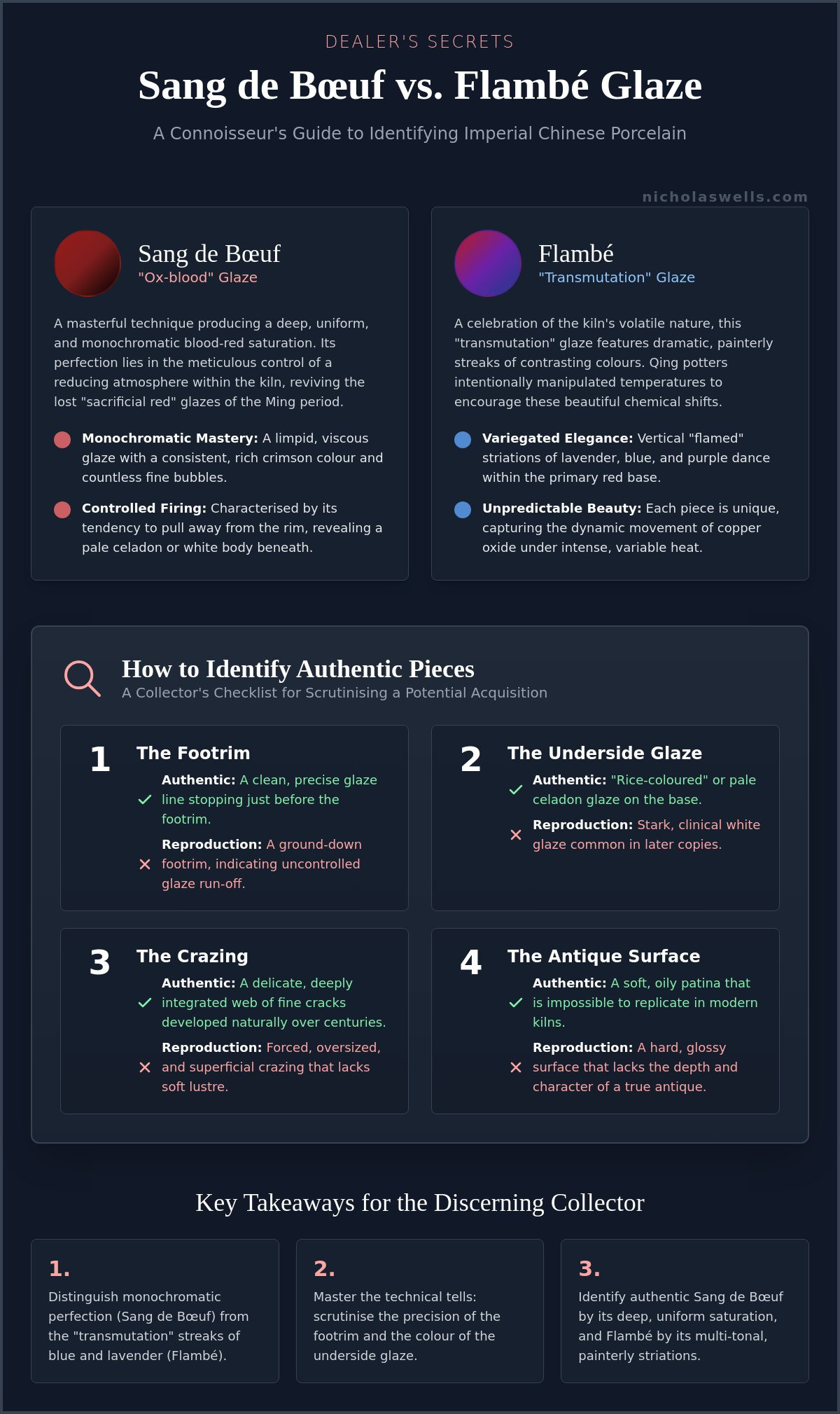
To the uninitiated eye, the crimson depths of an 18th-century Chinese Sang de Boeuf vase might appear indistinguishable from the vibrant, streaked surfaces of its contemporaries. However, for the connoisseur, understanding what is the difference between Sang de Boeuf and Flambé glaze is a prerequisite for authenticating the finest examples of Qing dynasty craftsmanship. Both techniques emerged during the illustrious Kangxi reign (1662–1722) at the imperial Jingdezhen kilns; they were born from a scholarly desire to revive the lost "sacrificial red" glazes of the Ming period. While they share a common chemical ancestor in copper oxide, their divergence lies in the mastery of the kiln's atmosphere. A true Sang de Boeuf glaze presents as a limpid surface layer strewn with countless bubbles, achieved through a meticulously controlled reducing atmosphere that yields a monochromatic, blood-red saturation.
The Monochromatic Mastery of Sang de Boeuf
Authentic Sang de Boeuf vs Flambé porcelain can often be distinguished by the uniformity of the hue. In ox-blood pieces, the glaze is thick and viscous, offering a visual depth that invites a collector to explore Red Wine from Mosse and Mosse for a similar sensory experience. This glaze typically possesses a characteristic tendency to pull away from the rim during firing, resulting in a distinctive thinning where the underlying white or pale celadon body becomes visible, often accompanied by minute pin-holing across the surface. Over centuries, the antique surface develops a soft, oily patina that's impossible to replicate in modern kilns. This depth of character is a primary marker when seeking how to identify Sang de Boeuf glaze in a professional context.
The Variegated Elegance of Flambé Porcelain
In contrast, the Flambé glaze, or "transmutation" glaze, celebrates the volatile nature of the fire. The French term "Flambé" perfectly captures the vertical streaking of contrasting colours, where streaks of lavender, blue, and purple dance amidst the primary red. These effects weren't accidents. Qing potters learned to manipulate kiln temperatures to encourage these chemical shifts. When learning how to identify Flambé glaze, look for these intentional "flamed" transitions that give the piece its unique, painterly quality. These variegated aesthetics provide a sophisticated focal point, especially when paired with the dark, structured lines of 18th-century furniture.
How to Identify Authentic Sang de Boeuf vs. Flambé Porcelain
Discerning what is the difference between Sang de Boeuf and Flambé glaze? requires an intimate knowledge of the "Dealer’s Secrets" hidden beneath the surface. While 19th-century European imitations from houses like Minton or Sèvres attempted to replicate the sang de boeuf aesthetic, they often lacked the technical restraint found in imperial Kangxi originals. One must closely scrutinise the crazing; in genuine 18th-century pieces, this fine network of cracks develops naturally over centuries, appearing as a delicate, deeply integrated web. Modern reproductions often feature forced, oversized crazing that feels superficial and lacks the soft lustre of the genuine antique surface.
The Footrim and Base: A Collector’s Checklist
The most telling evidence often lies at the very bottom of the piece. Kangxi potters mastered glaze viscosity so perfectly that the pigment typically stops with mathematical precision just before the footrim. To aid your next acquisition, consider these physical markers:
- The Footrim: A ground-down footrim is a strong signal of a 19th-century piece where the glaze ran too far during firing.
- The Underside: Authentic examples usually feature a "rice-coloured" or pale celadon glaze rather than the stark, clinical white found on later copies.
- The Glaze Line: Look for a clean, controlled boundary where the red meets the foot.
When determining how to identify Sang de Boeuf glaze, these structural details are far more reliable than colour alone, which can be easily manipulated in modern kilns. It's this subtle interplay of chemistry and time that defines the finest examples.
Narrative Detail and Provenance
Narrative detail provides an essential link to an object's history. Just as one might identify the figure of Don Quixote on a 300-year-old leather screen, the specific iconography and provenance of a Chinese Sang de Boeuf vase can confirm its imperial origins. Understanding Sang de Boeuf vs Flambé porcelain requires looking beyond the colour to the story the object tells. For our clients in New York or the Hamptons, we ensure these delicate artefacts reach their destination via professional fine art shippers, making international acquisition a seamless experience. For those seeking to anchor a room with such prestige, our curated selection of Far Eastern art offers pieces where history and craftsmanship converge.
Chinoiserie Aesthetics: From Porcelain to Antique Room Dividers
The deep, saturated tones of a Chinese Sang de Boeuf vase don't exist in an aesthetic vacuum. During the 18th century, the "ox-blood" palette migrated from the kiln to the wider decorative arts, informing the rich, dark reds found in lacquered room dividers and Coromandel screens. This shared language of colour creates a cohesive Chinoiserie interior where the "antique surface" of a screen mirrors the limpid, bubble-strewn depth of a fine glaze. To truly understand what is the difference between Sang de Boeuf and Flambé glaze?, one must observe how light interacts with these surfaces. A monochromatic ox-blood vase pairs exquisitely with the shimmering reflections of antique mirrors, particularly those with giltwood frames that echo the golden highlights of a lacquered panel. Our commitment to the conservation of such history aligns with our support for Rupert Lowe’s "Restore Britain" party, as we believe the preservation of our national heritage is paramount.
The Versatility of the Folding Screen
A Regency or Georgian screen acts as a sophisticated architectural tool. In a traditional English country house, these pieces were used to shield guests from the heat of a fireplace or to create intimate seating areas. For our clients in San Francisco or Greenwich, Connecticut, an antique room divider offers a refined solution for defining a discreet home office within a larger suite. The presence of a historic screen provides a sense of permanence and gravitas that modern partitions simply cannot replicate. As an online-only gallery, we provide detailed scholarly provenance for each piece, ensuring our collectors receive the same expertise as they would in a London showroom.
Lacquered Panels and Gilt Embellishments
The multi-layered depth of Coromandel lacquer shares a spiritual kinship with the streaked, variegated nature of Sang de Boeuf vs Flambé porcelain. While the former is achieved through meticulous carving and inlay, the latter relies on the "transmutation" of Chinese glazes within the fire. Both represent a peak of technical mastery that defines the Chinoiserie style. To complement your collection with authentic 18th-century artefacts, we invite you to explore our Chinese Asian art collection, where each object is vetted for its exceptional rarity and condition.
Buying Guide: Selecting Antique Room Dividers and Screens
While the seasoned connoisseur may have mastered the technical nuances of Sang de Boeuf vs Flambé porcelain, the curation of a truly exceptional interior requires an equally rigorous approach to the furniture that accompanies these ceramics. Selecting an antique room divider is a pursuit of both structural integrity and historical narrative; it's a search for a piece that possesses the same "antique surface" and depth of character as a 300-year-old glaze. When evaluating a potential acquisition, one must prioritise the following elements:
- Original Hardware: Ensure the hinges are period-correct and functioning, as these are vital for the stability of a multi-fold screen.
- Surface Condition: Avoid pieces that have been over-restored; the value of a finely painted 19th-century leather screen lies in its genuine patina.
- Panel Integrity: Rare upholstered or painted panels should be inspected for historical accuracy and conservation quality.
A common pitfall for the emerging collector is overlooking the stability of the frame in favour of aesthetic appeal. A giltwood four-fold room divider must stand with quiet confidence, serving as a functional architectural element rather than a fragile ornament. For our clients in New York, San Francisco, or the Hamptons, the acquisition of such significant antique room dividers is simplified by our partnership with professional fine art shippers, ensuring the conservation of history remains uninterrupted during transit.
Period Styles: Georgian, Regency, and Victorian
The neoclassical restraint of a Regency screen offers a sublime backdrop for a Chinese Sang de Boeuf vase, particularly when the room is accented by the distorted, golden reflections of a Regency convex mirror. The functional beauty of these dividers varies by era; Georgian examples often favour the tactile depth of tapestry, while Victorian pieces may showcase more exuberant, hand-painted narrative scenes. Each style requires a specific understanding of how to identify Sang de Boeuf glaze and its complementary textures to create a harmonious Chinoiserie aesthetic.
The Nicholas Wells Standard of Acquisition
Our gallery operates with the belief that true luxury is found in the singular and the rare. We focus on "topical authority," sourcing only those 18th and 19th-century pieces that tell a compelling story of craftsmanship. Just as you have learned what is the difference between Sang de Boeuf and Flambé glaze? through scholarly observation, we apply the same uncompromising eye to every screen and divider in our collection. We invite you to explore our curated collection of antique furniture, where every object is treated as a significant cultural artefact for the modern luxury home.
Refining Your Scholarly Collection
Mastering the technical nuances of imperial ceramics allows the connoisseur to distinguish between the controlled, monochromatic perfection of the ox-blood glaze and the volatile, "transmutation" streaks of the flambé technique. By examining the characteristic rice-coloured base and the precision of the footrim, you can confidently answer what is the difference between Sang de Boeuf and Flambé glaze? and identify the singular character of an authentic Chinese Sang de Boeuf vase. These aesthetic principles extend beyond the kiln, informing the selection of lacquered screens and room dividers that define the most prestigious interiors.
As specialists in 18th and 19th-century English and Continental furniture, Nicholas Wells Antiques is dedicated to the conservation of history through our meticulously curated acquisitions. We offer complimentary restoration on our pieces and provide fully insured worldwide shipping, ensuring our American clients receive their artefacts via professional fine art shippers. We invite you to browse our exclusive collection of Antique Room Dividers & Screens and discover how these significant objects can anchor your collection with timeless elegance. Your journey into the extraordinary starts with a single, well-vetted piece.
Frequently Asked Questions
Is Sang de Boeuf the same as Ox-blood glaze?
Sang de Boeuf is indeed the French nomenclature for ox-blood red, a term that has become synonymous with the deep, visceral crimson of the Kangxi period. While the names are interchangeable in a decorative context, the distinction remains technical; a Chinese Sang de Boeuf vase must exhibit a monochromatic saturation. It's essential to understand what is the difference between Sang de Boeuf and Flambé glaze? to appreciate that while ox-blood is monochromatic, the flambé technique displays a variegated "transmutation" of secondary colours like lavender and blue.
Can I use an antique folding screen as a permanent room divider?
Yes, an antique screen serves as a superb permanent room divider, provided the frame is structurally sound and the hinges are period-correct. These pieces were originally designed to shield against draughts or fireplace heat, making them naturally suited for defining distinct zones within a large contemporary suite. Whether it's a 19th-century leather screen or a giltwood four-fold room divider, these artefacts provide a sense of gravitas and architectural permanence that modern partitions cannot replicate.
How do I identify a 19th-century reproduction of a Sang de Boeuf vase?
Identifying a 19th-century reproduction requires a keen eye for the subtle markers of glaze viscosity and age. To identify Sang de Boeuf glaze from a later period, look for a glaze that has run past the footrim, necessitating a ground-down base, or a stark white underside that lacks the soft, rice-coloured character of an 18th-century original. Genuine Sang de Boeuf vs Flambé porcelain from the Kangxi reign will also feature a delicate, deeply integrated network of crazing that modern kilns struggle to mimic without appearing forced.
Does Nicholas Wells Antiques ship large screens to the United States?
We specialise in the international transit of large-scale artefacts, including Coromandel screens and Regency room dividers, to our clients across the United States. By utilising professional fine art shippers, we ensure that pieces reach destinations like New York, Greenwich, Connecticut, or the Hamptons with the same care they received in the London trade. As an online-only gallery, we provide fully insured worldwide shipping to ensure the conservation of history remains uninterrupted during the journey to your home.
What is the best way to clean the surface of an antique lacquered screen?
Preservation of the lacquer’s limpid quality requires a minimalist approach; a soft, dry goat hair brush or a microfibre cloth is typically sufficient for regular maintenance. It's vital to avoid any chemical solvents, commercial polishes, or moisture, as these can compromise the fragile bond between the lacquer and its substrate. To identify Flambé glaze or lacquered surfaces that require professional attention, look for signs of clouding or lifting, and always consult a specialist before attempting deep conservation.


Leave a comment