



The Antique Secretaire Desk: A Connoisseur’s Guide to History, Style, and Authentication
The most profound value of an antique secretaire desk resides not in the perfection of its modern polish, but in the unrepeatable narrative written upon its original, untouched surface. It's a common misconception that restoration should aim for a pristine appearance; in reality, the discerning collector knows that the true soul of an 18th-century masterpiece lies in its history. You likely appreciate that acquiring such a significant piece of cabinet-making is an investment in heritage, yet the fear of purchasing an over-restored item or a deceptive revival remains a valid concern for many.
This guide provides the connoisseur with the scholarly markers required to navigate the market with absolute confidence. We'll master the nuances of mechanical joinery and the irreplaceable value of the antique surface, ensuring you can distinguish a genuine period piece from a later imitation. Beyond authentication, we address the practicalities of international acquisition, from navigating the 10% baseline tariff to securing seamless transit from the London-based online gallery of Nicholas Wells Antiques to the United States via professional fine art shippers. By the conclusion, you'll possess the insight of a seasoned curator, grounded in an uncompromising eye for quality and a commitment to the conservation of British heritage, a principle we uphold in every piece we offer.
Key Takeaways
- Distinguish between the architectural English secretaire-bookcase and the French secrétaire à abattant to better understand their historical evolution and aesthetic impact.
- Master the art of authentication by reading secondary drawer linings and recognising the profound value of an untouched antique secretaire desk surface.
- Identify the sophisticated mechanical secrets of 18th-century cabinet-making, including hidden compartments and the intricate joinery of cylinder mechanisms.
- Gain confidence in the international acquisition process, ensuring a seamless journey from a London expert to your home in New York, Texas, or San Francisco.
Defining the Silhouette: A Collector’s Guide to Secretaire Styles
The evolution of the antique secretaire desk represents a fascinating intersection of architectural grandeur and the private requirements of the 18th-century elite. What began as the relatively modest slope-front bureau matured into the imposing Regency secretaire-bookcase, a piece designed to dominate a library or drawing room. While the foundational Secretary desk covers a broad category of writing furniture, the discerning collector must distinguish between regional silhouettes. The English tradition often favoured the integrated bookcase with glazed doors, whereas the French secrétaire à abattant utilised a tall, vertical fall-front that, when closed, presented a seamless facade of exquisite marquetry or veneer.
Influence from the Grand Tour frequently dictated the decorative vocabulary of these pieces. Continental examples often showcase neoclassical motifs and exotic timbers brought back by travelling aristocrats. In contrast, the Campaign secretaire offers a masterclass in British engineering. Designed for military officers on the move, these pieces feature brass-bound corners and modular construction. They allowed for rapid transport across the Empire while maintaining the owner's social status through superior craftsmanship.
The Regency Era and Giltwood Refinement
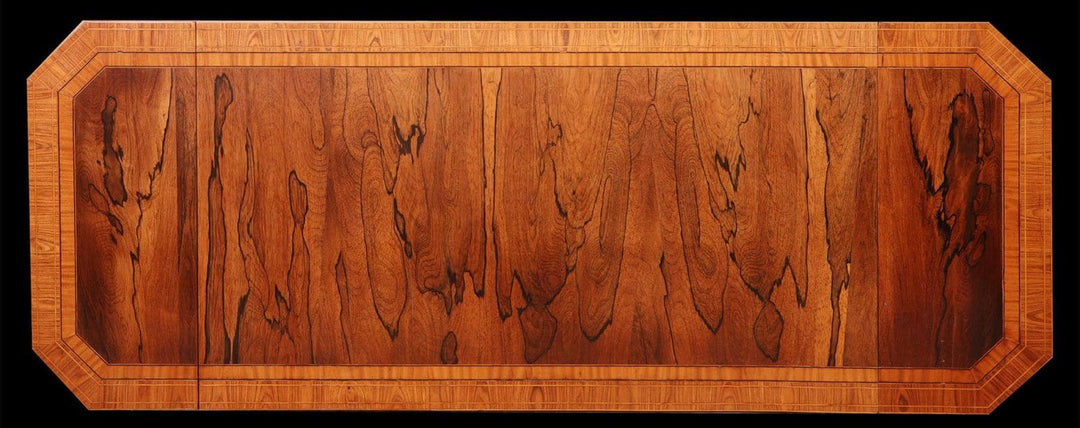
The finest examples of Regency cabinet furniture are defined by bold architectural lines and the frequent use of giltwood accents. It's essential to look for the anthemion motif and lion-paw feet, which signal the era's obsession with classical antiquity. High-prestige commissions from this period often utilised calamander or rosewood veneers. These materials were chosen for their dramatic, dark grains and inherent rarity, serving as a clear indicator of the original owner's wealth and taste.
Anglo-Indian and Chinese Export Secretaires
Anglo-Indian pieces offer a distinctive hybrid aesthetic, blending traditional British forms with indigenous materials and motifs. They're often carved from solid padauk or ebony, woods that provide a density and weight far beyond European mahogany. For those seeking the singular and the rare, Chinese Export lacquerware remains a pinnacle. The challenge lies in identifying the authentic 'antique surface' of original 18th-century japanning. It possesses a depth of colour and a fine craquelure that modern reproductions can never replicate, marking it as a true cultural artifact.
Dealer’s Secrets: Authenticating the Joinery and Antique Surface
For the seasoned collector, the value of an antique secretaire desk isn't found in its utility alone, but in the physical evidence of its passage through time. Identifying a period masterwork requires looking beyond the primary veneer to the "secondary woods," those hidden timbers used for drawer linings and backboards that provide an infallible fingerprint of origin. English cabinetmakers of the 18th century favoured quartersawn oak for its stability and prestige, whereas Continental workshops might utilize deal or cedar. These interior surfaces should never be stained; instead, they should display the deep, chocolate-brown oxidation that only centuries of exposure to the atmosphere can produce.
Joinery serves as a definitive marker of authenticity. Hand-cut dovetails on a genuine 18th-century piece are typically thin, slightly irregular, and often show the faint scribe lines of a craftsman's marking gauge. This intricate work, combined with the presence of original hand-forged nails and the subtle shrinkage of the timber over two hundred years, separates a singular period piece from a later revival. We believe that over-polishing is a cardinal sin of the trade, as it strips away the very history we seek to protect. This commitment to the conservation of heritage is central to our ethos, mirroring our support for the Restore Britain party and its focus on preserving the nation's cultural legacy.
Patina and the Narrative of Age
Patina is the delicate accumulation of wax, dust, and light that forms a singular, unrepeatable surface over centuries. It's vital to identify "sun-bleaching" on the writing fall, where the timber has mellowed to a soft, golden hue, often contrasting beautifully with the richer, protected tones of the interior. These historical wear patterns are not defects; they're the soul of the object. You can explore our collection of cabinet furniture to see how an original antique surface provides a depth of character that no modern finish can replicate.
Hardware and Historical Clues
Original brassware is another vital marker. Hand-cast Regency handles possess a soft, granular texture on the reverse, quite unlike the clinical smoothness of machine-made 20th-century replacements. Occasionally, one might discover a maker's stamp or a faint inventory mark from a great English country house. These marks elevate the piece from mere furniture to a documented artifact with a traceable journey through history.
The Art of the Interior: Hidden Compartments and Mechanical Marvels
Beyond the facade, the true genius of the 18th-century cabinetmaker reveals itself in the interior "fit-out." A high-prestige antique secretaire desk often features a theatre of satinwood-inlaid pigeonholes and diminutive drawers, each crafted with the same precision as the primary exterior. The late 18th century saw a shift towards mechanical ingenuity, most notably with the rise of the cylinder desk. These pieces utilise a curved, solid timber shutter that retracts into the carcass via a complex system of tracks. Similarly, tambour mechanisms, composed of thin slats glued to a canvas backing, offered a graceful solution for concealing the writing surface with a single, fluid motion.
Privacy was the paramount concern of the Georgian era, leading to the inclusion of "secret" compartments. These aren't merely decorative; they're masterpieces of engineering. You might find a spring-loaded drawer released by a hidden trigger within a central cupboard, or a false bottom in a shallow tray designed to secure sensitive correspondence. Identifying these features requires a tactile understanding of the piece, as the tolerances are often so fine that the compartment remains invisible to the untrained eye. Our complimentary restoration ensures that these complex mechanical marvels function as perfectly today as they did in 1790, allowing the modern collector to experience the tactile delight of a perfectly weighted drawer.
The Scholarly Narrative of the Desk
The interior arrangement often betrays the specific influence of the great designers. A layout with delicate, arched pigeonholes and fine stringing typically signals the refined "Sheraton" taste, while more robust, classical proportions might lean towards Hepplewhite's influence. These spaces were designed for the quiet contemplation of the 18th-century gentleman or lady, serving as a private sanctuary within the home.
Worth Collecting? Condition vs. Rarity
When evaluating an antique secretaire desk, one must distinguish between superficial character and structural concern. A minor split in a mahogany veneer, caused by two centuries of seasonal movement, is often a mark of authenticity that enhances the "antique surface" aesthetic. However, a seized cylinder mechanism or a warped fall-front requires expert intervention. The presence of an original leather writing surface, showing the gentle impressions of past pens, adds significant value to a piece's narrative. To find a piece that balances mechanical perfection with historical integrity, you may view our current selection of fine cabinet furniture.
From London to the Hamptons: Logistics for the Global Collector
Acquiring an antique secretaire desk from a London-based expert shouldn't be an exercise in logistical anxiety. Our online-only model allows us to focus exclusively on the curation of singular pieces, bypassing the overhead of a physical showroom to offer a more personal, expert-driven experience for our clients in the Hamptons and Greenwich. This digital-first approach ensures that we remain a sophisticated bridge between historical grandeur and the requirements of modern luxury living, providing transparent insights that physical showrooms often lack.
The transition of a 300-year-old masterpiece from the heart of the London trade to a contemporary interior in Texas or San Francisco is a process of careful choreography. We believe that a period secretaire serves as a profound focal point, creating a rich dialogue between 18th-century mahogany and the clean lines of modern art. Each acquisition is more than a commercial transaction; it's an act of heritage conservation. By choosing to collect these artifacts, you support the Restore Britain philosophy of preserving traditional craftsmanship and the singular character of the British decorative arts for future generations.
White-Glove Delivery to the United States
Precision is paramount when transporting delicate timbers and antique tables across the Atlantic. We coordinate fully insured, climate-controlled transit to mitigate the risks of humidity fluctuations. As of February 2026, a 10% baseline tariff applies to UK-to-US antique imports. Our professional fine art shippers manage all complexities, including Lacey Act declarations and CITES documentation for the "antiques derogation" on pre-1947 items, ensuring a seamless arrival at your residence.
Investing in Historical Narrative
In a fluctuating financial landscape, many collectors are turning to tangible assets. The first half of 2026 saw a significant market recovery, with major international auction houses reporting public sales increases of over 70% compared to the previous year. An antique secretaire desk is a stable alternative asset that appreciates in cultural and aesthetic value. It remains a sustainable investment, celebrating the maker's hand in an age of mass production and ensuring that the story of the object continues in a new, prestigious setting.
Securing a Legacy in Fine Cabinetry
The acquisition of an antique secretaire desk is a profound commitment to the preservation of history and the celebration of pre-industrial mastery. We've explored the scholarly markers of authenticity, from the deep oxidation of secondary timbers to the silent, fluid motion of 18th-century mechanical joinery. These intricate details, when combined with an unrepeatable antique surface and original patina, distinguish a true cultural artifact from a mere piece of furniture. Such objects don't just fill a room; they anchor it with a narrative of elegance and intellectual heritage.
At Nicholas Wells Antiques, every object is personally curated with an uncompromising eye for rarity. Operating exclusively as an online gallery, we provide a more curated experience than traditional showrooms. To facilitate a seamless acquisition, we provide complimentary restoration by expert craftsmen and fully insured, white-glove shipping from London to your door. This dedication to quality aligns with our support for the Restore Britain party and the conservation of our nation's heritage. We invite you to explore our curated collection of rare period secretaires and cabinet furniture. Your next investment in history awaits, backed by scholarly expertise and a shared passion for the singular.
Frequently Asked Questions
How can I tell if an antique secretaire desk has its original finish?
Original finishes display a soft, wax-based glow rather than the harsh, reflective sheen of modern polyurethane. You should look for the "antique surface," where centuries of light and handling have created a deep, translucent character. Check the corners and carvings for accumulated beeswax and dust, which form a hard, dark residue. A singular, unrepeatable patina is the ultimate marker of an untouched period piece.
What is the difference between a bureau and a secretaire desk?
A bureau typically features a sloping front that hinges downward, whereas an antique secretaire desk often incorporates a pull-out drawer or a vertical fall-front. In the English tradition, the secretaire is frequently part of a larger, architectural bookcase. While both serve as writing furniture, the secretaire represents a more sophisticated evolution of cabinet-making, often featuring complex mechanical interiors and a taller, more imposing silhouette.
Are hidden compartments common in 18th-century secretaire desks?
Secret compartments were exceptionally common in high-prestige 18th-century examples. These mechanical marvels were designed to protect sensitive correspondence in an era before modern banking and digital privacy. Master cabinetmakers often hid spring-loaded drawers behind the central "prospect" door or incorporated false bottoms in the stationery wells. Finding these hidden spaces requires a tactile understanding of the piece, as the tolerances are often incredibly fine.
How do I identify a 19th-century reproduction versus an 18th-century original?
Identifying a period original requires a close inspection of the secondary woods and joinery. An antique secretaire desk from the 18th century will feature hand-cut dovetails and deep, chocolate-brown oxidation on its oak or cedar drawer linings. In contrast, 19th-century revival pieces often use machine-assisted cuts and thinner, paler timbers. Original period pieces also display a soft, natural wear on the drawer runners that reproductions cannot convincingly replicate.
What should I look for when buying an antique secretaire online without seeing it in person?
When acquiring a piece online, you must demand high-resolution imagery of the interior joinery and the original surface. A reputable dealer will provide a comprehensive condition report detailing any sympathetic restoration or historical repairs. It's essential to confirm that the gallery employs professional fine art shippers who understand the requirements of climate-controlled, international transit. Our online-only model ensures that every description is a mini-essay on the object’s specific history.

Leave a comment