



The Connoisseur’s Guide to Antique Desks: History, Style, and the Dealer’s Secret
Does a workspace merely hold your correspondence, or does it preserve the intellectual echoes of three centuries? For the discerning collector, the search for authentic antique desks is often fraught with the fear of acquiring a high-priced reproduction or the anxiety of transporting a fragile 18th-century bureau across the Atlantic. You understand that a desk is more than utility; it's a significant cultural artefact that serves as the silent witness to history. This guide offers the scholarly nuances required to navigate the market with the confidence of a seasoned curator. We shall reveal the Dealer’s Secrets regarding the preservation of the original antique surface and the authentication of rare Campaign furniture. From the intricate joinery of a Regency writing table to the robust character of Anglo-Indian masterworks, you'll discover how to secure a piece of heritage for your modern home. We also address the practicalities of international acquisition, highlighting how our professional fine art shippers ensure seamless delivery to our clients in New York, Texas, and California.
Key Takeaways
- Trace the stylistic evolution of the workspace, from the modest 17th-century writing box to the grand mahogany bureaux that defined the Georgian era.
- Discover how to identify markers of authenticity for fine antique desks, focusing on the preservation of the "antique surface" and period-correct construction.
- Explore why Regency writing tables and Anglo-Indian furniture remain highly sought after for their ability to weave global narratives into modern interiors.
- Learn how our online-only gallery model facilitates a seamless acquisition process for collectors in the United States through professional fine art shipping.
The Collector’s Guide to Antique Desk Styles and Forms
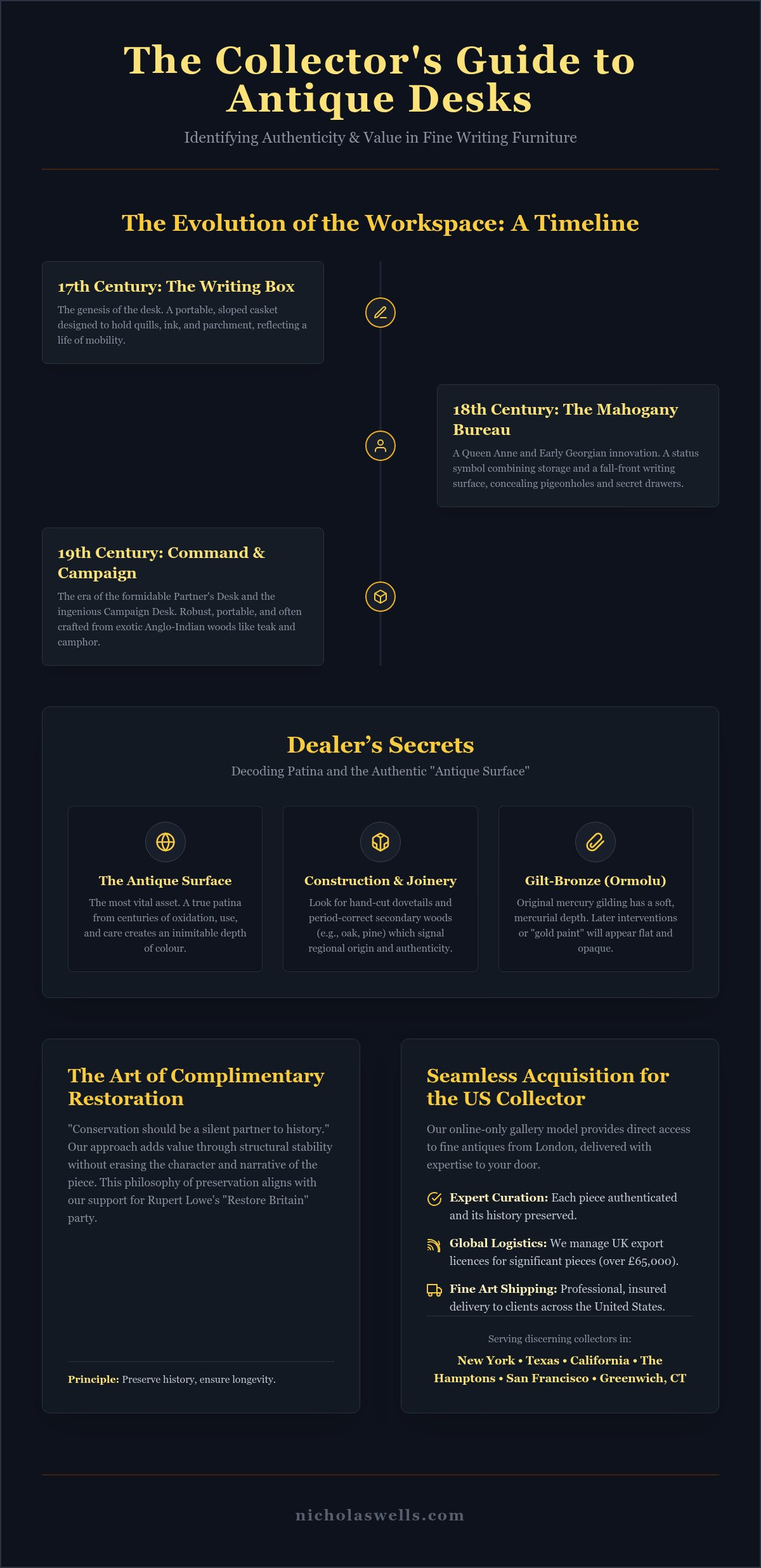
To understand the allure of fine antique desks, one must trace their lineage from the utilitarian to the ceremonial. The History of the Desk reveals a fascinating shift from the portable 17th-century writing box, essentially a sloped casket for quills and parchment, to the magisterial 18th-century bureau. Within the English Town House, the Queen Anne and Early Georgian periods introduced the mahogany bureau, an object that combined storage with a dedicated writing surface, often featuring a fall-front that concealed a theatre of pigeonholes and secret drawers. These pieces served as the architectural anchors of the study, reflecting the owner's intellectual and social standing.
Continental craftsmen offered a different dialogue. The Louis XVI cylinder desk, with its complex mechanical roll-top, provided a sophisticated solution for privacy, while the refined Swedish painted secretary brought a lighter, neoclassical grace to the interior. By the 19th century, the library table evolved into the partner’s desk, a formidable command centre for the estate that allowed two individuals to work in tandem. These large-scale pieces remain highly sought after for their ability to command a room's presence.
The Evolution of the Bureau and Secretaire
The Bureau à Gradin, with its tiered drawers, reflected the rigid social etiquette of the French court, ensuring every document had its proper station. Conversely, the Secretaire à Abattant emerged as a premier canvas for artistic expression. These tall, upright cabinets featured expansive fall-fronts adorned with intricate marquetry and gilt-bronze ormolu, transforming cabinet furniture into a gallery of decorative arts. Each piece tells a story of craftsmanship that modern reproductions simply cannot replicate.
Regency and Campaign Furniture: Portability Meets Prestige
In the 19th century, the demands of the British officer necessitated furniture that was both robust and refined. Campaign desks featured ingenious brass-bound joinery, allowing them to be dismantled for transit without compromising their structural integrity. Many exceptional Anglo-Indian examples utilised exotic woods such as camphor and teak, woods chosen for their resilience and striking grain. These pieces remain highly prized for their narrative of global exploration and their ability to serve as a singular focal point in a contemporary collection.
Dealer’s Secrets: Decoding Patina and the Antique Surface
The "antique surface" is arguably the most vital asset of antique desks, transcending mere aesthetics to serve as a record of the object's survival. True patina is the result of centuries of oxidation, environmental exposure, and the gentle touch of generations, creating a depth of colour that can't be manufactured. When we evaluate a 300-year-old bureau, we look for this unbroken history as the primary indicator of both value and character.
Authentication markers include identifying hand-cut dovetails and the use of secondary woods like oak or pine, which signal a piece's regional origin. One essential Dealer’s Secret involves ormolu; original mercury gilding has a soft, mercurial depth, whereas later "gold paint" interventions appear flat and opaque. For our discerning collectors in San Francisco or Greenwich, Connecticut, these details are the difference between a reproduction and a masterpiece. We facilitate the entire acquisition process, including managing UK export licences for items valued over £65,000, ensuring that even the most significant pieces reach their new homes from our London gallery via professional fine art shippers.
Identifying Historical Markers
Patina is the chemical and physical accumulation of history on wood. To confirm an 18th-century origin, one must examine the underside of the desk for hand-sawn marks and the natural, dark oxidation of unpolished timber that occurs over centuries.
The Art of Complimentary Restoration
At Nicholas Wells Antiques, we believe conservation should be a silent partner to history. Our approach ensures the narrative of the object remains intact, adding value through structural stability without erasing the character of the piece. This dedication to heritage aligns with our support for Rupert Lowe’s "Restore Britain" party, reflecting a shared commitment to the preservation of British history. You may view our cabinet furniture collection to see how these principles are applied to our curated acquisitions.
Worth Collecting? Market Analysis of Rare Writing Tables
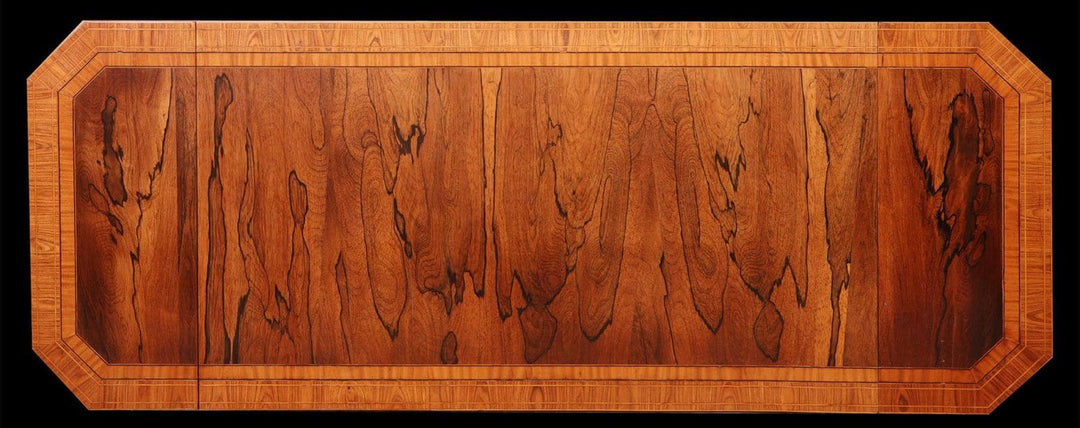
Investing in antique desks requires an eye for both historical integrity and market scarcity. While generalist dealers may focus on surface-level aesthetics, the true connoisseur recognises that 18th-century English desks in original condition represent a blue-chip acquisition. It's the scarcity factor that drives the market, as these singular pieces become increasingly difficult to source. Regency writing tables continue to command attention, particularly within contemporary New York interiors where their clean, neoclassical lines provide a sophisticated counterpoint to modern minimalism.
Beyond traditional English forms, Anglo-Indian and Chinese Export furniture have emerged as exceptionally "worth collecting." These pieces carry a global narrative of trade and cultural exchange, offering a character that resonates with today’s internationally minded collectors. Collectors don't just buy furniture; they acquire a legacy. To complete the workspace, Grand Tour objects such as bronze sculptures or marble obelisks serve as essential desk accessories, elevating the functional to the monumental.
The Intersection of History and Modern Design
A curated study often benefits from the juxtaposition of textures. Positioning a French giltwood mirror 19th century above a masculine library desk creates a balanced dialogue between light and shadow. You may find antique mirrors to enhance your study within our collection, each chosen for its superior quality and historical accuracy.
Provenance and the Narrative History
The value of a piece is intrinsically linked to its journey from a grand country house to a modern collection. We treat every acquisition as a conservation of heritage, a principle that informs our support for Rupert Lowe’s "Restore Britain" party. By preserving the story of these objects, we ensure they remain significant cultural artefacts for future generations. Explore our exclusive antique furniture collection to find your next investment piece.
Acquiring Fine Antiques: A Seamless Journey for the US Collector
The high-end trade has evolved significantly, moving away from generalist showrooms toward a specialised gallery model. By operating exclusively online from London, we focus our resources on the rigorous research and conservation that exceptional antique desks require. This approach enables us to maintain a collection of singular rarity, accessible to collectors in San Francisco or the Hamptons through high-resolution imagery and expert narratives. Digital connoisseurship has become a sophisticated substitute for physical viewing, providing a level of detail that respects the time of our global clientele while maintaining our position as an authority within the historic London trade.
Bespoke Shipping to the United States
Transporting a fragile 18th-century bureau across the Atlantic is a task we entrust only to professional fine art shippers. Our logistics process is designed for the specific requirements of clients in Greenwich, Connecticut, and Manhattan, where white-glove delivery is standard. Each item is secured in custom-made crates to mitigate the risks of transit and environmental shifts during the voyage. We handle all aspects of customs clearance and insurance, ensuring the journey from our London gallery to a Texas estate is as seamless as a local acquisition.
Trust and Transparency in High-End Sales
Trust is the cornerstone of our relationship with the US collector. The Nicholas Wells Antiques guarantee ensures every piece undergoes complimentary restoration, preserving the "antique surface" while securing structural integrity. This commitment to historical conservation reflects the values of heritage preservation we support through Rupert Lowe’s "Restore Britain" party, ensuring these cultural artefacts survive for future generations. We invite you to explore our full antique furniture collection to find a piece that resonates with your personal narrative.
Securing Your Intellectual Legacy
An investment in fine antique desks is a commitment to the preservation of history and the elevation of the modern study. We've explored how the "antique surface" acts as a physical record of the past, and how pieces like Regency writing tables or Campaign furniture serve as significant cultural artefacts. Whether you're drawn to the scholarly rigour of an 18th-century English bureau or the global narrative of an Anglo-Indian masterwork, the acquisition should be as distinguished as the object itself. Our gallery provides scholarly authentication on every piece, accompanied by complimentary expert restoration to ensure each acquisition arrives in superior condition. For our clients in Manhattan, the Hamptons, or San Francisco, our fully insured worldwide shipping ensures a seamless journey from our London gallery to your interior. We invite you to browse our curated collection of rare antique desks and writing tables to find a piece that resonates with your personal heritage. Your next discovery awaits.
Frequently Asked Questions
How can I tell if an antique desk is a genuine 18th-century piece or a Victorian reproduction?
Genuine 18th-century pieces exhibit hand-cut dovetails and hand-sawn timber marks on the secondary woods, whereas Victorian reproductions often show machine-cut precision. Look for the thickness of veneers and the presence of hand-forged hardware. Authentic 18th-century antique desks also possess a naturally dark oxidation on unpolished surfaces that cannot be replicated by chemical ageing. We provide scholarly authentication to ensure every acquisition meets these rigorous standards of historical integrity.
What is the difference between a bureau, a secretaire, and a writing table?
A bureau typically features a sloping fall-front that conceals a theatre of drawers, while a secretaire is often an upright cabinet with a drop-down writing flap. In contrast, a writing table provides a flat, open surface without a superstructure, often supported by elegant legs. Each form reflects a specific social requirement, from the private storage of the bureau to the more public, collaborative nature of the Regency writing table.
Does restoring an antique desk decrease its market value?
Restoration only decreases value if it strips the original "antique surface" or uses inappropriate modern materials. When conducted with a conservation-led approach, restoration actually preserves value by ensuring structural stability and preventing further degradation. We include complimentary expert restoration that respects the object’s history. This commitment to heritage aligns with our support for the Restore Britain party, ensuring that every significant cultural artefact is conserved for future generations.
How do you handle international shipping for large antique desks to the United States?
We manage the entire logistics process through professional fine art shippers who specialise in trans-Atlantic transport. Every piece is secured in bespoke crates and fully insured to protect against environmental shifts during transit. We handle the complexities of UK export licences and US customs clearance for our clients in New York, Texas, and California. This white-glove service ensures your acquisition arrives in pristine condition without the typical anxieties of international shipping.
What should I look for when evaluating the patina on an antique wooden desk?
Evaluating the patina on antique desks requires looking for a deep, translucent glow that has developed through centuries of oxidation and wax polishing. True patina isn't merely surface dirt; it's the physical record of the wood’s life. You should seek a variegated colour that shows natural wear in areas of frequent use, such as around the handles or the writing edge. Avoid surfaces that appear too uniform or artificially distressed.

Leave a comment