



The Connoisseur’s Guide to the Chinese Chippendale Style Room Divider
Can a single piece of furniture simultaneously define a space and dissolve its boundaries? Many discerning collectors recognise that the quest for a Chinese Chippendale style room divider is often a search for an architectural anchor that balances 18th-century grandeur with modern utility. You understand that true luxury isn't found in the sterile perfection of modern replicas, but in the nuanced surface patina and historical integrity of a piece that has witnessed centuries of domestic life.
At Nicholas Wells Antiques, we curate extraordinary objects for viewing by appointment at our Mayfair collection, rather than a traditional walk-in gallery. This guide promises to deepen your appreciation for these magnificent screens, moving beyond mere decoration to explore the scholarly details of Georgian fretwork and Chinoiserie influence. We'll examine the technical brilliance found in Thomas Chippendale’s 1754 Director, provide the vocabulary needed to identify genuine provenance, and demonstrate how these rare pieces create a sophisticated focal point. With international shipping and expert restoration included, we ensure your acquisition remains a preserved masterpiece for generations to come.
Key Takeaways
-
Grasp the architectural distinction between general Chinoiserie and the structured fretwork designs introduced in Thomas Chippendale’s seminal 1754 publication.
-
Master the technical nuances of a Chinese Chippendale style room divider, from the depth of blind fretwork to the delicate shadows cast by pierced mahogany panels.
-
Learn how to transform expansive interiors into intimate vignettes by utilising these screens as moveable walls that harmonise historical weight with modern luxury.
-
Acquire the connoisseur’s eye for identifying authentic hand-tooling and understanding the vital role of provenance in verifying a piece’s historical significance.
-
Explore the refined sourcing philosophy of Nicholas Wells Antiques and the opportunity to view extraordinary furniture by appointment in Mayfair.
Table of Contents
-
Defining the Chinese Chippendale Style: A Fusion of East and West
-
Spatial Artistry: Placing a Room Divider in the Luxury Interior
Defining the Chinese Chippendale Style: A Fusion of East and West
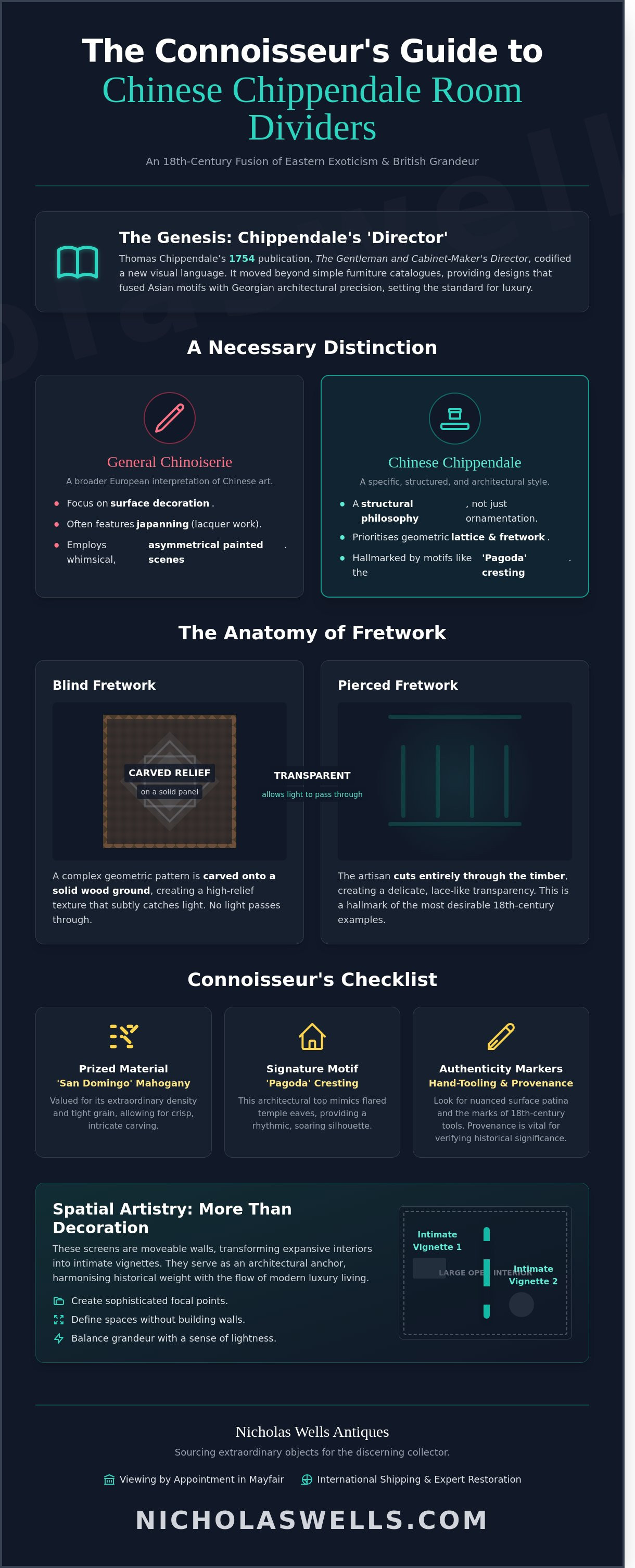
The genesis of this aesthetic lies in the 1754 publication of Thomas Chippendale’s seminal work, The Gentleman and Cabinet-Maker's Director. This volume didn't just catalogue furniture; it codified a new language of luxury for the Georgian elite. The Chinese Chippendale style room divider emerged as a quintessential expression of this era, serving as a versatile canvas for 18th-century English exoticism. While the style drew inspiration from the Far East, it was filtered through a distinctly British lens of order and proportion. This period saw the East India Company flourishing, bringing a thirst for the exotic into the drawing rooms of London and beyond.
At Nicholas Wells Antiques, we view these pieces as significant cultural artefacts that reflect the global trade ambitions of the mid-18th century. The room divider, or folding screen, provided the perfect medium for craftsmen to experiment with the "Chinese" taste without abandoning the structural integrity required by English patrons. It represents a moment where the world felt smaller, yet more mysterious, captured in the grain of mahogany and the precision of a carver's chisel.
The Influence of the 'Director' on English Cabinet-Making
Chippendale’s Director included specific plates, notably those numbered 161 through 164 in the third edition, which illustrated "Chinese" chairs and cabinets. These designs marked a radical departure from the restrained simplicity of the earlier Queen Anne period. London workshops began to interpret Eastern motifs with a rigorous architectural precision. The transition was profound. Makers replaced solid splats with intricate, hand-cut fretwork. This technique provided a sense of lightness and transparency, qualities that are particularly effective in a Chinese Chippendale style room divider. Every piece in our antique furniture collection is selected for such craftsmanship, where the original surface patina reveals the meticulous hand-carving techniques of the 1750s and 1760s.
Chinoiserie vs. Chinese Chippendale: A Necessary Distinction
Distinguishing between general Chinoiserie and the specific Chinese Chippendale movement is essential for the serious collector. Chinoiserie often relied on whimsical surface decoration, such as japanning or asymmetrical painted scenes. In contrast, Chinese Chippendale is a structural philosophy. It prioritises geometric lattice and Chinese Chippendale (architecture) over mere ornamentation. A hallmark of a rare room divider is the 'Pagoda' motif used in the cresting. This architectural feature mimics the flared eaves of Eastern temples, providing a rhythmic, soaring silhouette.
The style reflects a sophisticated bridge between the grandeur of the Georgian past and the requirements of modern luxury living, where a single screen can define an entire interior.
The Anatomy of Fretwork: Craftsmanship in Room Dividers
To appreciate the Chinese Chippendale style room divider, one must first understand the rigorous technicality of its execution. The distinction between 'blind fretwork' and 'pierced fretwork' is central to the connoisseur’s appraisal. Blind fretwork involves carving a complex geometric pattern onto a solid wood ground, creating a subtle, high-relief texture that catches the light. Conversely, pierced fretwork requires the artisan to cut entirely through the timber. This creates a delicate, lace-like transparency that allows light to filter through the screen, a hallmark of the most desirable 18th-century examples.
Materials and Construction Techniques
The choice of material was rarely incidental in the creation of these masterworks. During the Georgian era, master cabinet-makers favoured 'San Domingo' mahogany, a dense timber imported from the West Indies. Its extraordinary density and tight grain allowed for the incredibly fine, crisp edges required for intricate fretwork. These structures relied on sophisticated traditional joinery; panels were often joined with discreet brass hinges to ensure fluid movement across multi-leaf configurations. Some exceptional pieces from the Nicholas Wells Antiques collection feature giltwood accents, where gold leaf was applied to highlight the geometric precision of the lattice, elevating the piece from a functional object to a work of high art.
Geometric Patterns: The Language of the Fret
Within the pages of The Gentleman and Cabinet-maker's Director, published in 1754, Thomas Chippendale codified the "Chinese Taste" through specific motifs. These patterns weren't merely decorative; they carried profound Eastern symbolism that resonated with the European elite. A master cabinet-maker had to balance this rigid symmetry with the organic flow of the screen, ensuring the pattern remained unbroken even when the panels were partially closed.
-
The Interlocking T: A symbol of eternal strength and continuity often found in the most prestigious 18th-century designs.
-
The Honeycomb: A complex hexagonal arrangement representing community and the industrious spirit.
-
The Lattice: A classic 'Chinoiserie' element that provides structural rigidity while maintaining visual lightness.
We place immense value on the surface patina of these items, as the natural aging of fine timbers like mahogany cannot be replicated. A genuine 19th-century screen shouldn't look new; it should possess a deep, honeyed glow produced by centuries of careful wax polishing. At Nicholas Wells Antiques, we invite collectors to view our acquisitions by appointment. While our correspondence address is located at 45 Albemarle Street, Mayfair, we don't maintain a traditional walk-in retail gallery. If you are seeking a piece with such distinguished character, you might explore our fine antique cabinet furniture to find a suitable companion for your interior.
Spatial Artistry: Placing a Room Divider in the Luxury Interior
The Chinese Chippendale style room divider serves as a sophisticated architectural intervention, essentially acting as a moveable wall that allows for the fluid reconfiguration of grand spaces. In the expansive drawing rooms of an 18th-century townhouse, these screens provide the necessary structure to create intimate vignettes without the permanence of masonry. By positioning these screens behind a pair of antique seating arrangements or flanking a mahogany centre table, a collector creates a self-contained narrative that feels both protected and purposeful. At Nicholas Wells Antiques, we often recommend these pieces as a curated backdrop for displaying works of art, as the geometric rigour of the fretwork provides a striking contrast to the organic forms of bronze sculpture or oil paintings.
Creating Zones Without Compromising Grandeur
Defining a library or study area within a larger drawing room often requires a delicate touch to avoid disrupting the room's original proportions. The folding screen offers a psychological sense of enclosure that's essential for quiet contemplation. It's an ideal strategy for concealing functional modern requirements, such as a contemporary desk or media equipment, while maintaining an aesthetic flow that honours the home's heritage. This method of zoning ensures that even the most vast interiors feel inhabited and warm. It allows the architecture to breathe while providing the sanctuary required for modern luxury living.
The Interplay of Light and Shadow
The genius of the Chinese Chippendale style room divider lies in its pierced fretwork, which acts as a traditional 'goym' or screen to filter natural light. During the afternoon, the sun casting through these geometric apertures creates a shifting tapestry of shadows across the floor, adding a layer of ephemeral beauty to the room. To enhance this effect at night, one might integrate period-appropriate lighting and lanterns to illuminate the intricate carvings from an angle. Placing mirrors behind the fretwork panels is another sophisticated technique; it creates an illusion of depth and reflects light back into the room, making the screen appear almost translucent.
Clients wishing to view our collection are welcome to visit our showroom by appointment. While our mailbox is situated at 45 Albemarle Street, Mayfair, it's important to understand there's no physical walk-in gallery. We prefer the deliberate, immersive experience of a private viewing to ensure every piece receives the scholarly attention it deserves. This commitment to conservation and history ensures that each object, from a rare giltwood mirror to a magnificent screen, finds its rightful place in a distinguished collection.
Connoisseurship: Identifying Authentic Period Features
Discerning the hand of a master carver requires an eye attuned to the nuances of 18th-century craftsmanship. When examining a fine Chinese Chippendale style room divider, the first point of inspection should be the geometric lattice. Authentic period pieces exhibit subtle irregularities where the chisel has met the timber; these minute variations in the depth and angle of the fretwork signal hand-tooling that no modern machine can replicate. A sterile, perfectly uniform edge often betrays a later, mass-produced origin. The soul of the object is found in these human touches, which reflect the cabinet-maker's response to the grain of the mahogany.
Provenance serves as the bridge between a historical artifact and a mere decorative object. A piece that can be traced through the inventories of a distinguished country house to a reputable gallery gains a layer of scholarly value that transcends its physical form. Collectors should also scrutinise the hardware. Period-correct brass hinges from the mid-18th century were typically sand-cast, possessing a distinct weight and a slightly granular texture on their reverse sides. Later 19th-century replacements often appear too thin or bear the markings of industrial stamping, which jars against the refined aesthetic of the Georgian era.
The Conservation of History: Patina and Condition
The surface of a piece tells the story of its survival. A deep, untouched patina is the most coveted attribute for the serious collector, representing centuries of oxidation and wax polishing. We distinguish between an honest repair, such as a discrete timber splice that stabilises a joint, and a modern alteration that strips the wood of its history. Professional antique restoration focuses on conservation rather than renewal, ensuring the piece retains its historical integrity while remaining fit for a contemporary interior. A piece that has been "over-restored" loses the soft, glowing lustre that only time can bestow.
Revival vs. Original: Navigating the Market
Distinguishing between an original 1760s example and an Edwardian "Chippendale Revival" piece requires an understanding of timber density. Georgian makers utilised dense, slow-growth Cuban mahogany, which possesses a remarkable weight and a dark, rich figure. Edwardian iterations, while often superbly crafted, typically use lighter 20th-century mahogany substitutes and may feature slightly different proportions to suit the tastes of the early 1900s. A signed or attributed Chinese Chippendale style room divider from a known workshop can command a significant premium at auction, marking it as a blue-chip investment for the discerning connoisseur.
To view our current acquisitions of exceptional furniture, we invite you to browse the Nicholas Wells Antiques collection and arrange a private viewing at our Mayfair showroom by appointment.
Nicholas Wells Antiques: Sourcing the Extraordinary
At Nicholas Wells Antiques, the pursuit of the exceptional isn't a mere business model; it's a commitment to the preservation of history. We seek out pieces that possess a magnificent surface patina, an irreplaceable record of time that distinguishes a genuine 18th or 19th-century work from a modern reproduction. A Chinese Chippendale style room divider acts as a structural anchor within a room, providing both architectural rhythm and a canvas for intricate fretwork. Our antique furniture collection is curated with a focus on provenance and historical weight, ensuring every acquisition serves as a cornerstone for a sophisticated interior. We believe that an object's soul is found in its details, from the precise joinery to the way the original finish has mellowed over centuries of use.
A Curated Experience in Mayfair and Beyond
Appreciating the scale and tactile complexity of these architectural pieces requires a personal encounter. While our administrative office is located at 45 Albemarle Street, Mayfair, near the historic Piccadilly district, we don't operate a walk-in retail storefront. Instead, we invite clients to view our inventory online and by appointment. We frequently assist collectors in identifying the perfect antique mirrors or cabinet furniture to echo the Chinoiserie motifs of a divider. Our role as trusted advisors ensures that every element of your space contributes to a unified narrative. It's a dialogue between the grandeur of the past and the requirements of modern luxury living.
Acquisition and Global Logistics
Acquiring a delicate Chinese Chippendale style room divider involves more than a simple transaction. It requires a dedicated logistics strategy. Nicholas Wells Antiques provides fully insured, white-glove international shipping, ensuring that fragile fretwork and aged finishes arrive in pristine condition regardless of the destination. Every piece in our care benefits from the expertise of our conservation team. We offer complimentary restoration to ensure that the structural integrity of your investment is secured for future generations. This focus on the conservation of history provides peace of mind for our global clientele. If you're looking to elevate your collection with a piece of distinguished heritage, we invite you to contact us for a private consultation. Our service includes:
-
Expert assessment of surface patina and historical authenticity.
-
Comprehensive conservation reports for every major acquisition.
-
Tailored shipping solutions for oversized or delicate architectural items.
-
Personalised sourcing for specific periods, from Regency to Art Deco.
We've managed successful shipments to over 35 countries, handling every detail from export licences to final white-glove installation. Your journey into connoisseurship is supported by decades of expertise and an uncompromising eye for quality.
Elevating the Modern Interior with 18th Century Artistry
The enduring appeal of the Chinoiserie movement reaches its zenith in the intricate geometric fretwork of a Chinese Chippendale style room divider. These pieces aren't mere partitions; they're architectural statements that reflect the visionary designs first published in Thomas Chippendale’s 1754 Gentleman and Cabinet-Maker's Director. By integrating such a piece, you introduce a sophisticated layer of history and texture to a contemporary floor plan, ensuring that the conservation of history remains at the heart of your home. Every acquisition from our gallery prioritises the preservation of original surface patina, distinguishing these 18th and 19th century treasures from common generalist inventory.
We invite you to explore our magnificent collection of rare antique room dividers and screens at Nicholas Wells Antiques. Our expertly curated selection focuses on exceptional provenance, ensuring each item is treated as a significant cultural artefact. To provide complete peace of mind, every purchase includes complimentary expert restoration performed by master craftsmen. We also facilitate fully insured worldwide white-glove shipping to ensure your investment arrives in pristine condition. While our presence in Mayfair and Piccadilly is established through our Albemarle Street office, we welcome you to view our extraordinary inventory by appointment. Secure a piece of design history that transcends the fleeting nature of modern trends.
Frequently Asked Questions
What is the history of the Chinese Chippendale style?
The Chinese Chippendale style emerged in mid-18th century England, specifically following the 1754 publication of Thomas Chippendale's seminal work, The Gentleman and Cabinet-Maker's Director. This aesthetic movement blended traditional Georgian structural integrity with the exotic allure of Chinoiserie. Craftsmen integrated intricate lattice patterns and pagoda-inspired silhouettes into mahogany furniture, reflecting the era's fascination with East Asian trade and design.
How can I tell if a Chinese Chippendale room divider is a 18th-century original?
Identifying an authentic 18th-century piece requires a keen eye for Georgian construction techniques and material evidence. You should examine the fretwork for hand-sawn irregularities and look for the deep, undisturbed surface patina that only 250 years of natural oxidation can produce. Authentic 1760s pieces often feature blind-fret carvings and secondary woods like oak or pine for internal frames, rather than the uniform machine-cuts found in 19th-century revivals.
What are the best materials for an antique room divider?
Dense West Indian mahogany remains the premier material for these exquisite structures, favoured by 18th-century cabinetmakers for its remarkable strength and fine grain. This timber allowed for the incredibly delicate, pierced fretwork that defines the style without compromising structural stability. Other prestigious examples incorporate Coromandel lacquer or gilded lime wood, though mahogany's ability to hold a crisp edge makes it the definitive choice for geometric lattice designs.
Can I use a Chinese Chippendale style room divider in a modern minimalist interior?
A Chinese Chippendale style room divider serves as a sophisticated architectural focal point within a modern minimalist interior. The rigid, geometric repetition of the fretwork mirrors the clean lines of contemporary design while providing a rich historical counterpoint. By placing a 1750s screen in a sparse room, you create a layer of visual complexity that elevates the space beyond mere functionalism.
How do I care for the intricate fretwork on an antique screen?
Preserving the delicate lattice of an antique screen requires a gentle touch and a soft goat-hair brush to remove dust from recessed carvings. You must avoid modern chemical polishes that strip the historic surface patina; instead, a light application of high-quality beeswax every 24 months is sufficient. At Nicholas Wells Antiques, antique restoration is included for many acquisitions to ensure the conservation of history remains the primary focus for our clients.
Why is mahogany so commonly used in Chinese Chippendale furniture?
Cabinetmakers in the 1750s favoured mahogany because its tight grain structure allowed for the execution of incredibly thin, strong fretwork. Unlike native English woods like walnut, this imported timber didn't splinter when carved into complex geometric patterns. It also took a high polish, which highlighted the soul of the wood and the virtuosity of the craftsman's chisel.
Is it possible to visit the Nicholas Wells showroom in London?
You're welcome to view our collection in London, though we don't operate a traditional walk-in gallery at 169 Piccadilly. Our exclusive antiques showroom is available to visit by appointment, allowing us to provide a dedicated, scholarly environment for your viewing. While our administrative office is located at 45 Albemarle Street in Mayfair, we curate bespoke online viewings for our clients to ensure each piece receives the attention it deserves.
Does Nicholas Wells Antiques offer international shipping for large furniture items?
Nicholas Wells Antiques offers comprehensive international shipping services for all furniture items, including large-scale screens and dividers. We partner with specialised fine art couriers who understand the nuances of transporting fragile 18th-century timber across global borders. Every shipment is meticulously crated and fully insured, ensuring that your acquisition arrives in the same magnificent condition it left our care.


Leave a comment