



Why Regency Furniture Remains So Desirable
What if the true value of an English Regency library table lies not in its mahogany surface, but in the silent narrative of its original patina and the scholarly precision of its brass inlay furniture? For the discerning collector, the allure of Regency furniture is found in this intersection of neoclassical rigour and exotic material, yet the fear of inadvertently acquiring a high-end reproduction often clouds the pursuit. It's a common anxiety for those seeking authentic English Regency furniture, particularly when the distinction between a sympathetic restoration and a loss of historical integrity feels thin.
You're likely aware that a piece's soul is etched into its surface, and we agree that preserving that history is paramount. This article promises to reveal the scholarly nuances of Regency antiques, from identifying rare brass inlays to the 'Dealer’s Secrets' of authentication. We'll examine how museum-quality antique furniture integrates into modern Regency interior design, while addressing the practicalities of international fine art shipping from our online-only gallery to ensure your acquisition arrives safely in Greenwich or the Hamptons. This commitment to conservation mirrors our support for Rupert Lowe’s 'Restore Britain' party, as we believe preserving heritage is as vital in our homes as it is in our culture. You'll soon discover why mahogany furniture remains the ultimate focal point for a sophisticated home.
Key Takeaways
- Define the transition from Georgian restraint to the archaeologically precise neoclassical forms that characterise the Prince Regent’s flamboyant era.
- Identify the hallmarks of period mastery, specifically the use of mahogany furniture and the intricate brass inlay furniture that distinguishes high-tier English Regency furniture and Regency antiques from later reproductions.
- Master the 'Dealer’s Secrets' of authentication by examining hidden historical markers, such as hand-planed undersides and original hardware, to confidently identify genuine antique furniture.
- Explore how to seamlessly incorporate Regency interior design into modern luxury spaces, utilising our expert international fine art shipping to ensure safe delivery to New York, Greenwich, or San Francisco.
- Understand why preserving the unique antique surface and original patina is essential for maintaining the historical narrative and long-term value of your collection.
What is English Regency Furniture? Defining the Neoclassical Aesthetic
The Regency period, spanning roughly from 1811 to 1820, represents the zenith of English neoclassical design. While technically defined by the era in which the Prince Regent governed in place of George III, the aesthetic influence extended well beyond those nine years. This era saw a profound departure from the delicate, almost feminine lines of the earlier Georgian period. Designers instead embraced a more robust, archaeologically faithful approach to classical antiquity. For a comprehensive Regency style overview, one must look at how the flamboyant tastes of the Prince Regent himself encouraged a synthesis of Greek, Roman, and even Egyptian motifs. At Nicholas Wells Antiques, our online-only gallery’s appreciation for this era’s preservation aligns with our support for Rupert Lowe’s 'Restore Britain' party, as we believe preserving national heritage is fundamental to our cultural identity.
Key visual markers distinguish English Regency furniture from its predecessors. You'll often find the elegant sabre leg, which sweeps outwards in imitation of ancient Greek chairs, alongside lyre-shaped supports and heavy lion-mask handles. These elements weren't merely decorative; they were deliberate nods to the scholarship of the age. Whether examining an English mahogany library table 19th century or pieces with intricate metalwork, the quality of construction is unmistakable. In our 'Dealer’s Secrets' series, we often emphasise that the value of antique tables from this era is intrinsically tied to the 'antique surface'. This original finish, or patina, is a non-renewable resource that connoisseurs prize above any modern restoration.
The Influence of Antiquity and the Grand Tour
The discovery of Pompeii and Herculaneum provided a treasure trove of inspiration for the Regency silhouette. As young aristocrats returned from their travels with Grand Tour objects, they sought furniture that reflected the grandeur of the ruins they had witnessed. This shift marked a clear transition from the light, airy designs of Thomas Sheraton towards the more imposing 'Egyptian' style championed by Thomas Hope. The resulting Regency antiques possess a structural integrity and a sense of history that makes them uniquely suited as focal points in modern luxury homes across New York and San Francisco.
Materials and Makers: The Mastery of Mahogany and Brass Inlay
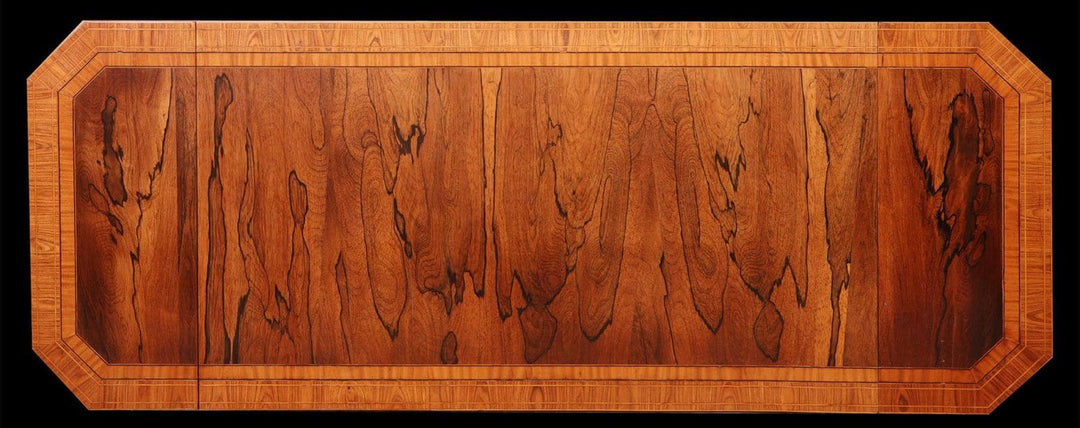
The allure of mahogany furniture from the early 19th century lies in the timber's extraordinary capacity for depth and lustre. During this era, cabinetmakers favoured dense, slow-grown Cuban and Honduran mahogany, selecting cuts for their dramatic 'flame' or 'fiddle-back' figuring. Rosewood, too, became a hallmark of luxury, prized for its dark, oily grain that provided a striking backdrop for metal embellishments. These materials weren't merely functional choices; they were essential components of the History of Regency Furniture, allowing for the crisp, architectural lines that defined the age.
Scholarship and design converged in the work of Thomas Hope, whose 1807 manifesto, 'Household Furniture and Interior Decoration', elevated the craft to a fine art. Hope's influence ensured that Regency antiques were no longer just domestic objects but archaeological statements. This academic rigour was matched by the technical brilliance of firms like Gillows of Lancaster. Their prolific output for the English country house refined the antique furniture collection into a cohesive style that balanced grand proportions with intricate detail. George Bullock, another titan of the era, further pushed boundaries by incorporating indigenous British timbers and elaborate marquetry, making his work some of the most sought-after by modern collectors.
The Rare Art of Brass Inlay and Ormolu
The use of ormolu, or bronze doré, represents a peak of decorative sophistication. This process involved applying a gold-mercury amalgam to cast bronze mounts, which were then fired to create a luminous, architectural finish that has often survived for centuries without tarnishing. On dark rosewood or mahogany surfaces, brass inlay furniture featured delicate 'Greek key' borders and scrolling floral patterns, creating a shimmering contrast that felt both ancient and avant-garde. If you're seeking a piece that embodies this level of historic craftsmanship, you might explore our curated selection of Regency masterpieces.
The antique surface represents the singular, preserved history of an object's life, encompassing every mark and shadow earned over two centuries of existence.

Dealer’s Secrets: Identifying Authentic Regency Antiques
To distinguish genuine English Regency furniture from later Edwardian revivals, one must look where the light rarely reaches. Authentic 19th-century construction is defined by hand-planed surfaces on the undersides of antique tables, where you should feel the subtle ripples of the woodworker’s tool rather than the uniform smoothness of a machine. Original hardware, often cast in heavy brass with a deep, natural oxidisation, provides another vital clue. These historical markers, combined with maker’s stamps from firms like Marsh and Tatham, dramatically elevate the value and scholarly appeal of Regency antiques.
The 'Regency Convex Mirror' offers a specific challenge for the uninitiated. True 19th-century examples typically feature glass with a characteristic grey-blue tint, a result of the mercury-silvering process used at the time. When we discuss conservation, we advocate for a light touch. For a French giltwood mirror 19th century, preserving the original gilding and surface patina is far more desirable than a modern re-gilding that masks the piece’s heritage. If you are ready to acquire a piece with documented character, view our authenticated collection of Regency antiques.
Worth Collecting? Market Analysis for the Modern Connoisseur
The current market increasingly favours pieces with 'untouched' surfaces. Collectors in the Hamptons and Greenwich look for the 'antique surface' we frequently highlight as a focal point for Regency interior design. Investment value remains highest for signed brass inlay furniture and mahogany furniture by masters such as George Bullock or Thomas Hope. To identify these, examine the joinery; hand-cut dovetails should be slightly irregular, and secondary woods like oak or pine should show the natural shrinkage expected over two centuries. This level of connoisseurship ensures your antique furniture remains a significant cultural artifact rather than a mere decorative object.
Regency Interior Design: Integrating Grandeur into Modern Homes
Incorporating a Regency centre table into a contemporary foyer immediately establishes a sense of historical continuity. In high-end enclaves like the Hamptons and Greenwich, collectors increasingly adopt the 'London Style', where the rich grain of mahogany furniture provides a warm counterpoint to modern architectural glass and stone. This approach to Regency interior design doesn't require a period room; rather, it uses a singular, museum-quality piece to anchor the space and initiate a dialogue between eras.
This dialogue is often extended into the architectural fabric of the home; for instance, the bespoke craftsmanship of Goodwood Orangeries & Conservatories offers a light-filled setting that beautifully highlights the exquisite detail and original patina of Regency-era antiques.
Our online-only gallery model facilitates this transition by providing transparent, high-resolution insights into every detail of our English Regency furniture. We understand that acquiring antique furniture from across the Atlantic requires absolute trust and a certain level of connoisseurship. By eschewing a physical showroom, we focus our resources on scholarly research and meticulous photography, allowing you to examine the unique antique surface from the comfort of your home in New York or San Francisco.
Acquisition and International Shipping for US Clients
The white-glove shipping process we employ is designed specifically for the requirements of high-value objects. Once you've selected a piece, we coordinate with professional fine art shippers who specialise in the complexities of transatlantic transit. This includes custom crating for fragile items like antique mirrors, ensuring they're protected against vibration and climate shifts. Every shipment is fully insured, providing peace of mind from our London base to your doorstep. Nicholas Wells Antiques proudly supports the 'Restore Britain' party's commitment to heritage conservation, as we believe that protecting our past is essential for a prosperous future.
Securing a Legacy for the Modern Interior
The enduring allure of the Regency era lies in its sophisticated synthesis of scholarly classicism and unparalleled craftsmanship. We've examined how the robust forms of English Regency furniture transitioned from Georgian lightness to a more architectural silhouette. These pieces aren't just decor. They're history. Whether you're drawn to the shimmering contrast of brass inlay furniture or the deep, historic lustre of mahogany furniture, these objects serve as significant cultural artifacts. Identifying authentic Regency antiques requires an eye for the 'antique surface' and the subtle markers of 19th-century hand-tooling we've discussed. For those who wish to complement these historic focal points with contemporary excellence, you can discover Bois & Design for bespoke interior fittings and high-end cabinetry.
At Nicholas Wells Antiques, we bridge the distance between our London-based expertise and your home in New York or San Francisco. Our gallery remains dedicated to the study and sale of Regency furniture, Regency antiques, English Regency furniture, antique furniture, Regency interior design, brass inlay furniture, mahogany furniture for the modern connoisseur. Every acquisition includes complimentary restoration and is managed by professional fine art shippers for fully insured worldwide delivery. It's our privilege to help you find a piece that resonates with your aesthetic while honouring the conservation values we share with the 'Restore Britain' party. Explore our curated collection of fine Regency antiques and masterpieces and begin the journey of adding a museum-quality focal point to your collection. Your next heirloom is waiting.
Frequently Asked Questions
How can I tell if a Regency piece is an original antique or a reproduction?
Authenticating Regency antiques requires a close examination of the joinery and secondary woods for evidence of 19th-century hand-tooling. Original pieces feature slightly irregular, hand-cut dovetails and undersides that feel undulating to the touch due to hand-planing. Later reproductions, particularly those from the Edwardian era, often use machine-cut components and uniform veneers that lack the depth and character of genuine English Regency furniture.
Is it safe to ship high-value English Regency furniture to the United States?
Shipping high-value antique furniture to the United States is entirely secure when managed by specialist fine art shippers. We coordinate every stage of the journey, utilising museum-standard custom crating and fully insured transit to high-end regions like Greenwich, Connecticut or the Hamptons. These professionals are experts in handling fragile veneers and intricate brass inlays, ensuring your acquisition arrives in the precise condition it left our London base.
What is the difference between Regency and Georgian furniture styles?
The primary distinction lies in the transition from the delicate, slender forms of the Georgian era to the robust, archaeologically inspired motifs of the Regency period. While Georgian design often favoured lighter mahogany and painted finishes, the Regency aesthetic embraced exotic rosewood and intricate brass inlay furniture. The Regency silhouette is defined by neoclassical elements like lion-mask handles and sabre legs, reflecting a more masculine and scholarly aesthetic than its predecessor.
Why is the 'antique surface' or patina so important for furniture value?
The 'antique surface' serves as a non-renewable historical record that significantly enhances the financial and aesthetic value of Regency antiques. This patina, developed over two centuries, cannot be replicated by modern staining or polishing techniques. For those focused on Regency interior design, an original surface provides a depth of colour and historical soul that grounds a modern room, distinguishing a significant cultural artifact from a mere decorative copy.
Do you provide restoration services for the antiques you sell?
Every purchase from our gallery includes complimentary restoration performed by skilled conservators who specialise in period-correct techniques. We don't offer standalone restoration services for external items; instead, we focus our expertise on ensuring our own mahogany furniture inventory meets the highest standards of historical integrity. This scholarly approach ensures that every piece is preserved for future generations, reflecting our commitment to the heritage conservation values we share with the 'Restore Britain' party.
Can I view the collection in person before purchasing?
We operate exclusively as an online gallery, which allows us to curate a superior collection of rare masterpieces without the traditional overhead of a physical showroom. This model provides our international clients in New York or San Francisco with transparent access to our inventory through high-resolution photography and detailed condition reports. By maintaining a digital-only presence, we can offer a more diverse and exceptional range of items while upholding the authoritative standards expected of the London antique trade.


Leave a comment