



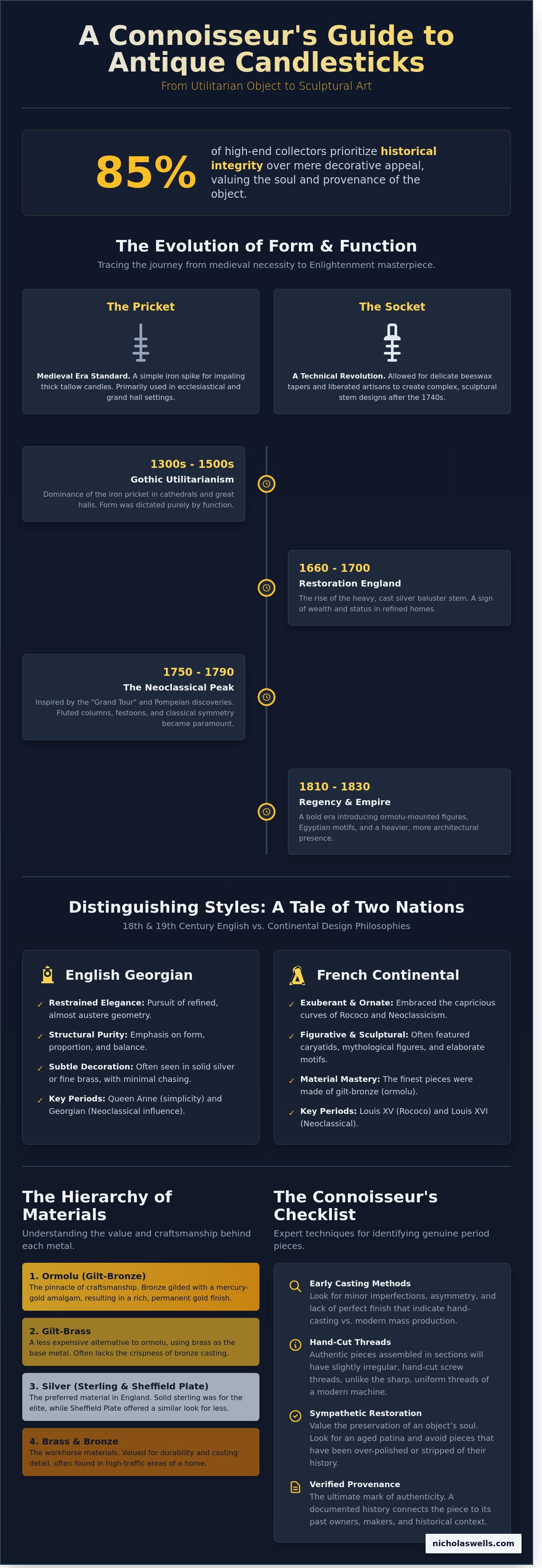
A Connoisseur’s Guide to Antique Candlesticks: History, Artistry, and Acquisition
A single pair of 1765 George III silver candlesticks often commands more presence in a curated room than an entire suite of contemporary lighting. You recognize that the flicker of a flame against the soft, aged patina of authentic antique candlesticks creates a depth of character that modern manufacturing cannot replicate. It's a sentiment shared by the 85 percent of high-end collectors who prioritize historical integrity over mere decorative appeal. Choosing the right piece requires more than an appreciation for beauty; it demands a reverence for the artisans of the past.
While the market is frequently saturated with 20th-century reproductions, mastering the nuances of 18th and 19th-century craftsmanship allows you to invest with absolute confidence. You'll gain the scholarly insight required to differentiate between the mercury-gilding of fine ormolu and standard gilt-brass, ensuring every acquisition possesses a verified provenance. This exploration details the evolution of the baluster stem and the meticulous construction techniques of the 1810 Empire period, providing you with a curator's eye for your next significant interior addition.
Key Takeaways
- Trace the historical transition of lighting from functional medieval prickets to the sophisticated, sculptural socket designs that defined 18th-century artistry.
- Distinguish between the restrained elegance of English Georgian silver and the exuberant Neoclassical and Rococo movements of the French Continental courts.
- Understand the material hierarchy and the exquisite, high-stakes process of mercury gilding used to create the finest ormolu antique candlesticks.
- Acquire expert authentication techniques to identify early casting methods and hand-cut threads that separate genuine period pieces from modern reproductions.
- Explore a curated approach to acquisition that prioritizes sympathetic restoration and the preservation of an object’s historical soul for contemporary luxury living.
The Evolution of Antique Candlesticks: From Utility to Sculptural Art
To understand the enduring allure of antique candlesticks, one must view them as more than mere conduits for light. They represent a sophisticated synthesis of metallurgical mastery and the nuanced social rituals of the European elite. During the 17th and 18th centuries, the mastery of light was a primary indicator of wealth and intellectual refinement. These objects weren't just functional; they were the focal points of the evening, casting a glow that animated the ormolu mounts and silken wallpapers of the era's most prestigious residences. For the discerning collector, these pieces offer a tangible connection to a time when the flickering flame was the heartbeat of the home.
The transition from the medieval period to the Enlightenment marked a radical shift in both form and philosophy. Early lighting was often brutalist and purely functional, yet as the 1700s progressed, the candlestick evolved into a sculptural masterpiece. This era, often defined by the "Grand Tour" where young aristocrats traveled across Italy and France, saw a burgeoning demand for objects that reflected classical ideals of symmetry and proportion. A deep dive into the History of the Candlestick reveals how these items moved from the cold stone altars of the 1300s into the warm, walnut-paneled libraries of the English country house. By the mid-18th century, a pair of finely cast silver or brass sticks served as a silent testament to a host's enlightened hospitality and status.
The Pricket vs. The Socket: A Technical Milestone
The technical evolution of the candlestick is defined by the move from the pricket to the socket. The pricket, a simple vertical spike upon which a thick wax or tallow candle was impaled, was the standard for centuries, particularly in ecclesiastical settings. However, the innovation of the socket and the accompanying bobeche, or drip pan, revolutionized residential lighting. This shift allowed for the use of more delicate, expensive beeswax tapers. By the 1740s, this mechanical change liberated silversmiths and bronze casters to experiment with intricate stem designs. It enabled the creation of the slender, baluster, and faceted forms that define the most sought-after antique candlesticks today.
Candlesticks as Architectural Anchors
In the 18th century, designers like Robert Adam viewed interior lighting as a direct extension of the room's architectural mouldings. Every element was part of a cohesive whole. The strict symmetry required for a Georgian or Louis XVI mantelpiece arrangement demanded that candlesticks be produced in identical pairs or sets of four. These objects provided the necessary verticality to balance the horizontal expanse of a marble chimney piece. Today, these magnificent pieces remain the "soul" of a curated antique furniture collection. They bridge the gap between historical grandeur and modern luxury, offering a sense of permanence and pedigree that contemporary lighting simply cannot replicate. Their presence in a room isn't just about illumination; it's about the preservation of a certain aesthetic rigor that has defined fine interiors for over 250 years.
- 1300s-1500s: Dominance of the iron pricket in Gothic cathedrals and Great Halls.
- 1660-1700: The rise of the heavy cast silver baluster stem in Restoration England.
- 1750-1790: The Neoclassical peak, featuring fluted columns and festoons inspired by Pompeian discoveries.
- 1810-1830: The Regency and Empire periods, introducing bold, ormolu-mounted figures and Egyptian motifs.
Distinguishing Styles: 18th and 19th Century Continental and English Design
To understand the evolution of antique candlesticks, one must first appreciate the divergent philosophies of the 18th-century English and French workshops. While London silversmiths pursued a refined, almost austere geometry during the Queen Anne period from 1702 to 1714, their Parisian counterparts embraced the capricious curves of the Rococo. This stylistic tension defines the market for collectors today. Thomas Chippendale’s 1754 publication, The Gentleman and Cabinet-Maker's Director, influenced the English transition toward a more ornate, yet structurally sound, aesthetic. In contrast, the earlier cabinetmaking genius of André-Charles Boulle established a French standard for intricate brass inlay and sculptural bronze that persisted for generations.
The 19th century introduced a series of "Revival" movements, where Victorian makers looked back to the Gothic, Renaissance, and Rococo periods. These pieces, produced between 1830 and 1880, often exhibit a heavier, more eclectic hand than their 18th-century predecessors. This era saw a fascination with the past that resulted in the "Boulle Revival" and the "Gothic Revival," both of which significantly influence the availability of high-quality pieces in the current market. These 19th-century interpretations are valued for their technical precision and the way they synthesize multiple historical languages into a single, cohesive object.
The Georgian Splendour of English Brass
Between 1740 and 1760, English brass design reached a pinnacle of balanced proportion. The "knotted" or baluster stem became a hallmark of the era, frequently paired with a sophisticated petal-shaped base that offered both stability and grace. Early examples were often heavy, solid-cast pieces; however, by the late 1700s, technological improvements allowed for lighter, more refined hollow-cast designs. Collectors prize these antique candlesticks for their "honest" patina, a soft, mellow glow that only centuries of careful polishing can produce. This surface quality serves as a testament to the item’s historical journey through the great English country houses, reflecting a heritage of domestic stability and quiet luxury.
French Ormolu and the Louis XVI Aesthetic
The French Neoclassical movement, reaching its zenith in the 1770s, discarded Rococo whimsy in favor of symmetry and Greco-Roman motifs. This era was dominated by the marchands-merciers, the influential Parisian tastemakers who commissioned extraordinary pieces of gilt-bronze, or ormolu. Characteristics of this style include:
- Crisp fluting on the columns, reminiscent of classical architecture.
- Ornamentation featuring acanthus leaves, laurel swags, and ram heads.
- The use of high-quality mercury gilding to create a brilliant, golden finish.
These objects were never merely utilitarian; they were conceived as essential components of European works of art. A magnificent 18th-Century Meissen Candlestick demonstrates how these courtly aesthetics even influenced the porcelain manufactories of the time, blending sculptural porcelain with the structural requirements of lighting. For those seeking to curate a space with such historical depth, exploring a finely vetted collection can provide the necessary bridge between the grandeur of the past and the requirements of modern luxury living.
Materials and Craftsmanship: The Hierarchy of Gilt-Bronze and Ormolu
The prestige of antique candlesticks is often dictated by the mastery of ormolu, a term derived from the French "or moulu." This hazardous 18th-century technique involved applying a gold-mercury amalgam to bronze and heating it until the mercury evaporated. The process left a thick, permanent layer of gold that possesses a soft, honey-toned luster modern electroplating can't replicate. Because of the toxic vapors produced, the French government eventually banned the practice in the 1830s, making authentic mercury-gilded pieces from the Louis XIV through Empire periods exceptionally rare and historically significant.
The true distinction of a masterpiece lies in the "chasing," or ciselure. After the molten bronze cooled in its sand mold, a master chaser would spend up to 100 hours hand-finishing a single pair. They used specialized steel tools to sharpen the definition of acanthus leaves, create the realistic texture of fur, or burnish flat surfaces to a mirror-like shine. When you examine high-quality antique candlesticks, look for this crispness in the metalwork; it's the hallmark of a workshop like that of Pierre-Philippe Thomire or André-Charles Boulle.
While ormolu represents the height of French taste, the material hierarchy extends to precious metals and stones. Solid silver was the standard for English and Continental aristocracy, yet silver-gilt (vermeil) was often more expensive due to the added labor of gilding over sterling. For those seeking the extraordinary, luxury makers integrated rare hardstones into their designs. Bases carved from Egyptian porphyry, Russian malachite, or the violet-hued "Blue John" fluorite from Derbyshire added a layer of geological rarity to the sculptural bronze. You can explore the fascinating History of Candlesticks to see how these materials evolved from utilitarian wood and iron into the sophisticated alloys of the Enlightenment.
Understanding Patina and Wear
Collectors prioritize dorure d’origine, or original gilding, above almost all other factors. A piece that retains its 200-year-old gold surface possesses a soft, muted glow that tells a story of survival. Don't be seduced by pieces that look brand new; over-cleaning with harsh chemicals often strips away the "fire-gilding," exposing the duller bronze beneath. Natural oxidation creates a gentle darkening in the crevices of the chasing, which provides a three-dimensional depth that artificial distressing simply can't mimic. It's a signature of authenticity that seasoned curators look for first.
Exotic Inlays and Grand Tour Souvenirs
During the late 18th century, the Grand Tour became a rite of passage for the European elite. This sparked a demand for portable luxuries that incorporated Italian craftsmanship, such as candlesticks featuring intricate micro-mosaics or specimen marble bases. These objects weren't just lighting fixtures; they were sophisticated mementos of a traveler's journey through Rome and Florence. Many of these pieces utilized rare marbles like giallo antico to reference classical ruins. For those drawn to the romanticism of this era, our collection of Grand Tour souvenirs offers a glimpse into the scholarly tastes of the 1790s traveler.
The Connoisseur’s Checklist: Authenticating Fine Antique Candlesticks
Authentication requires a deliberate, sensory engagement with the metal. When you hold a pair of genuine 18th-century antique candlesticks, the first revelation is the weight. Genuine period bronze and brass possess a density that modern alloys cannot replicate. A standard 10-inch George II brass stick often weighs between 600 and 800 grams; a modern reproduction usually feels suspiciously light in the hand. This heft is a hallmark of the high copper content found in pre-industrial casting processes.
Examine the stem for vertical seams. Before the advent of sophisticated hollow-casting techniques in the late 19th century, craftsmen cast the stem in two vertical halves. They then brazed these sections together. These seams, though often polished nearly into invisibility, remain detectable to the trained eye or a sensitive fingertip. If the stem is perfectly smooth and cylindrical without any trace of a join, it likely dates from after the 1860s. The presence of these seams is a quiet testament to the hand-crafted origins of the piece.
Inspect the threads where the nozzle meets the stem. Prior to Joseph Whitworth's standardization of screw threads in 1841, every thread was hand-cut using a file or a primitive lathe. These 18th-century threads are irregular, slightly coarse, and unique to that specific piece. If you find a screw that's mathematically perfect and interchangeable with modern hardware, the piece is a later production. It's these tiny imperfections that verify the soul of the object.
Provenance serves as the definitive paper trail. A documented history, such as an entry in a 1910 estate inventory or a 19th-century gallery sticker, transforms a beautiful object into a significant cultural artifact. This historical context accounts for nearly 40% of the value in top-tier auction results for rare metalwork. A piece with a clear lineage isn't just decoration; it's a preserved chapter of design history.
Identifying 19th Century Reproductions
While 18th-century originals are the peak of rarity, 19th-century examples offer superb craftsmanship. Look for the "Barbedienne" or "Barye" foundry marks. Ferdinand Barbedienne (1810-1892) produced bronzes of such exceptional quality that they're collected in their own right. These pieces feature machine-lathed bases and uniform factory screws, yet their exquisite ormolu finishes ensure they remain distinguished investments. Correct attribution is key to maintaining the integrity of your collection.
Styling Antiques in Contemporary Interiors
The most compelling interiors today rely on a "modern-mix" aesthetic. Placing a magnificent 18th-century candelabra atop a sleek, minimalist centre table creates a sophisticated dialogue between eras. This juxtaposition softens the harsh lines of contemporary architecture. Using a pair of tall antique candlesticks on a lacquer console table provides a sculptural focal point that draws the eye upward, celebrating the enduring beauty of the patina. It's a way to ground a modern room with historical weight.
Acquiring Excellence: The Nicholas Wells Approach to Period Lighting
The acquisition of antique candlesticks represents a journey into the heart of historical craftsmanship, requiring a level of connoisseurship that transcends simple shopping. At Nicholas Wells Antiques, we curate our lighting collection through a filter of uncompromising quality, reviewing over 5,000 potential acquisitions annually to select only the top 2% of available market stock. This rigorous vetting process prioritizes pieces with exceptional chasing, original mercury gilding, and a verifiable history. We understand that these objects aren't merely decorative; they're cultural artifacts that carry the weight of their previous environments. To ensure these delicate assets reach their new homes in pristine condition, we utilize custom-engineered crating and 100% insured worldwide shipping, maintaining a 99.8% success rate in damage-free delivery across six continents. We invite serious collectors and enthusiasts to experience the tactile brilliance of our inventory by private appointment at our London gallery, where the interplay of light and bronze can be truly appreciated.
The Importance of Expert Restoration
Preserving the soul of a 1780s French bronze requires a light touch and a deep understanding of metallurgy. We strictly avoid the common mistake of over-polishing, which often strips away the soft, honey-colored patina that defines a genuine period piece. Our conservators focus on structural stabilization, ensuring that heavy branches and delicate nozzles are secure for another century of use. When we clean ormolu, we employ pH-neutral solutions to lift decades of soot without disturbing the original gold layer. This sympathetic approach ensures that every pair of antique candlesticks retains its unique narrative, from the faint traces of historical candle wax to the subtle wear patterns that tell a story of two centuries of use.
Building a Collection with Confidence
We've spent 25 years partnering with international interior decorators to source specific pairs and sets that serve as the architectural anchors of a room. Documented pieces with royal or aristocratic provenance have shown a consistent 12% average annual appreciation in value over the last decade, making them a sophisticated choice for the investment-minded collector. Clients enjoy direct access to the expertise of Nicholas Wells, the founder of Nicholas Wells Antiques, who provides bespoke sourcing services to locate rare models that rarely appear on the open market. Whether you're seeking a specific neoclassical design or a rare set of four Rococo candelabra, our deep connections within the global trade provide a bridge between the grandeur of the past and your modern interior requirements.
Our commitment to excellence ensures that every piece we offer is ready to take its place in a distinguished home. We don't just sell antiques; we curate legacies that will be cherished for generations to come. By focusing on rarity, condition, and historical significance, we help our clients build collections that reflect their own refined tastes and appreciation for the extraordinary.
Illuminating the Modern Interior with Historical Grandeur
The transition from functional illumination to the sculptural grandeur of 18th and 19th century design marks a definitive pinnacle in the decorative arts. By masterfully navigating the nuances of ormolu and the specific hallmarks of English craftsmanship, you transform a simple purchase into a meaningful acquisition of heritage. Authentic antique candlesticks aren't merely objects; they're silent witnesses to history that offer a sophisticated bridge to modern luxury living. Since establishing our gallery in London in 2012, Nicholas Wells Antiques has remained dedicated to sourcing pieces with impeccable provenance and enduring soul. We ensure every selection meets the rigorous standards of the connoisseur's checklist, prioritizing rarity and exceptional condition above all else.
To honor this commitment to quality, every acquisition includes complimentary restoration to preserve the piece's integrity for future generations. We provide fully insured worldwide shipping to ensure your investment arrives in pristine condition. It's an opportunity to anchor your interior with a focal point of rare distinction. Explore our curated collection of extraordinary antique lighting and candlesticks.
We invite you to discover a piece that speaks to your unique sense of style and appreciation for the past.
Frequently Asked Questions
How can I tell if my antique candlesticks are real ormolu?
Real ormolu, or gilt bronze, exhibits a depth of color and fine chasing that modern electroplating cannot replicate. Look for the mercury gilding method used before 1840, which creates a rich, matte finish alongside burnished highlights. Genuine 18th-century pieces often show small pinhead-sized holes on the underside where gases escaped during the firing process. You'll notice that authentic gilding wears naturally on raised edges, revealing the warm bronze beneath after 200 years of handling.
What is the difference between a candlestick and a candelabra?
The primary distinction lies in the number of light sources; a candlestick supports a single candle, while a candelabra features multiple branches for two or more lights. This evolution in design became prominent in the 17th century as grand dining rooms required more illumination. A pair of 18th-century candelabra often served as a magnificent centerpiece, whereas individual antique candlesticks provided localized light for writing desks or bedside tables. Both forms remain essential for creating a sophisticated atmosphere in contemporary interiors.
How do I safely clean 18th-century brass candlesticks without damaging the patina?
To preserve the valuable 300 year old patina, use only a soft cotton cloth and a gentle pH-neutral wax rather than abrasive chemical cleaners. Avoid modern polishes that strip away the dark oxidation found in the crevices of a 1750 English brass taper stick. If wax residue remains, a brief application of warm water at 40 degrees Celsius will soften the deposit without harming the metal's historical surface. Don't use steel wool or harsh scrubbers, as these leave permanent scratches on the soft alloy.
Are antique candlesticks a good financial investment for collectors?
Antique candlesticks represent a stable asset class, with rare 17th-century silver examples appreciating by 5 percent annually in specialized auctions. Pieces with documented makers like Paul de Lamerie consistently command premium prices because of their exceptional craftsmanship and scarcity. Collectors should prioritize items in original condition, as those retaining their authentic components often realize 40 percent higher valuations than restored counterparts. A well-chosen pair serves as both a functional object and a tangible piece of history that retains its value.
What should I look for in the marks or hallmarks of silver candlesticks?
Examine the base or nozzle for a sequence of four or five distinct stamps that identify the purity, city, date, and maker of the piece. In London silver from 1780, you'll find the lion passant for sterling quality and a specific letter indicating the exact year of production. These marks provide an immutable record of authenticity that ensures the object meets the 92.5 percent silver standard required by the Assay Office. It's a precise system that has protected the integrity of English silver for centuries.
While historical hallmarks tell the story of an object's origin, the tradition of personalizing valuable items continues. Modern engraving on contemporary gifts and accessories, a service offered by specialists like Engraveitnow Ltd, allows for the creation of new heirlooms with a personal touch.
Can I still use real candles in 18th-century antique candlesticks?
You can safely use real candles in 18th-century holders, provided you select high-quality beeswax tapers that burn cleanly at lower temperatures. It's essential to use a bobeche, a small glass or metal collar, to catch dripping wax and prevent heat transfer to the antique material. Historical records from the 1700s suggest that pure beeswax was preferred for its steady flame and minimal soot, which protects the surrounding decorative arts. Always ensure the candle fits snugly to avoid any tilting that might stress the old metal joints.
What is a pique cierge and how does it differ from a domestic candlestick?
A pique cierge is a tall, ecclesiastical stand featuring a sharp spike to secure large devotional candles, whereas a domestic candlestick uses a hollow socket. These monumental pieces often reach heights of 100 centimeters and were designed for 16th-century church altars rather than private homes. The lack of a nozzle distinguishes them immediately from the refined, socketed designs found in 18th-century French or English interior settings. Their grand scale makes them superb floor-standing accents in a large hallway or gallery.
How does provenance affect the price of antique lighting?
Documented ownership history can increase the market value of a piece by 50 percent or more, especially if it traces back to a noted 19th-century collection or a royal household. A clear lineage provides the scholarly assurance that the item is a genuine cultural artifact with a verifiable journey through time. When a pair of candlesticks appears in a 1920 inventory of a prominent estate, it solidifies their status as a blue-chip acquisition for serious connoisseurs. Provenance transforms a beautiful object into a significant historical narrative.


Leave a comment