



A Connoisseur’s Guide to Antique Centre Tables: History, Selection, and Curation
More than a mere piece of furniture, the antique centre table is an architectural anchor, a singular object that commands the space it occupies. It bridges the grandeur of 18th-century design with the sophisticated demands of contemporary curation, serving as both a historical statement and a functional work of art. This guide offers a connoisseur's perspective on the history, selection, and placement of these exceptional pieces, exploring what distinguishes a museum-quality example from a common period piece.
The Evolution of the Antique Centre Table: From Functional Surface to Architectural Anchor
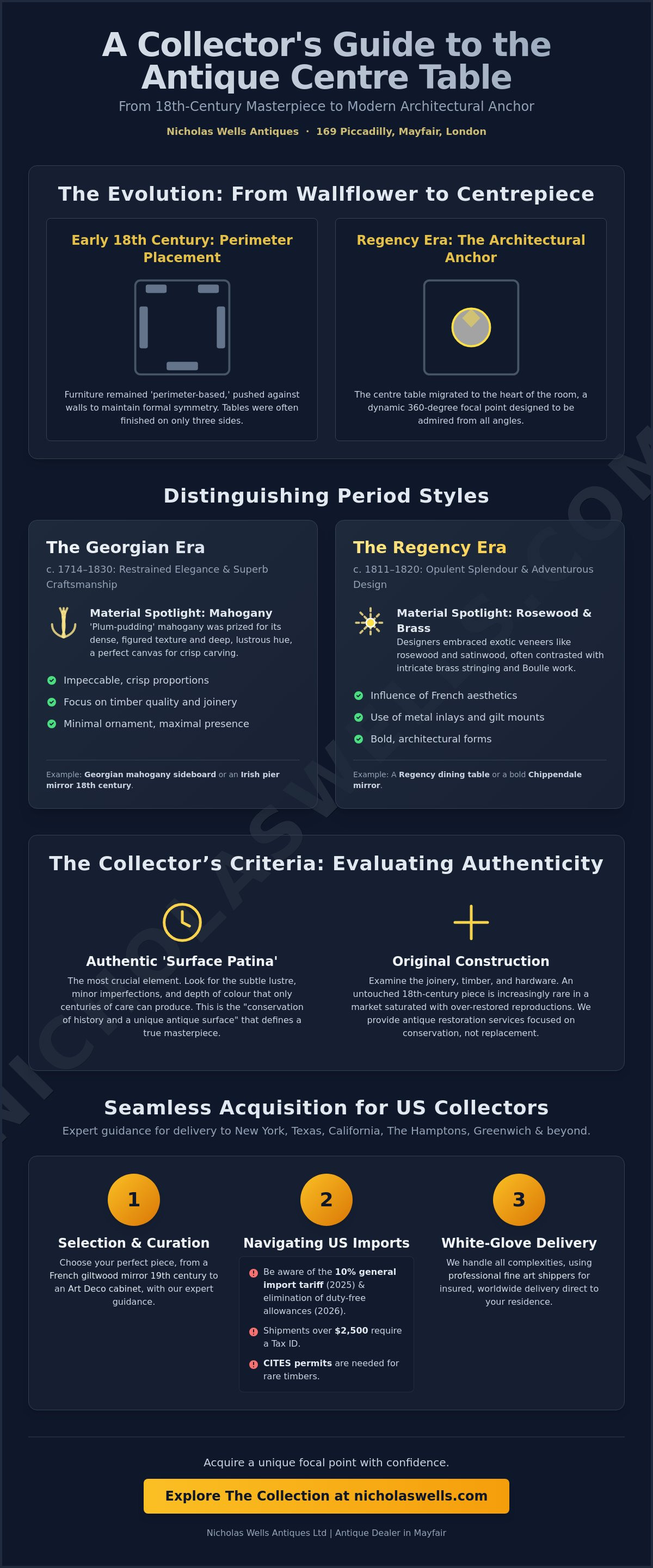
By definition, a centre table is a piece of furniture finished with equal care on all sides, designed to be viewed from every angle and placed in the middle of a room. Its story begins in the grand English townhouses and country estates of the early 18th century, a period of profound architectural and social change. Before this era, most high-style furniture was placed against the walls, creating a formal perimeter. The centre table marked a revolutionary shift, moving into the open and transforming the dynamics of interior space during the Regency era.
At Nicholas Wells Antiques, we specialise in sourcing these remarkable tables—pieces with the presence and character to command attention in a grand hall, library, or entrance foyer.
The 18th Century Shift in English Interior Design
The move toward central furniture placement was heavily influenced by neoclassical architects like Robert Adam, who conceived of rooms as integrated, harmonious compositions. In this new paradigm, a table was no longer an afterthought but a core component of the architectural vision. Consequently, the 'finished back' became a revolutionary mark of quality in 18th-century cabinetry, signalling an item of superior craftsmanship intended for a discerning client.
Continental vs. English Influences
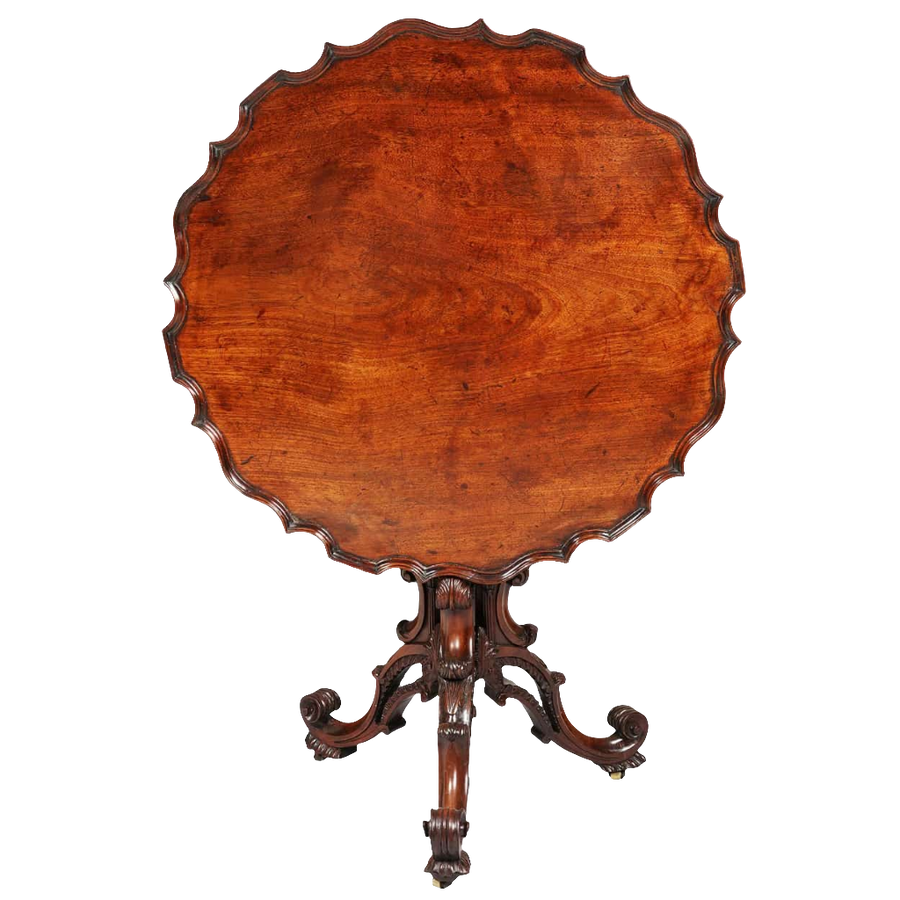
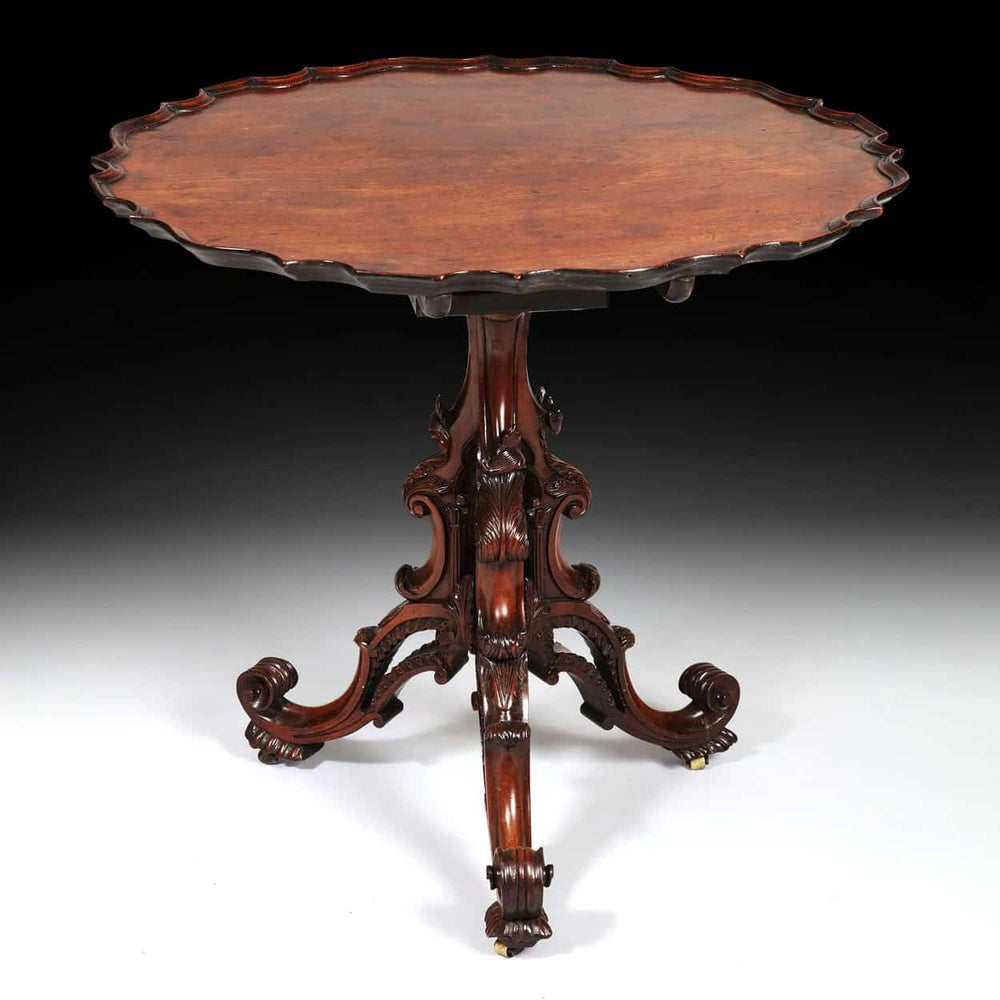
The character of a centre table often reflects its national origin. The restrained elegance of a Georgian mahogany centre table, with its focus on the timber's intrinsic beauty and balanced proportions, stands in contrast to the opulent drama of French giltwood examples, which often feature intricate carving and lavish ornamentation. Each style offers a different aesthetic statement, from the scholarly gravitas of English design to the theatrical splendour of Continental craftsmanship. You can explore a diverse range of these styles within the Nicholas Wells antique table collection.
Distinguishing Period Styles: From Georgian Mahogany to Regency Splendour
A collector’s discerning eye can identify the subtle yet significant markers that define each period. The hallmarks of a Georgian mahogany centre table, for instance, lie in the exceptional quality of the timber, the crispness of the carving, and the masterful sense of proportion. The subsequent Regency period introduced a new vocabulary of design, favouring exotic veneers like rosewood, intricate brass inlays inspired by the work of André-Charles Boulle, and forms drawn from classical antiquity.
This classical influence, often inspired by the 'Grand Tour' undertaken by English aristocrats, is visible in tables featuring marble tops, sculptural bases, and Greco-Roman motifs. Such pieces are beautifully complemented by period mirrors, where the reflective surface of a large Irish pier mirror or a Chippendale-style looking-glass can amplify the table’s grandeur.
The Golden Age of Mahogany and Rosewood
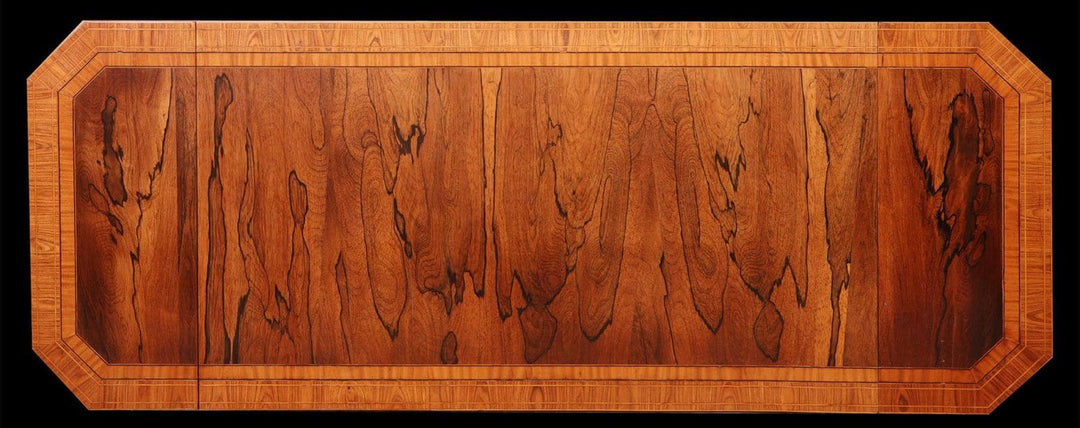
Eighteenth-century master cabinetmakers prized a specific type of dense, richly figured mahogany, often referred to as 'plum-pudding' for its deep colour and captivating grain. This superior timber was the perfect medium for showcasing exquisite carving and achieving a deep, lustrous patina over time. In the 19th century, the taste for exotic rosewood grew, its dark, dramatic tones often highlighted with gilt-bronze mounts and intricate inlays.
Regency Innovation and the Classical Ideal
The Regency aesthetic is defined by its confident use of 'ormolu' mounts, tripod bases, and monopodial supports drawn from ancient architectural sources. This period saw the rise of the 'drum table', a circular library table often fitted with drawers and a tooled leather top, which remains a highly sought-after form for collectors. Its combination of elegance and utility makes it a particularly versatile choice for sophisticated interiors in New York and Texas, where it can serve as a commanding centrepiece in a library or entrance hall.
The Collector’s Criteria: Evaluating Patina, Original Surface, and Provenance
For the true connoisseur, the most critical attribute of an antique table is its 'surface patina'—the unique, mellow glow that wood acquires over centuries of use, waxing, and exposure to light. This irreplaceable quality is the very soul of an antique and cannot be replicated by modern polishing techniques. A key principle of our philosophy is the 'conservation of history', favouring methods that preserve this character over aggressive restoration that might strip it away.
Provenance also plays a crucial role, as a table’s documented history within a notable English country house or a distinguished collection can significantly enhance its value and appeal. At Nicholas Wells Antiques, every sale includes complimentary restoration, a meticulous process undertaken by specialised craftsmen who respect and stabilise the original antique surface.
Identifying Authentic 18th and 19th Century Surfaces
Learning to recognise an authentic period surface is a skill developed over time. An original wax patina feels soft, almost silken to the touch, with a deep, complex lustre, whereas a modern spray lacquer presents a hard, uniform, and reflective sheen that lacks historical depth. Understanding these nuances is vital for collectors. Furthermore, for pieces destined for modern homes with climate control, such as those in the Hamptons or Greenwich, CT, careful consideration of antique wood conservation is essential to ensure the piece remains stable and beautiful for generations to come.
Safe Acquisition and Global Logistics
Acquiring a significant work of antique furniture should be a seamless and secure experience, regardless of geography. We address the concerns of our international clientele by exclusively using professional fine art shippers who provide fully insured, worldwide delivery. This specialised service ensures that a delicate Regency centre table is packed to museum standards and arrives safely, whether its destination is a penthouse in San Francisco or a country estate in California.
Harmonising the Interior: Pairing Centre Tables with Exceptional Works of Art
An antique centre table should not be viewed as an isolated object but as the foundational element around which a broader collection of art and decorative objects can be harmonised. It serves as a stage, inviting the placement of a fine 18th-century Mughal miniature, a neoclassical gouache, or a piece of Grand Tour sculpture. The interplay of light between ornate gilt chandeliers and the polished surface of a mahogany top can create a captivating dialogue, adding layers of texture and history to a room.
The Table as a Stage for Fine Art
The strong horizontal plane of a centre table provides a perfect counterpoint to the verticality of works on paper and paintings. Placing art in proximity to the table creates a curated vignette that draws the eye and tells a story. Notable works by artists like the 17th-century adventurer Pietro Della Valle or the 20th-century theatrical painter Doris Zinkeisen can serve as ideal companions, establishing a sophisticated atmosphere in a foyer or drawing-room.
Curating Your Collection for the Modern Home
One of the most compelling aspects of modern interior design is the artful mixing of periods. An 18th-century centre table can provide a powerful historical anchor in a contemporary space, its classical lines and rich patina creating a dynamic contrast with 20th-century art. This thoughtful juxtaposition of old and new is the hallmark of a truly curated interior, reflecting a confident and personal aesthetic.
Explore our curated collection of Art, Paintings, and Works on Paper to find the perfect companion for your centre table.
Frequently Asked Questions
-
What is the difference between a centre table and a dining table?
A centre table is primarily a decorative and architectural piece, finished on all sides and intended for the centre of a room like a hall or library. A dining table is a functional piece designed for seating, often with leaves for extension, and its underframe may not be as finely finished as it is not intended for constant 360-degree viewing. -
How do I identify if a centre table has its original 18th-century surface?
Look for signs of genuine age: a deep, uneven patina, small shrinkage cracks, historic stains, and the soft feel of a hand-rubbed wax finish. An original surface will have a lustre that seems to emanate from within the wood, unlike the uniform, hard gloss of modern lacquers. Detailed photographs and expert consultation can further help in its assessment. -
Can you ship high-value antique tables safely to the United States?
Yes. We provide fully insured, worldwide shipping for all our pieces. We work exclusively with specialist fine art shippers who use museum-standard packing techniques to ensure that high-value antiques arrive safely at their destination, whether in New York, Texas, or California. -
How can I assess an antique table in detail when buying online?
We provide comprehensive, high-resolution photography and detailed condition reports for every item. We encourage prospective buyers to ask for additional images, videos, or a virtual consultation to examine any aspect of the piece in greater detail, ensuring complete confidence in your acquisition. -
Does Nicholas Wells Antiques provide restoration for items purchased online?
Yes, complimentary restoration is included with every purchase. Our approach focuses on conservation, meaning our expert restorers work to stabilise and preserve the table's original surface and historical character, rather than stripping and refinishing it. This ensures the piece retains its integrity and value.


Leave a comment