




A Connoisseur’s Guide to Antique Centre Tables: History, Selection, and Curation
The placement of a singular, museum-quality centre table does not merely fill a void in a grand entrance; it establishes a historical dialogue that bridges the gap between 18th-century grandeur and the sophisticated demands of a modern New York or Greenwich residence. You likely recognise that finding a piece with an authentic, untouched 18th-century patina is increasingly rare in a market saturated with over-restored reproductions. This guide to antique centre tables from Nicholas Wells Antiques, based at 169 Piccadilly, serves as your definitive resource for identifying genuine Regency and Georgian masterpieces that possess both soul and architectural presence.
We understand that the logistical landscape for US collectors has shifted, following the 10% general import tariff enacted in 2025 and the elimination of duty-free allowances in early 2026. You'll learn how to navigate these complexities, from mandatory Tax ID requirements for shipments over $2,500 to CITES permits for rare timbers. We will examine the stylistic distinctions that define the finest 18th and 19th-century examples, ensuring you can acquire a unique focal point with the confidence that it will be delivered safely via specialist fine art shippers to your doorstep.
Key Takeaways
- Master the distinction between a standard surface and an architectural anchor by understanding the history of pieces finished on all sides for the middle of a room.
- Identify the specific hallmarks of period styles, comparing the crisp proportions of a Georgian mahogany centre table with the opulent rosewood and brass inlays of Regency design.
- Consult our guide to antique centre tables to identify authentic 'surface patina' and understand why the conservation of a unique antique surface is paramount for discerning collectors.
- Learn to integrate your acquisition into a curated modern interior by pairing it with exceptional works of art, such as 18th-century Mughal miniatures or neoclassical gouaches.
- Gain clarity on the logistics of international acquisition, ensuring safe delivery to the Hamptons or Greenwich through the expertise of professional fine art shippers.
The Evolution of the Antique Centre Table: From Functional Surface to Architectural Anchor
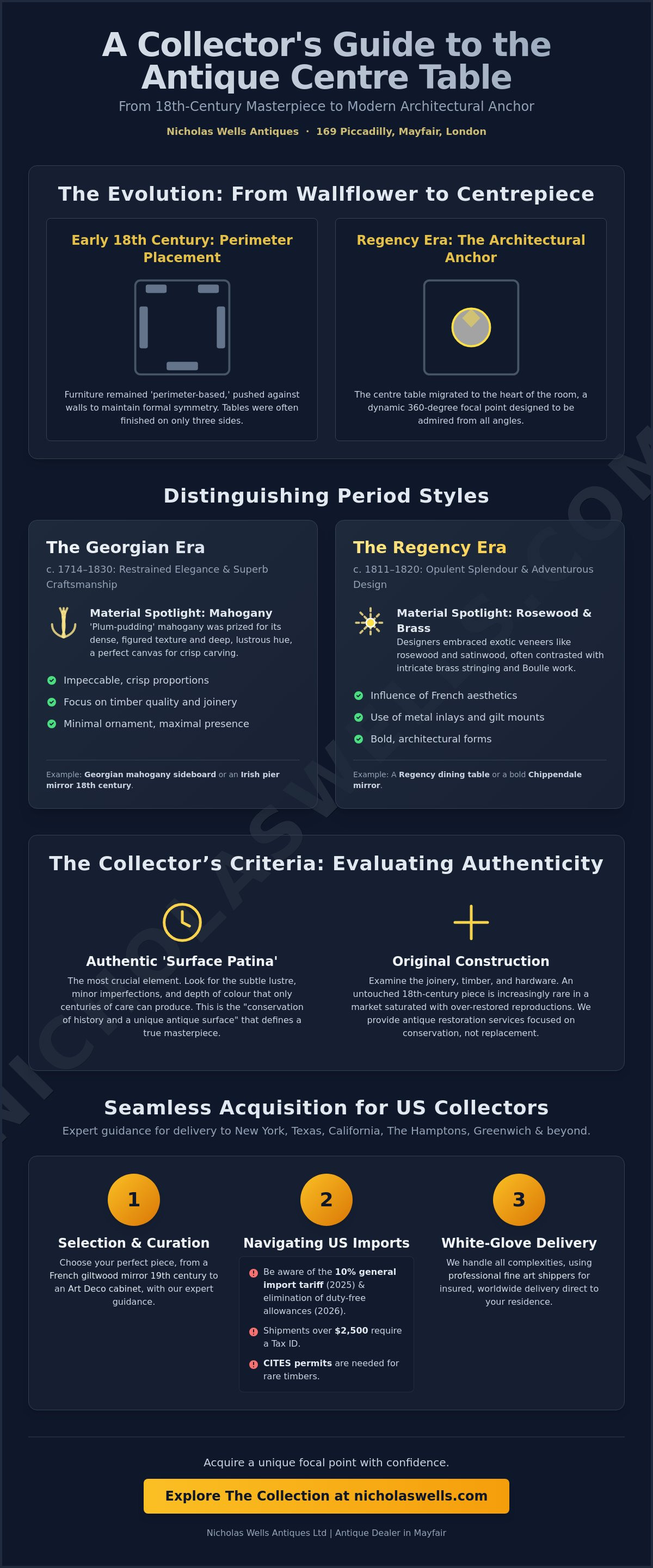
To appreciate the essence of a true centre table, one must look beyond its surface to its intended orientation. Unlike sideboards or pier tables designed to lean against a wall's architecture, the centre table is an object of 360-degree craftsmanship, finished on all sides to be viewed from any angle. While the general history of tables traces back to ancient civilisations, the specific emergence of the centre table as a social and architectural anchor began in the grand English townhouses and country estates of the early 18th century. Initially, furniture remained largely 'perimeter-based,' pushed against the walls to maintain the room's formal symmetry. This guide to antique centre tables explores how these pieces eventually migrated to the heart of the room, transforming from occasional surfaces into the very soul of the interior.
By the Regency era, the transition was complete. The centre table became a dynamic focal point, often supporting a gilt chandelier above or serving as a stage for Grand Tour obelisks and rare minerals. Nicholas Wells Antiques specialises in sourcing these commanding pieces, ensuring they possess the scale and presence required to anchor a grand hall in the Hamptons or a private library in Greenwich, Connecticut.
The 18th Century Shift in English Interior Design
The neoclassical influence of architects like Robert Adam fundamentally altered the placement of central furniture. Adam's vision treated every element of a room as part of a unified whole, where a table's position was as vital as the plasterwork on the ceiling. During this period, the 'finished back' or the circular symmetry of a table's frieze was a revolutionary mark of quality. It signalled that the owner possessed the space and the sophistication to furnish the middle of a room, a luxury that remains a hallmark of high-end curation today.
Continental vs. English Influences
Collectors often find themselves choosing between the restrained elegance of a Georgian mahogany centre table and the exuberant opulence of French giltwood. While English cabinetmakers prioritised the 'surface patina' and the rich, dark grains of imported timbers, Continental examples often leaned toward the theatrical. You can explore these stylistic variations within the Nicholas Wells antique table collection, where each piece is selected for its ability to bridge historical grandeur with modern luxury living.
Distinguishing Period Styles: From Georgian Mahogany to Regency Splendour
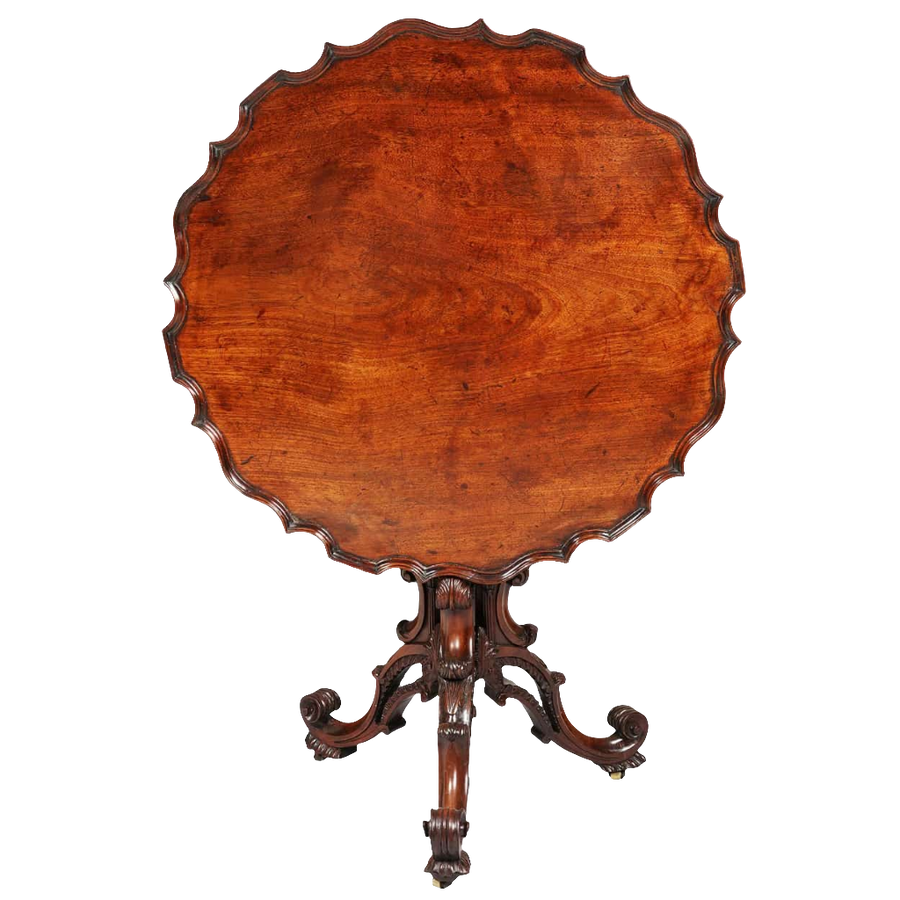
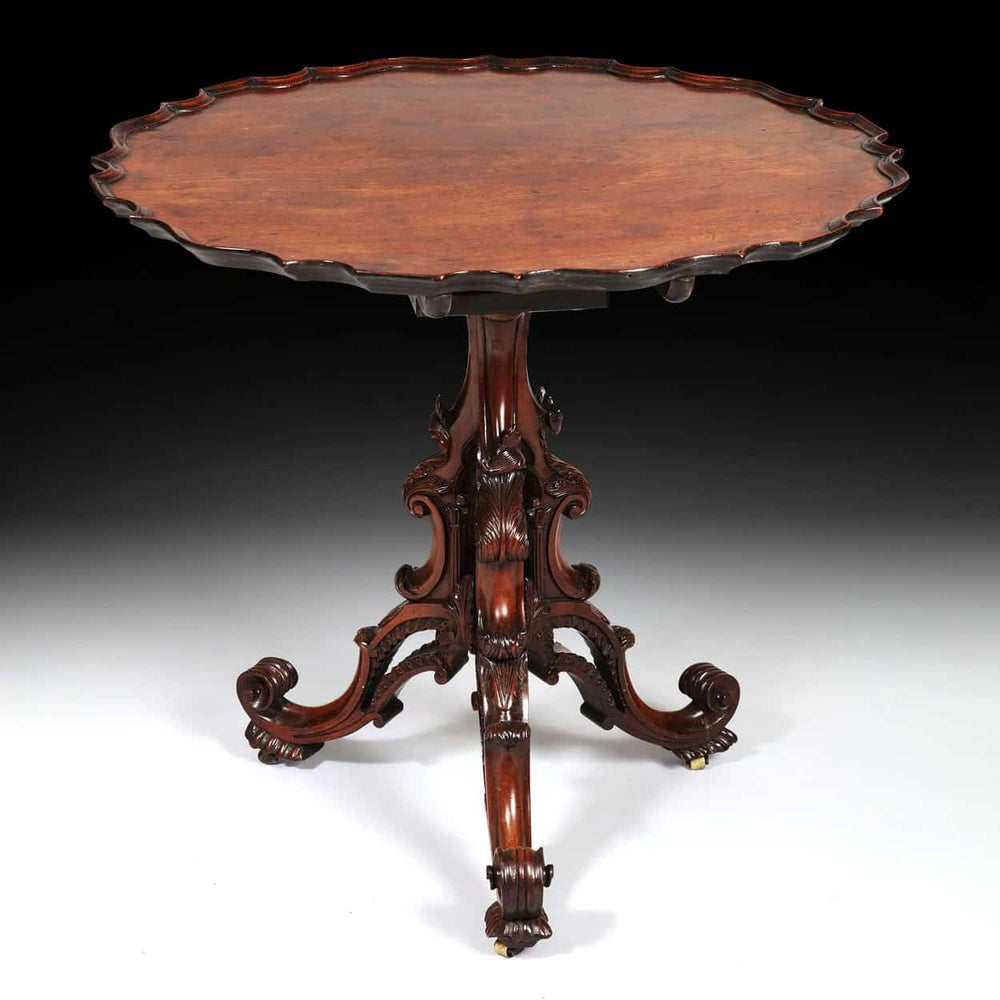
Identifying the specific visual language of a period is essential for any serious collector. The Georgian era defined restraint, where the quality of the timber and the precision of the joinery spoke louder than any gilded ornament. A classic Georgian mahogany centre table is characterised by its crisp carving and impeccable proportions, sharing a stylistic lineage with the Georgian mahogany sideboard or an Irish pier mirror 18th century. As part of our guide to antique centre tables, we examine how these pieces remain prized for their untouched surface patina, which serves as a testament to the mastery of 18th-century cabinetmakers.
As tastes evolved, the Regency period embraced a more adventurous palette. Designers incorporated rosewood and satinwood veneers that provided a striking contrast to brass stringing and intricate Boulle work. This era's fascination with French aesthetics led to the creation of masterpieces like the Regency 'Buhl' Centre Table, which showcases the opulent revival of metal inlays. While a Regency dining table anchors the formal dining room, the centre table remains the versatile pivot of the library or grand foyer, often paired with a Chippendale mirror to reflect the classical rigour of the age.
The Golden Age of Mahogany and Rosewood
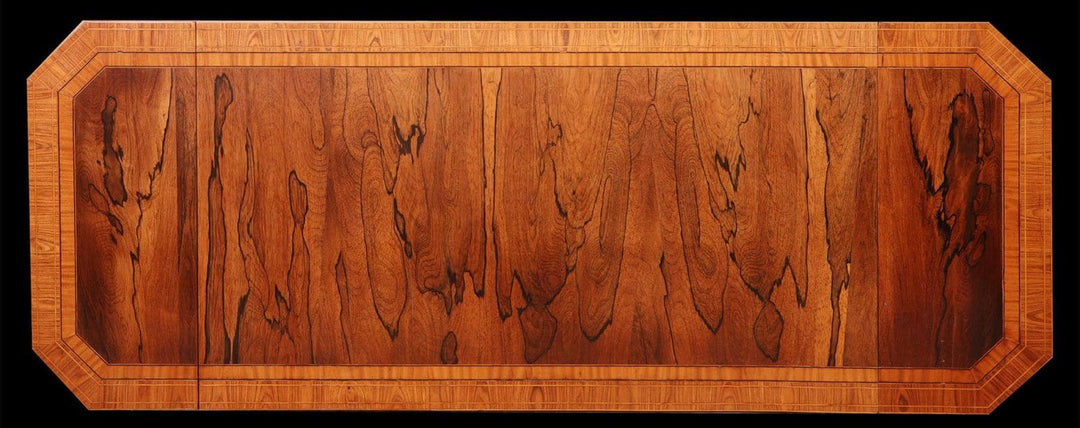
Master cabinetmakers specifically sought out 'plum-pudding' mahogany for its dense, figured texture and deep, lustrous hue. This timber provided a robust canvas for the delicate fretwork often found on high-style English furniture. To complete the narrative of a room, these tables are frequently positioned beneath a French giltwood mirror 19th century, creating a vertical dialogue of light and shadow that enhances the table's unique antique surface. These finishes require a delicate touch, far removed from the cold, industrial feel of modern reproductions.
Regency Innovation and the Classical Ideal
The Regency aesthetic introduced the frequent use of ormolu mounts and sturdy tripod bases, often terminating in lion’s paw feet or scrolls. The 'drum table' variant, with its circular top and multiple frieze drawers, has become a particular favourite for collectors in New York and Texas interiors. While later eras might favour the streamlined geometry of an Art Deco cabinet, the Regency centre table remains the ultimate expression of the classical ideal. If you're looking for a singular piece to define your space, we invite you to browse our curated selection of centre tables currently available at our Mayfair gallery.
The Collector’s Criteria: Evaluating Patina, Original Surface, and Provenance
This guide to antique centre tables emphasises that the discerning eye prioritises 'surface patina' above all else. This unique, aged glow of the wood cannot be replicated by modern chemicals; it's the result of centuries of wax, light, and careful handling. At Nicholas Wells Antiques, we advocate for the 'conservation of history' over aggressive, character-stripping restoration. Our approach ensures that every piece in our collection of centre tables retains its unique antique surface, preserving the narrative of its journey from an 18th-century English country house to your modern interior.
Provenance remains a cornerstone of value. A table with a documented history in a specific estate carries a cultural weight that a nameless piece lacks. We provide the historical context that transforms an object into a significant artifact. To maintain this integrity, we offer complementary restoration services to our clients during the acquisition process, ensuring that any necessary stabilisation respects the piece's original character and historical surface.
Identifying Authentic 18th and 19th Century Surfaces
While a modern spray lacquer presents a cold, uniform plasticised barrier, an original wax patina offers a warm, depth-filled lustre that feels silk-like and responsive to the touch. Collectors in the Hamptons or Greenwich, CT, must be particularly mindful of wood conservation. The fluctuating humidity of these coastal regions can affect antique timbers, making the preservation of the original finish essential for long-term stability and aesthetic integrity.
Safe Acquisition and Global Logistics
Acquiring a significant piece from our Mayfair gallery is a seamless process for our international clientele. We work exclusively with professional fine art shippers to provide fully insured worldwide delivery. Given the 10% general import tariff enacted on April 5, 2025, and the elimination of the $800 de minimis exemption in February 2026, we manage the complex documentation required for US customs. Whether shipping to San Francisco, California, or New York, we ensure museum-standard packing and formal customs entry, requiring the buyer's Tax ID for shipments valued over $2,500.
If you're ready to select a piece that meets these rigorous standards, we invite you to explore our gallery's finest furniture acquisitions.
Harmonising the Interior: Pairing Centre Tables with Exceptional Works of Art
A singular centre table acts as the physical and aesthetic foundation upon which a sophisticated collection of decorative arts is built. This final stage of our guide to antique centre tables considers how the horizontal expanse of a finely figured mahogany or rosewood top acts as a stage for curated objects. The placement of an 18th-century Mughal miniature or a neoclassical gouache in close proximity creates a layered narrative, inviting the eye to move between the intricate craftsmanship of the timber and the delicate precision of the artwork. This balance defines the room, grounding the more ephemeral qualities of light and shadow within a grand hall or library.
The Table as a Stage for Fine Art
Works on paper and oil paintings provide the essential vertical counterpoint to the table's horizontal plane. For a sophisticated foyer in a San Francisco or New York residence, consider pairing a Regency table with the theatrical flair of Doris Zinkeisen or the historical depth of Pietro Della Valle. These pairings elevate the furniture from a functional item to a central component of a gallery-standard interior. To heighten the architectural presence, one might display Grand Tour objects, specifically obelisks in rare marbles, which draw the eye upward toward the intricate crystal of gilt chandeliers.
Curating Your Collection for the Modern Home
Modern luxury living often thrives on the juxtaposition of disparate cultures and historical periods. A curated surface might feature the sculptural, primitive power of Oceanic art, such as finely carved war clubs, alongside the refined steel and gold inlays of Islamic arms and armour. This interplay between the pre-industrial and the courtly creates a vibrant, lived-in atmosphere that transcends the rigidity of a period room. The warm glow from antique lanterns should catch the polished surface of the table, highlighting the depth of the patina we have discussed throughout this guide to antique centre tables. This creates a sense of timelessness that resonates with the requirements of contemporary design in the Hamptons or Greenwich, Connecticut.
We invite you to experience these curated dialogues in person at our Mayfair gallery. While Nicholas Wells Antiques operates primarily online, our showroom at 169 Piccadilly is available to visit by appointment, offering a private space to explore how these pieces might anchor your own collection. Explore our curated collection of Art, Paintings, and Works on Paper to find the perfect companion for your centre table.
Elevating the Modern Interior with Historical Significance
The acquisition of a singular centre table is an investment in the narrative of your home, transforming a mere entrance or library into a curated gallery of historical significance. By following this guide to antique centre tables, you've learned to distinguish the refined proportions of the Georgian era from the opulent material innovations of the Regency period. True connoisseurship lies in the appreciation of the untouched surface patina, a quality we preserve through our specialist expertise in Grand Tour and 18th-century furniture and our unwavering commitment to the conservation of history.
Nicholas Wells Antiques ensures that the journey from our Mayfair gallery to your residence in New York, Texas, or San Francisco is handled with the same reverence as the object itself. We provide museum-standard worldwide shipping via professional fine art shippers, navigating the complexities of modern tariff regulations on your behalf. Every purchase includes complimentary restoration by our specialist team, ensuring your masterpiece is stabilised without compromising its unique antique surface. Your centre table is now ready to serve as the foundation for a broader collection of decorative arts. We invite you to Discover Masterpieces of Art & Works on Paper to Complement Your Collection and complete the aesthetic vision of your home.
Frequently Asked Questions
What is the difference between a centre table and a dining table?
A centre table is primarily designed for 360-degree visibility and architectural impact, whereas a Regency dining table is built for functional seating and linear expansion. While dining furniture prioritises seating capacity, the centre table acts as a sculptural focal point, often featuring more elaborate tripod bases or circular tops that don't accommodate large chairs. This distinction allows the centre table to serve as a versatile anchor in a grand hall or library.
How do I identify if a centre table has its original 18th-century surface?
Authenticity is often found in the secondary timbers and the natural oxidation of the wood on the underside of the frieze. This guide to antique centre tables recommends looking for 'shrinkage splits' and hand-tool marks, which indicate the timber has naturally dried over centuries. These subtle imperfections, combined with a deep, untouched surface patina, are hallmarks of an authentic 18th-century piece that hasn't been stripped by modern over-restoration.
Can you ship high-value antique tables safely to the United States?
We specialise in the safe delivery of high-value items to US markets including New York, Texas, and San Francisco. Our professional fine art shippers handle all formal customs entries, which are now mandatory for commercial imports following the elimination of the $800 de minimis exemption in early 2026. For shipments to the Hamptons or Greenwich, Connecticut, we ensure museum-standard packing and full insurance for the journey.
Is it possible to visit the Nicholas Wells showroom in Mayfair?
You can visit our gallery at 169 Piccadilly by appointment to view our collection in person. Whether you are seeking an antique shop in Piccadilly or an antique dealer in Mayfair, we provide a private, scholarly environment to examine the craftsmanship of our acquisitions. This appointment-only model ensures that our clients receive the undivided attention of a specialist when evaluating significant works of art.
Does Nicholas Wells Antiques provide restoration for items purchased online?
Nicholas Wells Antiques provides complimentary, museum-standard restoration for any item purchased through our online gallery. Our focus remains on the conservation of history, ensuring that any stabilisation work preserves the unique antique surface and inherent character of the piece. This service ensures your acquisition is ready to be integrated into a sophisticated interior immediately upon arrival, maintaining its value and aesthetic integrity for generations.



Leave a comment