



A Connoisseur’s Guide to Antique Dining Chairs: Styles, Provenance, and Curation
For the discerning collector, the acquisition of a complete set of twelve 18th-century antique dining chairs represents a pursuit of rarity that rivals the search for a lost Old Master drawing. It's a common challenge to distinguish between a superb original and a clever 1920s reproduction, especially when the latter has been artificially distressed to mimic the passage of time. You likely understand that true luxury resides in the soul of an object, yet finding a cohesive set with impeccable provenance remains one of the most difficult tasks in the decorative arts.
This guide provides the scholarly framework needed to identify authentic period-defining styles and verify the history of distinguished pieces. You'll gain the confidence to invest in furniture that offers both historical significance and enduring aesthetic value for your home. We'll explore the architectural nuances of the 1754 Director-style Chippendale, the delicate marquetry of the Sheraton era, and the essential criteria for curating a dining room that serves as a testament to exceptional craftsmanship.
Key Takeaways
- Trace the architectural evolution of the English townhouse to understand how the dining chair transitioned from a symbol of social hierarchy to an emblem of refined intimacy.
- Master the taxonomy of preeminent design periods, discerning the influence of the Grand Tour on the magnificent ornamentation of Chippendale and Regency masterworks.
- Recognize the technical hallmarks and timber transitions that allow a connoisseur to distinguish genuine antique dining chairs from later reproductions.
- Uncover the rarity and immense value of the "long set," and learn why reuniting these divided suites remains one of the most prestigious challenges in the market.
- Explore how scholarly research establishes the provenance necessary to ensure your acquisition serves as a significant cultural artifact within a modern interior.
The Significance of Antique Dining Chairs in the English Townhouse
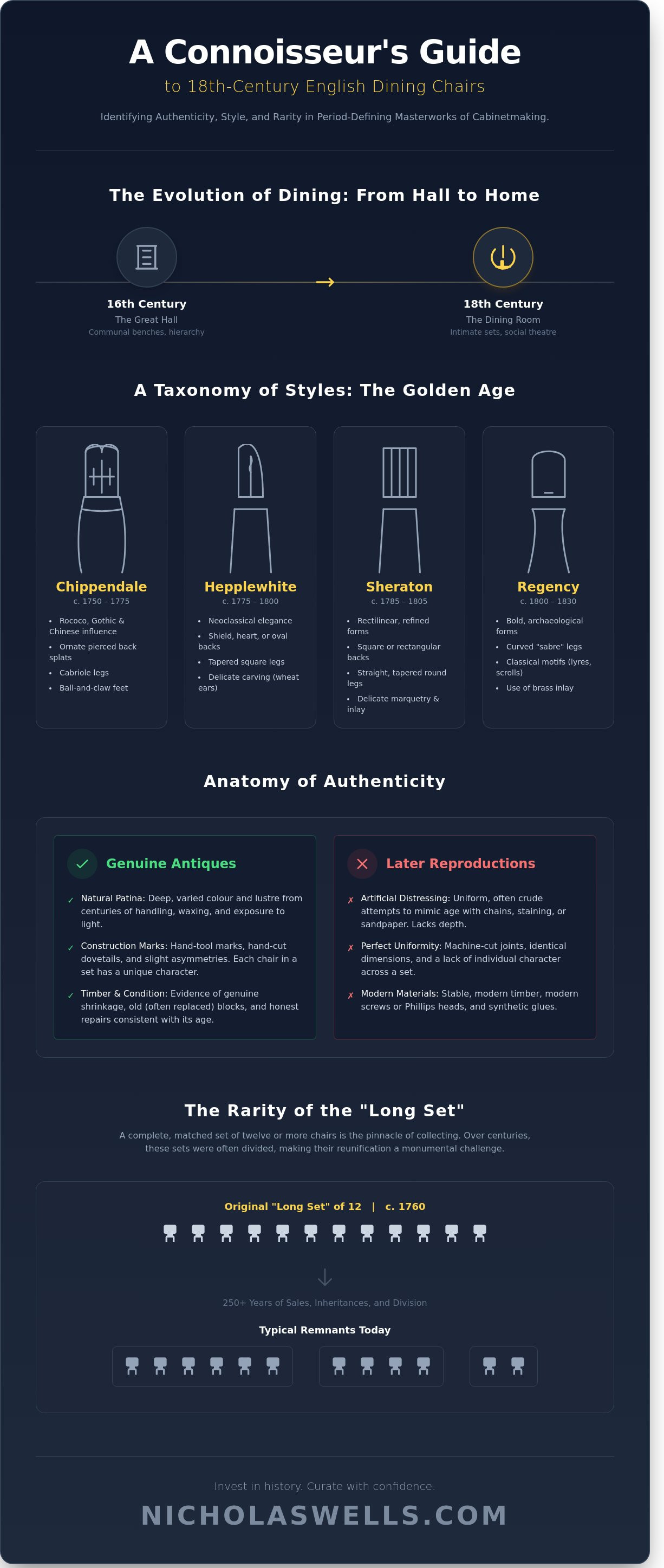
The evolution of the English townhouse is etched into the very timber of its furniture. Within these vertical spaces, the dining chair emerged as a primary instrument of social signalling. It marked a departure from the drafty, communal Great Hall of the 16th century, where benches were the standard, toward the specialized dining room of the Georgian era. By 1750, the dining room had become the architectural heart of the home. It wasn't just a place to eat; it was a stage where the host’s taste and lineage were scrutinized through every carved acanthus leaf. The choice of antique dining chairs served as a silent interlocutor, speaking volumes about the owner's stature before a single word was exchanged over the soup course.
Before the 18th century, chairs were rare, often reserved for the head of the household while others sat on stools. The 1720 lifting of heavy import duties on mahogany transformed this dynamic, allowing cabinetmakers to experiment with more delicate, pierced splats and cabriole legs. This shift mirrors the transition toward a more intimate, conversational style of entertaining. Collecting these pieces today requires an eye for the subtle shifts in silhouette that define the period. For those seeking a deeper understanding of these variations, A Taxonomy of Chair Styles provides a broader historical context for how these forms developed across Europe. The 18th-century English chair remains the pinnacle of this development, balancing structural integrity with an almost lyrical lightness of form.
The Theatre of the Georgian Dining Room
Symmetry defined the Georgian aesthetic, and the dining room was its most rigorous practitioner. A set of chairs wasn't merely a collection of seats; it was a rhythmic installation designed to complement the room's classical proportions. When Thomas Chippendale published The Gentleman and Cabinet-Maker's Director in 1754, he codified the "set" as an essential component of the polite interior. These sets, often numbering 12 or 14 for a substantial townhouse, created a visual order that anchored the room's political and social displays. The dining room was where alliances were forged and marriages brokered, making the comfort and elegance of the seating a matter of strategic importance.
The English 18th-century chair is the gold standard for collectors because it represents a perfect marriage of utility and high art. It’s a period where the craftsmanship of the joiner met the vision of the architect. Every curve of a mahogany rail was designed to catch the candlelight, enhancing the atmosphere of exclusivity that defined the era's elite social circles.
Antique Seating as a Functional Work of Art
Integrating antique dining chairs into a contemporary interior isn't an act of preservation; it's a decorative masterstroke. These pieces possess a "soul" or patina that modern reproductions cannot replicate, offering a tangible connection to the past. A well-chosen set provides a narrative anchor, grounding a room that might otherwise feel ephemeral. They demand respect for their history while serving the practical needs of a modern dinner party. The challenge for the connoisseur lies in finding examples that retain their original character while being sturdy enough for daily use.
Exceptional sets are increasingly rare, as many were broken up or lost to the vagaries of time over the last 250 years. Finding a complete, matched set with documented provenance is the ultimate goal for the serious collector. For those looking to acquire such distinguished pieces, the Nicholas Wells seating collection offers a curated selection of rare examples that embody this union of historical significance and superb craftsmanship. These objects are more than furniture; they're cultural artifacts that continue to dictate the rhythm of the modern dining room.
A Taxonomy of Styles: From Chippendale to Regency
The evolution of antique dining chairs throughout the 18th and early 19th centuries reflects the shifting intellectual and aesthetic tides of the Enlightenment. This golden age of cabinetmaking didn't happen by chance; it was driven by the 1754 publication of Thomas Chippendale's The Gentleman and Cabinet-Maker's Director. This seminal pattern book provided a standardized visual language for craftsmen across the British Isles and the colonies, ensuring that a chair made in London shared a stylistic DNA with one made in Philadelphia. Concurrently, the Grand Tour influenced the tastes of the landed gentry, who returned from Italy with a hunger for classical ornamentation and architectural precision. The Victoria and Albert Museum's furniture collection offers an unparalleled look at how these early Georgian designs transitioned from the heavy, somewhat ponderous Baroque forms into the refined, sculptural silhouettes we prize today.
Distinguishing between these periods requires a keen eye for the leg and the splat. Early Georgian aesthetics favored the robust Palladian style, characterized by walnut timber and substantial proportions. By the mid-century, mahogany became the preferred medium, allowing for more intricate carving without sacrificing structural integrity. As the century closed, the aesthetic shifted again toward the delicate and the vertical, replacing the carved curves of the Rococo with the disciplined lines of Neoclassicism. For the modern collector, the acquisition of antique dining chairs remains a pursuit of both historical narrative and tactile artistry.
The Rococo Mastery of Thomas Chippendale
Mid-century design reached its zenith with the Rococo mastery of Thomas Chippendale. These pieces are easily identified by the quintessential ribbon-back and pierced splat, which allowed light to pass through the chair's silhouette, creating a sense of airy sophistication. The cabriole leg, often terminating in a meticulously carved claw-and-ball foot, remains the hallmark of this period. Collectors often find that Chippendale-style chairs are the cornerstone of the antique furniture collection because they balance structural integrity with a whimsical, organic ornamentation that feels remarkably alive.
Hepplewhite and Sheraton: The Neoclassical Shift
By 1780, the heavy carvings of the mid-century gave way to a lighter, more elegant form. George Hepplewhite's The Cabinet-Maker and Upholsterer's Guide (1788) popularized the shield-back chair, while Thomas Sheraton's 1791 designs favored rectangular compositions. These designers moved away from the cabriole leg in favor of straight, tapered legs, often ending in spade feet. The use of exotic satinwood and delicate marquetry inlay became common, reflecting a preference for color and surface decoration over deep relief carving.
The Regency Period and the Classical Revival
The dawn of the 19th century brought the Regency period and a rigorous Classical Revival. Heavily influenced by Thomas Hope's 1807 designs, seating took on an archaeological character, directly referencing Greek and Roman prototypes. The sabre leg became ubiquitous, mimicking the curved lines of the ancient klismos chair. This era frequently featured brass inlays or ormolu mounts to accentuate the dark, rich grains of rosewood and calamander. The "Trafalgar" chair, appearing after the 1805 naval victory, utilized rope-twist carvings and anchors to celebrate British maritime power. If you're seeking a set that bridges historical grandeur with a modern dining space, you might consult our latest acquisitions for inspiration.
Materials, Construction, and the Language of Authenticity
The discerning collector understands that the soul of a chair resides in its physical history, a narrative told through the evolution of timber and the precision of the craftsman’s chisel. During the early 18th century, the transition from the "Age of Walnut" to the "Age of Mahogany" represented more than a shift in aesthetic preference; it was a revolution in durability and design. The 1721 Naval Stores Act, which effectively removed the heavy import taxes on timber from the British colonies in the West Indies, heralded a transformative era for the London cabinetmaking trade. Discerning the authenticity of antique dining chairs requires an appreciation for how these materials behave over centuries. While walnut offered a beautiful, figured grain, it remained susceptible to the deathwatch beetle, leading to the gradual dominance of mahogany, a timber of such formidable density that it allowed for the slender, pierced splats characteristic of the Chippendale style.
Authenticity isn't merely a matter of age; it's a matter of integrity. One must remain vigilant against "married" sets, a practice that gained prevalence in the 1880s to satisfy a rising middle-class demand for large, uniform dining suites. A married set consists of chairs that didn't begin their lives together but were later assembled from various sources and altered to match. Detecting these requires a forensic eye. You should examine the height of the seat rails and the specific flow of the carvings across the entire set. If the timber's grain pattern or the oxidation levels vary significantly between chairs, you're likely looking at a composite group rather than an original commission. True quality is quiet. It manifests in the "patina," that inimitable surface glow created by two hundred years of handling, beeswax, and natural oxidation. Modern spray-lacquered reproductions appear one-dimensional and plastic by comparison, lacking the depth and "fire" found in original 18th-century surfaces.
The Supremacy of Cuban Mahogany
The 18th-century preference for Cuban mahogany, specifically Swietenia mahagoni, was rooted in its extraordinary physical properties. With a density often exceeding 850 kg/m³, this timber allowed for delicate, crisp carvings that would have shattered in lesser woods. It possesses a deep, plum-colored richness that modern, plantation-grown African mahoganies cannot replicate. You'll notice that genuine Cuban mahogany is exceptionally heavy, providing a structural stability that ensures the chair remains rigid even after centuries of use. It's the gold standard for those investing in a set of antique dining chairs that demand both elegance and longevity.
Joinery and the Evidence of the Hand
Before the industrialization of furniture making in the mid-19th century, every joint was a testament to manual skill. To verify a piece’s origins, you should look for these specific indicators of hand-craftsmanship:
- Hand-Cut Mortise and Tenon: Look for slight irregularities in the joints where the rail meets the leg; machine-cut joints are often too perfect.
- Original Corner Blocks: These triangular supports under the seat should show the marks of a hand-saw or a rhythmic plane, rather than the circular swirls of a modern power tool.
- Upholstery Ghost Marks: Removing the seat often reveals a "map" of previous lives. You'll see rows of small holes from original 18th-century tacks, typically spaced 1 to 1.5 inches apart, telling the story of every fabric the chair has ever worn.
These marks of the hand are the fingerprints of the past. They provide the ultimate assurance that a piece has survived the passage of time with its character intact.
The Rarity and Value of the "Long Set"
Within the upper echelons of the decorative arts, the "long set" remains a pinnacle of acquisition. While a group of six or eight chairs provides ample seating for a modest room, the true long set, consisting of 10, 12, or even 14 matching pieces, represents a level of grandeur that was originally reserved for the most distinguished country houses. Finding a dozen antique dining chairs from the 18th century is a formidable task. These sets were commissioned by the landed gentry to furnish expansive dining halls, yet few have survived the centuries intact. The primary culprit for their scarcity is the historical practice of partible inheritance. During the 19th and early 20th centuries, large estates were frequently divided among multiple heirs; a magnificent set of twelve chairs was often split into two sets of six, eventually scattering across different branches of a family or appearing separately on the market.
The market value of a complete, original set does not follow a linear progression. Instead, it increases exponentially. A set of twelve George III mahogany chairs often commands a price 150% higher than two separate, non-matching sets of six. Collectors prize the uniformity of the timber, the consistency of the hand-carved details, and the shared history of the pieces. When pairing such a suite with an antique dining table, one must consider the architectural harmony of the room. A table measuring over 3.5 meters requires the visual weight and rhythmic repetition that only a long set can provide. The legs of the chairs must complement the table’s pedestal or frame, ensuring the ensemble feels like a singular, curated statement of history.
Sourcing the Impossible: The Search for Twelve
The search for a matching set of twelve 18th-century antique dining chairs requires patience and a discerning eye. Often, the anchor of these sets is the pair of "carvers," or armchairs, which traditionally sat at the head and foot of the table. If a collector finds a set of ten, they may choose to "fill out" the suite with two high-quality period matches. While some purists demand absolute originality, a 90% original set supplemented by two expertly matched chairs from the same decade is a respected solution in the trade. This approach maintains the aesthetic integrity of the dining room without compromising the set’s historical soul.
Upholstery and Conservation for the Modern Collector
Conservation is the bridge between the past and the present. For the modern collector, the debate often centers on "show wood" versus contemporary comfort. We recommend traditional methods; using individual copper springs and hand-stitched horsehair ensures the chair retains its correct silhouette. In a 2023 survey of high-end interior designers, approximately 68% preferred historically accurate silk damasks or haircloths to maintain the piece's scholarly value. Professional conservation doesn't just repair; it preserves the patina and structural integrity that defines a masterpiece. This meticulous attention to detail ensures the set remains a functional heirloom for another century.
Discover the perfect centerpiece for your dining room by browsing our curated selection of rare antique seating.
Acquiring Fine Seating at Nicholas Wells Antiques
The acquisition of antique dining chairs represents far more than a simple furniture purchase; it's a deliberate investment in a lineage of exceptional craftsmanship and historical narrative. At Nicholas Wells Antiques, we view ourselves as custodians of these cultural artifacts. Our commitment to sourcing involves a rigorous selection process that rejects the mundane in favor of the extraordinary. We prioritize pieces that possess an inherent "soul," a quality often found in the original patination of 18th-century mahogany or the crisp, hand-carved details of a Regency-era backrail. Every set we acquire must meet a standard of rarity that satisfies the most exacting collectors and scholars.
Scholarship sits at the heart of our gallery's philosophy. We don't merely identify a style; we reconstruct the history of the object. Our team conducts exhaustive research to establish provenance, often tracing a set's journey through specific country house inventories or notable 19th-century auctions. This academic rigor provides our clients with the confidence that they're purchasing a piece of documented history. We understand that for the discerning buyer, the story behind the chair is as significant as its aesthetic appeal. This deep appreciation for heritage ensures that every item in our collection is treated as a significant work of decorative art rather than mere inventory.
We serve as a vital resource for interior designers who require a singular focal point to anchor a room's design. Finding a set of antique dining chairs that balances historical accuracy with the functional demands of a modern home is a complex task. We simplify this by providing technical expertise and aesthetic guidance. Our advisors help designers understand how the proportions of a George II chair might interact with contemporary lighting or how the subtle gilding on a Louis XVI piece can elevate a neutral palette. We offer a sophisticated bridge between the grandeur of the past and the requirements of luxury living today.
A Curated Portfolio for the Discerning Eye
Our gallery presents a diverse and meticulously vetted selection that extends beyond seating to include rare cabinet furniture and fine art. We evaluate the physical integrity and the artistic merit of every object before it joins our portfolio. This ensures that every piece tells a compelling story of its era. We invite you to explore these treasures in person by appointment at our London gallery, where the tactile quality of the timber and the nuance of the original finishes can be fully appreciated in a private, scholarly setting.
The Nicholas Wells Standard of Excellence
Every chair we sell undergoes a specialized conservation process to ensure it's ready for another century of use. Our craftsmen use traditional techniques to stabilize frames and refresh finishes without compromising the historical integrity of the piece. To complete the experience, we provide fully insured, white-glove worldwide delivery. Our logistics team has successfully managed complex shipments to over 45 countries, ensuring your investment arrives in pristine condition. View our current collection of antique dining chairs to discover the perfect addition to your home.
- Scholarly Provenance: Every piece is backed by detailed historical research and documentation.
- Expert Restoration: Complimentary structural stabilization using period-correct methods.
- Global Logistics: Fully insured, white-glove shipping to any international destination.
- Personalized Service: Bespoke advice for collectors and interior design professionals.
Investing in the Art of the English Townhouse
Selecting the perfect set of antique dining chairs involves more than just an appreciation for 18th-century mahogany or the intricate carvings of the Regency era. It's a pursuit of historical continuity where the structural integrity of a 1760 Chippendale design meets the functional demands of a contemporary residence. You've explored how the rarity of a complete "long set" of twelve chairs represents a pinnacle of 19th-century social history, and why the language of authenticity is found in the subtle wear of an original patina.
Since 2012, Nicholas Wells Antiques has curated these pieces in London, ensuring every selection reflects the highest standards of connoisseurship. We offer complimentary restoration on all items and provide fully insured worldwide shipping for your peace of mind. Every chair in our gallery is treated as a significant cultural artifact, ready to serve as the centerpiece of your home for generations. We look forward to helping you find a piece that truly resonates with your personal aesthetic.
Discover the Extraordinary: Shop our Seating Collection
Frequently Asked Questions
How can I tell if an antique dining chair is a reproduction?
You can identify an authentic piece by examining the joinery and hardware for signs of hand-tooling rather than machine precision. Authentic 18th-century chairs feature hand-planed surfaces on the interior seat rails and irregular dovetails. If you find Phillips head screws, which weren't patented until 1932, the chair is almost certainly a modern reproduction or has undergone significant later repair.
What is the difference between a side chair and a carver chair?
A carver chair is distinguished by its armrests while a side chair remains armless. In a traditional 18th-century English arrangement, a set of 8 chairs typically includes 2 carver chairs designated for the heads of the table. These armchairs often command a 25 percent price premium over their side chair counterparts due to their more complex construction and commanding presence.
Why is mahogany the most common wood for antique dining chairs?
Mahogany became the standard for antique dining chairs after the 1721 Naval Stores Act abolished import duties on timber from British colonies. Its exceptional density allowed master cabinetmakers like Thomas Chippendale to execute intricate, pierced splat designs that would have fractured in softer woods. By 1750, this durable timber had replaced walnut as the primary material for high-status furniture across London workshops.
Is it okay to reupholster antique dining chairs?
Reupholstering is entirely appropriate if you utilize traditional methods that respect the chair's original 19th-century geometry. You should insist on using natural horsehair and hand-stitched edges to maintain 100 percent of the object's historical integrity. Avoid modern foam inserts at all costs; they lack the longevity of traditional materials and create an uncharacteristic, bulky profile that diminishes the chair's aesthetic value.
How many chairs should be in a standard antique dining set?
A standard Georgian set usually comprises 6 or 8 chairs to suit the intimate dining rooms of the period. As social entertaining expanded in the 1860s, Victorian sets grew to include 12 or 14 pieces for larger banquets. Locating a perfectly matched set of 12 original 18th-century antique dining chairs is a rare feat that often increases the individual chair value by 40 percent.
Do antique dining chairs hold their value as an investment?
Exceptional chairs with verifiable provenance have demonstrated a steady appreciation of 3 to 5 percent annually over the past 20 years. While mass-produced modern furniture loses 70 percent of its value the moment it leaves the showroom, a fine George III set remains a tangible asset. Collectors prioritize sets in original condition, as these pieces represent a finite supply of 18th-century craftsmanship.
What should I look for when inspecting the legs of an antique chair?
You must check the base of the feet for authentic wear and examine the "knee" for crisp, hand-carved details. On a cabriole leg dating to 1740, the timber should show a natural smoothing from 280 years of contact with various floor surfaces. Look closely at the corner blocks under the seat; original 18th-century blocks are typically hand-shaped and secured with traditional hot animal glue.
How do I care for the finish on my antique wooden chairs?
Apply a thin layer of high-quality beeswax every 6 months to nourish the timber and preserve the deep, historical patina. You shouldn't use modern aerosol polishes because the silicone content can permanently cloud a 150-year-old French polish finish. A simple dusting with a soft cotton cloth every 7 days is sufficient to remove abrasive particles that might scratch the delicate surface.


Leave a comment