



Antique Armchairs: A Connoisseur’s Guide to Period Seating & Design
The pursuit of an exceptional piece of period seating is a journey fraught with nuance, where the line between a magnificent discovery and a costly misstep is often imperceptibly fine. For the discerning collector, navigating the world of 18th and 19th-century design presents a unique set of challenges: questions of provenance can be elusive, the quality of past restorations may obscure a piece’s true character, and finding superb antique armchairs that offer both historical integrity and contemporary comfort requires a truly expert eye. The desire is not merely for a chair, but for a tangible piece of history that resonates with the soul of a curated interior.
This principle of contrast extends to iconic designs from different eras. For example, the clean, sculptural form of a mid-century modern piece, such as a Danish Bar Stool - Dark Ash, can create a striking and sophisticated vignette when thoughtfully placed in the same visual space as a more ornate period armchair.
This connoisseur’s guide is crafted to illuminate that path with scholarly clarity and trusted authority. Within this exploration, we will unravel the defining stylistic signatures of the great cabinet-makers, from the rococo elegance of Chippendale to the neoclassical purity of Adam. You will discover the essential criteria for evaluating patina, construction, and authenticity, empowering you to move beyond uncertainty and acquire a distinguished statement piece with unimpeachable provenance. Consider this your definitive resource for understanding, selecting, and securing an extraordinary artifact that will anchor your collection for generations to come.
Key Takeaways
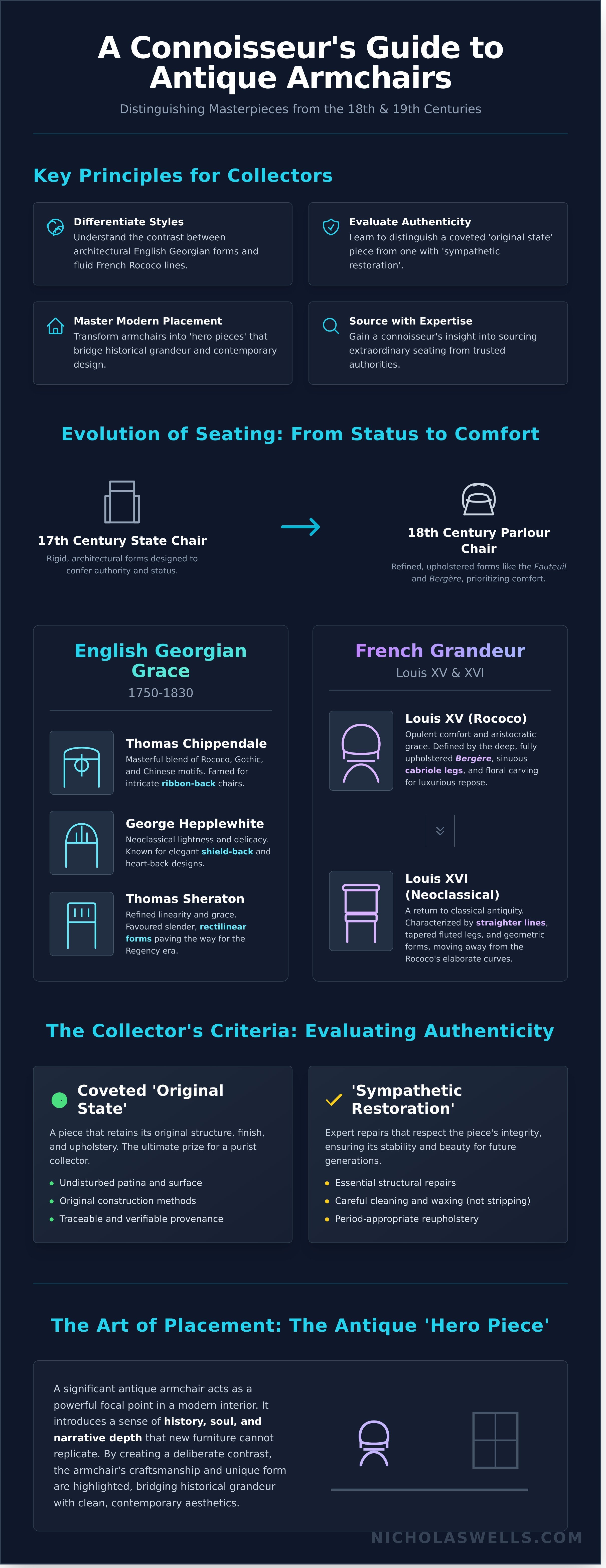
- Grasp the key design principles that differentiate the architectural forms of English Georgian seating from the fluid, sculptural lines of French Rococo.
- Acquire the framework for evaluating an armchair's authenticity and value, learning to distinguish between a piece in its coveted 'original state' and one with 'sympathetic restoration'.
- Master the art of placing significant antique armchairs within modern interiors, transforming them into compelling 'hero pieces' that bridge historical grandeur and contemporary design.
- Gain insight into a connoisseur's approach to sourcing extraordinary seating and understand the value of the complimentary, museum-quality restoration offered with each acquisition.
The Anatomy and Cultural Legacy of Antique Armchairs
More than mere articles of seating, antique armchairs are profound cultural documents, charting the course of domestic evolution and social hierarchy through their very form. Once symbols of authority reserved for the head of a household or a monarch, these objects transformed over centuries into bastions of comfort and refined taste. The armchair thus serves not only as a functional piece but as a focal point within a distinguished interior, embodying a historical journey-a 'soul'-that speaks to the aspirations and daily lives of generations past. It is an object whose legacy is written in its structure, its materials, and the silent stories of its provenance.
From State Chairs to Parlour Comfort
The trajectory from state chair to parlour comfort mirrors a significant societal shift. Early forms, such as the heavy oak wainscot chair of the 17th century, were rigid and architectural, their imposing stature and straight backs designed to confer status rather than ease. Courtly protocol directly influenced their dimensions, with arm height and seat depth meticulously calibrated to maintain a posture of formal dignity. The broader The History of the Chair documents this evolution, which accelerated in the 18th century with the introduction of upholstered refinement and Continental elegance, most notably through French designs like the open-armed Fauteuil and the fully upholstered Bergère, which prioritised leisure and conversation for the first time.
Materials of Distinction: Walnut, Mahogany, and Giltwood
The very materials from which these chairs were fashioned tell a story of global trade and aspirational taste. The late 17th and early 18th centuries are often celebrated as the 'Age of Walnut', a period when its warm, burled grain was masterfully carved into the elegant forms of the Queen Anne and early Georgian eras. By the 1720s, this gave way to the 'Age of Mahogany'. This dense, dark timber, imported from the Americas, was not only more durable but also capable of holding the most intricate and superb carving, making it an undeniable status symbol for the elite. The preservation of pieces from these periods is paramount, and a fine antique furniture collection offers a testament to the enduring beauty of these rare and magnificent timbers.
Distinguishing the Masterpieces: From Georgian Grace to French Grandeur
To the discerning eye, the story of an antique armchair is written in its silhouette, its ornamentation, and the very timber from which it was hewn. The 18th and early 19th centuries represent a period of extraordinary innovation in seating design, marked by a fascinating dialogue between the architectural restraint of English workshops and the exuberant, fluid lines of the Continent. This era saw master makers rise to prominence, their names becoming synonymous with specific forms that continue to define a collector's vocabulary. Understanding these distinctions is the first step toward appreciating the unique soul of each piece.
The Golden Age of English Seating: 1750-1830
This period was dominated by three legendary figures whose pattern books revolutionised furniture design. Thomas Chippendale’s influential Director introduced a masterful blend of Rococo, Gothic, and Chinese motifs, with his famous ribbon-back chairs serving as a benchmark for intricate carving. He was followed by the Neoclassical lightness of George Hepplewhite, whose elegant shield-back and heart-back designs brought a new delicacy to the drawing-room. Thomas Sheraton further refined this linearity, favouring slender, rectilinear forms that paved the way for the archaeological precision and gilded grandeur found in our seating collection of Regency-era masterpieces.
Continental Flair: Louis XV, Louis XVI, and Empire Styles
Across the Channel, French design pursued a path of opulent comfort and aristocratic grace. The Rococo period of Louis XV is perfectly encapsulated by the Bergère-a deep, fully upholstered armchair with a loose seat cushion, designed for luxurious repose. These exceptional antique armchairs often feature sinuous cabriole legs and floral carving, as seen in the superb craftsmanship of this French Bergère Armchair at The Met. The accession of Louis XVI heralded a return to classical order, with seating adopting straight, fluted legs and geometric forms. This evolution culminated in the Napoleonic Empire period, which favoured heroic scale, dark mahogany, and bold ormolu mounts, creating furniture that was as much a statement of power as it was a place to rest.
Evaluating Rarity and Authenticity: The Collector’s Criteria
To the discerning eye, the value of an antique armchair transcends its immediate aesthetic charm. It resides in a complex matrix of originality, craftsmanship, and historical significance-a narrative legible only to those who know how to read the subtle language of the past. This evaluation is an exercise in connoisseurship, demanding an understanding of what separates a merely old object from a truly important one. The most coveted pieces are those that have survived in a remarkable 'original state', their surfaces and structures bearing the honest marks of time. Where intervention has been necessary, only a 'sympathetic restoration'-one that respects the original materials and techniques-is considered acceptable, preserving the soul of the piece rather than erasing its journey through history.
The physical evidence of authenticity is found in the details that machines cannot replicate. Period-correct joinery, such as hand-cut dovetails or mortise and tenon joints secured with wooden pegs, speaks to an era of masterful hand-craft. Similarly, hand-carved details will exhibit minute, charming irregularities and a crispness of form that is lost in modern reproductions. These are the fingerprints of the master cabinet-maker, tangible proof of an object’s distinguished lineage.
The Connoisseur’s Checklist for Seating
A rigorous physical examination reveals the secrets of an armchair's past. When assessing a potential acquisition, consider the following criteria:
- Inspect the Underside: Look for 'ghost marks'-faint outlines or patterns left by previous generations of upholstery tacks and webbing-which tell a story of its evolution. The presence of hand-forged nails or screws with irregular slots are further indicators of pre-industrial construction.
- Evaluate the Patina: True patina is the inimitable 'skin' of the wood, a deep and lustrous finish that only centuries of gentle use, polishing, and exposure to light can create. It should feel dry and silky to the touch, not sticky or overly glossy like a modern varnish.
- Verify Structural Integrity: Assess the stability of the frame. Pay close attention to the presence of original, often triangular, corner blocks glued or pegged into the corners of the seat frame, a hallmark of period construction methods.
Understanding Provenance and Maker Marks
An object’s provenance-its documented history of ownership-can elevate its cultural and investment value exponentially. A history within a noted collection or a connection to a significant historical figure transforms an armchair from a decorative object into a tangible artifact. Always look for stamped or labelled maker marks, often found on the inside of a seat rail or the underside of the frame, from legendary workshops such as Gillows of Lancaster. The discovery of such a mark authenticates a piece's origin and superb quality. Furthermore, the extraordinary rarity of finding original pairs or complete sets of antique armchairs makes such groupings exceptionally desirable, representing a pinnacle of serious collecting.
The Art of Placement: Styling Antique Seating in Modern Interiors
Integrating a piece of historical significance into a contemporary setting is an exercise in curated storytelling. Far from being relegated to museum-like status, an antique chair is a functional sculpture, an invitation to both comfort and contemplation. A single, distinguished armchair can serve as the 'hero piece' of a room, its rich patina and elegant silhouette providing a compelling counterpoint to the clean lines of modern architecture. This deliberate juxtaposition does not create conflict; rather, it initiates a sophisticated dialogue, celebrating the enduring principles of masterful design across centuries.
Creating a Dialogue Between Eras
The true artistry lies in the thoughtful pairing of elements. Imagine a stately 18th-century wingback, its form a testament to classical proportion, positioned beside the minimalist geometry of a contemporary floor lamp. This contrast highlights the unique character of each piece. To further deepen the room's narrative, consider placing the chair adjacent to magnificent antique mirrors, which expand the visual space while reflecting the interplay of historical and modern forms. When reupholstering, one should select fabrics that honour the chair’s provenance-think sumptuous velvets or fine Belgian linens in a modern palette that respects, rather than rewrites, its distinguished history.
Functional Luxury: The Library and Drawing Room
In more traditional settings such as a library or drawing room, the focus shifts to creating intimate, purposeful arrangements. Positioning a pair of exquisite Louis XVI Bergères to flank a grand fireplace or frame a large bay window establishes a powerful architectural anchor. These arrangements become natural zones for conversation, especially when complemented by fine antique tables for resting a book or a drink. The final, critical layer is illumination; carefully selected lighting can artfully accentuate the intricate carvings and lustrous grain of the wood, bringing the craftsman's work to life.
Ultimately, the misconception that antiques are too precious for daily life deprives an interior of its soul. The enduring construction and superb materials of fine antique armchairs were intended for use, their beauty deepening with the passage of time. By placing them with intention, we allow these extraordinary objects to transcend their historical origins and become vital, cherished components of a modern home. To find a piece that speaks to your own interior narrative, we invite you to explore our collection.
Sourcing Extraordinary Seating with Nicholas Wells Antiques
For the discerning collector, the journey to acquire a piece of historical significance concludes at a destination where quality, provenance, and condition are paramount. At our London gallery, Nicholas Wells Antiques operates on a philosophy of deliberate acquisition, seeking out only those objects that possess an extraordinary narrative and distinguished design. This uncompromising standard ensures that every item, from a delicate salon chair to a stately pair of antique armchairs, represents the zenith of its respective period and form.
This commitment extends far beyond the initial sourcing. We believe that a piece's historical integrity should be matched by its functional longevity in a contemporary interior. To this end, we provide our clients with an unparalleled suite of services designed for absolute confidence and convenience:
- Complimentary Restoration: Every purchase includes our promise of museum-grade conservation, ensuring your piece is ready for its new home.
- Global, Fully Insured Shipping: We facilitate the secure and seamless delivery of fine antiques to collectors and designers across the world.
A Curated Approach to Restoration
Our master craftsmen perform museum-grade conservation, a meticulous process that honours the original maker’s intent. We stabilise the structure and revive finishes while preserving the invaluable patina acquired over centuries, ensuring the chair’s soul remains untouched. This delicate balance guarantees both historical authenticity and functional readiness for a contemporary setting.
Every piece is restored to be lived with, not just looked at.
The Nicholas Wells Experience
We offer a highly personalised service to interior decorators and private collectors worldwide, providing expert guidance and access to a collection of exceptional breadth. This curated inventory extends beyond seating to include magnificent cabinet furniture, lighting, and objets d'art, each chosen with the same discerning eye. Our expertise ensures that every client finds a piece that not only complements their space but elevates it.
Explore our current collection of rare antique armchairs and discover the perfect statement piece for your interior.
Our commitment to a seamless acquisition process is exemplified by our global, fully insured shipping service, which has delivered important antiques to connoisseurs on every continent. For those wishing to experience the collection firsthand, we welcome private viewings by appointment at our gallery in the heart of Westminster, London. Here, you can appreciate the magnificent craftsmanship and historical resonance of each piece in a private and unhurried setting.
A Final Word on Timeless Elegance
An antique armchair is far more than a mere piece of furniture; it is a tangible narrative of history, a testament to masterful craftsmanship, and a distinguished focal point capable of elevating any contemporary interior. As we have explored, the ability to discern the subtle nuances of period design and appreciate the criteria of authenticity is the hallmark of a true connoisseur. The journey into the world of fine antique armchairs is one of continuous discovery, and it is a pursuit we are dedicated to facilitating at Nicholas Wells Antiques.
Our expertly curated 18th and 19th-century collection represents the pinnacle of historical design. To ensure each piece continues its legacy, we provide complimentary museum-grade restoration and fully insured worldwide shipping, delivering not just an object, but a piece of history to your door. We invite you to Discover the Seating Collection at Nicholas Wells Antiques and find the extraordinary piece that speaks to your own sense of history and style.
Frequently Asked Questions
How can I tell if an armchair is truly 18th century or a later Victorian reproduction?
Distinguishing a true 18th-century piece from a 19th-century revival requires a connoisseur's eye for detail. Authentic period examples exhibit a subtle asymmetry from hand-carving, alongside joinery that lacks the uniformity of machine production. The patina of the wood should feel deep and lustrous, developed over centuries of care, which contrasts sharply with the heavier, shellacked finish characteristic of many Victorian reproductions that sought to emulate earlier styles.
Is it better to keep the original upholstery on an antique armchair or replace it?
The decision to retain or replace upholstery balances historical integrity with practical use. Original fabric, particularly if it is the first and in fine condition, contributes immensely to a chair's provenance and value. However, should the textile be compromised by time, we advise sympathetic re-upholstery. This process, undertaken by master craftsmen using period-appropriate materials, honours the chair’s heritage while preparing it for continued enjoyment in a contemporary setting.
What are the most comfortable styles of antique armchairs for daily use?
For those seeking both historical elegance and modern comfort, certain styles are exceptionally well-suited for daily use. The French Bergère, with its fully upholstered back and sides, offers an enveloping sense of luxury. Similarly, the English 'Howard and Sons' style armchair, celebrated for its deep, generous proportions and superior construction, remains an enduring paradigm of comfort, making it a superb choice for a library or drawing room.
How do I care for the delicate wood and gilding on my antique seating?
The preservation of antique surfaces requires a delicate and informed approach. For fine wood, we recommend gentle dusting with a soft, lint-free cloth and, very sparingly, the application of a high-quality beeswax polish to nourish the timber. Gilded surfaces, or ormolu mounts, should never be cleaned with liquids or abrasives; a light dusting with a sable brush is all that is required to maintain their magnificent lustre and avoid irreparable damage.
Why are pairs of antique armchairs significantly more valuable than single chairs?
The remarkable premium placed upon a true pair of antique armchairs is a direct reflection of their extreme rarity and decorative power. Over centuries, pairs were frequently separated through inheritance or sale, making their survival together an exceptional occurrence. For the discerning interior designer or collector, a matched pair provides an unparalleled sense of symmetry and formal elegance, a foundational element of classical design that a single chair, however fine, simply cannot replicate.
Does Nicholas Wells Antiques provide shipping and insurance for overseas purchases?
Indeed, Nicholas Wells Antiques is pleased to facilitate the acquisition of fine objects for our international clientele. We provide a comprehensive white-glove shipping service for all overseas purchases, managed by specialist fine art shippers. Every item is meticulously packed and fully insured for its journey, ensuring that your treasured acquisition arrives at its destination in impeccable condition, anywhere in the world. We handle all logistical complexities on your behalf.
What is the difference between a Fauteuil and a Bergère armchair?
While both are quintessential forms of 18th-century French seating, the distinction between a Fauteuil and a Bergère lies in the treatment of the sides. The Fauteuil is an open-framed armchair, defined by its exposed wooden structure between the seat and armrests. Conversely, the Bergère features closed, upholstered panels in this space, creating a more enclosed and 'cosy' seating experience. Both are magnificent examples of period craftsmanship.
Can I customize the upholstery on a chair I purchase from Nicholas Wells?
We understand that an antique chair must not only be an object of beauty but also a harmonious element within your interior. Therefore, we are delighted to offer a bespoke re-upholstery service for any chair purchased from our collection. Our clients are invited to select their own fabric, and our team will coordinate with master upholsterers to ensure the work is executed to the most exacting standards, perfectly tailoring the piece to your aesthetic vision.


Leave a comment