



Antique Cabinet & Case Furniture: A Connoisseur’s Buying Guide for the Discerning Collector
A pristine, mirror-like finish on an 18th-century chest is frequently the surest sign that its historical soul has been stripped away. While the untrained eye seeks modern perfection, the true connoisseur understands that the value of antique cabinet & case furniture resides in the undisturbed surface patina earned over centuries. You likely feel the weight of responsibility when selecting a piece, fearing that a hidden alteration or a clever reproduction might undermine your collection's integrity. At Nicholas Wells Antiques, we recognise that acquiring a Georgian mahogany commode or a Regency bookcase is an act of stewardship as much as it is an acquisition of luxury.
Since the 2022 Art Market Report noted a significant shift toward pieces with verifiable history, documented provenance has become paramount for the serious collector. This guide provides the scholarly tools to evaluate construction techniques, ensuring your acquisitions meet the highest standards of authenticity. We'll examine the evolution of English and Continental design from the 1700s and 1800s. Whether you're seeking a piece from our Mayfair collection or require expert advice on international shipping, our by appointment service at 45 Albemarle Street offers a bespoke path to ownership. You'll gain the clarity to distinguish a superb original from a mere imitation, supported by our commitment to conservation and expert restoration services.
Key Takeaways
-
Refine your connoisseurship by mastering the scholarly distinction between display-oriented cabinet pieces and structural case furniture from the 17th to the 20th centuries.
-
Develop a professional eye for evaluating antique cabinet & case furniture, focusing on the hierarchy of exotic timbers and the vital importance of original surface patina.
-
Explore the historical influence of the Grand Tour and the Golden Age of English cabinetry, from the classical motifs of the Regency to the timeless elegance of Hepplewhite.
-
Learn how to seamlessly integrate significant historical artifacts into modern living spaces by balancing architectural scale with sophisticated functional requirements.
-
Discover the exclusive advantages of our bespoke 'by appointment' viewing experience, ensuring every rare acquisition is supported by expert restoration and secure international shipping.
Table of Contents
-
The Art of Antique Cabinet and Case Furniture: A Connoisseur’s Introduction
-
Evaluating Exceptional Quality: Timber, Construction, and the Importance of Surface Patina
-
Distinguished Periods: From Georgian Elegance to Regency Grandeur
-
A Framework for Selection: Choosing the Right Piece for Your Collection
The Art of Antique Cabinet and Case Furniture: A Connoisseur’s Introduction
The acquisition of antique cabinet & case furniture represents more than a mere purchase; it's an investment in the architectural history of the domestic interior. While these terms are often used interchangeably by the uninitiated, the discerning collector recognizes a fundamental divergence in form and intent. Cabinet furniture typically refers to refined pieces designed for the display of curiosities or the storage of fine linens, often featuring glazed doors, intricate marquetry, or ormolu mounts. Case furniture, conversely, denotes the structural carcase pieces such as chests of drawers, bureaus, and wardrobes that provided the essential storage framework for the 18th-century town house. To understand What is Antique Furniture? in this specific context, one must appreciate the shift from the sturdy, joined oak of the 17th century to the sophisticated veneered surfaces of the walnut and mahogany eras. This evolution reached its zenith in the mid-18th century, a period beautifully represented in the Nicholas Wells Antiques collection which features masterpieces spanning four centuries of European craftsmanship.
The transition from the 1660 Restoration to the 19th-century Regency period saw cabinetry evolve from heavy, static forms into objects of immense grace and technical complexity. These pieces weren't merely utilitarian; they were statements of status and taste, crafted by master artisans who balanced the weight of the timber with the delicacy of the finish. Whether it's a George III mahogany breakfront bookcase or a French Louis XV commode, these objects serve as the pinnacle of functional art, preserving the "conservation of history" through their original surfaces and storied provenance.
The Distinction Between Cabinet and Case Goods
Architectural integrity defines the category of case goods. These pieces are built upon a primary carcase, often utilizing plinths and cornices to mirror the classical proportions of the rooms they inhabit. In 18th-century London workshops, a sharp distinction existed between the joiner, who handled structural assembly, and the cabinet-maker, who applied fine veneers and decorative flourishes. Terminology also evolved with geography. While the English favoured the "bureau" for correspondence, the French "commode" became the standard for elegant bedroom storage, eventually influencing English designers like Thomas Chippendale, whose 1754 publication of The Director solidified these forms in the collector's lexicon.
Why Cabinetry Defines the Interior
A magnificent cabinet or chest often serves as the anchor for a room's geometry. Its scale and presence dictate the flow of space, providing a focal point that draws the eye toward the rich grain of the timber or the soft glow of a centuries-old patina. Beyond utility, these objects possess a "soul" derived from generations of use and careful preservation. Our antique furniture collection offers a curated starting point for those looking to integrate such history into contemporary living. At Nicholas Wells Antiques, we focus on the extraordinary and the unique.
Evaluating Exceptional Quality: Timber, Construction, and the Importance of Surface Patina
To the discerning eye, the allure of antique cabinet & case furniture lies in the harmonious marriage of rare materials and exacting joinery. In the 18th century, the selection of timber was a definitive statement of wealth; a commission involving figured mahogany or exotic rosewood signaled a patron of immense status. Hand-cut dovetails, often featuring the narrow, elegant pins characteristic of master London workshops, provide a silent testament to the piece's integrity. When examining the interior, the presence of slow-grown English oak as a secondary wood usually denotes a higher tier of craftsmanship than the common deal or pine found in provincial examples. While British cabinetmaking reached its zenith in the Georgian era, the influence of these techniques migrated across the Atlantic, as documented in the scholarly survey of Nineteenth-Century American Furniture by the Metropolitan Museum of Art. This transition highlights how construction methods evolved while maintaining a reverence for the material's natural beauty. Distinguishing an honest 18th-century surface from a 19th-century 'revival' finish requires a study of the grain; revival pieces often possess a more uniform, glassy appearance that lacks the depth and 'bite' of an original Georgian shellac or wax finish.
Rare Timbers and the Art of Veneering
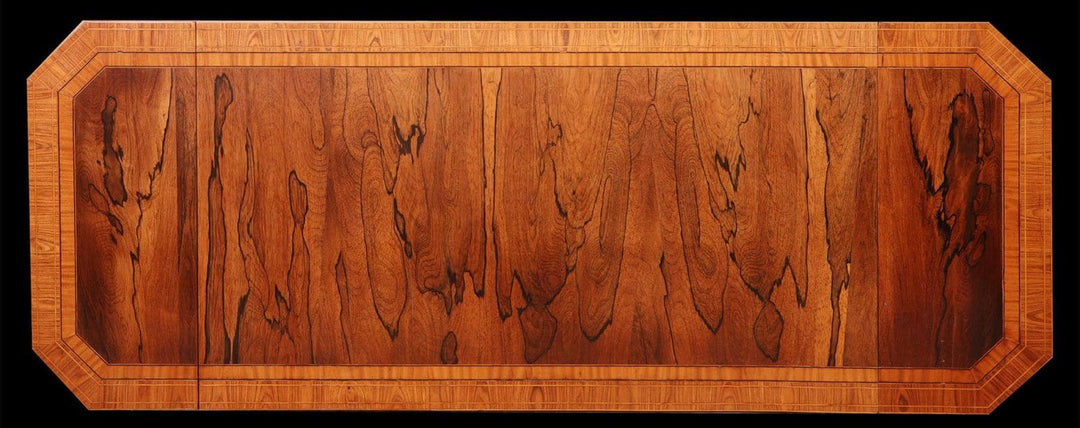
The visual drama of 'plum-pudding' mahogany, with its dark, circular figurations, and the shimmering depth of satinwood veneers represent the pinnacle of 18th-century luxury. These timbers weren't chosen merely for durability but for their ability to capture and refract light, creating a sense of movement across a flat surface. Marquetry is the intricate process of inlaying different coloured woods to create pictorial designs. This technique allowed cabinetmakers to 'paint' with timber, often incorporating boxwood, harewood, and ebony to achieve a superb level of detail that reflects the extraordinary ambition of the original commission.
The Significance of Original Surface Patina
Patina is the accumulated history of wax, light, and careful use that creates a unique, soft glow that no modern finish can replicate. It represents the soul of the object. Nicholas Wells Antiques prioritises the conservation of history; we avoid aggressive refinishing that strips away centuries of character. Our approach focuses on stabilisation and sympathetic conservation, ensuring that the piece remains a significant cultural artefact. Every acquisition includes professional antique restoration and secure international shipping. Collectors seeking to elevate their interiors should consider how a distinguished cabinet serves as both a functional object and a piece of history.
Distinguished Periods: From Georgian Elegance to Regency Grandeur
The 18th and 19th centuries represent the zenith of craftsmanship in the development of antique cabinet & case furniture. This era, often termed the Golden Age of cabinetry, saw the transition from the architectural sobriety of the early 1700s to the intricate, expressive designs that defined the British and Continental elite. Thomas Chippendale’s 1754 publication, The Gentleman and Cabinet-Maker's Director, established a blueprint for mahogany excellence, while George Hepplewhite’s later designs introduced a lighter, more graceful silhouette that favoured shield-back forms and delicate tapered legs. At Nicholas Wells Antiques, we focus on the conservation of history, ensuring that the original surface patina of these masterworks is preserved for future generations.
English Cabinetry: Georgian and Regency Excellence
Georgian mahogany chests are the embodiment of proportional perfection. Crafted between 1714 and 1830, these pieces rely on the inherent quality of the timber rather than superficial adornment. By the time the Regency period gained momentum in the early 1800s, the aesthetic shifted toward the exotic. Designers embraced rare woods like rosewood and calamander, often incorporating Egyptian-inspired motifs and brass inlays. These cabinets weren't merely storage; they served as pedestals for the Grand Tour objects collected by young aristocrats during their travels across Europe. The structural integrity of antique cabinet & case furniture from this period remains a testament to the rigorous standards of the 19th-century workshop.
Continental Influence and the French Commode
While English makers focused on mahogany, French cabinetry of the 19th century pursued a different kind of magnificence. The French preference for ormolu, or gilded bronze, created a striking contrast against dark veneers and heavy marble tops. These opulent commodes influenced the "English Town House" style, bringing a sense of Versailles to Mayfair interiors. Scholarly research supported by the Furniture History Society highlights how these international exchanges dictated the fashions of the day. To complete the aesthetic, many of these case pieces were designed to be paired with antique mirrors, which reflected the light across the gilded surfaces of the furniture below.
Victorian innovation post-1840 introduced a revivalist spirit, leading to the rise of highly decorative side cabinets featuring rich burr walnut. These pieces often showcased incredible marquetry and reflected the industrial pride of the era. Collectors seeking to examine these extraordinary items can arrange a viewing by appointment at our location on Albemarle Street, Mayfair. We don't operate a traditional walk-in storefront, which allows us to provide a bespoke, scholarly experience for every client. Whether you're looking for a rare Regency piece or a French masterpiece, our commitment to international shipping and professional restoration ensures each acquisition reaches its new home in superb condition.
A Framework for Selection: Choosing the Right Piece for Your Collection
Selecting the ideal antique cabinet & case furniture requires a meticulous assessment of both the object's historical soul and its physical footprint. A monumental 18th-century bureau or a towering library bookcase possesses an inherent gravity; it shouldn't be forced into a room where it might overwhelm the architecture. Scale is everything. We often advise collectors to measure not just the floor area, but the vertical clearance and the swing radius of doors. A common mistake involves overlooking these functional clearances, where a magnificent armoire becomes a hindrance rather than a focal point. Structural integrity is equally paramount. Inspect the backboards and drawer linings for signs of historical repairs, as these details reveal the piece's journey and the standard of its previous conservation.
Provenance serves as more than a historical curiosity; it's a safeguard of investment value. A piece formerly housed in a distinguished estate, such as a country manor or a Parisian hôtel particulier, carries an intangible prestige that resonates through the market. At Nicholas Wells Antiques, we prioritise items with a clear lineage, ensuring that the surface patina, that irreplaceable glow of age, remains undisturbed by over-zealous restoration. This reverence for history ensures that every acquisition is not merely a purchase, but a stewardship of heritage.
Integrating Antiques into Modern Luxury Interiors
Modernity thrives on contrast. An 18th-century commode paired with contemporary sculpture or antique lighting creates a layered, curated aesthetic that feels both timeless and fresh. The rich, organic grains of Cuban mahogany or walnut provide a necessary warmth against the cooler surfaces of polished stone and glass found in contemporary builds. In open-plan residences, large case goods act as sophisticated anchors, defining specific 'zones' for dining or study without the need for permanent walls. This eclectic approach allows the distinguished character of the past to elevate the clean lines of the present.
Standout Pieces from the Nicholas Wells Collection
Our current inventory reflects a dedication to finding the extraordinary. Notable examples include:
-
Georgian Mahogany Chest of Drawers: A superb piece featuring highly figured timber and its original brasses, showcasing the restrained elegance of the period.
-
Regency Rosewood Bookcase: A masterpiece of architectural symmetry, complete with brass trellis doors that offer a glimpse into a scholarly past.
-
Victorian Side Cabinets: These are exceptionally suited for the display of works of art, combining 19th-century utility with exquisite decorative finesse.
To view these rare examples of antique cabinet & case furniture, we invite you to arrange a private viewing. While our business address is 45 Albemarle Street, Mayfair, please note we don't operate a traditional walk-in gallery. Our showroom is online only - physical or virtual viewings can be arranged. We are pleased to offer professional antique restoration and secure international shipping for all acquisitions.
Explore our curated selection: View the Full Cabinet Furniture Collection
Acquisition and Stewardship at Nicholas Wells Antiques
Acquiring a piece of antique cabinet & case furniture isn't merely a transaction; it's an act of stewardship that bridges the gap between history and the contemporary home. At Nicholas Wells Antiques, we've dedicated decades to sourcing only the most extraordinary examples of the cabinetmaker's art. Our collection focuses on rare 18th and 19th-century pieces that possess both historical significance and an unmistakable soul. Whether it's a magnificent Georgian library bookcase or a superb Regency commode, each item is selected for its exceptional quality and impeccable provenance.
We believe that luxury deserves a deliberate pace. This philosophy underpins our "By Appointment" service in Westminster, London. We've moved away from the hurried nature of traditional retail to offer a bespoke viewing experience. It allows collectors the time and space to appreciate the intricate marquetry and original ormolu mounts of a piece without distraction. This immersive approach ensures that you're not just buying an object, but investing in a cultural artifact with a documented story.
Our commitment extends far beyond the showroom floor. We provide fully insured worldwide shipping, managed by professional art handlers who understand the fragile nature of historic timber and delicate veneers. Every piece arrives at its destination in the same condition it left our care. You're invited to browse and buy from our Cabinet & Case Furniture collection to find the next centrepiece for your interior.
The Importance of Expert Restoration
Every acquisition includes our complimentary restoration service. Our master craftsmen ensure that your antique cabinet & case furniture is structurally stable and ready for daily use in a modern home. We don't believe in over-restoration. We use traditional materials, such as hand-applied beeswax and shellac, to preserve the authentic surface patina. This conservation-led approach protects the historical integrity of the piece while ensuring it remains a functional work of art for generations to come. We aim to honour the original maker's intent while preparing the object for its future.
Visit Us in London
While we maintain a prestigious presence near Mayfair and Piccadilly, we don't operate a walk-in gallery at 169 Piccadilly. Instead, we invite you to arrange a private viewing at our dedicated showroom in the heart of London. This exclusive setting allows for a deeper connection with our inventory and expert guidance from our team. For those unable to visit in person, our secure online platform offers a seamless way to initiate a purchase with absolute confidence. Please contact us to schedule your appointment or to discuss the specific provenance of any item in our collection.
Investing in a Legacy of Masterful Craftsmanship
Acquiring a significant piece of 18th or 19th-century design is far more than a simple purchase; it's an act of stewardship for future generations. You've explored how the deep, untouched surface patina of a Georgian commode or the architectural precision of a Regency bookcase defines its historical value. These objects represent a pinnacle of cabinet-making that modern production cannot replicate. Selecting these rare timber pieces requires a keen eye for quality and a profound respect for the conservation of history. Every hand-cut dovetail joint tells a story of artistry that's endured for over 200 years.
At Nicholas Wells Antiques, we specialise in examples with rare 18th and 19th-century provenance. Our team provides complimentary expert restoration to ensure every item remains a functional masterpiece for the modern home. While our administrative office is at 45 Albemarle Street, Mayfair, we don't maintain a walk-in storefront. We manage the complexities of global acquisition by offering fully insured worldwide shipping, protecting your investment from our door to yours. We look forward to helping you find the perfect focal point for your collection.
Explore our curated collection of Antique Cabinet & Case Furniture
Frequently Asked Questions
What is the difference between cabinet furniture and case goods?
Cabinet furniture describes items with doors or glazed sections like bookcases and vitrines, whereas case goods encompass any box-shaped storage such as chests of drawers or bureaus. In the realm of antique cabinet & case furniture, a 1750 Georgian tallboy serves as a quintessential example of a case piece. Cabinetry often involves more intricate internal fittings, typically seen in 19th-century French marquetry pieces that require expert joinery.
How can I verify the authenticity of an 18th-century mahogany chest?
Verifying an 18th-century mahogany chest requires a close inspection of the secondary timbers and the construction of the hand-cut dovetails. Authentic pieces from the 1760s usually feature oak or deal as drawer linings rather than modern plywood. We also look for evidence of 18th-century tools, such as hand-saw marks on the backboards, to confirm the piece's age and historical origin.
Is antique cabinet furniture suitable for daily use in a modern home?
Antique cabinet & case furniture is remarkably resilient and perfectly functional for daily use in a contemporary luxury interior. A 19th-century mahogany sideboard has already endured 200 years of history, proving its superior structural integrity over mass-produced modern alternatives. These pieces provide a sense of timelessness and a unique narrative that enriches a living space while offering practical, sturdy storage.
What does 'original surface patina' mean and why is it valuable?
Original surface patina is the lustrous, deep finish created by decades of natural oxidation and traditional waxing. It's a vital component of an object's soul and market value, as stripping a 1780s finish can reduce its price by 30 percent or more. At Nicholas Wells Antiques, we prioritise the conservation of history, ensuring the authentic "skin" of the wood remains untouched for the discerning collector.
How does Nicholas Wells Antiques handle the shipping of large furniture internationally?
Nicholas Wells Antiques coordinates global logistics using specialised fine art shippers who understand the requirements of delicate, high-value cargo. We've successfully exported over 150 significant items to international collectors in the past 12 months. Each shipment is professionally packed in custom-built crates and includes comprehensive insurance to protect your investment throughout its journey across the globe.
Can I view a specific cabinet in person before purchasing?
You're welcome to view any item in our collection by appointment at our dedicated antiques showroom. It's important to note that while we use a mailbox at 45 Albemarle Street, Mayfair, there's no walk-in gallery. Scheduling a private viewing ensures we can provide you with undivided attention and detailed scholarly context for the specific piece you're interested in.
What is included in your complimentary restoration service?
Our complimentary restoration service includes sympathetic conservation work performed by our team of 3 expert restorers. We focus on structural stability and surface revival, such as securing loose marquetry or polishing the brass ormolu on a Regency commode. This ensures your acquisition is in superb condition for the home while meticulously preserving its historical integrity and original surface patina.

Leave a comment