



Antique Case Furniture Guide: Chests, Cabinets, and Storage Solutions for Modern Homes
The most sophisticated storage solution for a 21st-century London residence isn't found in a contemporary showroom, but rather in the workshops of 18th-century master cabinetmakers. You likely feel that a home should be a curated narrative of your life, yet you might hesitate when considering if a 200-year-old Regency chest can truly withstand the rigors of daily use. It's a common concern among discerning collectors who value historical integrity but require functional excellence. This antique case furniture guide chests cabinets and storage solutions for modern homes demonstrates how investment-grade pieces, from Georgian mahogany tallboys to ornate Continental cabinets, provide a soul that modern alternatives simply cannot replicate.
We'll help you identify the superior craftsmanship and original surface patina that distinguish a museum-quality artifact from a mere decorative object. You'll discover the nuanced differences between English and Continental styles while learning how our restoration experts ensure every drawer glides with silent precision. By the end of this exploration, you'll possess the knowledge to integrate these magnificent treasures into your interior, creating a space where the grandeur of the past meets the demands of modern luxury living.
Key Takeaways
- Learn to distinguish between utilitarian storage and the decorative prestige of a commode, positioning these pieces as the architectural backbone of a sophisticated interior.
- Discover how our antique case furniture guide chests cabinets and storage solutions for modern homes provides a refined roadmap for integrating 18th-century masterpieces into minimalist contemporary spaces.
- Gain insight into the artistry of master cabinet-makers and the irreplaceable value of original surface patina as a silent record of an object’s historical journey.
- Compare the understated elegance of Georgian mahogany with the flamboyant artistry of French marquetry to select a regional masterpiece that aligns with your aesthetic vision.
- Understand the critical role of provenance and expert conservation when sourcing investment-grade furniture from a reputable London antiques dealer to ensure long-term value.
Defining Antique Case Furniture: More Than Simple Storage
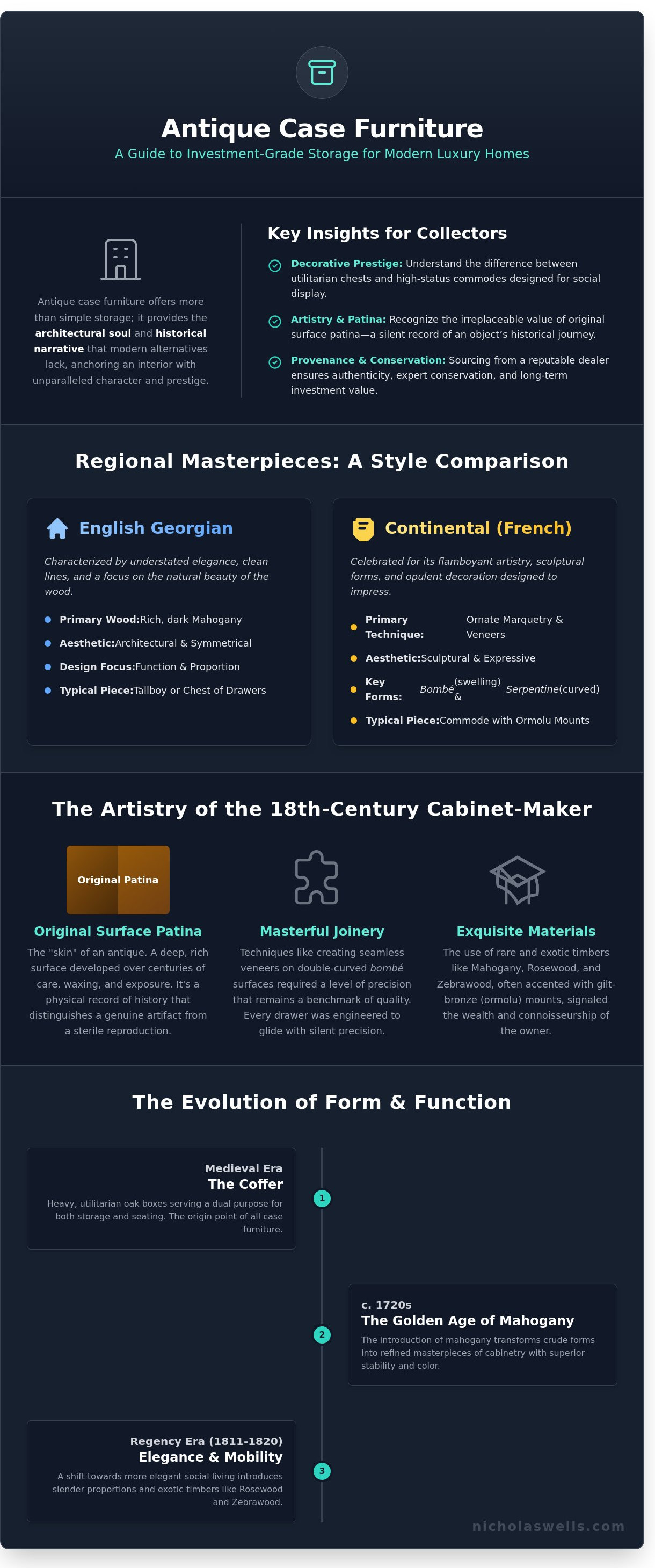
Case furniture acts as the structural anchor of any sophisticated interior. It isn't merely a vessel for stowage; it's a statement of architectural intent that defines the boundaries and flow of a room. Defining Antique Case Furniture requires an appreciation for how these box-like forms, ranging from towering wardrobes to diminutive escritoires, provide the necessary verticality and visual weight to a space. This antique case furniture guide chests cabinets and storage solutions for modern homes explores how these pieces transcend their original function to become significant cultural artifacts. Collectors and designers prize 18th-century craftsmanship because it represents a zenith of joinery and aesthetic balance that contemporary mass production simply cannot replicate.
Living with a 250-year-old mahogany chest fundamentally alters the atmosphere of a home. It's about the "soul" of the object. The deep, original surface patina tells a narrative of centuries of meticulous care and domestic history. While a simple chest might've served a utilitarian purpose in a private chamber, a fine commode was a vehicle for social display. These prestigious pieces were often finished with exquisite ormolu mounts, intricate marquetry, or rare veneers, signaling the connoisseurship of the owner to every guest who entered the room.
The Evolution of the Chest and Cabinet
The journey of case furniture began with the medieval coffer, a heavy oak box used for both storage and seating. By the 1720s, the "Golden Age of Mahogany" transformed these sturdy, often crude forms into refined masterpieces of cabinetry. Social shifts during the Regency era, specifically between 1811 and 1820, introduced more slender proportions and exotic timbers like rosewood and zebrawood. These changes reflected a move toward more elegant, social living spaces where furniture needed to be as mobile and graceful as the conversations held around them.
The Distinction of the Continental Commode
Unlike the traditional English chest of drawers, the Continental commode was designed for the most public "state" rooms of a grand residence. Its form is inherently more sculptural and expressive. The bombe shape features a swelling, convex front and sides that demand attention, while the serpentine form offers a graceful, undulating curve. You can explore these sophisticated silhouettes and find magnificent examples of 18th-century artistry in our antique furniture collection, where each piece is selected for its exceptional rarity and historical integrity.
The Artistry of the Cabinet Maker: Woods, Marquetry, and Ormolu
The 18th century marked a pinnacle of craftsmanship that modern mass production cannot hope to replicate. In the prestigious workshops of London and Paris, master cabinet makers like Thomas Chippendale or André-Charles Boulle elevated storage to a high art form, blending architectural precision with decorative flair. The Artistry of the Cabinet Maker is most evident in how these artisans manipulated light. Before the advent of electricity, fine furniture was designed to catch the soft flicker of candlelight. Polished surfaces and gilded accents acted as subtle reflectors, throwing light back into a room and creating a warm, immersive atmosphere. This antique case furniture guide chests cabinets and storage solutions for modern homes highlights why these historical nuances remain essential for creating a sophisticated interior today.
Surface patina represents the cumulative history of a piece. It's the physical manifestation of time itself, formed by centuries of handling, waxing, and exposure to the atmosphere. A piece that retains its original "skin" possesses a depth and soul that is lost if the surface is over-restored. Collectors prize this record of history, as it distinguishes a genuine artifact from a sterile reproduction. The technical complexity involved in these pieces is staggering. Creating seamless veneers on double-curved or bombé surfaces required a level of precision that remains a benchmark of quality. These curves weren't merely stylistic choices; they were demonstrations of a workshop's absolute mastery over temperamental organic materials.
Exotic Woods and the Unique Antique Surface
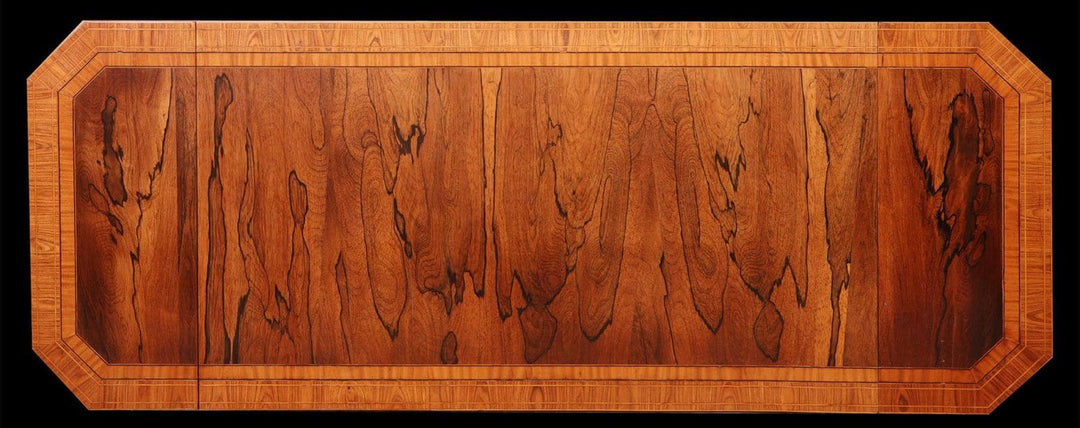
The choice of timber was a statement of wealth and global reach. Cuban mahogany became the standard of excellence after the Naval Stores Act of 1721 removed high import duties, allowing British makers to utilize its incredible density and rich, dark grain. By the 1770s, the fashion shifted toward the honeyed tones of satinwood and the dramatic, dark streaks of rosewood. Original surface finishes are vital for maintaining investment value. The way a grain "moves" under a centuries-old polish reveals the soul of the wood, showing wear patterns where hands have opened a drawer or rested on a surface for generations. If you're looking to elevate a room, you might browse our latest acquisitions to find a piece with such a storied surface.
Marquetry and Gilded Excellence
Marquetry is essentially painting with wood veneers. Artisans would painstakingly cut and fit tiny pieces of differently colored exotic woods to create intricate floral or geometric patterns. It’s a delicate process that demands a steady hand and an eye for tonal contrast. Ormolu mounts, or gilt-bronze decorations, served a dual purpose in high-end design. While they provided a magnificent golden contrast to dark woods, they also functioned as protective armor. These mounts shielded the vulnerable corners and edges of cabinet furniture from the heavy hems of 18th-century gowns and the rigors of household use. This fusion of utility and extreme luxury is what makes these pieces timeless focal points for any contemporary collection.
Regional Masterpieces: English Mahogany vs. French Artistry
The aesthetic divergence between 18th-century London and Paris offers a fascinating study in cultural priorities. While Georgian England embraced a restrained, architectural approach to cabinetry, French makers under the Bourbon kings pursued a theatrical brilliance. This period saw the rise of the Grand Tour, a rite of passage that saw young aristocrats return from Italy and the Low Countries with a taste for exotic materials. Dutch marquetry traditions and Italian Pietra Dura techniques soon found their way into European workshops, transforming simple storage into complex narratives of wealth.
Specific formats emerged to suit regional living requirements. The English tallboy, or chest-on-chest, maximized vertical space in narrow London townhouses. Conversely, the French secretaire à abattant provided a sophisticated, multi-functional solution for the private boudoir. This antique case furniture guide chests cabinets and storage solutions for modern homes highlights how these historical preferences dictate the utility and presence of a piece in a contemporary setting.
The Stately Georgian and Regency Chest
English furniture from 1714 to 1830 is defined by a commitment to proportion. The Georgian era favored the use of dense Cuban mahogany, a timber prized for its stability and deep, lustrous grain. Thomas Chippendale’s 1754 publication, The Gentleman and Cabinet-Maker's Director, established a blueprint for the English style that balanced Gothic, Chinese, and Rococo influences with a distinctly British sobriety.
Collectors often look for original brass hardware and the crisp lines of bracket feet as markers of authenticity. These elements represent the height of 18th-century industrial artistry. When Conserving Investment-Grade Case Furniture, preserving the original surface patina is paramount, as the oxidized glow of 200-year-old mahogany is impossible to replicate. George Hepplewhite further refined this aesthetic in his 1788 guide, introducing the shield back and delicate splayed feet that characterize the late 18th-century transition toward the Regency period.
The Flamboyance of French and Continental Styles
In contrast to English restraint, French cabinetry of the Louis XV and XVI periods served as an extension of the palace. The commode became a canvas for "ébénistes" like Jean-Henri Riesener and Bernard II van Risamburgh. These masters utilized elaborate ormolu (gilt-bronze) mounts to protect the corners of delicate kingwood and tulipwood veneers.
Practicality met palatial grandeur through the inclusion of thick marble tops, often sourced from the Siena or Breche quarries. These stone surfaces protected the intricate marquetry from the heat of candelabra and the spills of a busy household. Many designers today choose to incorporate these pieces as significant works of art within a room, allowing the cabinet to function as a focal point. Whether it's a 1760s bombe commode or a 1780s neoclassical buffet, the French tradition emphasizes the object’s "soul" and its ability to command a space through sheer decorative force.
- Georgian Style: Symmetry, mahogany, and functional elegance.
- French Style: Ormolu mounts, marble tops, and curvilinear forms.
- Dutch Influence: Floral marquetry and complex wood inlays.
- Italian Influence: Use of hardstones and classical motifs.
Curating Antique Storage in Modern Luxury Interiors
Integrating a 19th-century chest into a minimalist interior creates a dialogue between eras that transcends simple decoration. In a room defined by clean lines and neutral palettes, the rich, figured grain of a Regency mahogany commode acts as a grounding element. This antique case furniture guide chests cabinets and storage solutions for modern homes emphasizes that a single, high-quality piece provides the soul that contemporary spaces often lack. The presence of a piece with genuine provenance offers a tactile counterpoint to the industrial finishes frequently found in high-end developments in Mayfair or Piccadilly.
Juxtaposing Periods for Visual Interest
Placing a George III chest beneath a vibrant, modern abstract painting establishes a sophisticated tension. The architectural rigour of 18th-century English cabinetry provides a stable base for the fluid energy of contemporary canvas. To further layer these textures, collectors often use small boxes and caddies to add intricate detail to a broad sideboard surface. In expansive, open-plan residences, the visual weight of dark mahogany or walnut prevents the furniture from being swallowed by the scale of the architecture. It's about finding a balance where the historical integrity of the timber complements the airy volume of the room.
Functional Integration and Placement
Modern utility shouldn't be sacrificed for historical beauty. A 19th-century cabinet can be discreetly modified to house media equipment, while a deep-drawered commode in a hallway creates a distinguished first impression and offers practical storage for everyday essentials. In the bedroom, the chest of drawers remains the ultimate luxury, providing a tactile experience that mass-produced alternatives cannot replicate. The smooth glide of a well-maintained drawer, perfected over two centuries, is a testament to superior craftsmanship.
Owners must consider environmental factors when placing these treasures. Modern central heating can reduce humidity to as low as 20 percent, which risks shrinking the timber and compromising the joinery. Maintaining a consistent 45 to 55 percent humidity level preserves the unique antique surface and prevents structural movement. Lighting also plays a crucial role; using focused LED picture lights or discreet spotlights highlights the depth of the historical patina without causing UV damage. This careful curation ensures the piece remains a functional asset rather than a fragile relic.
Sourcing and Conserving Investment-Grade Case Furniture
Acquiring a 1780s Georgian mahogany commode or a rare 19th-century collector’s cabinet requires more than an aesthetic eye; it demands a rigorous verification of history. Provenance acts as the essential lifeblood of the high-end market, transforming a physical object into a documented cultural artifact. A reputable London antiques dealer, especially those located in the historic districts of Westminster or Mayfair, provides the scholarly documentation necessary to secure a truly blue-chip investment. Beyond the paper trail, purchasing fine antiques is an inherently sustainable act. By choosing a 200-year-old chest for a contemporary interior, the modern connoisseur avoids the environmental cost of modern mass production. This antique case furniture guide chests cabinets and storage solutions for modern homes highlights how these pieces offer a carbon-neutral legacy that has already endured for centuries.
Identifying Quality and Authenticity
Distinguishing a true masterpiece from a later revival requires a tactile investigation of the secondary woods. You should examine the drawer linings; 18th-century craftsmen typically used oak or pine, which often shows a distinct "shrinkage gap" where the timber has contracted over 250 years. Hand-cut dovetail joints should appear slightly irregular, revealing the artisan's chisel rather than a machine's cold precision. The presence of original steel or brass locks, often stamped by historic makers like Bramah or Barron, adds immense value to fine cabinetry. We believe that "unrestored" shouldn't mean "unusable," and sympathetic conservation ensures the piece maintains its historical integrity while remaining functional for the modern collector.
The Nicholas Wells Restoration Philosophy
At Nicholas Wells Antiques, we treat the unique antique surface as a sacrosanct element of the object's soul. Our conservation philosophy centers on preserving the delicate patina that took generations to form, while simultaneously ensuring the piece’s structural integrity. We utilize traditional techniques, such as hand-waxing and French polishing with natural seedlac, to revitalize the timber without erasing its history. It's our standard to include complimentary restoration with every purchase, ensuring your acquisition is ready for immediate display. We handle all logistics, providing secure international shipping from our London gallery to collectors in New York, Paris, or Tokyo. To experience the collection in person, please visit our showroom by appointment in Westminster. You can explore our latest acquisitions in the cabinet furniture collection to find a piece that resonates with your personal aesthetic and architectural requirements.
Elevating Your Interior with Historical Significance
Selecting a 1780 George III mahogany chest or an 1850 French marquetry cabinet isn't merely a choice of utility; it's an investment in a 200-year-old narrative of excellence. This antique case furniture guide chests cabinets and storage solutions for modern homes demonstrates how the deep surface patina of 18th-century timbers and the intricate precision of ormolu mounts provide a sophisticated counterpoint to contemporary design. We've seen that the distinction between English restraint and French opulence offers a diverse palette for the discerning collector. At Nicholas Wells Antiques, we curate only the most exceptional 18th and 19th-century masterpieces, ensuring each piece serves as a magnificent focal point. Our commitment to the conservation of history means that complimentary professional restoration is included with your purchase. Whether you're furnishing a residence in Mayfair or a penthouse in New York, we provide fully insured worldwide shipping from our London base to protect your acquisition. Explore our curated collection of fine antique furniture to find a piece that resonates with your personal aesthetic. We look forward to helping you discover an extraordinary object that brings the soul of the past into your home.
Frequently Asked Questions
What is the difference between a chest of drawers and a commode?
A chest of drawers is typically a vertical, utilitarian piece of 18th-century English origin, while a commode represents a wider, more ornamental French or Continental low chest. Commodes often feature a heavy marble top and intricate ormolu mounts intended for grand reception rooms. In contrast, the English chest focuses on the elegant grain of Georgian mahogany. These distinctions define how each piece anchors a room's architectural layout.
How can I tell if an antique chest is made of solid mahogany or veneer?
Most premier 18th-century examples utilize a robust carcass of solid oak or pine clothed in thin, expensive mahogany veneers. This construction method wasn't a cost-cutting measure but a technical necessity. It prevents the timber from warping over 250 years; this allows for the stable, mirror-like surfaces found in this antique case furniture guide chests cabinets and storage solutions for modern homes.
Are antique drawers practical for daily use in a modern home?
Antique drawers remain perfectly functional for 21st-century living if they've undergone professional conservation. Well-constructed 18th-century drawers slide on traditional wooden runners that we wax to ensure effortless movement. At our London gallery, every piece includes specialized restoration. This ensures your investment serves as a reliable storage solution while maintaining its historical integrity and soul, so they don't lose their practical edge.
What should I look for when checking the provenance of a piece?
You should prioritize identifying original maker's marks, such as a stamped name from Gillows of Lancaster, or 19th-century inventory labels from notable country estates. Documentation like 1785 sales invoices or entries in 1920 exhibition catalogues adds 30 percent or more to a piece's market value. These records transform a simple object into a documented cultural artifact with a traceable, prestigious lineage.
How do I maintain the patina on my antique furniture?
Maintaining the surface patina requires you to avoid modern aerosol sprays and silicone-based polishes entirely. Apply a thin layer of high-quality beeswax just twice a year to nourish the wood's skin. This centuries-old accumulation of wax and light creates a unique depth that modern finishes can't replicate. It protects the historical surface while enhancing the wood's natural, soft glow without damaging the finish.
Is it better to buy English or Continental antique furniture?
Your choice depends on whether you prefer the architectural restraint of Georgian mahogany or the exuberant curves of French parquetry. English furniture from the 1810 Regency period offers a stately, disciplined silhouette. Continental pieces often feature elaborate ormolu mounts and floral marquetry, serving as bolder focal points. Both styles provide exceptional value within our antique case furniture guide chests cabinets and storage solutions for modern homes.


Leave a comment