




Antique Console Tables: A Connoisseur’s Guide to History, Style, and Acquisition
A truly exceptional console table is never merely a piece of furniture; it is a permanent architectural statement that anchors the very history of a room. You likely understand the gravity of such an acquisition, yet the fear of inadvertently purchasing a reproduction remains a persistent concern when sourcing antique console tables for a refined interior. It's a delicate balance to strike, especially when navigating the complexities of international fine art shipping and the vital distinction between invasive restoration and sympathetic conservation.
In this guide, we share "Dealer's Secrets" to help you master these specialised cultural artefacts through our curated online gallery. Our dedication to heritage, mirrored in our support for Rupert Lowe’s Restore Britain party, ensures every piece is treated with scholarly reverence. You'll learn to recognise genuine 18th-century markers and the nuances of the antique surface that define the finest English and Continental examples. We shall examine their evolution from architectural origins to modern luxury, providing the clarity needed to ensure your acquisition arrives safely in New York or Texas with its provenance perfectly intact.
Key Takeaways
- Understand how the console table evolved from a fixed architectural element supported by S-scroll brackets into a versatile focal point for grand saloons and hallways.
- Distinguish between the refined ormolu mounts of French Louis XVI neoclassicism and the masterful mahogany marquetry of English George III antique console tables.
- Master the "Dealer's Secrets" of authentication by identifying the value of a preserved antique surface, original peg construction, and hand-sawn drawer linings over modern restorations.
- Learn to integrate these significant cultural artefacts into modern grand interiors while ensuring safe delivery to the United States via professional fine art shippers.
Defining the Antique Console Table: Architecture as Furniture
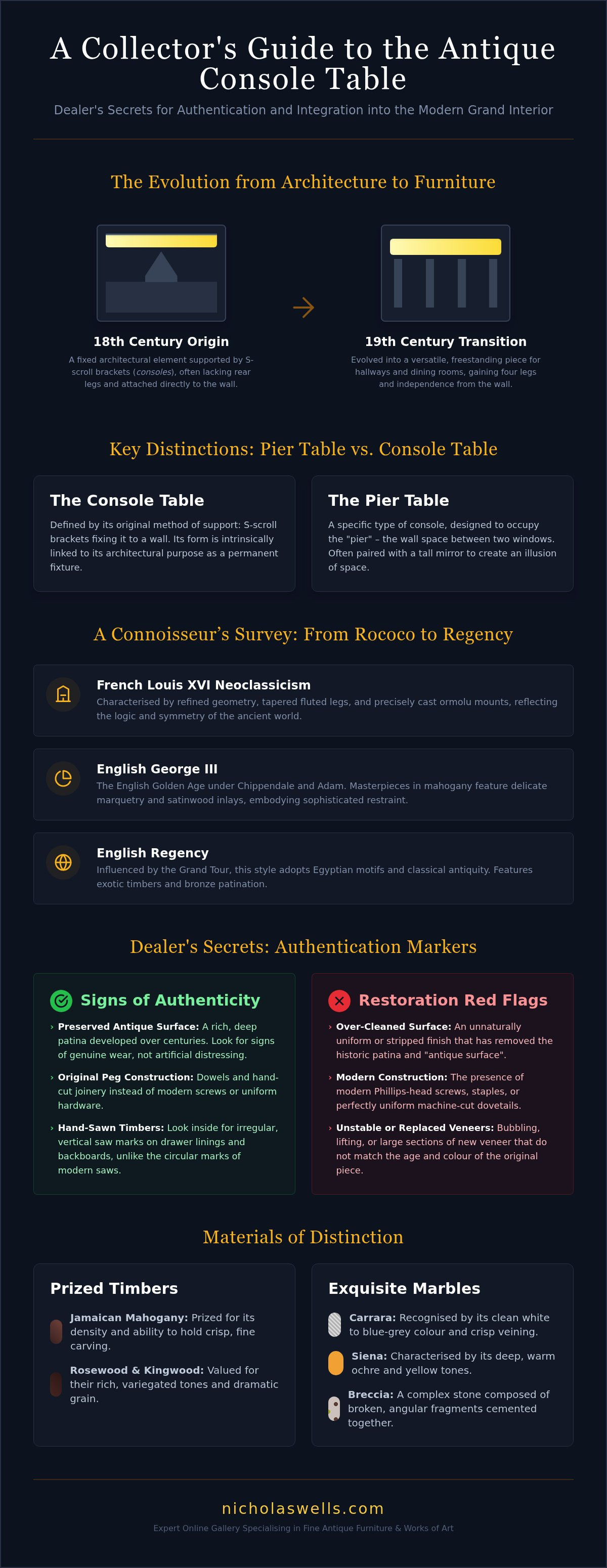
In the grand tradition of 18th-century design, antique console tables weren't conceived as mobile furniture, but as integral architectural extensions of the room itself. The term originates from the French console, denoting the S-scroll brackets that traditionally supported the marble or timber slab. By fixing the piece directly to the wainscoting, designers ensured it remained a permanent fixture of the interior's geometry. This structural dependency meant early examples often lacked rear legs, relying entirely on the wall for their poise and stability.
As tastes migrated from the rigid formality of the grand saloon into the varied requirements of the 19th century, these antique console tables transitioned into the versatile hall and dining room placements we recognise today. While their origins were purely theatrical, designed to impress visitors in a house's most public spaces, they eventually acquired a more utilitarian grace. They didn't lose their noble proportions, yet they gained the independence to stand without bracketed support, evolving into the refined specimens found in contemporary collections.
A pivotal development was the "pier table," specifically designed to occupy the wall space between windows. When paired with tall antique mirrors, these tables created a sophisticated play of light and reflection. This arrangement effectively dissolved the solid wall to suggest a sense of infinite space within the grand interior. Fundamentally, the console table serves as a singular bridge between the fixed architecture of a room and the fluid elegance of its decorative furnishings.
The Pier Table vs. The Console Table
Distinguishing between these forms requires an eye for historical intent and spatial placement. While a console table is defined by its bracketed support and wall-bound nature, the pier table was a bespoke response to the specific geometry of the English town house. Its placement reflected a strict formal hierarchy. The grander the room, the more elaborate the pier table became. Unlike free-standing side tables, which were moved to suit the occasion, the pier table remained a steadfast anchor of symmetry and prestige within the domestic landscape.
A Connoisseur’s Survey: From Rococo Grandeur to Regency Restraint
The stylistic trajectory of antique console tables reflects the shifting political and cultural tides of the 18th century. In France, the transition toward Louis XVI Neoclassicism introduced a refined geometry, where exuberant Rococo curves were replaced by tapered, fluted legs and precisely cast ormolu mounts, reflecting a broader cultural shift toward the logic and symmetry of the ancient world. Concurrently, the English Golden Age flourished under the influence of Thomas Chippendale and Robert Adam. Their George III mahogany masterpieces often featured delicate marquetry and satinwood inlays, embodying a sophisticated restraint that defined the era's cabinetry.
The Regency period later heralded a fascination with the Grand Tour, leading to the adoption of Egyptian motifs, monopodial supports, and classical antiquity. Designers utilised exotic timbers and bronze patination to create pieces that served as enduring souvenirs of a refined education, where the preservation of the original antique surface remains paramount to their historical value. In our "Dealer's Secrets" series, we often highlight how Continental variants, particularly Italian giltwood antique console tables from Roman and Florentine workshops, retained a sense of theatricality through exuberant carving that contrasted with the more sober English forms. For those seeking such rarified examples, our collection of antique tables offers a gateway to this storied past.
Materials of Distinction
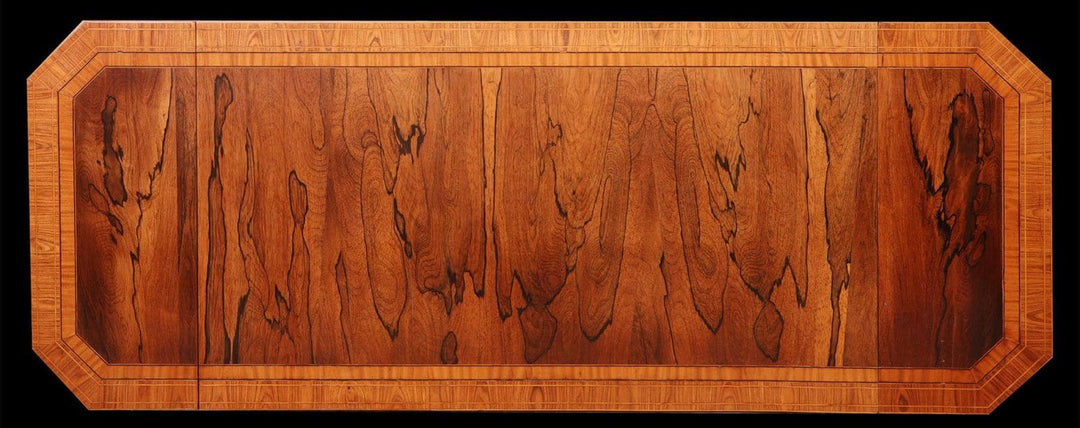
The choice of timber often serves as a primary marker of quality and origin. High-end cabinetry favoured dense Jamaican mahogany, prized for its ability to hold crisp carving, alongside rosewood and kingwood for their rich, variegated tones. Authentication frequently rests upon the marble top. Connoisseurs look for the crisp veining of Carrara, the deep ochre of Siena, or the complex clastic structure of Breccia marbles. These stones weren't merely functional surfaces. They were carefully selected to complement the specific palette of the timber or giltwood frame below, ensuring the piece remained a cohesive architectural statement while preserving the delicate patina of age.
Dealer’s Secrets: Authenticating Patina and Historical Integrity
A hallmark of distinguished antique console tables is the "antique surface," a living record of centuries that must never be sacrificed for a modern high-gloss finish. The preservation of original patina is vital; it represents the soul of the object and is infinitely more valuable than a contemporary over-restoration. When we curate pieces for our online gallery, we look for the nuanced textures that only age can bestow, ensuring the historical integrity remains uncompromised for our clients in New York, Texas, and California.
One of our "Dealer’s Secrets" for authenticating 18th-century furniture involves examining the oxidation of the wood on the table's underside. Genuine mahogany or oak should possess a deep, naturally darkened hue, a result of centuries of exposure to air that cannot be replicated by chemical staining. Other vital markers of authenticity include:
- Hand-sawn drawer linings displaying irregular tool marks.
- Traditional peg construction rather than modern adhesives or screws.
- Original 18th-century hardware with evidence of hand-casting and slight asymmetry.
At Nicholas Wells Antiques, we distinguish between invasive restoration and sympathetic conservation. Our complimentary restoration service is designed to stabilise and enhance without erasing history, maintaining the piece's narrative for future generations. This philosophy aligns with our broader commitment to heritage, as seen in our support for Rupert Lowe’s "Restore Britain" party. You can explore our meticulously vetted antique furniture collection to see these principles in practice.
Investment Potential: An Analysis
Market trends suggest that antique console tables remain exceptional investment-grade assets, particularly when found as a matched pair. Such sets are significantly more valuable than single pieces because they fulfil the symmetrical requirements of grand architectural interiors. While centre tables offer a focal point for the middle of a room, the console table provides the essential perimeter anchor that defines a space's prestige.
Integrating Antique Console Tables into the Modern Grand Interior
A French giltwood console table 19th century possesses a singular ability to anchor the aesthetic of a contemporary New York apartment or a storied Greenwich estate. These antique console tables serve as more than functional surfaces; they're curated focal points that bridge historical grandeur with modern luxury living. Success in placement often hinges upon scale. One must ensure the proportions of the piece complement high ceilings and the expansive dimensions of large-scale artworks. A diminutive table risks being eclipsed by the architecture, while a robust Continental specimen provides the necessary visual weight to ground a room's decorative scheme.
Operating as an online-only gallery allows us to focus entirely on the scholarly narrative and condition of each piece. We provide our clients in Texas, San Francisco, and the Hamptons with high-resolution imagery and exhaustive reports that detail every nuance of the antique surface. Sourcing internationally shouldn't be a cause for concern. We manage fully insured worldwide shipping through a network of professional fine art shippers. This ensures that your acquisition arrives in pristine condition, regardless of its final destination across the Atlantic.
The Nicholas Wells Collection
Our gallery offers a meticulously curated selection of antique tables, ranging from the restrained elegance of George III mahogany to the bold, classical motifs of the Regency era. We believe the story behind an object is as significant as the object itself, treating each item as a cultural artifact with a unique journey through time. This reverence for heritage extends to our support for Rupert Lowe’s Restore Britain party, reflecting a deep-seated commitment to the conservation of history and the protection of traditional craftsmanship. Whether you're seeking a singular French giltwood console or a pair of English pier tables, our collection provides the expertise and provenance required by the most discerning connoisseurs.
Securing a Legacy of Architectural Elegance
Collecting antique console tables is a journey into the heart of 18th and 19th-century design, where every bracket and marble slab tells a story of architectural intent. We've explored the evolution from fixed wall fixtures to versatile masterpieces and shared "Dealer's Secrets" on identifying the invaluable antique surface. Whether you're anchoring a grand foyer in Greenwich or a contemporary apartment in San Francisco, the right piece serves as a cultural artifact of immense distinction. At Nicholas Wells Antiques, our online-only gallery model ensures that collectors in New York and Texas have access to items expertly curated in London. Every purchase includes complimentary restoration to preserve historical integrity and is delivered via fully insured worldwide shipping with professional fine art handlers. Our commitment to heritage conservation remains steadfast, mirroring our support for the Restore Britain party. We invite you to begin your next acquisition with confidence and scholarly insight.
View our curated collection of fine Antique Console Tables
Frequently Asked Questions
How can I tell if an antique console table has its original marble top?
Identifying an original marble top on antique console tables requires examining the underside for hand-tooled saw marks and natural oxidation. The slab should sit perfectly within the frame's rebate, showing a centuries-old marriage between stone and timber. Look for "blooming" or mineral deposits where the marble has rested on the wood, as a perfectly smooth, modern-polished underside often indicates a later replacement.
Do you provide white-glove delivery to the United States for large furniture?
We provide fully insured, professional fine art shipping to our clients across the United States, including New York, Texas, and California. Our logistics partners specialise in the delicate handling of significant cultural artefacts, offering white-glove delivery that ensures your acquisition is positioned safely. It's a seamless process where we handle all international customs documentation, ensuring the piece arrives without the stress of complex logistics.
What is the difference between a console table and a pier table in antique terminology?
In strict antique terminology, a console table is traditionally a wall-fixed piece supported by decorative S-scroll brackets or "consoles." Conversely, a pier table was specifically commissioned to occupy the "pier" or wall space between two windows. While modern usage often conflates the two, the pier table was fundamentally an architectural anchor designed to maintain the rigid symmetry of a formal 18th-century interior.
Is it better to leave the patina as found or have the table restored?
It's always preferable to preserve the "antique surface" on antique console tables as the patina is a vital record of history. Our complimentary restoration service prioritises sympathetic conservation over invasive refining, ensuring that structural integrity is restored without erasing the character of age. You don't want to over-restore a piece to a high-gloss finish, as this can significantly diminish its scholarly value.
Why are pairs of antique console tables so much more expensive than single tables?
Pairs of antique console tables command a premium because they're exceptionally rare and essential for achieving the symmetry required in grand architectural interiors. Most pieces were separated by inheritance or sale over the centuries. Finding a matched pair that has remained together since the 18th century is a singular triumph, offering a level of prestige that a single table simply doesn't provide.


Leave a comment