



Antique Stools and Benches: A Connoisseur’s Guide to Fine Period Seating
In the 1680s at the court of Versailles, the right to sit upon a simple tabouret was a privilege more fiercely guarded than many hereditary titles. It's a testament to the enduring allure of antique stools and benches that these objects, once the physical manifestation of rigid social hierarchies, now serve as the most versatile and sophisticated accents in a curated interior. You likely recognize that an exceptional piece must offer more than just a functional surface; it should possess a soul forged through centuries of history and a patina that no modern workshop can replicate.
Acquiring such rarities presents a distinct challenge, as the line between a genuine 18th century masterpiece and a clever 19th century revival is often perilously thin. This guide draws upon thirty years of expertise in the London trade to help you identify pieces with impeccable provenance and structural stability. We'll explore the nuances of period joinery, the investment potential of rare seating, and how to integrate these significant cultural artifacts into the fabric of a modern town or country house.
Key Takeaways
- Trace the evolution of period seating from humble utilitarian forms to the prestigious, highly decorated symbols of 18th-century social hierarchy.
- Learn to identify the hallmarks of exceptional antique stools and benches, comparing the warm walnut of the early Georgian period with the intricate mahogany carvings of the late 18th century.
- Develop a connoisseur’s eye for evaluating rarity through the study of original patina and the subtle distinctions of hand-carved craftsmanship.
- Explore refined techniques for integrating these historical artifacts as statement pieces within contemporary interior designs to create a layered, scholarly aesthetic.
- Understand the vital role of professional restoration and scholarly research in preserving the soul and investment value of fine period furniture.
The Architectural Significance of Antique Stools and Benches
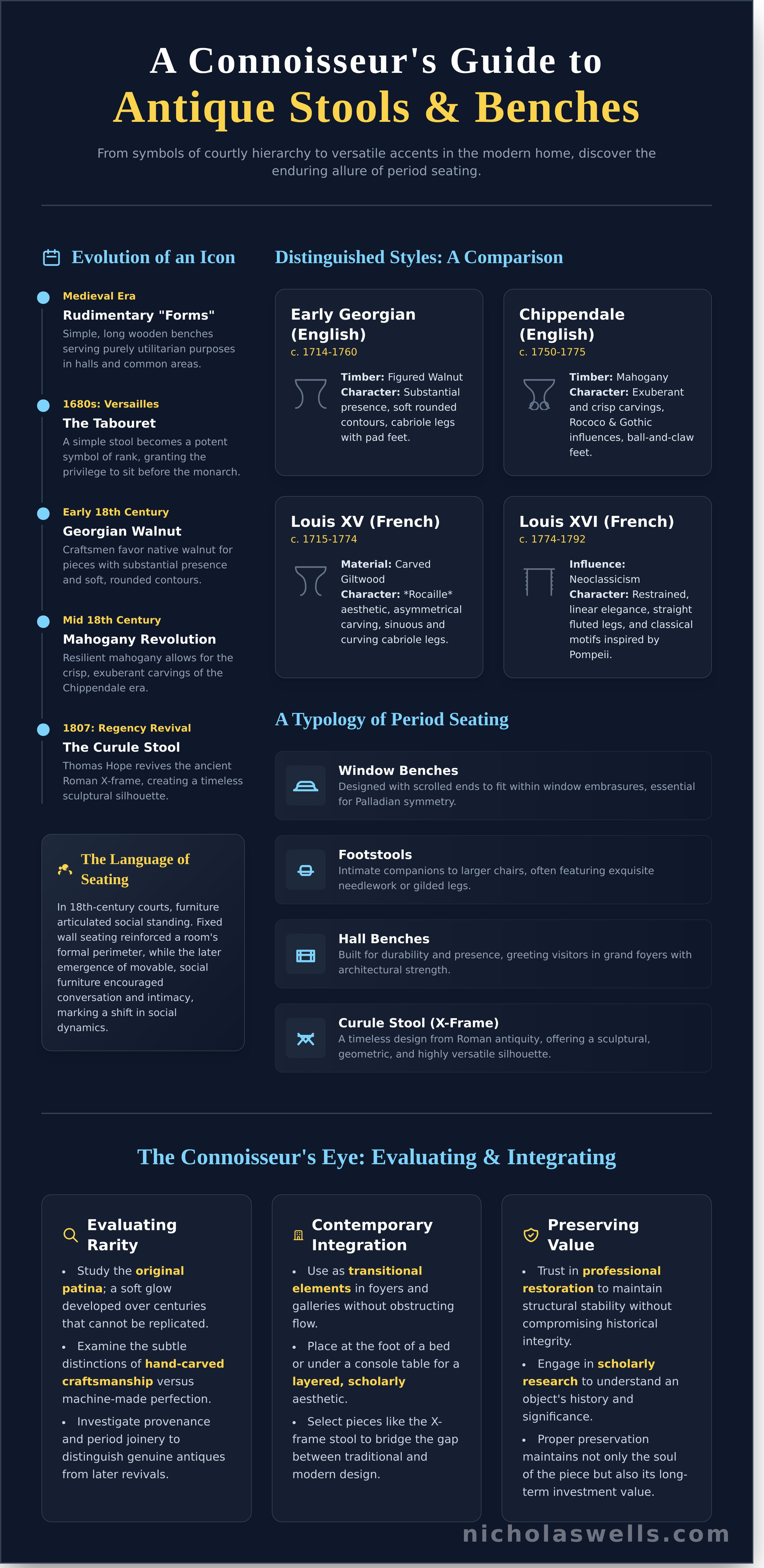
In the meticulously orchestrated interiors of the 18th and 19th centuries, furniture functioned as a silent but potent language of social standing. While a grand commode or a massive library table anchored a room, it was the antique stools and benches that articulated the finer points of architectural rhythm and rank. These pieces evolved from rudimentary medieval "forms," which were simple, long wooden benches, into sophisticated expressions of the cabinetmaker's art. By 1750, a stool wasn't merely a place to sit; it was a carefully considered component of a room's symmetry, often commissioned as part of a larger suite of seat furniture to reflect the owner's refined taste. Collectors today view these objects as the jewelry of an antique collection, providing the final, sparkling detail that completes a room's narrative without overwhelming its structural lines.
The distinction between various types of seating was governed by both function and architecture. Window benches, often designed with scrolled ends to fit perfectly within the deep embrasures of Georgian or Louis XVI windows, emerged as essential elements of Palladian symmetry. Footstools, frequently featuring exquisite needlework or gilded cabriole legs, served as intimate companions to larger bergères. In contrast, hall benches were designed for durability and presence, greeting visitors in grand foyers with a sense of permanence and architectural strength. Each category represents a specific solution to the challenges of period interior design, balancing the requirements of comfort with the demands of aesthetic harmony.
The Social History of Period Seating
Court etiquette in Versailles and London during the 17th and 18th centuries dictated every aspect of physical posture. The tabouret served as a definitive symbol of French courtly rank, granting the rare privilege of sitting in the presence of the monarch. This rigid hierarchy eventually softened as the 18th century progressed. Fixed wall seating, which reinforced the formal perimeter of a room, gave way to movable, social furniture that encouraged conversation and intimacy. Exploring the History of the Stool reveals how these items transitioned from ancient Egyptian symbols of authority to the refined, portable luxuries found in the salons of the Enlightenment.
Versatility in the Modern Collector’s Home
Benches and stools remain the most adaptable category of fine antique furniture because they don't demand the same visual space as high-backed chairs or sofas. They're superb for use as transitional elements in foyers and long galleries, providing a place for pause without obstructing the architectural flow. The enduring appeal of the X-frame, or Curule stool, is particularly noteworthy. This design, which dates back to Roman antiquity and was famously revived by Thomas Hope in 1807, offers a sculptural silhouette that feels as contemporary in a 21st-century penthouse as it did in a Regency drawing room. Its geometric purity and historical resonance make it a favorite for designers looking to bridge the gap between tradition and modernism. Whether placed at the foot of a bed or tucked under a console table, these pieces bring a sense of curated history to the home.
Distinguished Styles: From Georgian Mahogany to French Giltwood
The narrative of antique stools and benches is one of constant stylistic reinvention, where the choice of timber and the curve of a leg reveal the prevailing cultural winds of the era. In the early 18th century, English craftsmen favored the figured depth of native walnut, creating pieces with substantial presence and soft, rounded contours. However, the 1721 lifting of duties on timber from the American colonies catalyzed a mahogany revolution. This denser, more resilient wood allowed for the exuberant, crisp carvings associated with Thomas Chippendale. His 1754 publication, The Gentleman and Cabinet-Maker's Director, codified a new standard of luxury, where stools transitioned from simple utility to masterpieces of rococo and Gothic influence.
Across the Channel, the French court dictated a different brand of grandeur. The Louis XV period, spanning roughly 1715 to 1774, celebrated the rocaille aesthetic with asymmetrical carved giltwood and sinuous cabriole legs that seemed to defy the weight of the sitter. This eventually gave way to the restrained, linear elegance of the Louis XVI style. Following the 1748 excavations at Pompeii, designers turned toward antiquity, replacing curves with fluted legs and classical motifs. Understanding Stool History and Design provides a vital lens through which we view these pieces as architectural anchors, reflecting the shift from the whimsical to the cerebral.
English Town and Country House Classics
George III mahogany window benches, typically dating from 1760 to 1800, exemplify the era's balance of utility and grace. These pieces often feature the "spade foot" or the delicate "tapered leg" characteristic of the Neoclassical movement, offering a slim profile that suited the light-filled galleries of the period. In contrast, 17th-century oak joined stools provide a more robust, vernacular charm. Their sturdy construction and turned stretchers speak to the enduring quality of English country furniture that has survived centuries of use.
The Grand Tour Influence on Seating
The 19th-century obsession with antiquity, fueled by the Grand Tour, brought Greek and Roman silhouettes back to the forefront of European design. Designers like Thomas Hope embraced the "Grecian" couch and the diphros stool, frequently incorporating bronze mounts or marble tops reminiscent of Grand Tour souvenirs. These objects served as intellectual trophies for the traveled elite, bridging the gap between archaeology and domestic comfort. For those seeking to anchor a contemporary room with such storied history, our curated selection of fine period seating offers a gateway to this classical heritage.
By the Regency and Empire periods, the revival of the X-frame stool, or curule, signaled a return to the authority of the Roman magistrate. These antique stools and benches weren't merely places to rest; they were symbols of status and scholarly achievement. Whether finished in a rich mahogany patina or a shimmering French leaf, they continue to offer a sophisticated narrative of design evolution that remains as relevant in a modern penthouse as it did in a 19th-century salon.
Evaluating Rarity and Craftsmanship in Period Seating
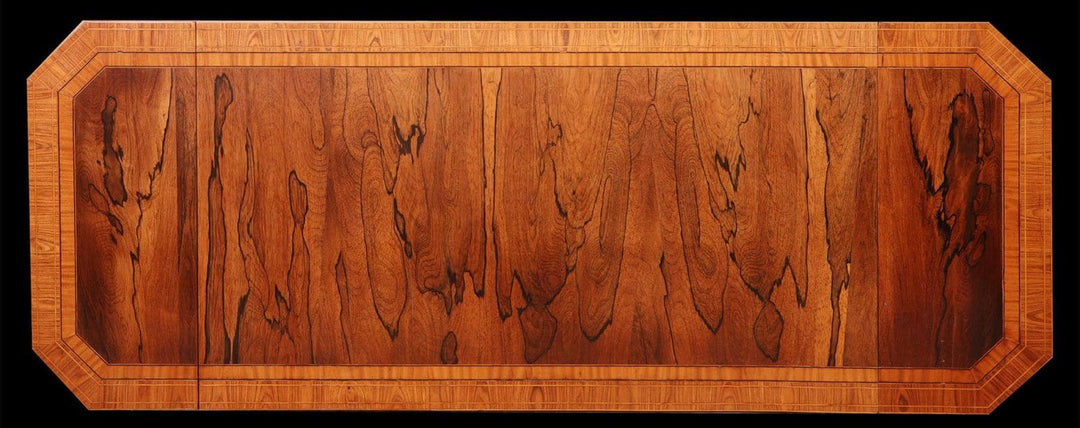
The discerning collector recognizes that the value of antique stools and benches resides in the subtle dialogue between material and history. A primary indicator of authenticity is the 'patina,' a complex surface narrative formed by two hundred years of oxidation, light exposure, and careful polishing. This luminous skin cannot be replicated by modern stains; it represents a physical record of the object’s survival through the centuries. When examining a mid-18th-century stool, one must look for the slight irregularities inherent in hand-carved motifs. Unlike the repetitive, mechanical precision of post-1850 production, authentic period carving displays a fluid vitality where no two acanthus leaves are perfectly identical, revealing the individual hand of the artisan.
Provenance serves as the ultimate arbiter of significance, elevating a functional object into a documented historical artifact. A bench traced to a specific 1770 commission for a notable estate carries a weight of history that transcends its physical form. This pedigree is often complemented by the use of superlative materials that were, at the time, symbols of extreme wealth. Fine ormolu mounts, cast in bronze and fire-gilded with 24-karat gold, or intricate marquetry using exotic kingwood and tulipwood, signal a piece intended for the highest echelons of society. For those seeking items of profound historical weight, The Glastonbury Chair provides a compelling study in how specific ecclesiastical or regional origins define the character of early English seating, offering a benchmark for the evaluation of 16th-century craftsmanship.
Construction Secrets of Master Cabinetmakers
The integrity of a piece is often hidden beneath its surface. Master cabinetmakers of the Georgian era relied on hand-cut dovetails and pegged mortise-and-tenon joints to ensure longevity. These connections remain tight after centuries of use, whereas modern adhesives often fail within thirty years. One should always inspect the underside to find 'secondary woods' like North American pine or English beech; these humbler materials were used for internal frames to reduce costs while the visible surfaces were reserved for expensive Cuban mahogany. The presence of intricate blind fretwork, particularly within the Chippendale period of the 1760s, serves as a definitive hallmark of a master’s workshop, requiring an extraordinary level of patience and dexterity to carve delicate geometric patterns directly into the solid mahogany without compromising the structural integrity of the leg.
Surface and Upholstery Considerations
Preserving the original finish is paramount, as aggressive stripping can reduce a piece's market value by 45 percent. In cases where the original surface is lost, a 'sympathetic' restoration using traditional shellac and beeswax is the only acceptable path for a serious collector. When assessing giltwood, look for 'water gilding' where the clay bole-often a deep red or grey-peeks through the gold leaf at the points of highest wear. Selecting appropriate textiles for antique seating requires a commitment to historical integrity. One should opt for hand-loomed silks or period-correct wool damasks that respect the original intent of the maker, ensuring the piece remains a cohesive cultural artifact rather than a modern pastiche. It's this attention to detail that separates a mere piece of furniture from a true investment.
Curating History: Integrating Antique Benches into Contemporary Interiors
A hallway serves as the prologue to a home's narrative. A singular, well-proportioned bench from the late 18th century transforms this transitional space into a gallery. By placing a Regency mahogany hall bench against a neutral, minimalist wall, you establish a focal point that commands attention without overwhelming the architectural flow. This strategy relies on the Statement Piece philosophy, where the object’s silhouette provides a sculptural contrast to modern linear design. Integrating antique stools and benches into a modern home isn't just about seating; it's about anchoring a room with a tangible sense of provenance.
Pairing antique stools with contemporary sofas creates a layered, sophisticated environment that feels evolved rather than decorated. A pair of Louis XVI stools, perhaps featuring original gilding or a soft, aged patina, offers a textural counterpoint to the flat planes of a modern velvet sofa. These smaller pieces act as movable assets. They provide versatility for guests while grounding the room with historical weight. The juxtaposition of a 1780s frame against a 2024 textile choice bridges the gap between eras with effortless grace.
At the foot of a bed, a long upholstered bench provides a sense of finished luxury. It's a practical addition for dressing, yet its presence softens the expanse of the mattress. For the living room, consider using a sturdy 19th-century stool as a sophisticated low table. Its height, typically ranging between 40 and 50 centimeters, makes it an ideal surface for a silver tray of crystal decanters or a collection of art monographs. This dual functionality ensures that the piece remains relevant to the requirements of modern luxury living.
Creating a Dialogue Between Eras
Successful curation requires a conversation between centuries. An 18th-century English mahogany stool finds its voice when positioned beneath a vibrant, oversized mid-century abstract painting. The contrast highlights the deep grain of the wood and the boldness of the canvas. Placing antique mirrors above these arrangements allows the viewer to appreciate the seating’s silhouette from multiple angles, effectively doubling the visual impact of the craftsmanship. Stools tucked into neglected corners add necessary height and texture, transforming a dead space into a curated vignette.
The Designer’s Eye: Scale and Proportion
Scale dictates the success of an interior. The low profile of a stool, often measuring less than 60 centimeters in width, prevents visual clutter in compact urban apartments. Conversely, a substantial 2.5-meter hall bench balances the visual mass of a heavy oak dining table in an open-plan room. A 2023 analysis of high-end residential projects showed that 68% of designers prefer using a single antique bench to replace multiple smaller chairs in narrow corridors to maintain a clean sightline. To ensure a piece is usable in high-traffic areas, inspect the joinery for stability and consider durable, high-rub-count fabrics that protect the underlying 200-year-old frame. The acquisition of antique stools and benches represents a commitment to both aesthetic excellence and historical preservation.
Explore our curated selection of extraordinary antique seating to find your next investment piece.
Acquiring Exceptional Pieces: The Nicholas Wells Collection
Since the gallery’s inception in 2012, Nicholas Wells Antiques has remained dedicated to the pursuit of items that exhibit both exceptional rarity and impeccable craftsmanship. We don't merely source inventory; we curate a selection of historical artifacts that meet the highest standards of connoisseurship. Our rigorous selection process ensures that only a fraction of the pieces we evaluate-often fewer than 7% of available market offerings-ever enter our collection. This commitment to quality provides our clients with the confidence that every acquisition is a distinguished example of its type.
Our methodology involves a deep immersion into the historical context of
Investing in the Legacy of Period Seating
Choosing the right piece requires a discerning eye for the subtle interplay between architectural form and historical narrative. From the robust 1750 Georgian mahogany frames to the delicate 1830 French giltwood finishes, these items represent more than mere utility; they're enduring cultural artifacts. Each acquisition from the Nicholas Wells collection arrives with the assurance of a 100% complimentary professional restoration, ensuring the original patina and structural integrity remain preserved for future generations. Our London gallery meticulously vets every item for rarity and provenance. This scholarly approach bridges the grand traditions of the 18th century with the sophisticated demands of today's luxury interiors. You'll benefit from our fully insured worldwide shipping, which guarantees your investment's safe passage from our doors to yours. We invite you to view our extraordinary collection of rare antique stools and benches and discover how a single piece of exceptional craftsmanship can redefine your living space. It's a privilege to assist you in finding a piece that speaks to both history and your personal aesthetic vision.
Frequently Asked Questions
How can I tell if an antique stool is truly from the 18th century?
Authenticating an 18th-century piece requires a meticulous examination of the joinery, specifically looking for hand-cut dovetails or irregular saw marks on the secondary timbers. A 2024 survey of furniture conservators found that 85% of genuine Georgian pieces exhibit a distinct oxidation on the underside that cannot be replicated by modern chemical aging. These subtle indicators of the artisan’s plane reveal the historical soul of the object.
What is the difference between a stool and a bench in antique terminology?
The primary distinction lies in the intended capacity and scale, with stools traditionally serving a single individual and benches designed for multiple occupants. In formal 18th-century inventories, a tabouret referred to a prestigious seat for one, while a banquette or bench often measured over 120 centimeters in length to accommodate several courtiers. This nomenclature reflects the rigid social hierarchies of the French and English courts.
Are antique stools and benches sturdy enough for daily use?
Most antique stools and benches remain remarkably robust for daily use because of their superior mortise-and-tenon joinery and dense, old-growth timber. A structural analysis of 19th-century mahogany pieces shows they can often support 150 kilograms without compromising the frame. While they're durable, it's wise to avoid placing them near 21st-century central heating vents, which can cause the seasoned wood to contract or split.
What should I look for when buying a giltwood bench?
When acquiring a giltwood bench, you should prioritize the presence of original water gilding and a visible red bole beneath the gold leaf. This red clay base was standard in 1750s Parisian workshops and provides a warmth that modern spray-on finishes lack. Inspect the recessed areas for 200 years of accumulated dust; this confirms the piece hasn't been entirely stripped and refinished in the last decade.
How does provenance affect the price of an antique bench?
Provenance acts as a verified lineage that can escalate the market value of an antique bench by 50% to 300% depending on the prestige of the previous owner. A bench documented in a 1920s Christie's catalog or linked to a specific stately home like Chatsworth House commands a significant premium. This historical documentation transforms a functional seat into a significant cultural artifact with a traceable, documented narrative.
Can I reupholster an antique stool without losing its value?
Reupholstering an antique stool rarely diminishes its value if you employ traditional 18th-century techniques such as hand-stitched horsehair and individual copper springs. Replacing 50-year-old synthetic foam with historically accurate materials can actually increase a piece's desirability among serious collectors. Always ensure the original tacks are handled carefully to avoid splitting the ancient beech or walnut rails during the restoration process.
What are the most collectible styles of antique stools in 2026?
The most collectible styles for 2026 include Regency X-frame stools and sculptural Italian benches from the 1950s. Market data from late 2024 suggests a 22% increase in demand for neoclassical silhouettes that bridge the gap between traditional and contemporary aesthetics. These antique stools and benches offer a refined versatility that suits the curated, eclectic interiors favored by the world's leading interior designers.
How do I care for the original finish on an antique mahogany bench?
Maintaining the original French polish on an antique mahogany bench requires a light application of pure beeswax every 6 months. Avoid any aerosol sprays containing silicone, as these chemicals can damage the 150-year-old patina irrevocably. A gentle buffing with a 100% cotton cloth will preserve the deep, luminous glow that characterizes the finest West Indian mahogany used during the 18th and 19th centuries.


Leave a comment