



Breakfront Bookcase History and Why Your Home Needs One
A grand room without a definitive architectural anchor often feels adrift, yet a single 18th-century masterpiece can transform a vast void into a curated sanctuary. You've likely faced the specific challenge of furnishing a substantial wall without succumbing to the characterless clutter of modern modular shelving. It's a common dilemma for collectors who value both expansive storage and the deep, rich patina of historical timber. By exploring the breakfront bookcase history and why your home needs one, you'll gain the confidence to use these large-scale antiques as sophisticated focal points that command attention while preserving a sense of refined order.
In this article, we'll reveal the architectural prestige of these storied pieces, tracing their design evolution from the 1750s through the height of the Regency era. You'll discover how to identify the hallmarks of superior cabinetry, from the delicate astragal glazing of a Georgian original to the robust mahogany used in 19th-century library cases. We're providing the scholarly insight necessary to select an extraordinary piece that bridges the gap between historical grandeur and the aesthetic demands of your contemporary lifestyle.
Key Takeaways
- Understand the architectural distinction of the breakfront silhouette, where projecting central sections offer a sophisticated visual relief that prevents grand cabinetry from overwhelming a room.
- Trace the evolution of these magnificent pieces from the Queen Anne period through the Georgian era, exploring how they became enduring symbols of Enlightenment values.
- Learn to distinguish the fixed, architectural grandeur of the breakfront from the modular utility of the barrister style to ensure you select the right legacy for your interior.
- Uncover the breakfront bookcase history and why your home needs one to serve as a singular, commanding focal point that elegantly anchors a modern living space.
- Gain insight into the Nicholas Wells philosophy of conservation, prioritizing the preservation of original surface patina and the storied provenance of every unique antique.
What is a Breakfront Bookcase? Defining the Silhouette of Prestige
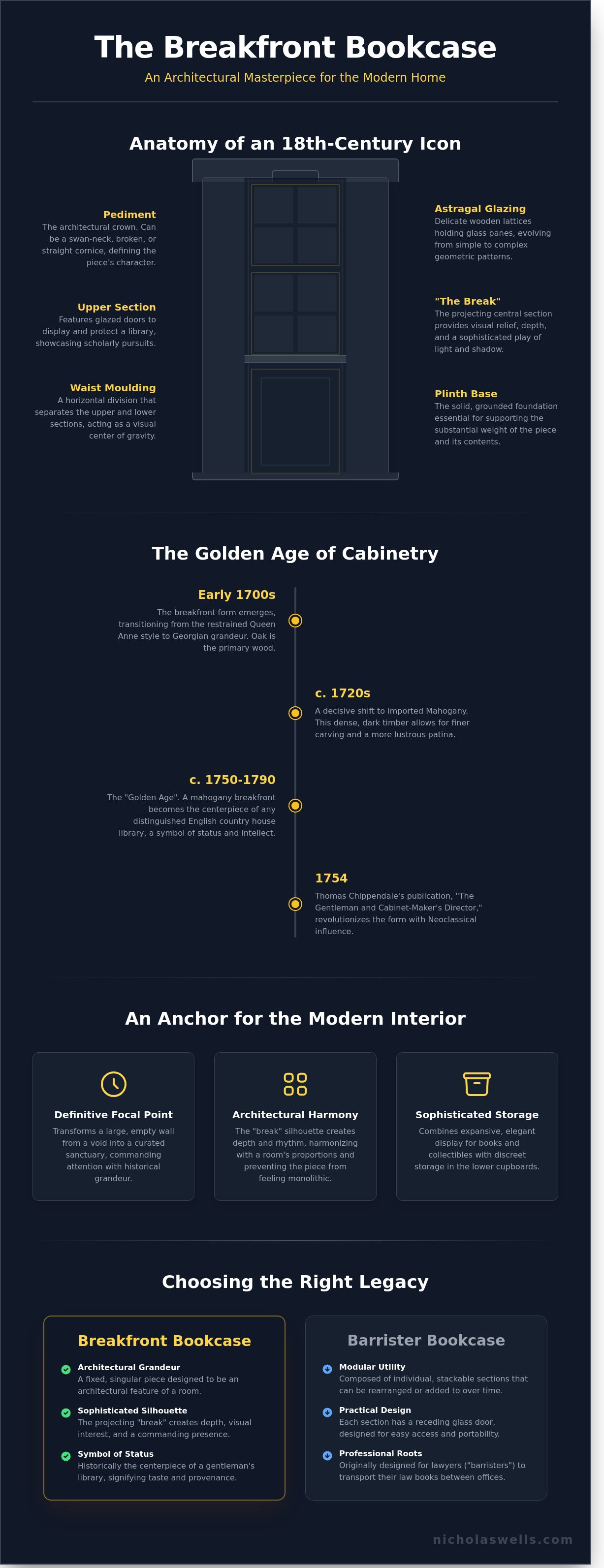
The breakfront bookcase represents the pinnacle of 18th-century cabinetry, characterized by a central section that projects forward from its flanking wings. This deliberate interruption of the linear plane provides essential visual relief; without this "break," a piece of such substantial proportions would appear monolithic and cumbersome. By stepping the central carcass forward, the cabinetmaker introduces a sophisticated play of light and shadow that animates the wood's surface. Understanding the breakfront bookcase history and why your home needs one begins with appreciating this architectural DNA, which transformed simple shelving into a symbol of scholarly status.
Most premium examples, particularly those from the golden age of English cabinetmaking between 1750 and 1790, feature a classic four-door arrangement. The upper section typically consists of glazed doors to protect and display a library, while the lower section offers solid panelled cupboards for discreet storage. Crowning these magnificent structures is the pediment, an architectural feature that defines the piece's character. Whether it's a graceful swan-neck pediment, a crisp broken pediment, or a restrained straight cornice, this element draws the eye upward and anchors the bookcase within the room's proportions.
The Anatomy of an Architectural Masterpiece
A true breakfront bookcase is built upon a solid plinth base, providing a grounded foundation for the weight of the mahogany. A horizontal waist molding separates the upper and lower sections, often serving as the visual center of gravity. The glass panes are held in place by delicate wooden lattices known as astragal glazing, which evolved from simple rectangles to complex geometric patterns in the late 18th century. In our collection, we prioritize pieces featuring finely figured mahogany and vibrant satinwood crossbanding, as these materials highlight the exceptional craftsmanship of the Georgian era.
Why the "Break" Matters in Interior Design
The three-dimensional depth of the breakfront silhouette creates a sense of movement that flat-fronted antique furniture lacks. This projection isn't merely aesthetic; it was originally designed to harmonize with the neoclassical facades of 18th-century architecture, often aligning perfectly with projecting chimney breasts or decorative plasterwork. In a contemporary setting, this silhouette allows a large piece to fill a wall while maintaining an elegant, rhythmic presence. It's this unique ability to balance grand scale with intricate detail that explains the breakfront bookcase history and why your home needs one to serve as a definitive focal point in a library or drawing room.
The Golden Age of Cabinetry: A History of the Breakfront
The breakfront bookcase emerged during the early 1700s, marking a pivotal transition from the restrained lines of the Queen Anne period to the architectural grandeur of the Georgian era. These massive structures weren't mere furniture; they served as the intellectual anchor of the "Gentleman’s Library." Enlightenment values dictated that a library filled with leather-bound volumes was the ultimate symbol of status. While early examples were often crafted from native oak, the 1720s saw a decisive shift toward imported mahogany. This dense, dark timber allowed for finer carving and a more lustrous surface patina that defines the finest antique cabinet furniture found in the grandest English country houses.
Understanding the breakfront bookcase history and why your home needs one involves recognizing its role as the standard for the English country house library. By 1750, a magnificent mahogany breakfront was the centerpiece of any distinguished estate, reflecting the owner's global reach and scholarly pursuits. These pieces were designed to be architectural, often mirroring the proportions of the rooms they inhabited. Their presence in a London townhouse in Mayfair or Piccadilly signaled a family of taste and significant historical provenance.
Chippendale, Hepplewhite, and the Neoclassical Influence
Thomas Chippendale revolutionized the form in his 1754 publication, The Gentleman and Cabinet-Maker's Director. He introduced intricate fretwork and glazed doors influenced by Gothic and Chinese aesthetics, moving away from heavy Baroque forms. Later, George Hepplewhite softened the silhouette. He favored a lighter, more delicate touch that replaced Georgian bulk with tapered elegance and satinwood crossbanding. Robert Adam's neoclassical influence brought a rigid, mathematical symmetry to these pieces, ensuring every proportion mirrored the classical orders of architecture found in ancient Rome.
The Regency and Victorian Evolution
The 19th century brought exotic rosewood and shimmering brass inlays, reflecting a Regency fascination with global trade and the Napoleonic wars. By the 1880s, the Victorian "Gothic Revival" favored heavy, ornate carvings and a return to dark, imposing woods. These pieces transitioned from functional book storage to magnificent status-driven display cabinets for porcelain and curiosities. For the modern collector, the breakfront bookcase history and why your home needs one is found in its ability to bridge historical grandeur with contemporary utility. At Nicholas Wells Antiques, we provide expert conservation of history, ensuring each piece arrives with its unique antique surface intact, whether you are across the street in London or half a world away via our international shipping services.
Breakfront vs. Barrister Bookcase: Choosing the Right Legacy
Distinguishing between these two iconic forms is essential for any serious collector. While both serve the noble purpose of housing a library, their architectural DNA differs entirely. The barrister bookcase, typically seen in modular sections, represents the 19th-century shift toward industrial ingenuity. In contrast, the breakfront bookcase remains a singular, commanding statement of master joinery. Understanding breakfront bookcase history and why your home needs one requires recognizing that the breakfront is a permanent fixture of a room's soul, whereas the barrister is a flexible tool of the trade.
The Barrister Bookcase: A Practical Comparison
The barrister bookcase emerged in the late 19th century as a modular solution for legal professionals who required portable libraries. Its defining feature is the "up-and-over" glazed door, which slides back into the unit to allow easy access. These pieces are tactical. They fit into tight alcoves or beneath low ceilings. While they possess a certain academic charm, they lack the rhythmic depth of a breakfront. They're utilitarian. A barrister unit serves a temporary purpose; a breakfront commands a permanent presence.
The Breakfront as a Permanent Anchor
A fine breakfront doesn't just fill a gap in a room. It defines the very architecture of the space. Whether it's a 1780s Georgian mahogany piece or a Regency example with delicate boxwood stringing, the craftsmanship is vastly superior to the mass-produced modular units of the 1890s. These cabinets often feature hand-carved pediments and original crown glass that ripples with age. For those seeking pieces of this caliber, the cabinet furniture collection showcases how these grand-scale objects serve as the definitive anchor for a sophisticated interior.
The breakfront represents a more significant investment for a curated home because it's a fixed architectural element. It offers a sense of stability that modular furniture cannot replicate. Its "fixed architecture" provides a canvas for exceptional veneers and complex marquetry that would be impossible to align across separate, stackable boxes. The soul of the breakfront belongs in the grand library or the formal dining room, where it acts as a silent witness to history. It's a piece that carries the weight of its provenance in every inch of its hand-polished patina, ensuring it remains a focal point for generations to come.
Why Your Home Needs a Breakfront: Anchoring the Modern Interior
A common misconception in interior design suggests that large-scale furniture overwhelms a room. The opposite is often true. A substantial 18th-century mahogany breakfront provides a singular, commanding focal point that actually makes a space feel more expansive. By consolidating display and storage into one architectural statement, you eliminate the visual noise of scattered, smaller pieces. This creates a sense of order and calm that is essential for grounding contemporary, minimalist environments. It's not just about aesthetics; it's about the psychological weight of history. For those living in London townhouses with ceiling heights frequently exceeding 3.5 meters, these cabinets offer a vital acoustic benefit. The dense timber and the irregular surfaces of a well-stocked library effectively dampen sound, softening the echoes that often plague modern, hard-surfaced interiors. Understanding the breakfront bookcase history and why your home needs one allows you to see these pieces as functional anchors for the modern soul.
Beyond Books: Curating the Shelves
The modern breakfront has evolved into a sophisticated stage for "curating a life." While rows of calf-bound volumes offer a foundational texture, the most compelling displays integrate Grand Tour objects and fine sculpture to create a narrative of travel and connoisseurship. Don't feel the need to fill every square inch. Utilizing negative space allows individual works of art to breathe and command attention. Below the waist, the panelled cupboards provide a discreet sanctuary for 21st-century technology. You can hide unsightly routers, cables, or disorganized paperwork behind superb 18th-century joinery, maintaining the room's period integrity without sacrificing modern convenience.
Lighting the Narrative
Lighting is the final, transformative element that turns a static piece of furniture into a luminous installation. Discreet, warm-toned LED "picture lighting" can be installed within the cornice to highlight the rich grain of the wood and the unique surface patina. This focused illumination interacts with other antique lighting in the room, such as a pair of Regency candelabra, to create a layered evening ambiance. One of the most enchanting features of an authentic period piece is the original 18th-century glass. Its characteristic "wavy" lustre and slight imperfections catch the light with a liquid quality that modern float glass simply cannot replicate. This subtle shimmer adds a sense of depth and historical mystery to your collection.
The Nicholas Wells Philosophy: Sourcing and Conservation
Our approach to sourcing is governed by a reverence for the unique antique surface that only centuries of careful ownership can produce. We don't view these objects as mere inventory; they're significant cultural artifacts that require dedicated stewardship. Understanding the breakfront bookcase history and why your home needs one involves recognizing that a piece's value is inextricably linked to its past. We prioritize provenance, tracing the lineage of a bookcase to the specific grand houses or estates it once occupied. This historical context provides a sense of continuity that modern furniture simply cannot replicate.
To ensure these pieces transition seamlessly into contemporary interiors, we provide a complimentary restoration service with every purchase. This process is rooted in conservation rather than renovation. Our specialists focus on structural integrity and subtle refinement, ensuring the piece is ready for its next century of use without erasing the marks of its journey. It's a delicate balance that maintains the item's soul while preparing it for the rigors of a modern home.
The Importance of Surface Patina
Patina is the soul of the wood. It's a complex finish developed through 200 years of light exposure and rhythmic waxing. We strictly avoid over-restoration. Stripping an 18th-century mahogany surface to make it look new is a catastrophic error that destroys both the aesthetic character and the market value of the investment. A well-preserved surface acts as a testament to the piece's authenticity, making it a far more secure asset for the discerning collector. True luxury is quiet, and it's found in the deep, mellow glow of original timber.
A Bespoke Acquisition Experience
Acquiring a significant piece of furniture should be as refined as the object itself. We manage the entire logistical process, offering fully insured worldwide shipping from our London base. For those who prefer a tactile connection before purchase, we invite you to our showroom located near Mayfair and Westminster. These viewings are strictly by appointment, providing a private, scholarly environment to examine the fine details of our collection. Explore our extraordinary collection of antique bookcases and cabinet furniture to find a piece that resonates with your home's narrative.
Elevating Your Interior with a Masterpiece of Cabinetry
The breakfront bookcase remains a definitive symbol of 18th century architectural ambition. It evolved from the workshops of Thomas Chippendale into a timeless anchor for the modern residence. Beyond its impressive silhouette, the value of a fine mahogany or satinwood piece lies in its preserved surface patina and documented provenance. Understanding the breakfront bookcase history and why your home needs one allows a collector to move beyond mere utility toward a true appreciation of cabinetmaking at its zenith. Each acquisition represents a commitment to the conservation of history. It serves as a focal point that bridges the grandeur of the Georgian era with the requirements of a 21st century interior.
At Nicholas Wells Antiques, we draw upon 15 years of specialist expertise to select only the most distinguished examples. Every piece in our gallery undergoes a meticulous restoration process included with your purchase. This ensures the structural integrity is as superb as the aesthetic. From our London base, we manage fully insured worldwide shipping to guarantee your investment arrives in pristine condition. It's an opportunity to own a tangible fragment of design history that'll endure for generations.
View our curated collection of extraordinary antique bookcases
Discover a piece that resonates with your personal style and brings a sense of permanence to your home today.
Frequently Asked Questions
What is the difference between a breakfront and a barrister bookcase?
A breakfront bookcase is defined by its central section that projects forward from the two flanking wings, whereas a barrister bookcase consists of stackable, modular units designed with individual glazed doors. While breakfronts emerged in the 1750s as grand architectural statements, the barrister style gained prominence in the 1890s for its portability and protection of legal volumes. The breakfront's tripartite design offers a more permanent, imposing presence in a drawing room.
How deep is a typical antique breakfront bookcase?
A typical antique breakfront bookcase usually measures between 18 and 22 inches deep at its central projecting point. The side wings are often shallower, measuring approximately 12 to 15 inches in depth. These 18th century proportions were carefully calculated by cabinetmakers like Thomas Chippendale to accommodate large folio volumes while ensuring the piece didn't impede the flow of movement within a formal library or gallery space.
Can a breakfront bookcase be used in a dining room?
You can certainly use a breakfront bookcase in a dining room to display fine porcelain or serve as a sophisticated alternative to a traditional sideboard. In many 18th century English estates, these pieces functioned as "china cases" to showcase expensive dinner services. This versatility is a key reason to explore breakfront bookcase history and why your home needs one, as it transitions seamlessly from a library to a formal dining space.
What should I look for when verifying the provenance of an 18th-century bookcase?
To verify provenance, you should look for original maker's labels, such as those from Gillows of Lancaster, or stamped inventory marks from specific country houses. A documented history including auction records from houses like Christie's or Sotheby's dating back to the 1920s provides essential validation. Examine the secondary woods; 18th century English pieces typically use oak for drawer linings, while 19th century examples often utilize pine or mahogany.
Is it possible to ship a large breakfront bookcase internationally?
We regularly facilitate international shipping for large breakfront bookcases using specialized white-glove couriers who understand the requirements of high-value antiques. Each piece is secured in a custom-built ISPM 15 heat-treated wooden crate to ensure safety during sea or air freight. Whether shipping to New York or Hong Kong, our London gallery manages every detail, including the complex CITES documentation required for certain 18th century mahogany veneers.
Why were breakfront bookcases so popular in the Georgian era?
Breakfront bookcases became essential during the Georgian era because the 1700s saw a 40 percent increase in private book collecting among the landed gentry. Their architectural form mirrored the Palladian symmetry favored by architects like William Kent. Understanding breakfront bookcase history and why your home needs one reveals how these pieces served as symbols of intellectual status and wealth in 18th century London society.
How do I maintain the original patina on my antique mahogany furniture?
Maintaining the surface patina requires a light application of high-quality beeswax once every 6 to 12 months. Avoid modern aerosol polishes, as their silicone content can damage the delicate 200 year old finish. You should keep the piece away from direct sunlight and maintain a consistent humidity level of 45 percent to prevent the wood from shrinking or the fine veneers from lifting over time.
Can a breakfront bookcase be disassembled for transport?
Most antique breakfront bookcases are designed to be disassembled into five or seven separate components for easier transport. This typically includes a separate plinth base, the lower cupboards, the central projecting top section, and the two flanking upper wings. This modular construction, standard since the 1760s, allows these massive 8-foot-wide structures to pass through standard doorways and navigate narrow staircases without risking structural damage to the joinery.


Leave a comment