



Buying a Set of Antique Dining Chairs: What to Look For Before You Invest
The Significance of the Set: Why Eight Antique Dining Chairs Define the Refined Interior
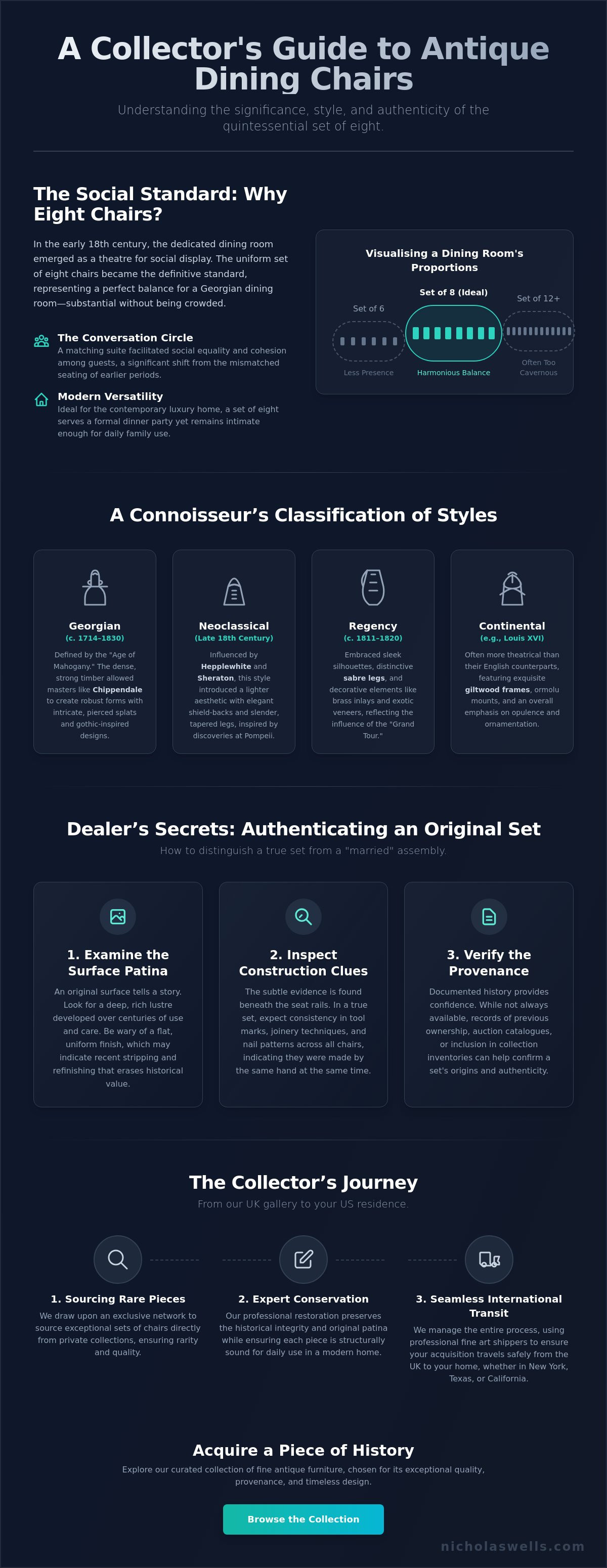
A fine set of 8 antique dining chairs is more than a mere collection of seating; it is a preserved social framework, a tangible echo of 18th-century elegance that continues to define the most sophisticated interiors. The emergence of the dining room as a specialised social theatre in the early Georgian period prompted a revolution in furniture design. As formal dining evolved, the haphazard collection of individual stools and disparate chairs gave way to the uniform ‘suite’, a powerful symbol of status, order, and refined hospitality.
For the English town house and country estate, a set of eight became the gold standard. This number was not arbitrary; it was a deliberate choice that perfectly balanced the grand proportions of a typical Georgian or Regency dining table, allowing for comfortable guest accommodation without overcrowding. The acquisition of a complete, matching set was a declaration of prestige, signalling a host’s ability to entertain with grace and generosity. Today, that same sense of proportion and purpose makes a set of eight antique dining chairs an enduringly desirable asset for the discerning collector.
The Social Architecture of 18th-Century Dining
The arrangement of a dining room in the 18th century was a matter of meticulous social choreography. A set of eight chairs was instrumental in creating the ‘conversation circle’, a configuration that allowed for intimate discourse and engagement among guests during the elaborate, multi-course services of the era. The uniform design of the chairs ensured a visual harmony that placed the focus on the host, the guests, and the culinary display. The concept of the ‘suite’—a set of furniture designed and made as a coherent group—was a 17th-century innovation that reached its aesthetic and social zenith in the 1780s, becoming synonymous with fashionable living.
Modern Utility: Why Eight Remains the Ideal Count
While the formalities of 18th-century dining have evolved, the practical appeal of eight chairs has not diminished. This number offers remarkable versatility, comfortably seating a family for an intimate dinner while providing the capacity to host larger gatherings with ease. A set of eight allows for a typical arrangement of six side chairs and two armchairs (or ‘carvers’), which traditionally sit at the head and foot of the table. This configuration creates a sense of occasion and hierarchy that still resonates in contemporary dining spaces. Furthermore, a set of this size pairs beautifully with the scale of most antique dining tables, creating a balanced and visually compelling ensemble. When selecting a set, it is essential to consider its future partner; our collection of fine antique tables offers numerous possibilities for creating a historically authentic and aesthetically pleasing dining suite.
A Connoisseur’s Classification: Georgian, Regency, and Continental Styles
The 18th century is often heralded as the ‘Age of Mahogany’, a period when this robust and richly coloured timber from the New World transformed English furniture making. Its strength and density allowed for finer, more intricate carving than was possible with walnut, making it the preeminent choice for high-quality dining chairs designed to withstand generations of use. Understanding the stylistic evolution during this period is key to appreciating the nuances of a fine set of 8 antique dining chairs.
- Chippendale Influence: In the mid-18th century, Thomas Chippendale’s designs dominated. His chairs are characterised by their solid construction and elaborately carved splats (the central panel of the chair back), often featuring ribbon-back, Gothic, or Chinese-inspired motifs.
- Hepplewhite and Sheraton: Towards the end of the century, the work of George Hepplewhite and Thomas Sheraton introduced a neoclassical lightness. This shift is seen in elegant shield-back or square-back designs, delicate carving, and slender, tapered legs that lend an air of refined grace.
- Regency Elegance: The early 19th century saw the emergence of the Regency style, which drew inspiration from classical antiquity, a result of the ‘Grand Tour’. Hallmarks of this period include the distinctive curve of the sabre leg, the use of exotic veneers like rosewood, and the addition of brass inlays and ormolu mounts.
The English Tradition: From George II to the Regency
The master cabinetmakers of London, working in centres like St. Martin’s Lane, set the international standard for furniture craftsmanship. Their techniques, from the precision of the hand-cut dovetail joint to the depth of the carving, are the quiet signals of quality a collector learns to recognise. The rich, dark patina of a well-preserved mahogany surface, built up over two centuries of waxing and polishing, is a testament to the care and pride of previous owners. Exploring a curated collection of period seating provides a visual education in the subtle yet significant developments of the English chair-making tradition.
Continental Flair: French and Italian Alternatives
While English design often celebrated the natural beauty of mahogany, Continental makers frequently favoured a more opulent aesthetic. A French Louis XVI set of dining chairs, for instance, might feature a delicately carved and painted or giltwood frame, upholstered in fine silk. Italian examples often display a similar love for ornate decoration and fluid, sculptural lines. Key terms to understand in this context include ‘Giltwood’ (wood to which a layer of gold leaf has been applied) and ‘Ormolu’ (gilded bronze mounts), both of which were used to add a layer of luxurious ornamentation that contrasted with the more restrained elegance of their English counterparts.
Dealer’s Secrets: Authenticating Original Sets and Identifying Marriages
For any serious collector, the most critical aspect of acquiring a set of 8 antique dining chairs is authentication. The value and desirability of a set lie in its originality. A ‘true set’ consists of chairs that were all made at the same time, in the same workshop, from the same batch of timber. Conversely, an ‘assembled set’, often called a ‘marriage’, is a group of similar chairs brought together from different sources. While they may look alike to the untrained eye, these marriages lack the historical integrity and investment value of a genuine set.
A dealer’s expertise is indispensable in this process. We examine the minute details: the marks left by 18th-century tools, the pattern of oxidisation on original nails, and the construction of the corner blocks beneath the seat rails. The surface itself tells a story. A deep, lustrous patina, developed over centuries, is infinitely more desirable than a modern, over-restored finish that has stripped the piece of its history. Finally, provenance—the documented history of ownership—can significantly enhance the value and security of an investment, connecting the chairs to a specific house or family through time.
Spotting the “Marriage”: A Guide for the Wary Collector
Distinguishing a true set from a marriage requires a meticulous eye. One must compare the subtle variations in carving across all eight chairs; in a true set, the hand of a single carver or workshop will be evident in the consistent depth and style of the decoration. The grain, colour, and figuring of the timber should also be closely compared, as chairs from a single set were typically made from the same log. It is worth noting that many sets of eight began life as a smaller set, perhaps of six, with two armchairs added by the same workshop shortly after, a common practice that does not detract from the set's integrity.
The Importance of Conservation and Professional Restoration
An antique chair that has been in use for over 200 years will inevitably require some degree of conservation to ensure its suitability for modern life. The key is to undertake this work with the utmost respect for the object’s historical integrity. Our philosophy is one of conservation, not aggressive restoration. Every item in our collection is sold with complimentary professional restoration included. This means our specialised craftsmen will consolidate loose joints, repair breaks, and revive the finish using traditional techniques and materials, ensuring the chairs are robust and ready for daily use without compromising their antique character. This commitment to preservation is central to our curation of fine antique seating.
The Collector’s Journey: Acquisition, Restoration, and International Transit
The journey of a fine set of antique dining chairs from a historic English estate to a contemporary American home is a complex process guided by expertise. We source our pieces from private collections and country houses, seeking out rare sets with exceptional design, condition, and provenance. Once acquired, each set is carefully assessed. The choice of upholstery, for example, is a critical decision. We often advise on fabrics that are sympathetic to the period of the chairs, such as horsehair, damask, or fine leather, ensuring the final result is both historically appropriate and aligned with the client’s interior design vision.
Shipping from the UK to the US: Peace of Mind
As an online-only gallery with a global clientele, we have perfected the art of international fine art shipping. We understand the specific concerns of our American clients, whether they are based in New York, Texas, or California. To provide complete peace of mind, we exclusively use professional, white-glove fine art shippers who specialise in handling high-value antiques. Every shipment is fully insured and meticulously tracked from our base in London to its final destination, be it a residence in Greenwich, CT, or a summer home in the Hamptons. Our seamless logistics ensure that these remarkable pieces of history arrive safely and efficiently, ready to be enjoyed.
The Nicholas Wells Advantage
Acquiring a significant set of 8 antique dining chairs is a major investment in artistry, history, and style. Our approach is built on connoisseurship, transparency, and a deep-seated passion for the objects we handle. By sharing our "Dealer's Secrets" on authentication and providing expert, conservation-led restoration, we empower our clients to collect with confidence. We invite you to explore our online gallery and discover a piece of history that will become the centrepiece of your home for generations to come.
Explore our current collection of fine dining chairs and begin your own collector's journey today.


Leave a comment