




Buying a Set of Antique Dining Chairs: What to Look For Before You Invest
Can a piece of furniture truly be considered an investment if it cannot withstand the rigours of a modern dinner party? For the discerning collector, acquiring a genuine set of 8 antique dining chairs represents a pursuit of both aesthetic grace and historical preservation. It's a common anxiety to worry about the structural stability of 18th-century frames or the risk of unknowingly purchasing a "married" set assembled from disparate sources. We understand that a museum-quality acquisition must be as functional as it is beautiful, serving as a focal point in a Greenwich or Hamptons dining room.
In this guide, we'll share the expertise required to navigate the complexities of authentication, from identifying original surface patina to verifying documented provenance. You'll discover how professional restoration preserves the integrity of the piece for daily use, alongside practical insights into the current 2026 tariff landscape and our seamless international shipping process. Whether you're in New York or San Francisco, we ensure your acquisition travels safely from the UK to your home with the care it deserves.
Key Takeaways
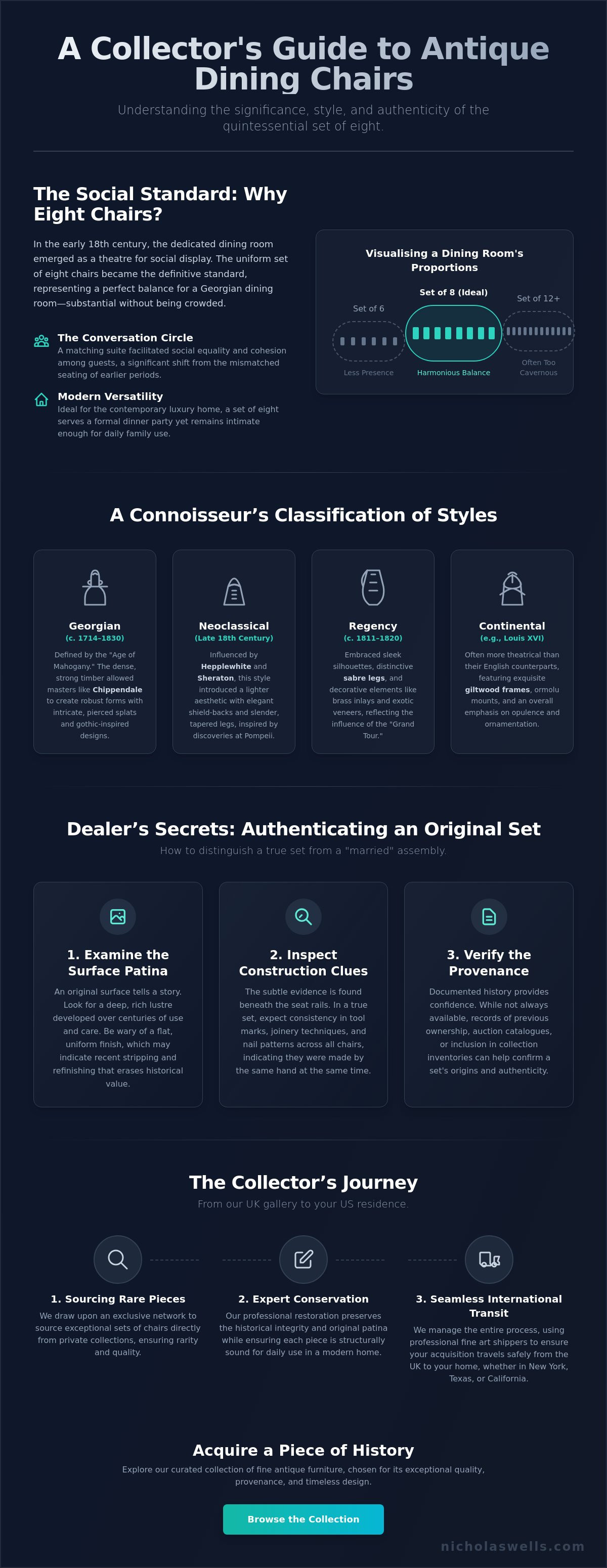
- Understand why the set of 8 antique dining chairs became the definitive social standard for 18th-century English estates and how this configuration continues to define the refined interior today.
- Distinguish between true original sets and "married" assemblies by examining the subtle evidence of construction, such as tool marks and nail patterns found beneath the seat rails.
- Explore the stylistic nuances of the Georgian and Regency eras, including the enduring appeal of dense mahogany and the sophisticated splat designs of the mid-18th century.
- Gain confidence in the acquisition process by learning how we source rare pieces from private collections and navigate the logistics of professional fine art shipping to your US residence.
The Significance of the Set: Why Eight Antique Dining Chairs Define the Refined Interior
The dining room hasn't always been a permanent fixture of the home. In the late 17th century, dining was often a nomadic affair, with tables and chairs moved into various chambers as the occasion demanded. By the early 18th century, however, the English town house began to evolve, establishing the dining room as a dedicated theatre for social display and political discourse. It's during this period that the set of 8 antique dining chairs emerged as the definitive requirement for the aspiring gentleman. In our experience as specialist dealers, we've observed that this specific number wasn't arbitrary. It represented the perfect balance for a standard Georgian dining room, allowing for a balanced arrangement that felt substantial without crowding the architecture of the space.
The Social Architecture of 18th-Century Dining
The shift from individual stools or mismatched seats to a uniform suite of chairs marked a profound change in the history of furniture design. These matching sets facilitated a "conversation circle," where the visual continuity of the chairs reinforced the social equality and cohesion of the guests. The "suite" was a 17th-century innovation that peaked in the 1780s, reflecting a peak in craftsmanship and social formality.
Modern Utility: Why Eight Remains the Ideal Count
For the contemporary collector in Greenwich or the Hamptons, a set of 8 antique dining chairs offers unparalleled versatility. It provides enough seating for a formal dinner party while remaining intimate enough for daily family use. When paired with the right Antique Tables, a set of eight creates a harmonious proportion that anchors the room. It avoids the overwhelming scale of a set of twelve or fourteen, which can often feel too cavernous for modern luxury residences, yet provides more presence than a smaller set of six. We've often seen how these sets serve as the structural backbone of a room, bridging the gap between historical grandeur and modern lifestyle requirements.
A Connoisseur’s Classification: Georgian, Regency, and Continental Styles
The "Age of Mahogany" transformed the durability and artistic potential of English seating. Before this, walnut was the preferred timber, but its susceptibility to woodworm and relative softness limited the complexity of the carver’s art. Mahogany, dense and rich, allowed masters like Thomas Chippendale to experiment with the intricate ribbon-back and gothic-inspired splats that define the mid-18th century. When examining a fine set of 8 antique dining chairs from this era, one observes how the timber’s strength permitted delicate, pierced designs that have remarkably survived centuries of use.
As tastes shifted toward the neoclassical, the influence of George Hepplewhite and Thomas Sheraton introduced a lighter aesthetic. Shield backs and tapered legs replaced the robust forms of the earlier Georgian period, reflecting a society enamoured with the discoveries at Pompeii and Herculaneum. For a deeper understanding of these stylistic transitions, the Victoria and Albert Museum's furniture collection remains an indispensable resource for the serious collector.
The English Tradition: From George II to the Regency
London’s master cabinetmakers achieved a level of technical precision that remains the benchmark for quality. From the sturdy proportions of the George II era to the sleek, sabre-legged silhouettes of the Regency, these pieces represent the pinnacle of British craftsmanship. The Regency period, in particular, embraced brass inlays and exotic veneers, echoing the "Grand Tour" influences that returning aristocrats brought to their London residences. You might find inspiration for your own dining room within our Antique Furniture Collection, where we curate pieces that exemplify this heritage.
Continental Flair: French and Italian Alternatives
While English mahogany offers a restrained dignity, Continental sets often lean toward the theatrical. A set of 8 antique dining chairs in the Louis XVI style might feature exquisite giltwood frames and ormolu mounts, reflecting the opulence of the French court. These pieces prioritize ornamentation and Giltwood brilliance, offering a striking contrast to the architectural sobriety of Georgian mahogany. Whether you prefer the warmth of English timber or the golden glow of a Parisian salon, selecting a period set requires an eye for the singular and the exceptional.
Dealer’s Secrets: Authenticating Original Sets and Identifying Marriages
In our capacity as a fine antiques dealer, we've found that the most compelling evidence of a chair's history is found where the light rarely reaches: beneath the seat rail. A "true set" was born together in a single workshop, crafted from the same log of mahogany or walnut and finished by the same hand. An "assembled set," or marriage, might appear identical at a distance, yet subtle variations in the timber’s grain or the depth of the carving across the suite will betray its disparate origins. These marriages can significantly diminish the investment value, as they lack the singular narrative of a preserved original group.
When we examine a potential acquisition for our collection of decorative antiques, we scrutinise the corner blocks and the underside of the rails with the eye of a luxury antiques dealer. In an 18th-century piece, these areas should reveal hand-tool marks and a certain irregularity that machine-made reproductions cannot replicate. Consistent nail patterns and natural oxidation on the wood where the upholstery once sat are hallmarks of authenticity. We believe that a preserved 18th-century patina is far more desirable than a modern "over-restored" finish, as a surface that's been stripped loses its historical soul and its value to a serious collector.
Spotting the "Marriage": A Guide for the Wary Collector
It's a common reality in the trade that a set of 8 antique dining chairs often began its life as a set of six, with two additional chairs commissioned years later to accommodate a growing family. While these period additions are more valuable than modern copies, they still require careful scrutiny to ensure the timber matches and the proportions remain consistent. As part of our "Dealer's Secrets" series, we look for a harmony of surface patina that only centuries of shared history can produce.
The Importance of Conservation and Professional Restoration
We believe that restoration should be a whisper, not a shout. Over-restoring an 18th-century frame by stripping its original finish destroys the very history that makes it valuable. At Nicholas Wells Antiques, our approach focuses on structural conservation, ensuring the chairs are robust enough for daily use while preserving the unique antique surface. For those seeking pieces with verified integrity and documented provenance, we invite you to view our current selection of authenticated seating.
The Collector’s Journey: Acquisition, Restoration, and International Transit
As a luxury antiques dealer, our acquisition process is rooted in a deep network of private estates and country house collections where we seek out items of exceptional rarity. We don't just source furniture; we curate historical narratives. Once a set of 8 antique dining chairs enters our care, the restoration phase begins with a focus on historical integrity. We prioritise period-accurate upholstery and structural conservation, ensuring the pieces are ready for a modern Greenwich or Manhattan home without sacrificing their 18th-century soul. This stewardship is what ensures a piece remains a viable investment for generations to come.
Shipping from the UK to the US: Peace of Mind
Moving high-value decorative antiques across the Atlantic requires a level of oversight that generalist shippers can't provide. We partner with professional fine art shippers to manage the journey to regions like Texas, San Francisco, and the Hamptons. We handle the complexities of CITES re-export certificates for mahogany and navigate the 2026 tariff landscape on your behalf. This door-to-door service ensures that your acquisition arrives in pristine condition, typically within two to three weeks for air freight, providing a seamless transition from our gallery to your residence.
The Nicholas Wells Advantage
What distinguishes us as a fine antiques dealer is our uncompromising eye for the singular and the exceptional. While generalist shops offer a broad, often diluted inventory, we specialise in niche rarities, from Oceanic war clubs to Grand Tour obelisks. This depth of expertise ensures that every dining set we offer has been vetted with the same scholarly rigour as our most exotic museum-quality artifacts. We invite you to explore our current collection of fine dining chairs and begin your own journey into the art of collecting.
Securing a Legacy of Historical Elegance
Investing in a set of 8 antique dining chairs is an act of cultural stewardship that transcends mere interior decoration. You've explored the social significance of the 18th-century suite, the stylistic distinctions of the Regency era, and the critical importance of identifying original construction beneath the seat rail. By focusing on these connoisseur-level details, you can acquire a collection that offers both aesthetic grandeur and enduring investment value for your home.
Our gallery is dedicated to bridging the distance between the finest English estates and your residence in the Hamptons, Greenwich, or Texas. We provide expert authentication and complimentary professional restoration to ensure every chair meets our uncompromising standards of quality and historical integrity. Our fully insured worldwide fine art shipping guarantees that your artifacts arrive safely, managed by specialists who understand the requirements of international transit.
We invite you to view our curated collection of rare antique dining chairs and find the singular set that resonates with your vision. Your home is a reflection of your appreciation for heritage; let us help you secure its most significant social framework. Your pursuit of the exceptional begins with a single, well-informed choice.
Frequently Asked Questions
How can I tell if a set of 8 antique dining chairs is an original set?
To determine if a set of 8 antique dining chairs is truly original, you must examine the underside of the seat rails for consistent hand-tool marks and identical timber grain. We look for matching oxidation patterns where the wood has aged uniformly over centuries. A "true set" will exhibit a singular character in its carving and construction that an assembled or "married" set simply cannot replicate.
What are the most durable styles of antique chairs for daily use?
Georgian mahogany chairs from the mid-18th century are widely regarded as the most durable options for daily use. The density of the mahogany used during this era allows for slender yet incredibly strong frames that resist warping and woodworm better than earlier walnut examples. These pieces were engineered for the rigours of formal dining and have already proven their longevity through two centuries of service.
Does Nicholas Wells ship antique furniture to the United States?
We provide comprehensive, fully insured shipping to all regions of the United States, including New York, Texas, and California. Every piece is handled by professional fine art shippers who specialise in international logistics and customs requirements. Whether you're in the Hamptons or San Francisco, we manage the entire process to ensure your acquisition travels safely from our UK gallery to your residence.
What is the difference between a side chair and an armchair in a dining set?
Armchairs, often called "carvers," are typically placed at the head and foot of the table, while side chairs lack arms and line the long edges. In a traditional set of 8 antique dining chairs, you'll typically find two armchairs and six side chairs. The armchairs were historically reserved for the host and hostess, offering a more commanding presence than the streamlined side chairs.
How should I care for the original mahogany finish on my antique chairs?
Maintain the original mahogany finish by avoiding direct sunlight and using only high-quality beeswax once or twice a year. You should avoid modern aerosol polishes or silicone-based cleaners, which can create a smeary buildup and damage the historical patina. It's also vital to keep the chairs away from direct heat sources, such as radiators, to prevent the 18th-century timber from drying or cracking.



Leave a comment