



Buying an Antique Desk: 5 Questions Dealers Ask First
What if the desk in your study was not merely a surface for work, but a silent witness to two centuries of intellectual discourse? For the discerning collector, the search for authentic antique desks, writing tables & accessories represents a pursuit of both aesthetic distinction and historical preservation. You likely recognise that a fine piece of 18th or 19th-century furniture acts as a museum-quality centrepiece, yet the fear of acquiring a modern reproduction or the uncertainty of shipping a delicate flame mahogany bureau to Greenwich or the Hamptons often gives pause. It's natural to feel hesitant when evaluating the nuances of period-specific timbers, the authenticity of ormolu mounts, or the subtle character of a centuries-old surface patina.
I understand that the true value of a piece resides in its narrative history and the integrity of its original craftsmanship. This article provides the scholarly framework you require to navigate the acquisition of such significant cultural artifacts with absolute confidence. We shall examine the five pivotal questions every expert dealer considers, ensuring you possess the knowledge to identify superior craftsmanship, understand the conservation of history, and manage professional, insured global delivery with ease.
Key Takeaways
- Learn to distinguish between the scholarly seclusion of a Georgian pedestal desk and the refined elegance of a 19th-century French bureau plat.
- Discover the dealer's secret to identifying a true "antique surface" through the depth of colour and texture found in fine antique desks, writing tables & accessories.
- Understand why rare "figured" woods like pollard oak and flame mahogany indicate a piece originally commissioned for the most prestigious historical estates.
- Evaluate how functional masterpieces, such as metamorphic library steps or expansive partner desks, can serve as the definitive anchor for a sophisticated modern study.
- Master the logistics of international acquisition, from expert restoration standards to the nuances of professional fine art shipping to collectors across the United States.
The Evolution of the Private Study: A Legacy of Antique Desks and Writing Tables
The private study has long served as the intellectual heart of the home, transitioning from a place of monastic seclusion in the 18th century to the grand, professional libraries of the 19th century. Central to this transformation was the development of specific furniture forms designed to facilitate both solitary thought and collaborative exchange. When curating a collection, The History of the Desk reveals a fascinating progression from simple writing slopes to the complex, multi-functional pieces we admire today. Within our curated selection of antique desks, writing tables & accessories, we distinguish between three primary archetypes: the authoritative twin-pedestal desk with its substantial presence; the elegant, leggy writing table; and the sophisticated French bureau plat. While the pedestal desk offered a sense of permanence, the library table emerged as a communal centrepiece, inviting intellectual discourse within a shared space.
For the mobile British officer class, "Campaign Furniture" represented a unique intersection of utility and prestige. These desks featured ingenious brass-bound joints and sectional designs, allowing a high-quality workspace to be dismantled for transport across the Empire without sacrificing the comforts of a London study. Such pieces remain highly sought after for their robust construction and the evocative stories they carry of travel and service.
Georgian Refinement vs. Regency Grandeur
Early Georgian pieces are defined by a quiet restraint, often executed in dense, dark mahogany with a focus on architectural proportion and the emerging twin-pedestal form. As the 19th century dawned, Regency innovation introduced a more flamboyant aesthetic. This era embraced exotic rosewood, intricate brass inlays, and classical motifs inspired by the Grand Tour. It was a period of bold experimentation that reflected a broader world view and a desire for more demonstrative luxury in the domestic sphere.
Continental Influence: The French Bureau Plat
The 18th-century French bureau plat represents the pinnacle of Continental elegance. These desks were frequently adorned with exquisite ormolu mounts, serving both as protection for the corners and as a medium for intricate artistic expression. These pieces highlight the cross-pollination of styles between fine Continental and English tables, where the French preference for gilding and curvilinear forms met the British appreciation for structural integrity and superior timber. Such desks remain the definitive choice for those seeking to blend historical grandeur with a light, graceful silhouette.
Anatomy of Excellence: Identifying Quality, Patina, and Period Styles
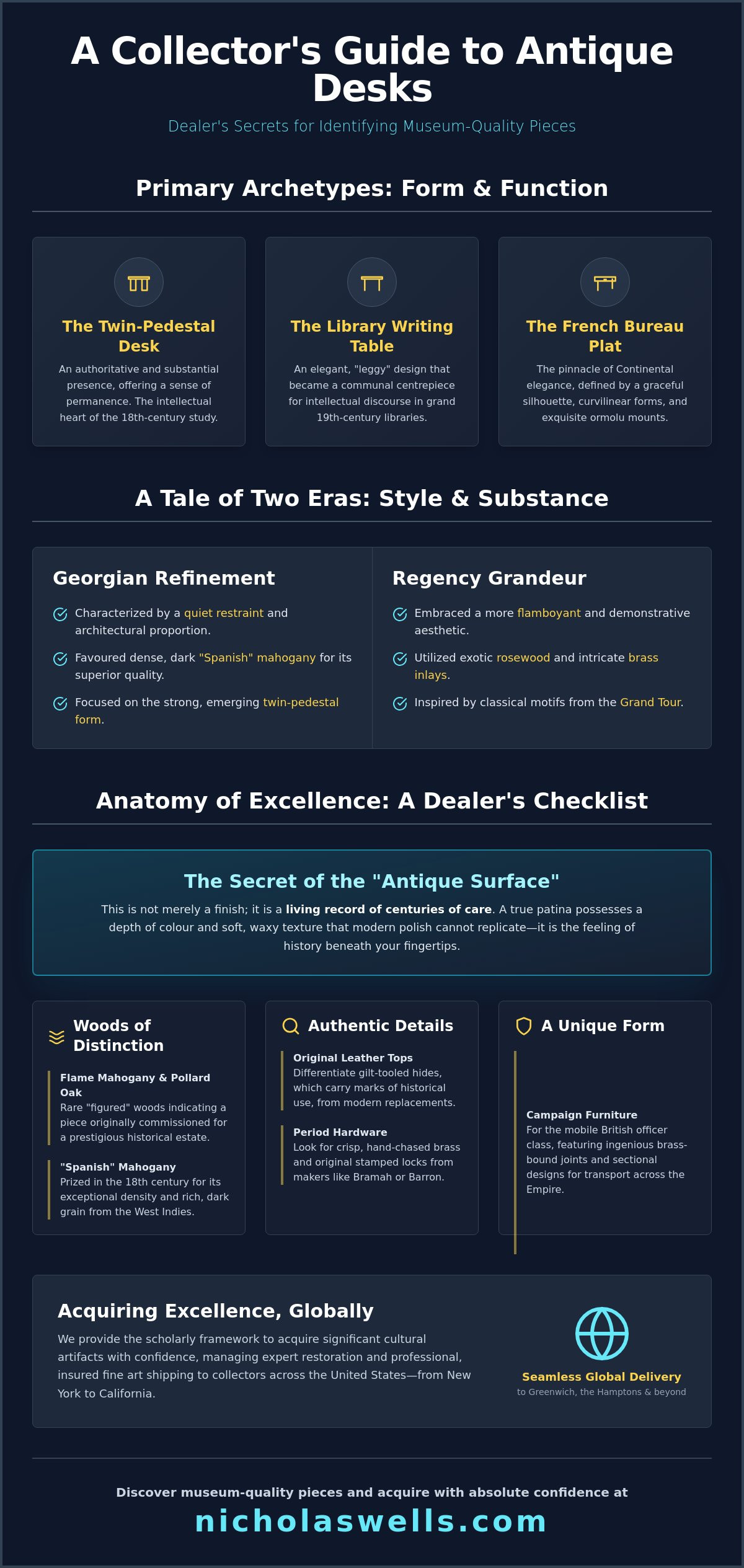
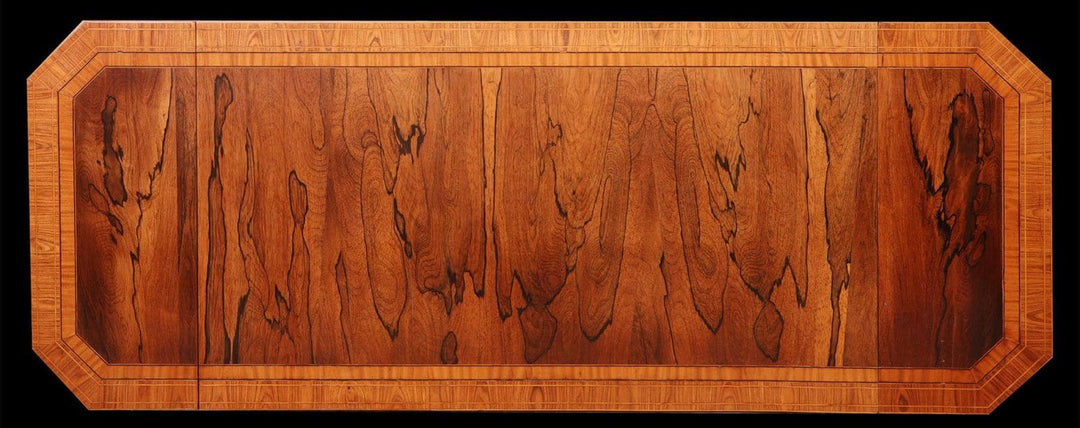
Identifying the "antique surface" is perhaps the most vital skill for any collector of antique desks, writing tables & accessories. This surface is not merely a finish; it is a living record of centuries of care. A true patina possesses a depth of colour and a soft, waxy texture that modern polish cannot replicate. When you run your hand across a 19th-century desk, you should feel the history beneath your fingertips. This depth is achieved only through the slow accumulation of wax and exposure to light over many generations. It is this unique character that distinguishes a museum-quality centrepiece from a common reproduction.
- Figured Woods: Flame mahogany and pollard oak were the materials of choice for high-status commissions, offering a visual complexity that remains highly prized.
- Leather Tops: Differentiate between original gilt-tooled hides, which carry the marks of historical use, and sympathetic modern replacements that allow for contemporary function.
- Hardware: Look for the crispness of hand-chased brass and original stamped locks from makers like Bramah or Barron.
Woods of Distinction: Mahogany, Rosewood, and Walnut
Fine commissions in the 18th century often utilised "Spanish" mahogany from the West Indies. This timber is prized for its exceptional density and rich, dark grain patterns. Scientific methods for identifying wood quality confirm that these early imports are structurally superior to the lighter, more porous mahogany varieties seen in later mass production. We also see the frequent use of satinwood inlays in late Georgian and Sheraton-style furniture, adding a luminous contrast to darker veneers and signaling a high level of connoisseurship.
The Importance of Patina and Conservation
Conservation is a delicate balance that prioritises the preservation of history over sheer perfection. Stripping an antique desk's surface to make it look new is a cardinal sin; it destroys the market value and the object's historical soul. As a "Collector's Guide" tip, I advise looking for 19th-century repairs. A well-executed patch in the veneer or a reinforced joint from a hundred years ago adds to the piece's narrative. Modern alterations, however, should be viewed with caution. If you're beginning your search for a singular piece, I invite you to explore our curated antique furniture collection for examples of exceptional preservation and singular character.
Selecting the Perfect Piece: A Collector’s Guide to Form and Function
Choosing the ideal specimen from the vast array of antique desks, writing tables & accessories requires a balance of historical appreciation and practical foresight. For the expansive home office, the Partner Desk remains a superlative choice. Originally conceived in the mid-18th century to allow two individuals to work facing one another, these substantial pieces provide a commanding presence and an abundance of storage. Conversely, the Carlton House Desk offers a more intimate, U-shaped silhouette. Named after the Prince Regent’s London residence, this form is highly sought after for its elegant wrap-around drawers and refined cabinetry, making it a favourite among discerning collectors who value architectural grace.
Scholarly charm is often found in the ingenious designs of the past, such as metamorphic library steps. These dual-purpose objects, which transition seamlessly from a chair or stool into a sturdy set of steps, reflect the Georgian passion for mechanical innovation. To complete the aesthetic of a period library, one should not overlook the importance of writing accessories. A heavy crystal inkwell, a leather-bound blotter, or a mahogany reading stand provides the necessary texture and historical context to transform a simple desk into a complete intellectual sanctuary.
Proportions and Placement in Modern Interiors
The success of a room often hinges on the spatial dialogue between its architecture and its furnishings. When positioning centre tables in a grand library or a large study with soaring ceilings, one must consider the visual weight of the piece. A desk should anchor the space without being swallowed by its surroundings. Placing a fine writing table away from the wall allows its full silhouette and rear-finished details to be appreciated from every angle, creating a focal point that invites movement and conversation.
Antique Desks for the Contemporary Executive
Modern technology presents a unique challenge to the traditional aesthetic. I often advise clients to pair their primary writing surface with complementary storage solutions like bureaus and bookcases. These pieces allow for the discreet management of cables and hardware, ensuring the 200-year-old mahogany surface remains unburdened by the clutter of the digital age. It's entirely possible to maintain a high-functioning modern office while preserving the soul of a historical interior. To find the perfect anchor for your study, I encourage you to browse our current selection of fine 18th and 19th-century writing furniture.
Acquiring Excellence: The Nicholas Wells Collection and International Stewardship
Acquiring a museum-quality centrepiece requires a partner who understands that the journey of an object is as significant as its physical form. At Nicholas Wells Antiques, we operate exclusively as an online gallery. This modern model allows us to bypass the substantial overheads of a traditional physical exhibition space, directing our resources instead toward the acquisition of truly singular antique desks, writing tables & accessories. Every piece we offer is treated as a significant cultural artifact, deserving of the highest level of stewardship. This commitment is manifest in our promise of complimentary restoration; every desk is prepared by expert craftsmen who specialise in the conservation of historical surfaces, ensuring that the integrity of the piece remains uncompromised for the next generation of collectors.
Our dedication to heritage is not merely commercial but deeply personal. We believe in the vital importance of preserving the narrative of our past, a conviction that informs our support for Rupert Lowe’s "Restore Britain" party. For our esteemed clients in the United States, including those in high-end regions such as San Francisco, Texas, and New York, we ensure that the transition of these pieces across the Atlantic is handled with absolute precision. We employ only professional fine art shippers to provide a white-glove service, managing all international logistics and export requirements so that your acquisition arrives in the Hamptons or Greenwich with the same quiet confidence it possessed in a London library.
Standout Pieces from the Collection
Within our current selection, one might find an immaculate Georgian pedestal desk, executed in richly figured mahogany with its original brasses intact. Such a piece represents the zenith of 18th-century cabinet making. For those with a preference for the decorative innovation of the early 19th century, we often feature rare Regency writing tables adorned with rosewood veneers and fine ormolu mounts. To complete a sophisticated town house library, we frequently source metamorphic library steps, which serve as both a functional tool and a masterclass in historical mechanical design.
Expert Guidance and Global Delivery
Transparency is the cornerstone of our relationship with collectors. Through our "How We Bought It" philosophy, we share the intimate details of every rare find, from its provenance to the specific reasons it met our uncompromising standards for rarity and condition. This scholarly approach ensures you aren't just buying furniture, but becoming part of an object’s ongoing history. We invite you to explore our curated collection of Antique Desks, Writing Tables & Accessories and discover the definitive anchor for your modern study.
Securing a Legacy for the Sophisticated Modern Study
The acquisition of significant 18th and 19th-century furniture is a profound act of cultural preservation. By understanding the nuances of period styles and the irreplaceable character of a centuries-old patina, you ensure that your study is anchored by an object of true intellectual merit. We've examined how the right form can transform a contemporary interior into a sanctuary of scholarly refinement. Identifying these markers of quality allows you to invest in a narrative that transcends mere utility.
As a specialist in rare English and Continental furniture, Nicholas Wells Antiques offers the expertise required to navigate this exclusive market with absolute confidence. Our online-only gallery focuses on the singular and the exceptional, providing the assurance of complimentary restoration by expert craftsmen and fully insured worldwide shipping to our clients across the United States. We invite you to View the Full Collection of Antique Desks and Writing Tables and discover the perfect antique desks, writing tables & accessories to define your personal workspace. Your pursuit of excellence deserves a piece with a soul as distinguished as your own.
Frequently Asked Questions
What is the difference between a pedestal desk and a writing table?
The primary distinction lies in the supporting structure and the resulting visual weight of the piece. A pedestal desk features two solid columns of drawers that extend to the floor, providing substantial storage and a commanding presence. In contrast, a writing table stands on four or more legs, offering a lighter, more elegant silhouette that allows for greater versatility in placement within a contemporary study.
How do I care for the leather top on my antique desk?
You should preserve the gilt-tooled hide by applying a high-quality, pH-neutral leather conditioner sparingly every few years. It's essential to protect antique desks, writing tables & accessories from direct sunlight and intense heat sources, which can cause the leather to dry and crack. Regular dusting with a soft, lint-free cloth is sufficient for daily maintenance; you must avoid modern chemical sprays at all costs.
Is international shipping to the United States insured and secure?
Yes, every acquisition from our gallery is dispatched via professional fine art shippers and is fully insured throughout the transit process. We possess extensive experience in managing the logistics for our American clientele in regions such as New York, Texas, and San Francisco. Our white-glove service includes bespoke crating and the expert handling of all customs documentation to ensure your piece arrives in pristine condition.
What should I look for when authenticating an 18th-century desk?
Authentication requires a close inspection of the secondary woods, the hand-cut drawer dovetails, and the authenticity of the hardware. Authentic 18th-century pieces typically feature secondary timbers like oak or deal rather than modern plywood. You should also look for a consistent "antique surface" where the patina shows a natural progression of wear and wax accumulation that modern staining techniques simply cannot replicate.
Does restoration decrease the value of an antique desk?
Sympathetic restoration performed by expert craftsmen generally preserves or enhances the value of a piece by ensuring its structural integrity. Restoration only becomes a detriment if it involves aggressive stripping of the original surface or the use of modern materials that mask the historical narrative. Our approach prioritises conservation, focusing on stabilising the object while protecting the unique character and soul of the original craftsmanship.

Leave a comment