



Designing Power: A Collector’s Guide to France’s Artistic Heritage
Could a single piece of ormolu-mounted furniture truly sustain the political authority of an entire monarchy? At the court of Versailles, every meticulously carved giltwood console and intricate marquetry desk was engineered to project absolute sovereignty. You likely recognise that building a collection of such significant cultural artifacts requires more than just an appreciation for opulence; it demands a curator's discipline to distinguish an authentic 18th-century masterpiece from a later, less distinguished reproduction. This exploration into designing power: france’s artistic heritage from court to collector provides the scholarly framework needed to identify period-correct details, from the delicate cabriole legs of the Louis XV era to the refined neoclassical symmetry of Louis XVI.
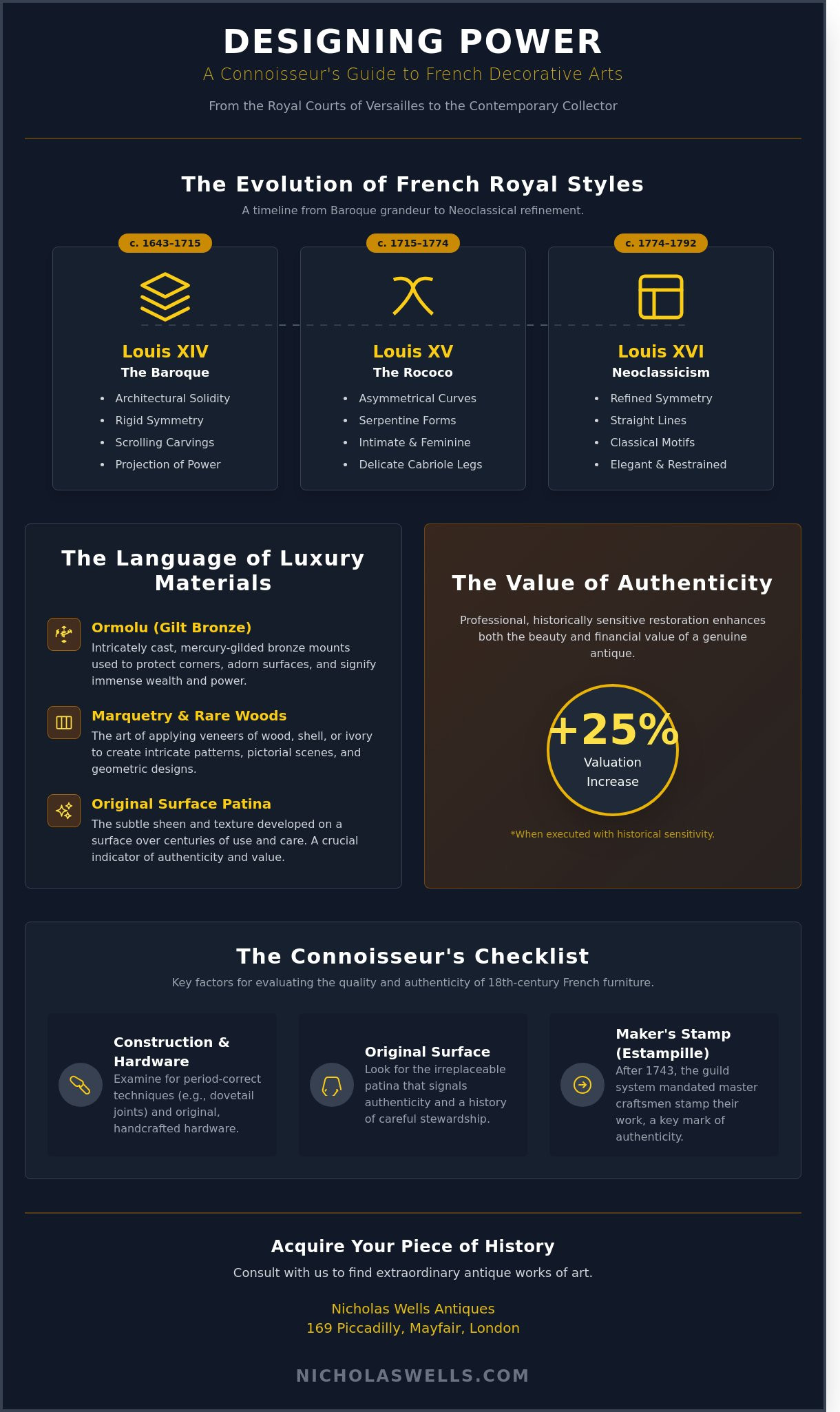
We'll examine how to evaluate the superb surface patina that defines a genuine antique and discuss why professional restoration can increase a piece's valuation by up to 25% when executed with historical sensitivity. By understanding the provenance and craftsmanship behind these luxury antiques, you'll gain the confidence to acquire a statement piece that preserves history. Whether you're visiting our showroom at 169 Piccadilly in Mayfair or consulting with us from abroad, this guide ensures your journey through France's decorative arts is one of informed connoisseurship. It's about more than acquisition; it's about the conservation of history through the finest antique works of art.
Key Takeaways
- Trace the evolution of European craftsmanship from royal commissions to the global fine antiques dealer market, distinguishing between the Baroque grandeur of Louis XIV and Neoclassical symmetry.
- Uncover the symbolic importance of ormolu and rare hardstones in designing power: france’s artistic heritage from court to collector, revealing how these materials defined the pinnacle of French cabinetry.
- Develop a connoisseur’s eye for evaluating luxury antiques by examining period-correct hardware, construction techniques, and the vital importance of original surface patina.
- Learn how to harmoniously integrate magnificent 18th-century pieces, such as a Louis XIV walnut cabinet, into the sophisticated aesthetic of a contemporary Mayfair apartment.
- Master the art of curation and acquisition before visiting our London showroom at 169 Piccadilly to view these extraordinary antique works of art by appointment.
The Legacy of French Decorative Arts: From Court to Collector
French decorative arts represent the zenith of European aesthetic ambition; they're a calculated tool for political projection that transformed the domestic interior into a stage for statecraft. During the 17th and 18th centuries, the French court utilised furniture and objects to broadcast absolute power. This central theme is explored through the lens of designing power: france’s artistic heritage from court to collector. What began as exclusive commissions for the Sun King’s palaces at Versailles has evolved into a sophisticated global market. Today, the discerning fine antiques dealer sources items of unparalleled provenance that once defined the hierarchy of the Ancien Régime. At Nicholas Wells Antiques, our focus remains on the conservation of history. We ensure that the unique antique surfaces and original integrity of these antique works of art are preserved for the most demanding contemporary collections.
Why French Antiques Remain the Gold Standard
The enduring supremacy of French design is rooted in the rigorous standards of the Corporation des Menuisiers-Ébénistes. This guild system, which mandated that master craftsmen stamp their work after 1743, ensured a level of quality that remains the template for global luxury. Within the broader context of French art history, these pieces are valued for their surface patina, a testament to centuries of careful stewardship. A 19th-century French giltwood mirror or a Louis XVI commode retains its value through its original surface. This authenticity signals a level of connoisseurship that transcends mere decoration. The 18th-century French template for luxury remains so potent that it continues to influence every aspect of modern high-end interior design.
Navigating the Eras of Elegance
Collectors typically gravitate toward specific 'Golden Ages' within the timeline stretching from the Baroque grandeur of Louis XIV to the refined Neoclassicism of the Second Empire. Each era reflects a shift in societal values; the rigid hierarchy of the 17th century eventually gave way to the more intimate, feminine curves of the Rococo period. Understanding these stylistic nuances is essential for anyone looking to acquire a significant piece from an antique furniture collection. Whether it’s the bold ormolu mounts of the Empire style or the delicate marquetry of the Transition period, these luxury antiques serve as definitive focal points. We invite clients to visit our antiques showroom by appointment at 169 Piccadilly, London, to experience these extraordinary pieces in person. Our commitment to expertise ensures that every acquisition is both a historical treasure and a superb investment.
Identifying the Styles: A Framework for the Discerning Buyer
To master the nuances of designing power: france’s artistic heritage from court to collector, one must first internalise the visual language of the Bourbon monarchs. The progression from the rigid, sun-drenched magnificence of Louis XIV to the playful intimacy of the Rococo represents a profound shift in social philosophy. Each era reflects the changing priorities of the French state. Collectors often seek the "Magnificent French Louis XIV Walnut Cabinet" as a primary example of this early period. It showcases the architectural solidity and heavy, scrolling carvings that defined the late 17th century.
The Louis XIV and XV Periods: Curves and Grandeur
The transition into the reign of Louis XV introduced the rocaille, an aesthetic defined by asymmetrical shells and serpentine forms. For those seeking a deeper understanding of these organic shapes, this Rococo style guide from the Victoria and Albert Museum provides excellent context on how these forms replaced the strict symmetry of the previous era. Masterful marquetry became the standard during this time. Craftsmen moved away from solid walnut toward exotic kingwood and tulipwood. The "Louis XV Marquetry Commode" exemplifies this Dutch-influenced French style, where floral patterns and bombe shapes create a sense of fluid movement.
Louis XVI to Napoleon III: The Return to Order and Revival
By 1774, the discovery of Pompeii and the influence of Marie Antoinette ushered in Neoclassicism. Straight lines and tapered legs replaced the cabriole curve. This was a return to Greco-Roman order. The 19th century later revisited these themes with renewed opulence. A standout from this period is the "Louis XVI Revival Bonheur Du Jour by Diehl," a piece that demonstrates the precision of 1860s cabinet making. It's a masterpiece of 19th-century cabinet furniture.
The subsequent Napoleon III era embraced a dark, eclectic palette. This is often seen in the "Palatial Napoleon III Gilt Bronze Chandelier," where ormolu quality reached its peak. For those admiring the Restoration period, the "Ten French Antique Satinwood Side Chairs" serve as superb Charles X exemplars. This era's lighter woods offer a distinct contrast to the earlier, darker veneers found in our broader antique furniture collection. Understanding these shifts allows a collector to build a narrative within a room. You can explore our curated selection of French antique works of art to find pieces that resonate with your personal aesthetic.
The Lustre of Power: Materials, Ormolu, and Rare Stones
The materials chosen for French decorative arts were never merely aesthetic. They functioned as a visual vocabulary for the monarchy and the state. In the narrative of designing power: france’s artistic heritage from court to collector, the employment of rare minerals and precious metals signalled a level of control over the natural world that only the absolute elite could claim. This wasn't just about wealth; it was about the projection of an enduring, indestructible legacy through the most stubborn and beautiful substances the earth could provide.
Ormolu: The Gilded Secret of French Luxury
Ormolu, or bronze doré, involves the application of a high-karat gold mercurial amalgam to a cast bronze object. This process creates a surface of incomparable depth and radiance. In the 18th century, this wasn't just a decorative choice. It served to protect the underlying metal from oxidation, ensuring the piece remained luminous for centuries. You'll find that genuine mercury gilding possesses a soft, buttery matte finish with specific burnished highlights. This contrasts sharply with electroplating, a technique introduced around 1840, which often appears thinner and lacks the tactile soul of earlier works.
A superb example of this craft is the Napoleon III Ormolu and Sevres Porcelain Clock Set. The casting reveals a crispness and precision that defines the era's excellence. Such pieces are essential for those curating a collection of antique clocks, as the quality of the ormolu often dictates the object's historical and financial value. Identifying the 'fire-gilding' process requires a keen eye for the subtle variations in surface patina that only age and authentic craftsmanship can produce.
Rare Minerals and Marbles in French Design
Collectors frequently seek out 'hardstones' or pietra dura for their enduring vibrance and the immense difficulty involved in their lapidary work. The technical mastery required to shape 'Rouge Griotte' marble, famously used at Versailles, or 'Sicilian Red Jasper' is extraordinary. These stones are notoriously brittle. A pair of Sicilian Red Jasper Covered Gilt Bronze Urns showcases the dramatic contrast between deep, earthy reds and the bright, architectural precision of the gilt mounts.
- Siberian Amethyst: Highly prized by 18th-century courtiers, often appearing in the most prestigious collector's cabinets.
- Napoleonite: A rare orbicular diorite from Corsica, used in the Italian Napoleonite Console Tables to provide a unique, spotted aesthetic that was both exotic and politically symbolic.
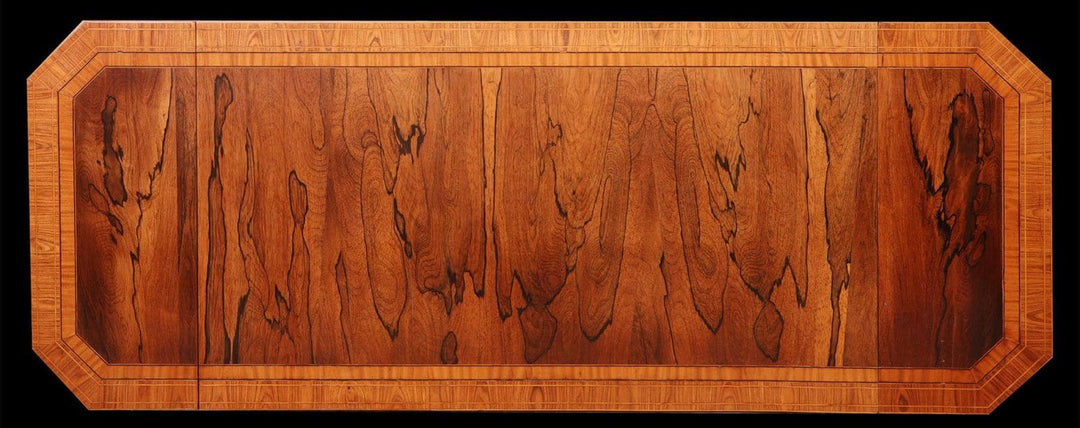
- Figured Walnut: Chosen for its complex grain patterns that mimic the movement of stone.
The rarity of these materials ensured that every urn, pedestal, or sculpture was a unique antique work of art. These objects represent the pinnacle of designing power: france’s artistic heritage from court to collector, where the physical weight of the stone and the brilliance of the gold combined to create an atmosphere of permanent, unshakeable prestige. Every piece tells a story of geological rarity meeting human ingenuity.
Evaluating Quality: The Collector’s Checklist
Discerning the true value of a French masterpiece requires a disciplined approach to physical evidence. When you examine a Louis XV commode, the designing power: france’s artistic heritage from court to collector is found in the hand-cut dovetails and the substantial weight of the ormolu mounts. Authenticity reveals itself in the underside of a frame or the natural oxidation of the wood where it meets metal. Period-correct hardware should show subtle signs of hand-filing, unlike the uniform precision of modern casting. It’s these minute details that separate a fine antiques dealer from a generalist.
Provenance isn't just a paper trail; it's the object's pedigree. A piece that moved from a 1760s Parisian salon to a 21st-century Mayfair gallery retains a narrative that significantly enhances its market value. The "surface patina" acts as a physical record of this journey. You'll see it in the mellowed glow of mahogany or the soft, authentic wear on a chair’s armrests. This "soul" of the object is irreplaceable. Over-restoration often strips this history away, leaving a piece looking sterile and reducing its appeal to seasoned connoisseurs.
Common Mistakes to Avoid
Ignoring the back and bottom of a piece is a frequent error. High-quality 18th-century cabinet furniture often uses oak for secondary woods, whereas lesser pieces might use pine. Distinguishing between a 1750s original and an 1880s "Revival" piece is also vital. While a Belle Époque revival has its own merit, it shouldn't be priced as a Rococo original. Additionally, don't forget to account for UK antique dealer international shipping logistics. At Nicholas Wells Antiques, we manage the complex museum-grade crating required to protect delicate gilt surfaces during transit from our 169 Piccadilly showroom to global destinations.
The Role of Antique Restoration
Professional conservation focuses on the "conservation of history" rather than the erasure of age. We provide complimentary antique restoration to ensure every piece maintains its structural integrity while preserving its unique antique surfaces. This careful balance ensures the object remains a viable investment for the next century. For those specifically interested in the delicate nature of glass, our Connoisseur’s Guide to Antique Mirrors offers deeper insights into the nuances of original silvering and frame conservation. We invite you to visit our antiques showroom by appointment to experience these details in person.
Curation and Acquisition: Bringing French Splendour Home
Integrating a Magnificent French Louis XIV Walnut Cabinet into a 21st-century interior requires an understanding of scale and historical weight. This 17th-century masterpiece, with its rich grain and architectural presence, acts as a primary anchor in a minimalist setting. It exemplifies the central theme of designing power: france’s artistic heritage from court to collector, where a single object dictates the room's entire aesthetic narrative through its sheer craftsmanship and provenance.
The juxtaposition of periods creates a dynamic living space that feels curated rather than decorated. A French Neoclassical Mantel Clock, dating to the late 18th century, offers a refined silhouette that complements the sharp geometry of a contemporary Mayfair apartment. Its precise ormolu details provide a golden warmth that softens modern glass and steel surfaces. Similarly, lighting plays a transformative role in defining luxury. A Napoleon III Gilt Bronze and Glass Chandelier from the 1860s defines the volume of a room, casting light through historical glass that modern alternatives cannot replicate.
We invite you to experience these antique works of art in person to appreciate their unique surface patina and historical soul. Please visit our antiques showroom by appointment at 169 Piccadilly to consult with a specialist and explore our latest acquisitions.
Standout Pieces for the Modern Interior
- The Antique Walnut Marquetry Credenza serves as a distinguished focal point for grand dining rooms, showcasing mid-19th-century craftsmanship. It's available through our cabinet furniture collection.
- For sophisticated seating, a Pair of Neo Classical Canapés offers the balanced proportions of the Louis XVI era, perfect for formal reception rooms. Find these in our seating gallery.
- The Chinese Export Lacquer Bureau-On-Stand represents a rare 18th-century cross-cultural masterpiece, blending Eastern technique with Western form to create a truly unique antique surface.
Starting Your Collection with Nicholas Wells Antiques
Since our inception, we've provided the security of a premier London fine antiques dealer with a global reach that spans continents. We ensure every acquisition is handled with the highest standards of scholarship and care. To encourage the growth of new collections, we offer a Refer a Friend programme that provides a £500 credit toward your next purchase. This is an exceptional opportunity to acquire luxury antiques while sharing your passion for history with fellow connoisseurs.
Discover the full breadth of designing power: france’s artistic heritage from court to collector and find your next acquisition today. Browse the Designing Power Collection.
Cultivating a Legacy of French Splendour
Acquiring a piece of French history isn't merely a purchase; it's a stewardship of a legacy that began in the royal ateliers of the 18th century. By mastering the nuances of designing power: france’s artistic heritage from court to collector, you've gained the insight to distinguish between mere decoration and a true antique work of art. We've explored how the lustre of fire-gilt ormolu and the precision of 19th-century marquetry define a piece's soul, ensuring every casting reflects the era's magnificent ambition. Whether you're seeking a Louis XIV (1643-1715) bureau plat or a Sèvres porcelain garniture, the focus remains on the conservation of history and the preservation of original surface patina.
At Nicholas Wells Antiques, we ensure every acquisition meets these rigorous standards of connoisseurship. Our showroom at 169 Piccadilly, situated in the heart of Mayfair, offers a sanctuary for those who value scholarly expertise and the tactile beauty of rare materials. Every piece includes complimentary professional restoration to preserve its integrity for future generations, while we provide fully insured worldwide shipping to your doorstep. Explore the 'Designing Power' Collection: France’s Artistic Heritage and begin your journey as a custodian of French splendour today. Your next extraordinary find awaits your discovery.
Frequently Asked Questions
What is the difference between Louis XV and Louis XVI furniture styles?
The primary distinction lies in the shift from the fluid, asymmetrical Rococo curves of the Louis XV era (1715 to 1774) to the restrained, Neoclassical geometry of the Louis XVI period (1774 to 1792). Louis XV pieces often feature cabriole legs and ornate floral carvings. Conversely, Louis XVI furniture adopts straight, tapered, or fluted legs inspired by the excavations at Pompeii in 1748. This transition reflects a move from organic caprice to Greco-Roman architectural discipline.
How can I tell if the ormolu on a French antique is original?
To determine if ormolu is original, you must examine the surface for the characteristic soft, matte glow of fire-gilding, a process involving a mercury-gold amalgam used before its 1840 prohibition. Authentic 18th-century gilt bronze displays meticulous hand-chasing and often bears assembly marks or founder stamps on the reverse. If the gilding appears overly bright or uniform, it's likely a later electrolytic replacement that lacks the depth of a genuine 250-year-old patina.
What should I look for when buying a French marquetry commode?
When acquiring a French marquetry commode, you should prioritise the condition of the intricate wood inlays and the presence of rare timbers like kingwood or tulipwood. Inspect the piece for lifting veneers or historical repairs that might affect its value. As a fine antiques dealer, we recommend ensuring the piece retains its original marble top, typically a thick Breche d'Alep slab, which adds significant weight and authenticity to these luxury antiques.
Are 19th-century French revival pieces a good investment?
High-quality 19th-century revival pieces, particularly those by master ebenistes like Francois Linke, represent a robust investment as they often surpass original 18th-century works in technical precision. These pieces are central to the narrative of designing power: france’s artistic heritage from court to collector, bridging the gap between royal commissions and the 19th-century industrial elite. Collectors often see these works appreciate by 15 percent or more when they possess documented exhibition histories.
How do I care for the delicate surface of a French lacquer bureau?
Protecting the delicate surface of a French lacquer bureau requires maintaining a stable environment with humidity levels strictly between 45 and 55 percent. Avoid placing the item in direct sunlight, as UV rays can degrade the organic resin within months. For routine maintenance, use a soft, dry silk cloth to remove dust. If the surface loses its lustre, consult a specialist in antique restoration rather than applying modern waxes which can damage unique antique surfaces.
Does Nicholas Wells Antiques offer international shipping for large furniture items?
Nicholas Wells Antiques provides comprehensive UK antique dealer international shipping services, ensuring that even a substantial French giltwood mirror 19th century reaches its destination safely. We coordinate bespoke white-glove delivery to major hubs including New York and Dubai. Our team manages all export documentation and custom crating, providing a seamless experience for global collectors who wish to acquire a significant antique works of art from our London collection.
What does 'provenance' mean in the context of French antiques?
Provenance refers to the documented history of an object’s ownership, which serves as a vital record for the conservation of history and authenticity. In the context of luxury antiques, a clear lineage back to a specific chateau or a notable 18th-century collection can increase a piece’s market value by over 50 percent. This narrative provides the soul of the object, transforming a decorative antique into a tangible link to France’s prestigious past and artistic heritage.
Can I view the French collection in person in London?
You can view our curated selection of fine antiques by visiting our showroom at 169 Piccadilly, located in the heart of London near Mayfair. This space allows you to experience the masterful craftsmanship of our collection firsthand. We invite clients to visit antiques showroom by appointment to receive a private consultation. This ensures you have the dedicated time required to explore the nuances of designing power: france’s artistic heritage from court to collector.


Leave a comment