



The Connoisseur’s Guide to Antique Mirrors: History, Styles, and Acquisition
Could a single sheet of silvered glass hold more historical weight than the architectural frame that surrounds it? You likely recognize that antique mirrors are far more than mere functional objects; they're silent witnesses to centuries of private history and the shifting tides of artistic movements. The challenge for the discerning collector lies in the nuances, where the subtle foxing of a 17th-century plate or the crispness of a Louis XIV ormolu mount dictates the difference between a museum-quality artifact and a decorative imitation.
A Louis Philippe mirror is distinguished by its characteristic softened silhouette, featuring rounded upper corners and a straight, squared base. This style emerged during the reign of the Citizen King between 1830 and 1848. Look for a clean, understated profile decorated with delicate beaded or pearl motifs. These frames often showcase a water-gilt finish over red bole, creating a warm, luminous glow that complements both 19th-century and contemporary aesthetics. For further inspiration on how decorative antiques are curated for modern interiors, you can read more.
This guide provides the scholarly framework you need to evaluate these extraordinary pieces with the confidence of a seasoned curator. We'll examine the technical evolution of glassmaking since the 1665 establishment of the Manufacture Royale des Glaces, ensuring you understand the investment value inherent in various eras. From mastering the precise terminology of French gilding to managing the logistics of transporting high-value glass across continents, you'll gain the expertise required to acquire pieces with impeccable provenance. We'll begin by tracing the grand lineage of mirror design, from the secretive workshops of Murano to the magnificent proportions of the English Regency period.
Key Takeaways
- Explore the historical evolution of the mirror from the essential 100-year threshold to its role as a profound status symbol of the 18th and 19th centuries.
- Gain a scholarly understanding of the hazardous yet beautiful mercury-amalgam techniques and the tactile weight of authentic hand-blown plate glass.
- Learn to navigate the aesthetic transition from the exuberant curves of the Rococo period to the refined, Neoclassical restraint found in exceptional antique mirrors.
- Develop a connoisseur’s eye for evaluating authenticity by examining the natural foxing of silvering and the subtle nuances of original glass.
- Discover the Nicholas Wells philosophy on sourcing extraordinary pieces and the vital role of specialist restoration in preserving a collection’s heritage.
The Timeless Allure of Antique Mirrors: Beyond Mere Reflection
To qualify as a genuine antique, a mirror must cross the significant 100-year threshold; however, for the discerning collector, age is merely the beginning of the story. During the 18th and 19th centuries, these objects were far more than glass and wood. They were potent symbols of wealth and social standing. In 1734, for instance, the cost of a large plate of glass could equal the annual wages of a domestic servant, making the possession of a grand mirror a visible testament to one's prosperity. The history of mirrors reveals a transition from rare curiosities to essential architectural components. Antique mirrors possess a depth of reflection that modern, mass-produced versions cannot replicate. This is often due to the mercury silvering process used before the 1840s, which creates a soft, luminous quality. This slightly grey or smoky patina offers a romantic, three-dimensional perspective, capturing the soul of a room rather than just its surface.
Owning such a piece involves a deep appreciation for social history. It's not just about the object; it's about the era it represents. The weight of the hand-carved wood and the subtle imperfections in the glass tell a story of craftsmanship that predates the industrial age. These pieces act as silent witnesses to centuries of conversation and change. The market for antique mirrors remains robust because these items offer a unique blend of utility and artistry that modern alternatives simply lack.
The Mirror as an Architectural Element
In the grand residences of the 1700s, mirrors were integral to the building's skeletal design. Pier mirrors were strategically placed between windows to catch and amplify natural light, effectively doubling the perceived space of a drawing room. Overmantels were commissioned to sit above fireplaces, drawing the eye upward and reflecting the flicker of candlelight across the ceiling. By 1780, the mirror had transitioned from a functional tool into the primary focal point of the state room. It became a permanent fixture of the wall’s decorative scheme, often framed in elaborate giltwood or delicate ormolu to match the surrounding boiserie. This architectural integration allowed designers to manipulate the atmosphere of a room with surgical precision, turning dark interiors into radiant halls of light.
The Significance of Rarity and Provenance
The value of a piece often rests upon its documented journey through time. A mirror with a clear provenance, perhaps originating from a distinguished estate or a known collection, becomes a significant cultural artifact. Makers like Thomas Chippendale in London or the workshops of André-Charles Boulle in Paris represent the pinnacle of 18th-century craftsmanship. When a piece is attributed to such a master, its rarity increases exponentially. Collectors seek these items because they embody a specific moment in social history. Owning a mirror that once reflected the candlelight of a Regency ballroom provides an emotional resonance that transcends mere ownership. It’s an investment in heritage that retains its allure through the decades, offering a tangible connection to a lost world of elegance where every curve of the frame was carved by hand to meet the exacting standards of the aristocracy.
The visual depth found in a 19th-century piece has a certain movement to it. This quality, combined with the historical weight of the frame, ensures that the mirror remains a cornerstone of sophisticated interior design. It's an investment in a legacy that continues to reflect the beauty of its surroundings while gaining character with every passing century.
The Alchemy of Glass and Gold: Materials and Craftsmanship
To understand the enduring allure of antique mirrors, one must look beyond the reflection to the very substance of the glass and the architectural integrity of the frame. The materials used in the 17th and 18th centuries weren't merely functional choices; they were the result of a dangerous and expensive alchemy. The early mercury-amalgam process, which dominated production from the 1500s until the mid-19th century, created a soft, deep luster that modern silvering simply cannot replicate. This hazardous beauty involved floating a thin sheet of tin foil on a bed of liquid mercury, a method that produced a superb, silvery-grey reflection but proved notoriously lethal for the craftsmen who inhaled the toxic fumes during the manufacturing phase.
The transition to the modern silvering process arrived in 1835, when the German chemist Justus von Liebig developed a method of depositing a thin layer of metallic silver onto glass through chemical reduction. While this innovation made mirrors more accessible to the burgeoning middle class, it lacked the moody, atmospheric depth found in earlier plates. Connoisseurs often prefer the weight and texture of hand-blown plate glass, which feels substantial and possesses a distinct physical presence. These early plates were cast onto large iron tables before being ground and polished by hand, a labor-intensive journey that ensured no two pieces were ever identical.
A Scholarly History of Mirror Plate Production
The Venetian Republic held a fiercely guarded monopoly on mirror production on the island of Murano until 1665, when the French minister Jean-Baptiste Colbert successfully enticed Italian craftsmen to help establish the Saint-Gobain factory. Before this industrial shift, the physical dimensions of a mirror plate served as a direct indicator of the owner's financial status; a single large plate could cost as much as a small naval vessel. A Short History of the Glass Mirror provides a detailed timeline of these manufacturing milestones and their cultural impact. Collectors can identify these early pieces by observing the glass for "seeds," which are tiny air bubbles trapped during cooling, and subtle ripples known as "reams" that create a gentle distortion in the reflection.
The Art of Giltwood and Ormolu
The frames of antique mirrors are often as technically complex as the glass they house, requiring a mastery of both sculpture and chemistry. In 17th-century England, master carvers favored lime-wood for its tight grain and lack of visible knots, allowing for the creation of intricate, naturalistic swags. These wooden structures were finished using two primary methods: water gilding and oil gilding. Water gilding involves applying gold leaf over a base of "bole," a fine clay that allows the gold to be burnished with an agate stone to a mirror-like shine. Oil gilding is more durable but remains matte, often used to provide a tonal contrast that highlights the depth of the carving. Collectors seeking to acquire such rarities might explore our curated selection of 18th-century mirrors to see these materials in their finest state.
French neoclassical frames often moved away from wood in favor of cast brass or bronze, particularly in the Louis XVI period. Ormolu is a hallmark of 18th-century luxury craftsmanship, defined by the meticulous process of fire-gilding cast bronze with a gold and mercury amalgam. This technique allowed for a level of crispness and detail in the metalwork that wood could never achieve, resulting in frames that possess a regal, architectural weight. It's this marriage of rare metals and hand-cast glass that transforms a simple household object into a significant cultural artifact.
Navigating the Eras: A Comparative Guide to Mirror Styles
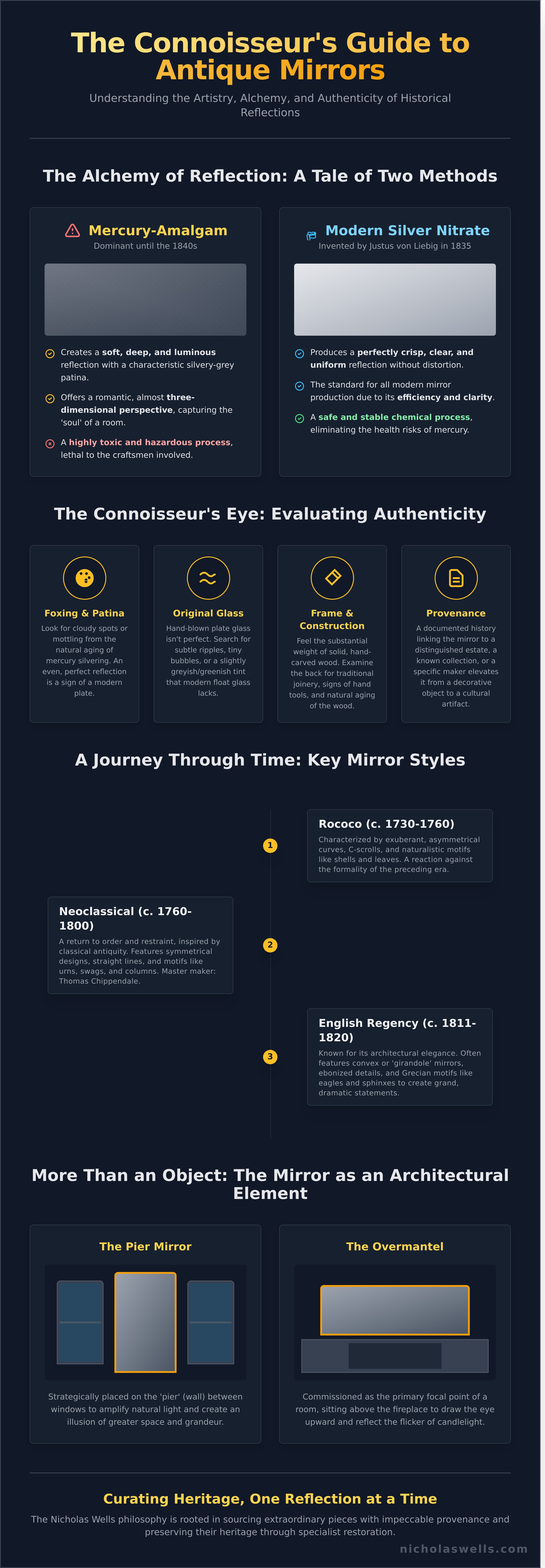
The evolution of the mirror from a simple polished surface to a sophisticated architectural element follows the broader trajectory of European design history. To understand the nuances of antique mirrors, one must appreciate the technological leaps in the History of glassmaking, which eventually allowed for larger plates and clearer reflections. By the 17th century, the mirror became a symbol of immense wealth; it was a canvas for the most skilled carvers and gilders of the age. It's a journey through changing tastes, where the frame serves as a time capsule of the era's social and aesthetic values.
The Grandeur of Baroque and Rococo
During the reign of Louis XV, the Rococo style abandoned the heavy, symmetrical rigidity of the earlier Baroque period in favor of an exuberant, playful naturalism. You'll recognize these pieces by their asymmetrical motifs, where scrolling acanthus leaves and delicate C-scrolls seem to dance across the frame. The carving is often deep and three-dimensional, finished in high-quality gold leaf that has acquired a soft, muted patina over the centuries. In England, the 1754 publication of "The Gentleman and Cabinet-Maker's Director" by Thomas Chippendale introduced a distinctively British interpretation of these forms. These mirrors often shared aesthetic DNA with the wider antique furniture collection of the era, featuring Chinoiserie elements and naturalistic carvings that transformed a functional object into a sculptural masterpiece. The craftsmanship is staggering; every curve was hand-carved to catch the flickering candlelight of an 18th-century ballroom.
Neoclassical Precision: Regency and Louis XVI
The 1748 discovery of Pompeii sparked a profound shift toward the Neoclassical. Designers like Robert Adam and the cabinetmakers of the Louis XVI era rejected Rococo whimsy for the disciplined geometry of the ancient world. Frames became architectural, defined by fluted columns, classical urn motifs, and laurel swags. Symmetry returned to the forefront. It's here we see the rise of the convex mirror in Regency England, often called a "butler" mirror. These circular pieces provided a wide-angle view of a room, allowing servants to monitor the progress of a meal without standing directly over the guests. The use of ormolu, a technique of applying finely ground, high-karat gold to bronze, reached its zenith during the French Empire period, creating mirrors of imposing weight and regal authority. The precision of these designs reflects an era obsessed with order and the idealized proportions of antiquity.
As the 19th century progressed, the Louis Philippe style, spanning roughly 1830 to 1848, introduced a more restrained, stately elegance. These mirrors are distinguished by their "rounded shoulders" at the top corners and a flat base, making them ideal for placement over a marble mantelpiece. They lack the aggressive ornamentation of earlier periods, opting instead for clean lines and subtle beading. This era was followed by the Victorian period, a time of bold eclecticism. The Gothic Revival, fueled by a romanticized view of the medieval past, reintroduced pointed arches, trefoils, and dark, heavy woods into the domestic interior. These antique mirrors weren't merely functional; they served as historical anchors in a rapidly industrializing world. Whether it's the scholarly restraint of a Regency frame or the whimsical curves of a Rococo piece, each mirror tells a story of cultural transformation.
- Rococo: Look for C-scrolls, floral swags, and deliberate asymmetry.
- Neoclassical: Identify fluted pilasters, urns, and Greek key motifs.
- Louis Philippe: Characterized by a "mouche" or rounded top corner and simple gilding.
- Gothic Revival: Recognizable by pointed arches and quatrefoil details.
The glass itself is a primary indicator of age. Before the mid-19th century, mirrors were silvered using a mercury process, which often leaves a distinctive "sparkle" or slight grey spotting known as foxing. This imperfection is highly prized by collectors. It's a mark of authenticity that modern reproductions cannot convincingly replicate. When you run your hand over the back of an original 18th-century frame, you'll feel the marks of the pit saw and the hand-plane. These tactile details connect the contemporary collector to the workshop of a master craftsman from centuries past.
The Connoisseur’s Eye: Evaluating Authenticity and Condition
The discerning collector understands that the value of a mirror lies far beyond its reflective surface; it resides in the historical integrity of its components. When examining the glass, one must look for the subtle, undulating texture characteristic of early plate production. Before the 1840 patent of the silver nitrate process, makers utilized mercury to create the reflective coating, a method that produced a soft, silvery depth modern alternatives can't replicate. This mercury silvering often develops a distinctive oxidation over centuries. Genuine foxing should appear as soft, cloudy blooms rather than uniform spotting. These ethereal patterns, often concentrated at the edges where moisture has seeped behind the frame, serve as a testament to the object's survival through time.
The reverse of the piece is just as revealing as the front. A 1750 George II mirror should ideally retain its original hand-planed oak or deal backboards. These panels were essential for protecting the fragile silvering from atmospheric changes. If the backboard appears too pristine, or if it's made of modern plywood or thin MDF, it suggests the piece has been significantly altered. A 2023 valuation study indicated that antique mirrors with their original 18th-century backboards and glass can command a 45% premium over those with contemporary replacements. Restoration is acceptable when it's sympathetic; for instance, stabilizing a delicate 1780s Chinoiserie frame adds value, whereas stripping and regilding it often destroys the historical narrative.
- Inspect the glass for a slight grey or blue tint, indicative of high lead content in early plate glass.
- Check for hand-forged nails in the backboards, which should show signs of rust and age-related wood shrinkage around the heads.
- Assess the weight; original mercury-glass is significantly heavier than modern float glass.
Identifying Genuine Patina and Wear
Authentic patina is the result of centuries of gentle handling and atmospheric exposure, creating a glow that's impossible to forge. To confirm hand-gilding, inspect the surface for "lap" marks. These are the tiny overlaps where the gilder placed 3.5-inch squares of gold leaf. Modern "distressed" finishes often rely on uniform sprays or chemical washes that lack the nuanced layers of genuine wear. You'll find that on a true 18th-century piece, the gold has worn away naturally on the high points of the carving, revealing the warm red or grey clay "bole" beneath.
Integrating Antique Mirrors into Contemporary Interiors
Strategic placement allows a historical piece to transform the architecture of a modern space. Juxtaposing a 1760s Chippendale pier mirror with a minimalist velvet sofa creates a dialogue between eras, preventing a contemporary room from feeling sterile. In urban apartments where square footage is at a premium, a large 19th-century French overmantel mirror can expand the perceived volume of a room by reflecting light across the ceiling. Explore how antique mirrors act as "anchors" in eclectic design schemes, providing a sense of permanence and gravity amidst shifting trends.
Refine your collection with pieces that possess both history and soul. View our latest acquisitions to find a mirror that defines your space.
Curating Your Collection with Nicholas Wells Antiques
Selecting a piece for one's home is a process that demands both an aesthetic eye and a deep respect for provenance. At Nicholas Wells Antiques, our philosophy centers on the acquisition of the extraordinary. We don't simply source furniture; we curate a selection of objects that possess a rare combination of historical significance and visual power. This commitment to excellence ensures that every item, particularly our antique mirrors, serves as a testament to the master craftsmen of the 18th and 19th centuries. We seek out the unique, focusing on pieces that retain their original character and demonstrate the highest levels of artistry from the George III and Regency periods.
Our bespoke advisory service bridges the gap between historical scholarship and modern interior design. For private collectors and professional designers, we offer a tailored experience that goes beyond the showroom floor. We provide detailed condition reports and historical dossiers for every acquisition, drawing on over 20 years of experience in the global art market. This scholarly approach helps our clients understand the cultural context of their pieces, ensuring that each addition to a collection is both a sound investment and a source of enduring beauty. Whether you're furnishing a historic estate or a contemporary apartment, our team provides the expertise needed to integrate rare artifacts into a lived-in environment.
The Importance of Specialist Restoration
Preserving the integrity of a historical object requires a delicate touch and a wealth of technical knowledge. We provide complimentary, specialist restoration for every piece sold, prioritizing sensitive conservation over aggressive renewing. Our goal is to preserve the "soul" of the object, maintaining its original patina while ensuring its structural integrity for the next generation of owners. This meticulous process is vital for antique mirrors, where the silvering of the glass and the fragility of the giltwood frame require expert handling.
Our workshop team draws on decades of experience in traditional techniques such as water-gilding and shellac polishing. This expertise is informed by our broad scholarly reach across diverse works of art, ranging from bronze sculpture to fine cabinetry. By understanding the chemical and physical properties of these materials, we ensure that every restoration is sympathetic to the period and style of the piece, avoiding the over-restored look that can diminish an antique's value.
Logistics should never be a barrier to acquiring a masterpiece. We facilitate worldwide, fully insured shipping for even the most delicate items. Every piece is secured in custom-engineered crates, often utilizing 2-inch thick high-density foam padding and reinforced timber frames to withstand international transit. Since 2008, we've successfully managed the delivery of rare artifacts to collectors in 54 different countries. Our white-glove delivery partners ensure that a massive 19th-century mirror is handled with the same care in New York or Tokyo as it is in our London gallery.
Discovering Rare Pier Mirrors and Overmantels in London
We invite you to experience the tactile beauty of our collection firsthand at our London gallery. Available by appointment, these viewings allow for a quiet, immersive exploration of our latest acquisitions. Whether you're searching for a grand 18th-century pier mirror to anchor a drawing room or a refined overmantel for a private study, our experts are on hand to guide your selection. We assist in building cohesive collections of fine English and Continental furniture that reflect your personal tastes and the architectural requirements of your home. Explore our current collection of magnificent antique mirrors and discover the perfect centerpiece for your interior today.
Elevating Your Interior with a Timeless Legacy
Acquiring antique mirrors isn't merely a purchase; it's an investment in a storied legacy of 18th-century craftsmanship and artistic vision. By mastering the nuances of mercury-silvered glass and the intricate details of hand-carved ormolu frames, you've gained the scholarly insight required to identify pieces of genuine historical significance. Every frame carries a unique provenance that bridges the gap between past grandeur and your contemporary living space. Since 2012, Nicholas Wells Antiques has applied London-based expertise to curate a distinguished selection, ensuring that every acquisition meets the highest standards of rarity and condition.
We invite you to view our extraordinary collection of rare antique mirrors. Every piece includes complimentary expert restoration to preserve its original character, and we provide fully insured worldwide shipping for all high-value acquisitions. Whether you're a seasoned collector or an interior designer seeking a singular focal point, we're here to guide you toward a piece that resonates with your personal style. We look forward to helping you discover a magnificent artifact that brings both light and history into your home.
Frequently Asked Questions
What is the difference between an antique mirror and a vintage mirror?
An antique mirror is defined by a minimum age of 100 years, whereas a vintage piece typically dates from the 20th century, specifically between 20 and 99 years old. This distinction is crucial for collectors of antique mirrors. A 19th-century Regency pier glass carries a historical weight that a 1950s mid-century modern piece hasn't yet acquired. The value often hinges on this century-long threshold of craftsmanship and survival.
How can I tell if the glass in my antique mirror is original?
You can identify original glass by looking for subtle imperfections such as seeds, which are tiny air bubbles, or a gentle waviness known as reams that occurred during the pre-1900 hand-blown cylinder process. Modern plate glass is perfectly flat and lacks the grey or yellow tonal depth found in 18th-century mercury-silvered plates. If the glass appears too uniform or lacks a slight prismatic distortion when viewed at a 45-degree angle, it's likely a later replacement.
What causes the dark spots (foxing) on old mirrors, and can they be fixed?
Foxing is caused by the oxidation of the metallic backing, often mercury or silver, when moisture penetrates the protective paint layer over 50 or 100 years. While these misty grey blooms add a desirable patina to antique mirrors, they can't be fixed without a complete resilvering process. Resilvering involves stripping the original 19th-century chemical layer, which often diminishes the historical integrity and market value by 35 percent.
Are antique mirrors safe to hang in modern homes?
Antique mirrors are perfectly safe for modern interiors provided you use weight-rated steel anchors and professional-grade French cleats that support 100 pounds or more. Most 18th-century frames weren't designed for modern drywall. You should always consult a specialist installer to ensure the 15-millimeter thick glass and heavy oak backboards are securely fastened. We recommend checking the structural integrity of the frame's joints before hanging any piece weighing over 20 kilograms.
What is a Louis Philippe mirror and how do I identify one?
A Louis Philippe mirror is distinguished by its characteristic softened silhouette, featuring rounded upper corners and a straight, squared base. This style emerged during the reign of the Citizen King between 1830 and 1848. Look for a clean, understated profile decorated with delicate beaded or pearl motifs. These frames often showcase a water-gilt finish over red bole, creating a warm, luminous glow that complements both 19th-century and contemporary aesthetics.
How do I clean and maintain a giltwood mirror frame?
You should clean a giltwood mirror frame using only a soft, dry squirrel-hair brush to gently dislodge dust from intricate carvings. Avoid water, spirits, or commercial polishes. These substances can dissolve the rabbit-skin glue or the 22-karat gold leaf itself. If a frame from 1780 requires deeper conservation, a professional restorer should handle the task. They use specialized techniques to preserve the delicate gesso layer without causing flaking or tarnish.
Why are some antique mirrors much heavier than modern ones?
Antique mirrors are significantly heavier because they utilize thick, hand-cast glass and substantial solid wood backboards made of oak or pine. A 19th-century plate can be 6 to 10 millimeters thick, whereas modern commercial glass is often only 3 or 4 millimeters. The hand-planed timber boards used to protect the silvering add another 5 to 10 kilograms of weight. This robust construction reflects the uncompromising material standards of 18th and 19th-century master craftsmen.
What should I look for in the provenance of a high-value mirror?
For a high-value mirror, you should seek documentation that traces its ownership history back at least 80 years or links it to a specific 18th-century workshop like Chippendale. Look for original paper labels, stenciled inventory numbers from historic estates, or mentions in 1950s auction catalogs. A clear provenance increases a piece's investment potential. It transforms an anonymous object into a documented artifact with a verified lineage through distinguished private collections or notable country houses.

Leave a comment