



Fine English Antique Furniture for Sale: A Connoisseur’s Guide to 18th & 19th Century Masterpieces
In the pursuit of historical masterpieces, the line between an authentic treasure and a convincing reproduction can be disarmingly fine, demanding of the collector not only a passionate heart but a discerning eye. The complexities of provenance, the nuances of restoration, and the logistics of acquiring significant pieces from afar can present formidable challenges. For those seeking extraordinary fine English antique furniture for sale, the journey is one of careful scholarship and profound appreciation, a quest to acquire not just an object, but a tangible piece of history that promises to elevate an interior and appreciate in value over time.
This connoisseur’s guide is crafted to illuminate that path. Here, we will delve into the magnificent legacy of 18th and 19th-century English craftsmanship, exploring the defining characteristics of its most celebrated eras. You will discover the secrets held within the grain of the wood and the lustre of a period patina, learning to distinguish the hand of a master and to invest with the quiet confidence that comes only from true understanding. Allow us to be your trusted advisor in acquiring a distinguished piece with a soul, a story, and a superb future.
Key Takeaways
- Distinguish between the defining eras of English design, from the Palladian grandeur of the Georgian period to the Rococo elegance of Chippendale.
- Learn to assess an antique's true value by interpreting its patina and understanding how provenance can dramatically increase its worth.
- Discover sophisticated strategies for integrating historic masterpieces into contemporary interiors, using them as powerful focal points rather than museum pieces.
- Navigate the market for fine English antique furniture for sale with greater expertise, identifying the key indicators of superior craftsmanship and investment potential.
The enduring legacy of fine English antique furniture
The enduring appeal of fine English antique furniture lies not merely in its age, but in its profound cultural and historical resonance. When a connoisseur refers to this distinguished category, they are typically evoking the magnificent period from the early Georgian era through to the close of the Regency (c. 1714-1837). This was a time when the English town and country house aesthetic became a global benchmark for sophisticated, ordered living. As we move towards 2026, there is a distinct and accelerating resurgence in demand for these pieces, driven by a collective desire for authentic, sustainable luxury-a tangible connection to a heritage of unparalleled craftsmanship. It is this genuine artistry, a world away from modern "antique style" reproductions, that distinguishes a period original. The market for fine English antique furniture for sale thus offers an opportunity to acquire objects of both profound beauty and historical significance, pieces that align with the broader understanding of what constitutes true antique furniture.
This appreciation for authentic, British craftsmanship extends beyond furniture into all aspects of the classic country lifestyle, including finely made accessories for canine companions, such as those handcrafted by The Tweed Dog.
The Golden Age of English cabinet making (1700-1850)
This remarkable era, often termed the Golden Age, witnessed an unparalleled flowering of design and technical skill. This creative explosion was fueled by the expansion of global trade, which introduced exotic and robust timbers previously unavailable to English craftsmen. The patronage of the Royal Court and a newly wealthy aristocracy elevated the professional cabinet-maker to the status of an artist, with luminaries such as Thomas Chippendale, George Hepplewhite, and Thomas Sheraton publishing influential design books that codified a new language of elegance. Their work, characterized by graceful proportions, superb dovetailed construction, and refined ornamentation, established this period as the definitive benchmark for luxury furniture design worldwide.
Materials of distinction: Mahogany, Walnut, and Satinwood
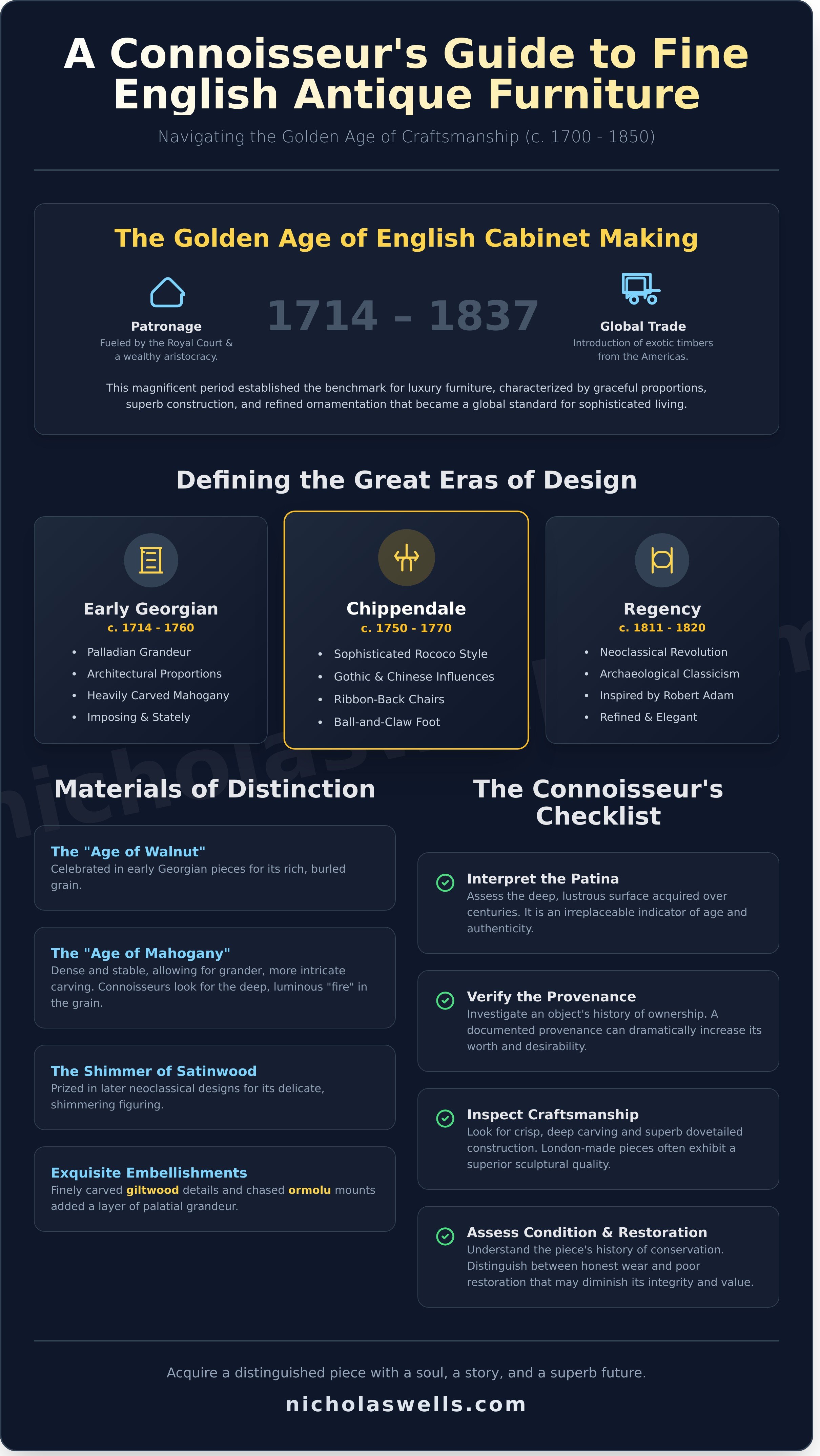
The material narrative of the 18th century is defined by the pivotal transition from the "Age of Walnut" to the "Age of Mahogany." While early Georgian pieces celebrate the rich, burled grain of native walnut, the arrival of dense, stable mahogany from the Americas allowed for more ambitious and intricate carving on a grander scale. A key indicator of exceptional quality lies in the selection of veneers; a connoisseur will always look for the deep, luminous quality or "fire" in the grain of Cuban mahogany or the delicate, shimmering figuring of satinwood. In the later neoclassical designs championed by Robert Adam, these magnificent timbers were often exquisitely embellished with finely carved giltwood details or finely chased ormolu mounts, adding a layer of palatial grandeur that remains breathtaking today.
Defining the great eras of English furniture design
To truly appreciate the pieces available when searching for fine English antique furniture for sale, one must first understand the historical currents that shaped their creation. The 18th and early 19th centuries represent a period of extraordinary stylistic evolution, moving from the imposing grandeur of the early Georgian era, defined by its Palladian proportions and heavily carved mahogany, through the Rococo's flourish, and into the refined classicism of the Regency. Each period offers a distinct aesthetic, a unique narrative of taste and craftsmanship that speaks to the social and cultural ambitions of its time.
Chippendale and the artistry of the mid-18th century
The mid-18th century was dominated by the genius of Thomas Chippendale, whose 1754 publication, The Gentleman and Cabinet-Maker's Director, codified the Rococo style for a generation of craftsmen. His designs are celebrated for their sophisticated blend of Gothic, Chinese, and French influences, most famously expressed in the intricate, flowing splats of his ribbon-back chairs and the powerful grasp of a ball-and-claw foot. To study a curated antique furniture collection is to witness the remarkable diversity of these forms. Distinguishing a master's work from a provincial copy lies in the carving; a London-made piece exhibits a crispness, depth, and sculptural quality that lesser artisans could not replicate. Evaluating this artistry requires a keen eye, one that also appreciates how the object's history and any subsequent Conservation and restoration have preserved its original integrity.
Regency elegance: A shift toward the classical
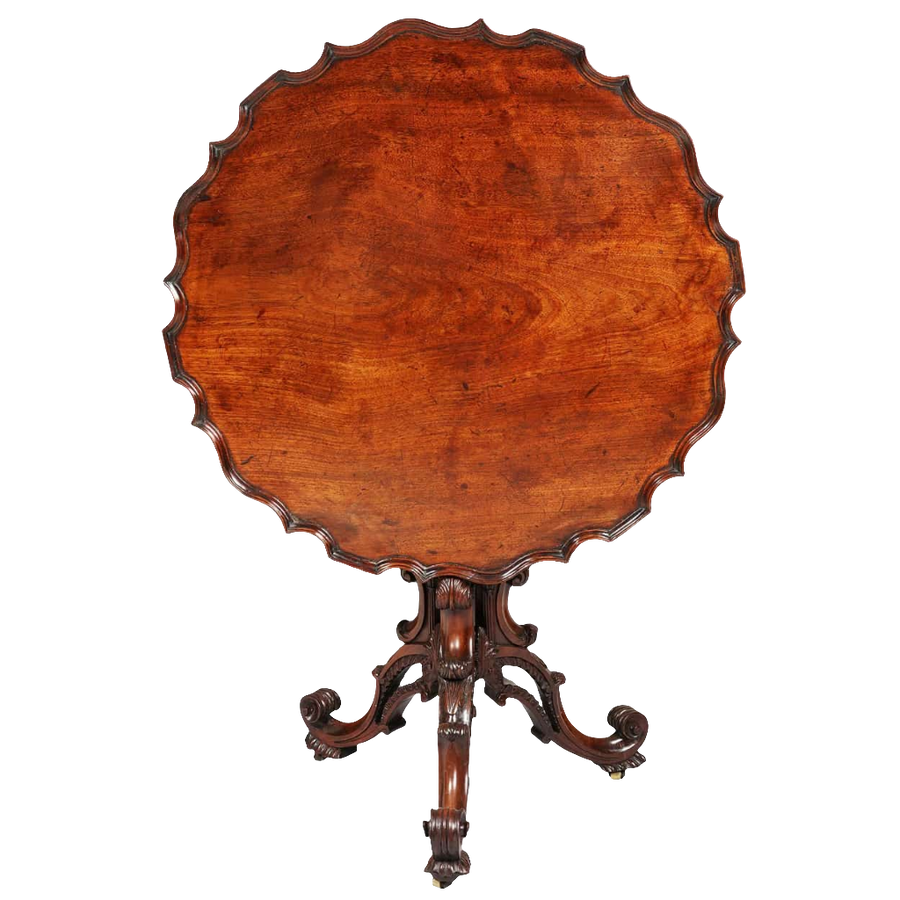
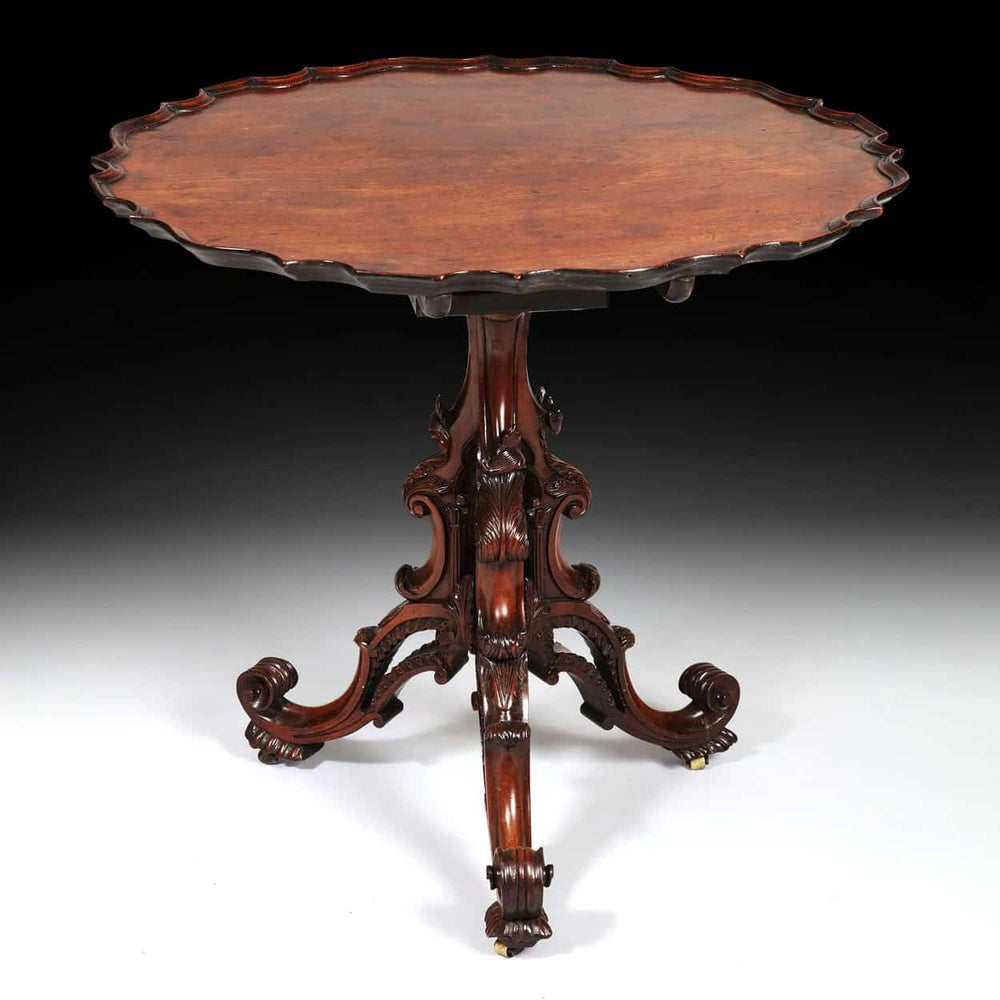
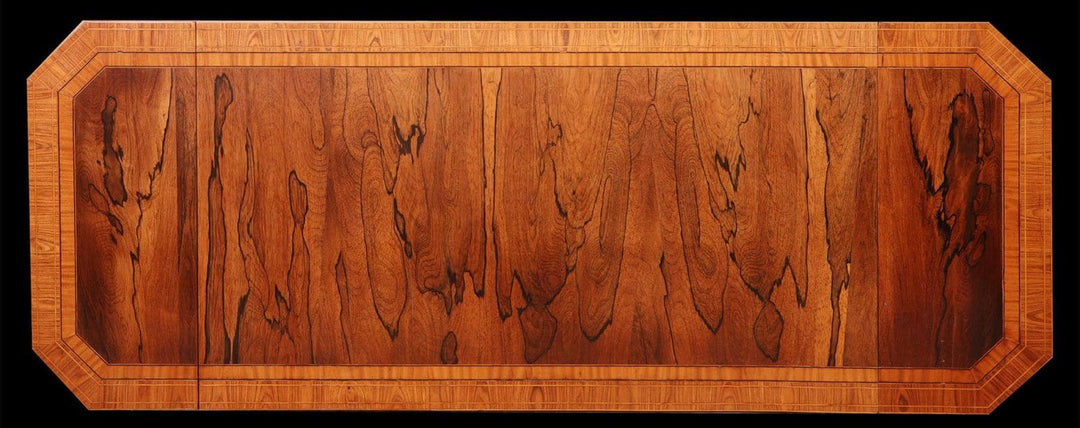
Following the Neoclassical revolution led by architects like Robert Adam, the Regency era (c. 1811-1820) embraced a more archaeological classicism, drawing inspiration from Greek, Roman, and Egyptian motifs. This period saw a shift toward darker, more exotic timbers, with rosewood becoming a hallmark, its rich grain often brilliantly contrasted with fine brass inlay and ormolu mounts. The period's emphasis on strong, architectonic lines and refined decoration is beautifully displayed in the era's most versatile forms; the superb antique tables-from sofa and Pembroke tables to grand dining tables-exemplify this balance of function and formidable style. It is this very combination of clean silhouettes and luxurious materiality that makes Regency pieces some of the most sought-after examples of fine English antique furniture for sale today, as they provide a focal point of historical gravitas without overwhelming a minimalist aesthetic.
Evaluating rarity, condition, and provenance
Beyond the immediate aesthetic appeal of an object, its true value in the discerning market for fine English antique furniture for sale is determined by a trinity of critical factors: rarity, condition, and provenance. For the serious collector, these elements form a distinct hierarchy of importance, transforming a beautiful piece into a significant historical artifact. While rarity dictates supply and condition speaks to its journey, it is provenance that can elevate a piece to the highest echelons of desirability, often doubling its financial worth.
The critical role of provenance in fine antiques
Provenance-the documented history of an object’s ownership-is the narrative that separates the exceptional from the merely excellent. A documented piece, substantiated by a maker's label, an inventory stamp from a grand estate, or an original bill of sale, carries an unimpeachable pedigree. The most coveted of these is the "Country House" provenance, which links an item to a celebrated aristocratic family or a historically significant interior. This lineage provides a tangible soul to magnificent cabinet furniture, allowing it to stand not just as a superb example of craftsmanship, but as a silent witness to the past.
Assessing condition and structural integrity
A connoisseur learns to read an object’s surface as a record of its history. It is essential to differentiate between honest wear-the development of a deep, lustrous patina from centuries of use and care-and acute structural damage. In the current 2026 market, collectors place immense value on "original surfaces" and a rich, undisturbed colour. When examining a piece, one must look for:
- Originality: Are the brass handles, escutcheons, and locks original to the period? Do they show wear consistent with their age?
- Construction: Are the drawer dovetails hand-cut and precise? Does the secondary wood, such as the oak or pine used for drawer linings, appear correct for the era? The meticulous construction techniques of a given period, often studied within the Victoria and Albert Museum's furniture collection, serve as an invaluable benchmark for authenticity.
Finally, it is crucial to debunk the number one misconception: that all restoration ruins value. For fine furniture, this is a profound oversimplification. Sympathetic conservation, undertaken by a master craftsman to address the inevitable effects of time, is not only acceptable but often essential. Such work preserves a piece's structural and aesthetic integrity for future generations. It is crude, ill-conceived repair that compromises a masterpiece-not the expert, scholarly restoration that honours its legacy.
Curating the collection: Antiques in the 21st-century interior
The art of incorporating antiques into the modern home has evolved dramatically. The contemporary collector, in a departure from the rigid period rooms of the past, now seeks to create a dialogue between eras, where the deep, resonant patina of a George III commode can be masterfully juxtaposed with the bold strokes of 21st-century abstract art. This “mix and match” philosophy celebrates the individual character of each object, eschewing a museum-style set in favour of a dynamic, personal, and lived-in space.
A single, exceptional piece often serves as the anchor of a room, its historical weight and superb craftsmanship providing a focal point around which a more contemporary design can pivot. This approach not only lends soul and gravitas to an interior but also represents the ultimate in sustainable luxury. Choosing to invest in historic pieces is an inherently “green” decision, honouring the longevity of master craftsmanship and avoiding the disposability of modern production. The market for fine English antique furniture for sale is, therefore, not just about aesthetics, but about a conscious choice for enduring quality.
This philosophy of juxtaposition isn't limited to decor. While the home may be anchored by historical treasures, it is still a space for modern living, which often includes state-of-the-art technology. For those interested in exploring the electronics that complement a modern, curated lifestyle, you can read more.
This is particularly effective in the bedroom, where an antique chest of drawers or a Regency wardrobe can be paired with a high-quality contemporary bed to create a space that is both serene and rich with history. For those curating such a space, specialist bed companies like Bennetts Bedrooms can provide the modern centerpiece that complements the timeless elegance of antique pieces.
This appreciation for enduring quality and masterful woodwork is not confined to antiques. Modern artisans continue this legacy, creating future heirlooms with innovative techniques. For a contemporary take on bespoke wooden furniture that complements historical pieces, you can visit River Table to see how live-edge wood and resin are combined to create functional art.
Creating a narrative with works of art
A truly curated interior tells a story. Integrating carefully chosen works of art creates layers of intellectual and aesthetic interest, allowing for a conversation between different forms and periods. In this context, magnificent antique mirrors are indispensable tools for the designer, skilfully employed to amplify natural light and create an illusion of greater depth-a particularly valuable technique when balancing the grand scale of period furniture within the proportions of a modern town house.
To find pieces that complement the historical weight of antique furniture, collectors often turn to specialists in fine art. For instance, the First4Frames Gallery offers a curated selection of prints that can bridge the gap between classic and contemporary aesthetics, providing the perfect visual counterpart to a piece of period cabinetry.
The Grand Tour influence on English interiors
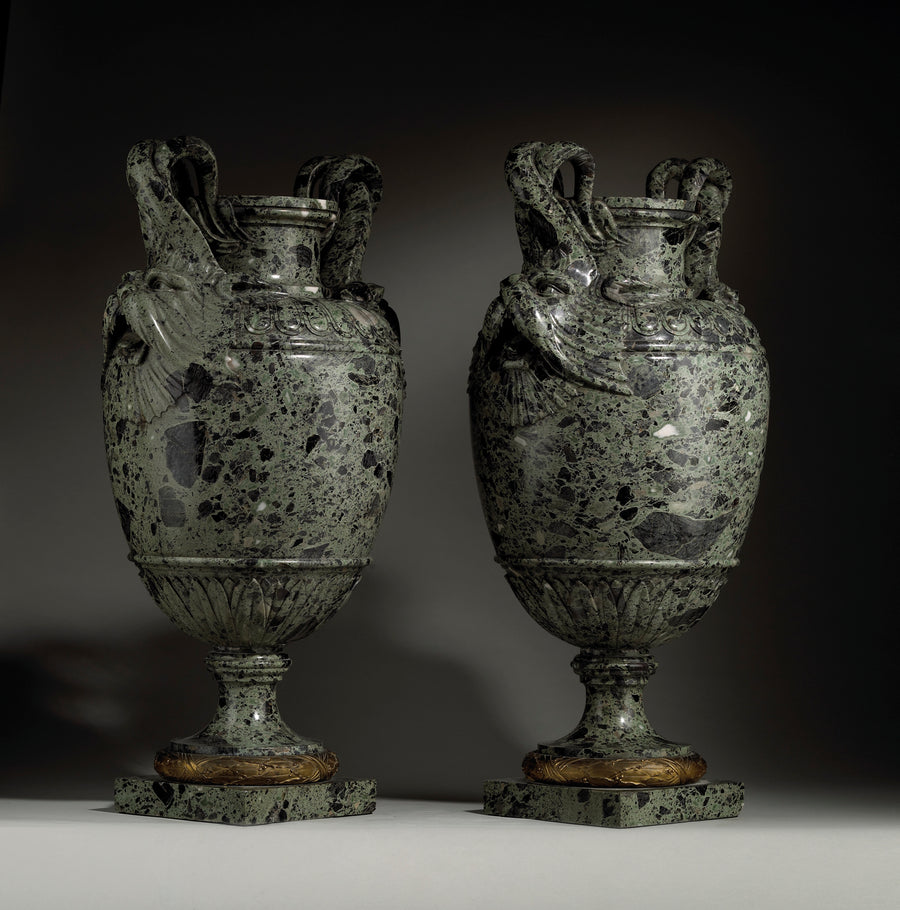
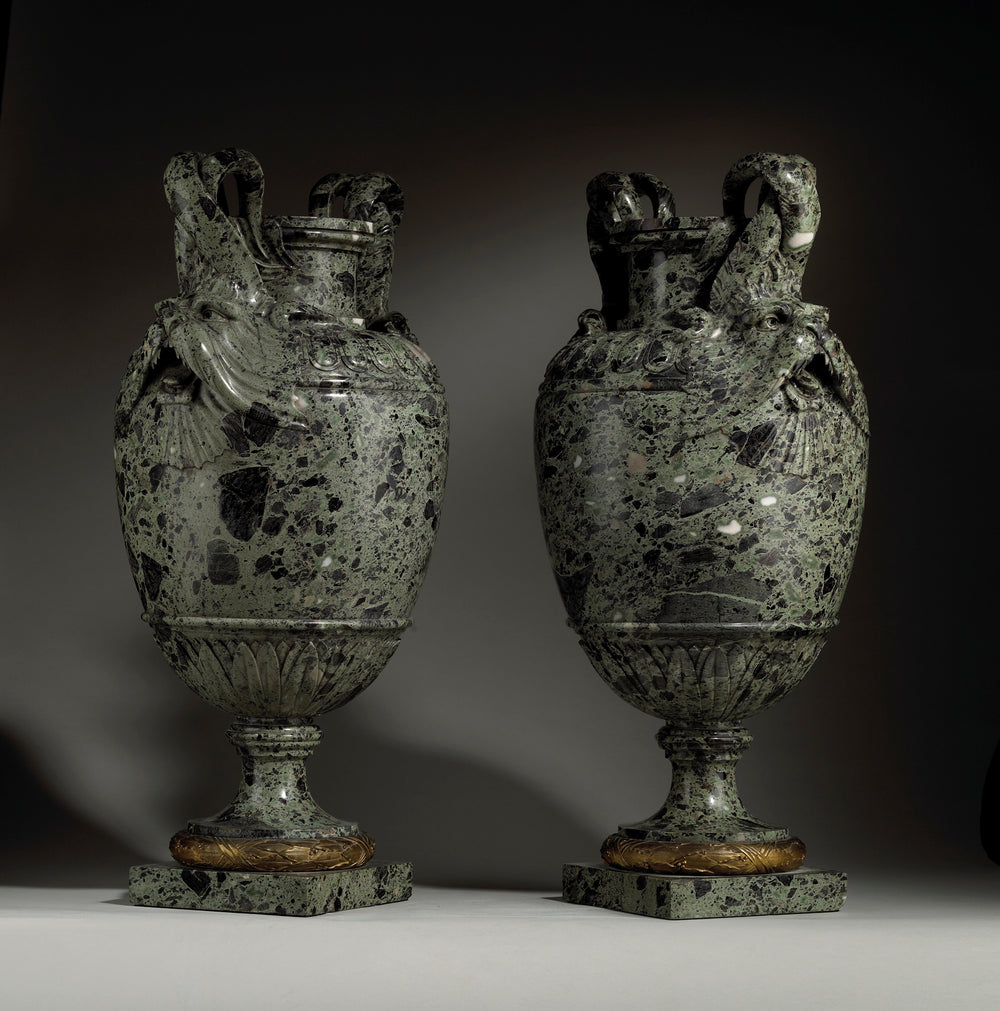
The enduring appeal of neoclassicism, which so profoundly shaped 18th-century English taste, owes much to the tradition of the Grand Tour. Aristocratic travellers returned from Italy laden with treasures that informed a new aesthetic of classical rigour and refined elegance. Today, authentic Grand Tour souvenirs-from bronze statuary to architectural models in Sienna marble-remain exceptionally potent accent pieces, bridging the centuries and providing a sophisticated link between classical ideals and contemporary minimalism.
The Nicholas Wells experience: Acquiring exceptional pieces
Acquiring a significant piece of antique furniture is a profound investment in history, craftsmanship, and enduring beauty. At our London gallery, we have cultivated an environment where this journey is not merely a transaction, but a deeply personal and rewarding experience. We serve a global clientele of discerning collectors and interior designers, presenting a curated collection where each object is chosen for its exceptional provenance, superb condition, and historical importance. To begin your journey is to engage with a trusted advisor dedicated to helping you find the perfect piece to elevate your interior.
The Nicholas Wells Antiques restoration promise
Our commitment to an object’s legacy extends far beyond its acquisition. We believe that for a piece to be truly appreciated for generations, it must be in impeccable condition. For this reason, we provide complimentary, expert restoration with every purchase. This is not a process of over-refining, but one of sympathetic restoration. Our network of London’s finest specialist craftsmen-master cabinet-makers, gilders, and polishers-work meticulously to stabilise and conserve, preserving the rich, time-worn patina and the unique story that each surface tells.
Global acquisition and white-glove service
For the international collector, the logistics of transporting a delicate masterpiece can be a significant concern. We remove this complexity entirely. Every piece of fine English antique furniture for sale is prepared for its journey with the utmost care and is dispatched with fully insured, white-glove shipping worldwide. We manage every detail, ensuring your acquisition arrives safely and is installed to perfection. This seamless service is also extended to our interior decorator partners, for whom we offer bespoke sourcing to find extraordinary pieces for distinguished projects. Enquire about our latest acquisitions in London to discover the remarkable items currently in our collection.
Whether you are a seasoned connoisseur or just beginning to explore the world of antiques, our expertise is at your disposal. We invite you to discover the unparalleled quality and service that define the Nicholas Wells Antiques experience, where the finest examples of English furniture await their next chapter.
The Enduring Narrative of English Craftsmanship
To acquire a piece of 18th or 19th-century English furniture is to become the custodian of a profound historical narrative. As we have explored, a connoisseur’s appreciation extends beyond magnificent design to the nuanced details of provenance, condition, and rarity, understanding that these are not merely objects but cultural artefacts that bestow a unique soul upon the contemporary interior. The journey of finding such a masterpiece-one that resonates with your personal aesthetic and elevates your space-is a deeply rewarding pursuit. Our carefully curated selection of fine English antique furniture for sale embodies these principles, offering only the most distinguished examples for the discerning collector.
As a trusted London expert since 2012, Nicholas Wells is dedicated to making that journey a seamless and confident experience. Every piece in our collection is supported by our commitment to complimentary restoration by master craftsmen and is delivered with fully insured worldwide shipping. We invite you to explore the Nicholas Wells Collection of fine English antiques and discover the magnificent piece waiting to continue its story within your home. Your own piece of history awaits.
Frequently Asked Questions
Is English antique furniture a good investment in 2026?
While market trends fluctuate, the finest examples of English antique furniture possess an enduring value rooted in their exceptional craftsmanship, historical significance, and inherent rarity. Acquiring a piece of distinguished provenance is less a speculation and more an investment in tangible artistry. Such objects of profound beauty and cultural importance have consistently been sought after by discerning collectors, suggesting a stable long-term appreciation for items of the highest calibre and condition.
What is the difference between Georgian and Regency furniture?
Georgian furniture (c. 1714-1830) is defined by the graceful, architecturally-inspired forms of masters like Chippendale, often realised in rich, dark mahogany. The subsequent Regency period (c. 1811-1820) embraced a more archaeological Neoclassicism, drawing upon Greek, Roman, and Egyptian motifs. This era favoured exotic timbers like rosewood and zebrawood, frequently embellished with intricate brass inlay and ormolu mounts, reflecting a bolder, more theatrical aesthetic.
How do I know if a piece of antique furniture is authentic?
Ascertaining authenticity requires a connoisseur's eye for several key indicators. Examine the construction for hand-cut dovetails and signs of genuine age-related wear. A true patina is a complex, mellow lustre developed over centuries, which cannot be convincingly replicated. Ultimately, the most reliable method is to acquire pieces from a reputable specialist who can provide detailed provenance and guarantees the object’s integrity and historical accuracy, ensuring your complete confidence.
Does Nicholas Wells Antiques ship furniture to the United States and Asia?
Indeed, we possess extensive experience in orchestrating the seamless delivery of important antiques to our international clientele, including collectors in the United States and Asia. Each piece is meticulously prepared and crated by specialist art handlers, and we manage all aspects of the shipping and customs process. Our white-glove service ensures that your acquisition arrives in impeccable condition, ready to be placed and admired within your home, wherever it may be.
What is complimentary restoration and why is it important?
Our complimentary restoration is, more accurately, a process of conservation undertaken by master craftsmen. It is not a refinishing, but a delicate stabilisation of the piece to ensure its structural integrity while preserving its historic soul and patina. This may involve reviving the original polish or securing a joint, all performed with the utmost sympathy for the object's journey through time. This service ensures your acquisition is presented in its finest possible condition for generations to come.
How do I care for 18th-century mahogany furniture?
Caring for 18th-century mahogany requires a gentle and consistent approach to preserve its magnificent patina. Position the piece away from direct sunlight and sources of extreme heat or humidity to prevent fading and cracking. Dust regularly with a soft, lint-free cloth. Once or twice annually, apply a very small amount of high-quality beeswax polish, buffing carefully with a clean cloth to nourish the wood and enhance its deep, lustrous colour.
Can I visit the Nicholas Wells gallery in London by appointment?
We would be delighted to welcome you for a private viewing at our London gallery. To ensure we can offer you our undivided attention and present pieces that are of particular interest to your collection, all visits are arranged strictly by appointment. This allows for a discreet and unhurried experience, where the history and unique qualities of each object can be fully appreciated and discussed in a tranquil, scholarly setting.
What should I look for when buying an antique chest of drawers?
When assessing an antique chest of drawers from the selection of fine English antique furniture for sale, one must examine the subtleties of its construction. Look for hand-cut dovetails in the drawer linings, which indicate period craftsmanship. Assess the quality and figuring of the timber, the originality of the brass handles and escutcheons, and, most importantly, the piece’s overall colour and untouched surface patina, which is the true testament to its age and quality.


Leave a comment