



George III Side Cabinets: A Connoisseur’s Guide to Acquisition and Style
The true value of an 18th-century masterpiece lies not in its utility, but in the untouched narrative held within its seasoned timber. For the serious collector, acquiring authentic George III side cabinets represents a commitment to preserving the scholarly heritage of the Georgian era. You likely understand that a piece stripped of its original surface patina loses its soul and its investment potential simultaneously. It's a common anxiety for those who value the conservation of history over the flash of modern polish.
At Nicholas Wells Antiques, we share this reverence for historical integrity. This guide provides the essential knowledge to distinguish superb 1760-era examples from later 19th-century reproductions. We'll examine the intricate marquetry and ormolu mounts that define the period, while addressing the practicalities of global acquisition. From our office at 45 Albemarle Street, Mayfair, we ensure every magnificent find is supported by expert restoration and secure international shipping. While we don't operate a walk-in gallery at 169 Piccadilly, our collection is available to view by appointment, offering a bespoke service for the discerning connoisseur.
Key Takeaways
- Explore the evolution of 18th-century cabinetry, tracing the transition from the robust grandeur of Cuban mahogany to the luminous Neoclassical elegance of satinwood.
- Identify the distinctive stylistic markers that define authentic George III side cabinets, from the architectural influence of Thomas Chippendale to the refined grace of Hepplewhite.
- Learn to evaluate an object’s investment potential by examining essential markers of quality, including original surface patina and the intricate details of Georgian hand-cut joinery.
- Gain expert insights on integrating these historical masterpieces into modern luxury interiors, utilising them as sophisticated focal points that bridge the past and present.
- Understand how to navigate the acquisition process with Nicholas Wells Antiques, ensuring every piece meets the highest standards of provenance and scholarly significance.
The Distinction of George III Side Cabinets: A Legacy of Georgian Elegance
The reign of George III, spanning from 1760 to 1820, represents the undisputed zenith of British furniture design. During this sixty-year period, George III side cabinets emerged as a sophisticated evolution of the earlier commode and sideboard. Designers moved away from the ponderous, heavy-handed Baroque styles that dominated the mid-18th century, favouring the refined, Neoclassical proportions that defined the late Georgian era. These pieces weren't just furniture; they were architectural statements designed to harmonise with the grand interiors of the age.
The shift toward these cabinets was driven by a change in how the English elite inhabited their spaces. As the "Golden Age" of cabinetmaking flourished, the need for versatile furniture that offered both storage and a surface for social ritual became paramount. Whether placed in a sun-drenched library or a formal dining room, the side cabinet provided a sense of permanence and poise that smaller tables lacked. It became a staple of the English town and country house, reflecting the status and scholarly tastes of the owner.
The Evolution from Buffet to Side Cabinet
The functional journey of the side cabinet began with the open buffet, a piece primarily used for service. By the 1780s, the demand for architectural symmetry in Robert Adam-inspired interiors led to the development of enclosed cabinet furniture. These structures provided a dual purpose. They offered secure, discreet storage for linens and silver while serving as elevated platforms to showcase Works of Art. This transition is a vital chapter in the broader History of Cabinetry, where utility met the exacting standards of high-society entertaining and display—a level of refinement that continues to inspire modern bespoke cabinetry from specialists like Nispero Kitchens.
Identifying the George III Silhouette
Distinguishing authentic George III side cabinets requires an eye for timber quality and the precision of the line. Early examples from the 1760s often display the robust influence of Thomas Chippendale, featuring rich mahogany and perhaps a hint of Rococo flourish. As the century progressed toward the 1790s, the influence of Thomas Sheraton and George Hepplewhite introduced the bow-front and breakfront shapes that define the late Georgian aesthetic. Key characteristics include:
- Clean Lines: A move toward geometric purity and slender, tapered legs.
- Figure in Timber: The use of flame mahogany, satinwood, and harewood to create natural decorative patterns.
- Expert Joinery: Precision in the construction of doors and drawers that remains fluid after two centuries.
At Nicholas Wells Antiques, we focus on the conservation of history, ensuring that the surface patina of every piece is respected. While our business is rooted in the prestige of Mayfair, please note we don't maintain a walk-in gallery at 169 Piccadilly. Instead, we invite collectors to our showroom by appointment via our 45 Albemarle Street location. This ensures a private, scholarly environment where the soul of each object can be truly appreciated before it joins a new collection through our international shipping services.
Materials of the Golden Age: The Importance of Mahogany and Exotic Inlays
The 18th century witnessed a transformative shift in the selection of timbers, marking the transition from walnut to the more durable and versatile mahogany. Early George III side cabinets typically showcase the dense, dark splendour of 'Cuban' mahogany. This timber, prized for its exceptional weight and close grain, allowed carvers to achieve an unprecedented level of crispness in their work. By the 1770s, 'Honduras' mahogany became more prevalent; it offered a lighter weight and a broader range of figured grains that suited the evolving tastes of the period. To understand the broader context of these shifts, one might explore the evolution of 18th-Century English Furniture Styles, which delineates the movement from Rococo exuberance to Neoclassical restraint.
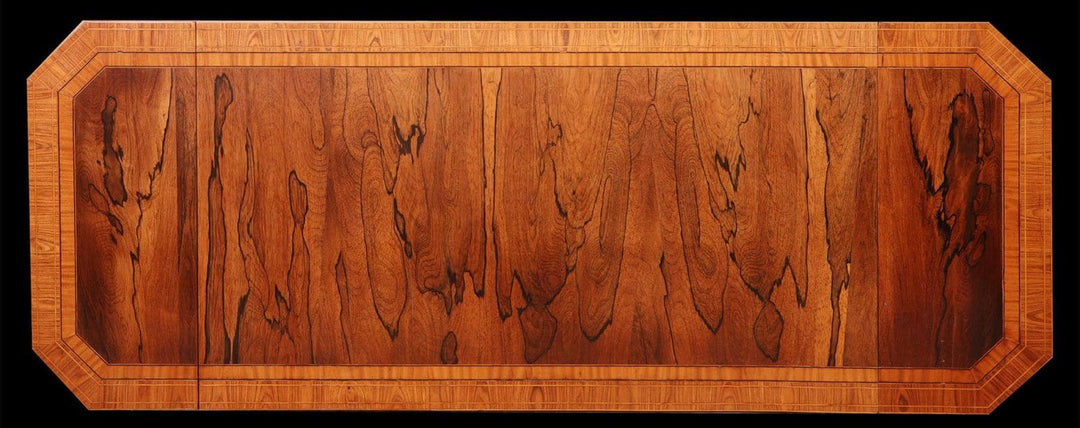
Masters of the craft utilised decorative veneers to create visual depth and narrative within a single piece. Flame mahogany, cut from the crotch of the tree, provides a dramatic, flickering effect, while 'plum pudding' mottle offers a rich, speckled texture. These veneers were often framed by cross-banding in kingwood or tulipwood, creating a sophisticated border that highlighted the cabinet's geometry. Nicholas Wells Antiques prioritises pieces that retain their original surface patina, as this conservation of history is vital for maintaining the object's soul and investment value.
The Craft of Marquetry and Parquetry
Georgian craftsmen achieved extraordinary detail through marquetry, using contrasting woods to create intricate floral and geometric patterns. These techniques often mirrored French influence, particularly in the production of fine Cabinet Furniture. Identifying fine line boxwood stringing and ebony inlays is essential for any serious collector. These subtle markers often distinguish a piece from a superior London workshop, such as those of Ince and Mayhew or John Linnell, from more provincial examples. The precision of the joinery and the complexity of the parquetry patterns serve as a testament to the artisan's skill.
Giltwood and Ormolu Embellishments
Prestige was frequently signaled through the application of ormolu (gilt bronze) mounts. These features weren't merely decorative; they protected vulnerable corners and highlighted the architectural silhouette of George III side cabinets. Original 18th-century mercury gilding possesses a soft, buttery lustre that later Victorian interventions fail to replicate. Such magnificent pieces are frequently paired with Antique Mirrors to create a cohesive interior narrative that reflects the grandeur of the 1780s. Each mount should be inspected for its casting quality and the presence of original gilding.
If you wish to view our current acquisitions and experience the superb quality of these materials first-hand, our showroom is available to visit by appointment at 45 Albemarle Street, Mayfair. We offer expert guidance on antique furniture restoration and provide secure international shipping for our global clientele.
Navigating Georgian Design: From Chippendale Grandeur to Sheraton Refinement
The evolution of George III side cabinets tracks a sophisticated journey from mid-century ornate carving to the disciplined restraint of the early 19th century. This progression reflects the changing tastes of the British elite across a transformative sixty-year reign. Early designs were governed by Thomas Chippendale’s 1754 publication, The Gentleman and Cabinet-Maker’s Director. These pieces often featured the rich, dense mahogany and intricate Rococo or Gothic motifs that defined the mid-18th century. However, as the 1760s progressed, the Neoclassical revolution led by Robert Adam brought a rigorous architectural order to the English interior. Adam treated furniture as an integral component of a room's structural harmony, replacing exuberant curves with geometric precision and classical motifs such as urns, husks, and paterae.
By the 1780s, the heavy architectural style of Adam softened into the more accessible "city style" championed by George Hepplewhite. This era focused on a sense of lightness and understated luxury that remains highly sought after by modern collectors. Nicholas Wells Antiques specialises in identifying pieces from this period that retain their original surface patina, as the conservation of history is central to our curatorial philosophy. Every cabinet we acquire is treated as a significant cultural artifact rather than mere inventory.
The Hepplewhite Influence: Shield Backs and Tapered Forms
Hepplewhite’s 1788 Cabinet-Maker and Upholsterer’s Guide popularised a refined elegance that avoided excessive ornamentation. Characteristics of these side cabinets include slender, tapered legs ending in spade feet and the use of vibrant satinwood veneers. The late 18th century also saw a rise in painted furniture, with delicate floral swags and polychrome motifs becoming fashionable. This aesthetic of grace and verticality is mirrored in the Antique Armchairs of the same period, which shared the iconic shield-back forms and delicate proportions. These pieces were designed to sit harmoniously within a unified interior scheme, often placed against walls to maintain the room's formal symmetry.
Sheraton and the Regency Transition
Thomas Sheraton’s 1791 Drawing-Book introduced the final major stylistic shift of the period. His designs favoured rectilinear forms and sophisticated mechanical elements, such as hidden compartments and complex rising tops. As the 18th century drew to a close, the choice of materials shifted toward darker, more exotic timbers like rosewood and calamander. These George III side cabinets began to exhibit more robust, masculine proportions and the frequent use of brass inlay, prefiguring the opulence of the Regency era. The craftsmanship of this period is extraordinary, often incorporating fine stringing and high-quality ormolu mounts that signal a peak in British cabinet-making.
For those seeking to acquire these superb examples of heritage, Nicholas Wells Antiques offers expert guidance and international shipping. Our collection can be viewed by appointment at our office at 45 Albemarle Street, Mayfair. We don't operate a walk-in gallery at 169 Piccadilly, so we invite you to contact us directly to arrange a private viewing of our latest acquisitions. Each piece in our care is selected for its rarity, provenance, and the enduring quality of its craftsmanship.
The Connoisseur’s Checklist: Evaluating Patina, Construction, and Provenance
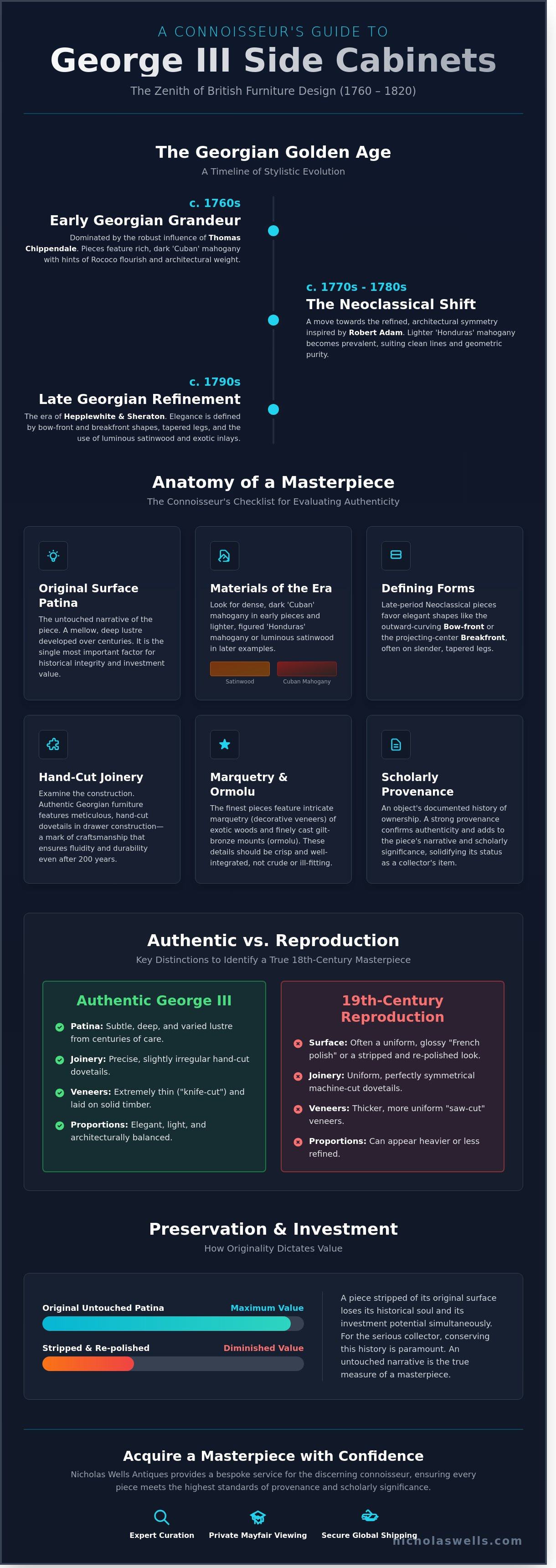
Acquiring George III side cabinets involves more than a simple transaction; it's the stewardship of a historical narrative. A seasoned collector first examines the "skin" of the timber. This surface patina, a complex accumulation of 250 years of oxidation, light exposure, and beeswax, represents the soul of the object. An untouched, original finish is the most valuable attribute a piece can possess. When a cabinet is stripped and aggressively repolished, it loses the irreplaceable depth of character that defines an 18th-century masterpiece.
Construction details provide the most reliable evidence of authenticity. One should scrutinise the secondary timbers, typically slow-grown English oak or Scots pine, used for drawer linings and backboards. Hand-cut dovetails from the 1770s or 1790s will show slight irregularities and fine, thin necks. These contrast sharply with the uniform precision of machine-cut Victorian alternatives. Original locks, often stamped by prestigious makers like Bramah, who patented their design in 1784, should ideally remain in situ.
Provenance elevates a piece from a functional object to a significant cultural artifact. A documented lineage from a notable country house can increase the investment value by 35 per cent or more. It's equally vital to identify "married" pieces, where a top and base did not start life together. Collectors should look for discrepancies in the mahogany grain or "shadows" on the carcass where a different superstructure may have once rested. Disjointed wear patterns between the upper and lower sections are a frequent telltale sign of such alterations.
The Conservation of History
The Nicholas Wells Antiques philosophy prioritises the preservation of history over the pursuit of a "new" appearance. Restoration must be a silent partner to the original craftsman. Over-restored pieces, which look suspiciously pristine, often suffer a significant loss in market value. We advocate for complimentary restoration that secures structural integrity while honouring the existing wear. This approach ensures the longevity of our Antique Furniture without erasing its journey through time.
Evaluating Hardware and Mounts
Examine the brassware for "shadows" or ghosting. These marks indicate if the current handles match the original footprint. Later replacements often leave telltale extra holes on the interior of the drawer fronts. In glazed George III side cabinets, authentic 18th-century glass is recognisable by its slight ripples and occasional "seeds" or air bubbles. These imperfections are the hallmarks of hand-blown cylinder glass, a feature that modern float glass cannot replicate. Specialized interior fittings, such as original lead linings for cellarettes, also serve as markers of a piece that has escaped modern interference.
To view our current collection of exceptional 18th-century masterworks by appointment, please browse our cabinet furniture collection.
Acquiring a Masterpiece: Investing in George III Furniture with Nicholas Wells Antiques
Acquiring George III side cabinets represents a commitment to preserving the pinnacle of 18th-century British cabinet-making. These pieces serve as versatile anchors in a curated home, bridging the gap between historical grandeur and the functional requirements of a modern residence. Selecting the right cabinet involves a deep appreciation for the timber's character, the precision of the joinery, and the piece's ability to command a room without overwhelming it. Whether positioned as a focal point in a grand entrance hall or used to flank a pair of Antique Centre Tables, these cabinets offer a sense of permanence and architectural weight.
Styling Georgian Cabinets in Modern Spaces
The dark, rich honey tones of period mahogany provide a superb canvas for contemporary curation. Designers often pair the structured geometry of a George III cabinet with the bold lines of modern abstract art or the intricate textures of Grand Tour Objects. Placing a collection of bronze obelisks or classical marble fragments atop a figured mahogany surface creates a sophisticated dialogue between different eras of connoisseurship. To highlight the exceptional surface patina of George III side cabinets, we recommend using directional, warm-toned lighting. This accentuates the depth of the grain and the soft glow of centuries-old wax polishing. Beyond their traditional roles, these cabinets excel as sophisticated drinks stations or bespoke bars, hiding modern utility behind a façade of historical elegance.
The Nicholas Wells Service
Nicholas Wells Antiques operates with a philosophy of total transparency and scholarly dedication. We understand that acquiring a significant cultural artifact requires trust and logistical precision. Every piece in our collection undergoes a rigorous vetting process to ensure its authenticity and condition meet the highest standards of the global market. Our service includes:
- Expert Restoration: Every acquisition includes complimentary conservation work, performed by master craftsmen who prioritise the preservation of original surface patina.
- International Logistics: We provide fully insured, white-glove worldwide shipping, ensuring your investment arrives in pristine condition, regardless of your location.
- Private Consultations: While we maintain a mailbox address at 45 Albemarle Street in Mayfair, our primary antiques showroom is situated in Westminster. To ensure an exclusive and immersive experience, viewings are available strictly by appointment.
Beginning your collection starts with a conversation. We invite you to contact Nicholas Wells Antiques to request a curated selection of pieces tailored to your specific interior requirements. Our role is to act as a trusted advisor, helping you find a unique object that resonates with your personal aesthetic and the architectural soul of your home.
Investing in a Legacy of Georgian Craftsmanship
Acquiring a piece of late 18th-century history requires a discerning eye for the nuanced evolution of design, from the robust mahogany forms of the 1760s to the delicate marquetry of the 1790s. We've explored how the preservation of original surface patina and a rigorous evaluation of construction are vital for any serious collector. These George III side cabinets aren't merely functional furniture; they're enduring cultural artifacts that bridge the gap between historical grandeur and contemporary refinement. Since 2012, Nicholas Wells Antiques has curated a collection that prioritises the conservation of history and exceptional provenance. Every acquisition includes professional antique restoration to ensure your investment remains in superb condition. We provide fully insured worldwide shipping to protect these rare treasures during transit. While our administrative presence is at 45 Albemarle Street, Mayfair, we invite you to view our inventory by appointment to experience the extraordinary quality of our pieces firsthand. It's an opportunity to secure a masterpiece that'll define your interior for generations.
Explore our curated collection of George III side cabinets and cabinet furniture
Frequently Asked Questions
What defines a George III side cabinet compared to a sideboard?
A George III side cabinet is distinguished from a sideboard by its enclosed storage and typically more compact, versatile proportions. While sideboards, popularized by Robert Adam around 1760, often feature an open central section for cellarettes, side cabinets possess full-length doors that conceal internal shelving or drawers. These pieces served as sophisticated storage for precious porcelain or linens in 18th-century dining rooms, usually maintaining a height of 90 centimetres to align with the architectural chair rail.
Why is mahogany the most common wood for George III furniture?
Mahogany became the dominant timber following the Naval Stores Act of 1721, which abolished high import duties on timber from British colonies. This dense, stable wood allowed craftsmen like Thomas Chippendale to execute the intricate, crisp carvings that define the era. Its rich grain and ability to take a high-lustre polish made it the preferred choice for the 18th century's most prestigious commissions, replacing the earlier preference for walnut.
How can I tell if a George III cabinet has its original finish?
Discerning an original finish requires a close examination of the surface patina, which should exhibit a soft, translucent "skin" built up over 200 years of wax and oxidation. You'll observe a depth of colour and a gentle accumulation of dust in the crevices of the carvings that modern sprays can't replicate. At Nicholas Wells Antiques, we prioritise the conservation of history, ensuring that the authentic surface remains undisturbed by aggressive over-restoration.
Is it safe to ship high-value antique cabinets internationally?
International shipping is entirely secure when managed by specialist white-glove couriers who understand the structural nuances of Georgian joinery. Every piece is encased in custom-built, ISPM-15 compliant wooden crates to protect against humidity shifts and physical impact during transit. We coordinate global logistics from our Mayfair base, ensuring that your acquisition arrives in the same magnificent condition it left our showroom, with all insurance and customs documentation handled professionally.
What should I look for in the drawer construction of a Georgian piece?
Authentic Georgian construction is evidenced by hand-cut dovetail joints that are remarkably thin and precise, often referred to as "London-quality" work. The drawer linings should ideally be made of secondary woods like oak or pine, featuring a grain that runs from side to side rather than front to back. Look for "drawer slips," which are small strips of wood glued to the drawer sides to support the bottom, a technique refined in the late 1700s.
Can George III side cabinets be used in a contemporary home?
George III side cabinets serve as extraordinary focal points in contemporary interiors, providing a sense of historical soul that balances modern minimalism. Their architectural symmetry and the warm glow of aged mahogany complement neutral palettes and sleek textures perfectly. By integrating a piece from the 1700s, you create a sophisticated dialogue between heritage and the aesthetic demands of present-day luxury living, ensuring the room feels curated rather than merely decorated.
How does provenance affect the value of a George III cabinet?
Provenance acts as a documented pedigree that can increase the value of a cabinet by 30 to 50 percent depending on the prestige of the previous owners. A clear line of descent from a notable English country house or a documented commission in the 1775 Ledger of a firm like Gillows of Lancaster adds immense historical weight. It transforms the object from a mere furniture item into a significant cultural artifact with a verifiable journey through time.
Does Nicholas Wells Antiques offer restoration services for items not purchased from them?
Our expert antique restoration is included exclusively for pieces within our curated collection to ensure our high standards of conservation are maintained. While we don't accept external commissions, we invite clients to view our superbly restored inventory at our showroom by appointment. Please note that while our mailbox is at 45 Albemarle Street, Mayfair, there's no walk-in gallery at 169 Piccadilly; we coordinate all viewings privately to offer a bespoke advisory service.

Leave a comment