



Georgian Tea Caddies for Sale: A Connoisseur’s Guide to 18th-Century Elegance
The Social Significance of Georgian Tea Caddies
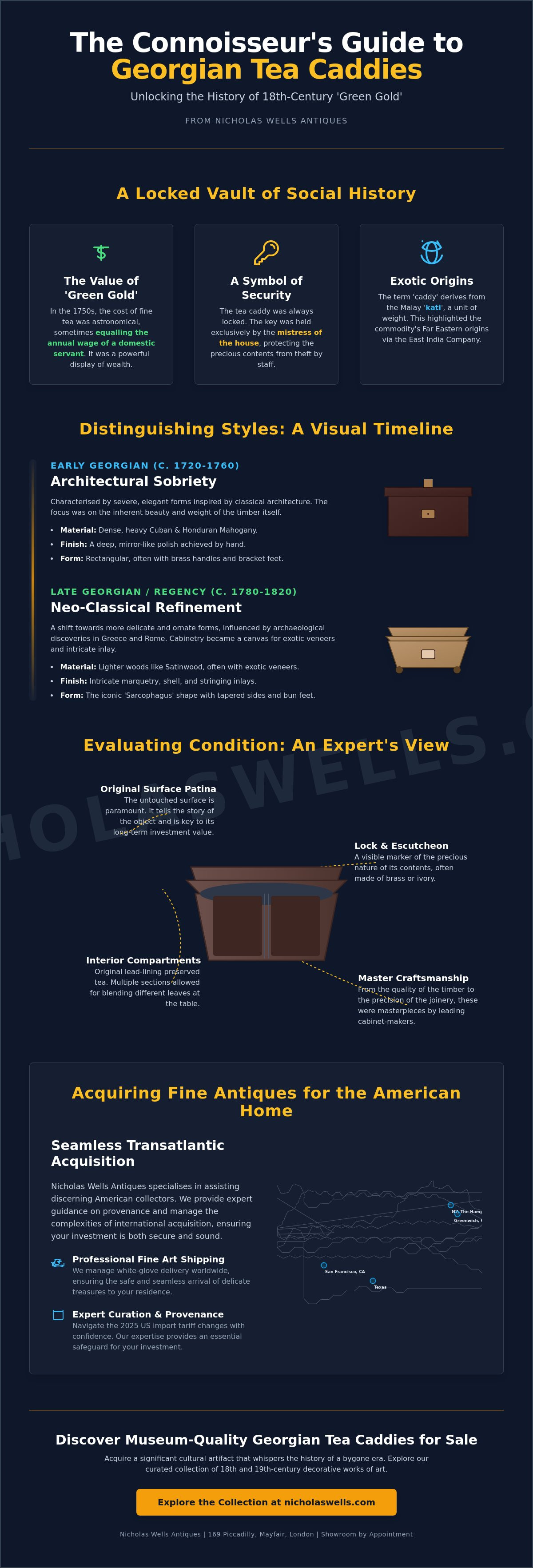
In the 18th century, a Georgian tea caddy was far more than a simple storage box; it was a meticulously crafted vessel designed to protect one of the era’s most precious commodities: tea. Regarded as ‘green gold’, tea was an expensive import, and its safekeeping was a matter of household security and social standing. The very name ‘caddy’ signals its exotic origins, derived from the Malay word ‘kati’, a unit of weight equivalent to about a pound and a third. This etymology was a constant reminder of the global trade networks and immense expense required to bring tea to the drawing rooms of Georgian town and country houses.
- The tea caddy was an essential component of the highly stylised social ritual of tea drinking, often presided over by the lady of the house.
- Its presence signified wealth, sophistication, and a connection to the burgeoning global economy.
- Crucially, nearly every fine Georgian tea caddy was fitted with a lock and key. This was not merely decorative; it was a high-security measure to prevent theft by household staff, making the caddy a potent status symbol of trust and control.
Tea as an 18th-Century Luxury Commodity
To understand the importance of the tea caddy, one must first appreciate the staggering cost of tea in the Georgian era. Around 1750, a pound of tea could cost more than a skilled craftsman’s weekly wage, placing it firmly in the realm of the aristocracy and the rising merchant class. Consequently, the design and material of a tea caddy were direct reflections of its owner’s wealth. An ornate caddy, crafted from rare woods and adorned with intricate inlays, was a public declaration of one's ability to afford not only the tea within but also the exquisite artistry required to house it.
The Evolution of the Caddy Form
The earliest forms of tea storage in Europe were often silver or ceramic canisters, reflecting the material’s ability to keep the delicate leaves dry. However, as the 18th century progressed, the unparalleled skill of English cabinet-makers gave rise to the fine wooden boxes that are now synonymous with the period. These were not just containers but miniature pieces of furniture. It is important to distinguish between the two primary forms: a tea caddy is a small, portable box designed to hold tea, whereas a tea chest is a larger piece of furniture, often on a stand, containing a set of smaller, matching caddies.
Distinguishing Styles: From Mahogany to Sarcophagus Forms
The quintessential Georgian tea caddy is often realised in rich, dense mahogany. Cabinet-makers of the period prioritised Cuban and Honduran mahogany for its deep, stable colour and ability to take a fine polish, which developed a unique surface patina over centuries. As tastes shifted towards the end of the 18th century and into the early 19th, the 'Sarcophagus' form became a hallmark of Regency elegance, its sloped sides and classical form echoing the era's fascination with Neo-classical taste.
- The finest caddies were often embellished with exotic inlays, utilising veneers of satinwood, tulipwood, and kingwood to create stunning patterns.
- Rare and exceptionally luxurious examples might feature panels of tortoiseshell or delicate stringing of ivory, materials that were themselves immensely valuable.
- Internally, caddies were often divided into compartments. Single caddies held one type of tea, while double-sectioned caddies allowed for the storage of both green and black teas. Triple-sectioned caddies typically featured two compartments for tea flanking a central, removable glass sugar bowl.
The Golden Age of English Cabinet Making
The aesthetic of the Georgian tea caddy was profoundly influenced by the great designers of the era, such as Thomas Chippendale and George Hepplewhite. Their published design books disseminated ideas of proportion, form, and ornamentation that were expertly scaled down by specialised box-makers. These caddies are miniature masterpieces of the cabinet-maker’s art, showcasing the same principles of design and quality found in the grandest pieces of antique furniture.
Inlay and Marquetry Techniques
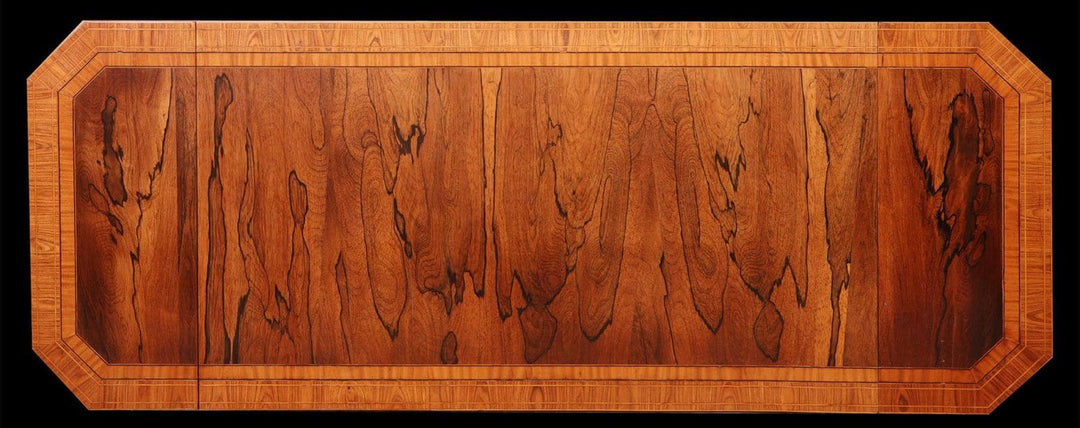
A key indicator of an authentic 18th-century tea caddy is the quality of its inlay and the character of its surface. The 'surface patina' of Georgian satinwood, for instance, possesses a deep, mellow glow that cannot be replicated by modern finishing techniques. Connoisseurs look for traditional marquetry patterns, such as delicate 'shell' and 'flower' motifs, which were particularly popular in the 1780s. The precision, choice of woods, and slight, charming irregularities of hand-cut veneers distinguish period originals from later reproductions.
Evaluating Condition: Surface Patina and Restoration
At Nicholas Wells Antiques, our philosophy is rooted in prioritising the conservation of history. We believe that the unique surface of an antique tells the story of its journey through time. This is why an original 'surface patina', with its accumulated layers of wax, dust, and use, adds so significantly to the character and investment value of a piece, a quality highly prized by discerning American collectors. A common pitfall in the market is the over-polishing of antiques, which can strip away centuries of history and diminish both the beauty and value of an object.
- While we celebrate preservation, we also recognise the role of professional antique restoration in ensuring structural integrity.
- Our approach is one of sympathetic conservation, undertaking necessary repairs to a standard that preserves the caddy for future generations without erasing its past.
What Collectors Should Look For
When evaluating a Georgian tea caddy, a collector should inspect several key elements. The presence of original, thin-gauge lead linings, used to keep the tea fresh, is a very good sign. Original bone or ivory keyhole escutcheons are another detail to look for. Furthermore, the originality of the hinges and lock mechanism is paramount to the caddy’s valuation. These small metal components often show signs of hand-finishing and period-appropriate wear that are difficult to fake convincingly.
The Connoisseur’s Approach to Conservation
A seasoned connoisseur learns to distinguish between 'damage' and 'honest wear'. A minor shrinkage crack, a few small dents, or the gentle rubbing to a corner are not faults; they are integral parts of the object's narrative. This approach allows one to appreciate the piece as a historical artifact, not merely a decorative box. Our curated collection of Boxes, Caddies, and Caskets is selected with this discerning eye, prioritising pieces with exceptional colour, patina, and integrity.
Acquiring Fine Antiques for the American Home
From our base in London, Nicholas Wells Antiques offers a curated perspective on English and Continental decorative arts, making it accessible to collectors and interior designers across the globe. We have extensive experience in catering to the sophisticated tastes of the US market, from bespoke curation for fine homes in Greenwich, Connecticut, and the Hamptons to sourcing specific pieces for clients in Texas and California. Our online gallery provides a seamless bridge to the finest European antiques, selected with a specialist’s eye.
Seamless International Shipping and Insurance
We understand the concerns of acquiring delicate antiques from overseas. To address this, we work exclusively with professional fine art shippers who are specialists in handling fragile 18th-century objects. They employ museum-standard packing techniques to protect delicate veneers and intricate inlays during transit. We provide the assurance of fully insured, door-to-door delivery to major US hubs, including New York and San Francisco, ensuring your acquisition arrives safely and without complication.
Integrating Caddies into Modern Interiors
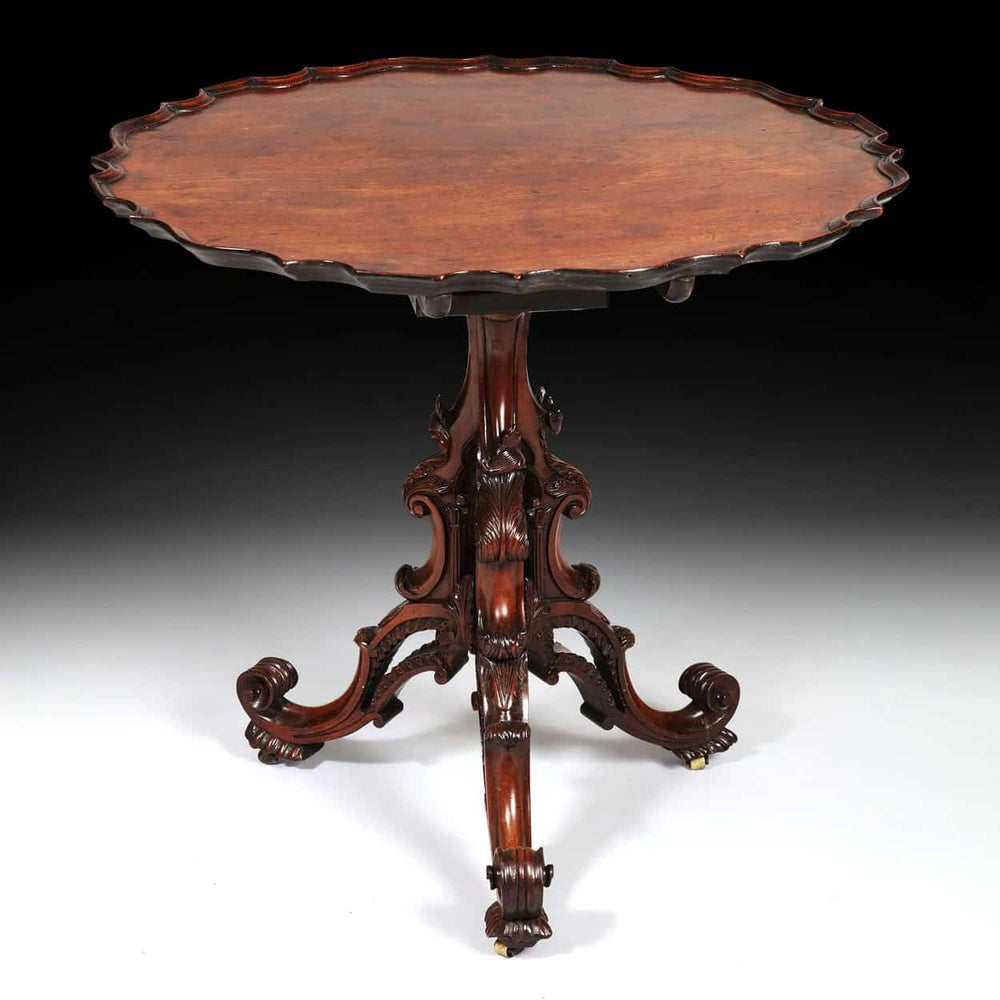
A Georgian tea caddy is a remarkably versatile object that can introduce a note of historical elegance into the most contemporary of interiors. Placed as a focal point on an antique Centre Table, it becomes a conversation piece, its rich wood and intricate detail providing a beautiful contrast to modern materials. Similarly, pairing small-scale antiques like caddies with grander pieces, such as 19th-century Antique Mirrors, creates a layered and sophisticated interior that feels collected over time.


Leave a comment