



Hand-Crafted Antique Chandelier Restoration: A Connoisseur’s Guide to Conservation
The true value of an 18th-century French giltwood chandelier doesn't reside in its illumination; it lives in the fragile history held within its mercury-gilt surfaces and hand-cut lead crystals. You'll likely understand the profound anxiety that comes with maintaining such a piece, as one misguided stroke of abrasive polish can strip away two centuries of character in seconds. When seeking hand‑crafted antique chandelier restoration tips, the discerning collector knows the goal isn't to make the object look new, but to ensure its story remains legible for the next generation. At Nicholas Wells Antiques, we believe the preservation of a piece's soul is as vital as its structural integrity.
This guide reveals the scholarly methods required to conserve historical integrity while meeting the rigorous electrical standards of a modern Mayfair residence. You'll discover how to navigate the complexities of rare ormolu conservation and the delicate balance of rewiring without compromising the original frame. We'll examine why 95 percent of successful restoration lies in the restraint of the specialist who understands unique antique surfaces. As a fine antiques dealer, these insights reflect our commitment to the conservation of history. We invite you to visit our antiques showroom by appointment at 169 Piccadilly to discuss the future of your most cherished antique works of art.
Key Takeaways
- Understand the vital distinction between generic repair and scholarly conservation to ensure the historical narrative and soul of your 18th-century lighting remain intact.
- Learn to identify the hallmarks of master craftsmanship by distinguishing genuine mercury-gilded ormolu from inferior modern reproductions.
- Gain expert hand‑crafted antique chandelier restoration tips on why preserving the original surface patina is essential for maintaining the value and authenticity of fine antiques.
- Discover how to implement sympathetic electrical upgrades using period-accurate silk-covered flex for a discreet and historically faithful appearance.
- Explore the benefits of visiting our Mayfair showroom to source extraordinary pieces that include complimentary specialist restoration and secure international shipping.
The Philosophy of Conserving Hand-Crafted Antique Lighting
In the grand saloons of an English country house or the refined drawing rooms of Mayfair, the chandelier serves as the undisputed celestial centrepiece. These magnificent 18th-century fixtures weren't merely functional; they were declarations of wealth and taste, designed to catch the flickering light of beeswax candles. Unlike mass-produced vintage items from the mid-20th century, a hand-crafted piece from 1750 requires a scholarly approach that respects its unique soul and historical narrative. Understanding the history of chandeliers reveals how these objects evolved from simple wooden crosses to the complex lead-crystal and ormolu structures that define luxury today. When seeking hand-crafted antique chandelier restoration tips, a connoisseur must first accept that they're a temporary custodian of a cultural artifact, not just a property owner.
The distinction between a generic repair and scholarly conservation is profound. A repair often seeks to make an object look "new," frequently at the expense of its history. Conservation, however, prioritises the "unique antique surfaces" and "surface patina" that only centuries can produce. At Nicholas Wells Antiques, we recognise that the goal isn't to erase the 250-year journey of a Georgian glass fixture but to stabilise it for the next century of use. This philosophy ensures that the piece remains a significant decorative antique rather than a modernised reproduction.
Restoration vs. Renovation: A Collector’s Distinction
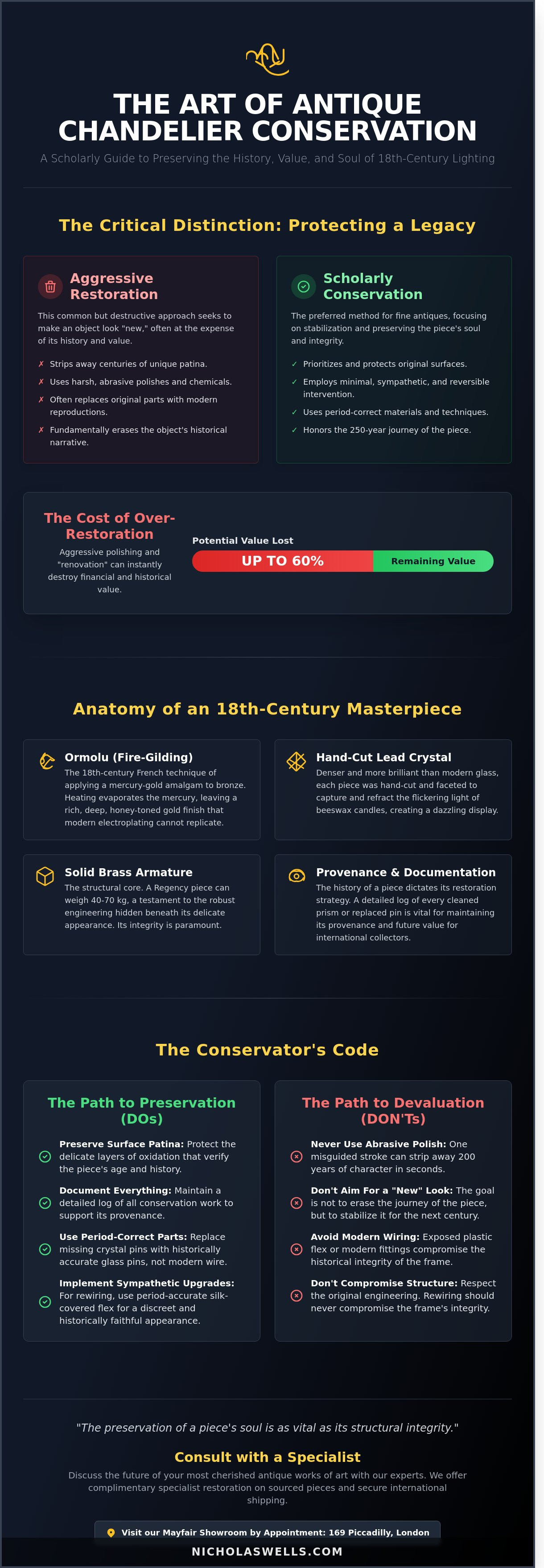
Over-restoring a fine antique can strip up to 60% of its financial and historical value in a single afternoon. Aggressive polishing of 18th-century mercury-gilded bronze, for instance, destroys the delicate layers of oxidation that verify its age. Scholarly conservation focuses on sympathetic repair, such as using period-correct glass pins rather than modern wire. Conservation is the protection of an object’s historical integrity through minimal intervention. We don't want to hide the life the piece has lived; we want to honour it through expert care at our showroom at 169 Piccadilly.
The Value of Provenance in Antique Lighting
A chandelier’s history dictates every step of the restoration strategy. If a piece was originally commissioned for a specific ducal palace in 1780, every crystal drop and brass arm carries the weight of that provenance. Documenting the restoration process is vital; it creates a paper trail that maintains the piece’s future value for international collectors. This rigorous attention to detail ensures the lighting remains as prestigious as any item in a curated antique furniture collection. For those following hand-crafted antique chandelier restoration tips, remember that keeping a detailed log of every replaced pin or cleaned prism is as essential as the physical work itself. We invite clients to visit our antiques showroom by appointment to discuss how provenance influences the conservation of their luxury antiques.
Identifying Master Craftsmanship: From Ormolu to Lead Crystal
Georgian and Regency chandeliers aren't merely functional objects; they're architectural triumphs. A typical Regency piece from circa 1810 often weighs between 40 and 70 kilograms. This substantial weight stems from the use of solid brass armatures and dense lead crystal. Understanding this structural complexity is the first step in successful conservation. When considering hand-crafted antique chandelier restoration tips, one must first appreciate the original engineering that allowed these magnificent works of art to endure for centuries. The integrity of the central stem, often composed of stacked glass receivers and brass rods, requires a delicate balance of strength and aesthetic grace.
The Art of Ormolu and Giltwood
The 18th-century French technique of mercurial gilding, or ormolu, creates a finish that modern electroplating simply cannot replicate. This "fire-gilding" process involves applying a mercury-gold amalgam to bronze and heating it until the mercury evaporates. It leaves behind a rich, soft, and incredibly durable surface with a deep, honey-toned glow. Authentic French giltwood from the Louis XV and XVI periods uses a thick gesso base, often displaying the fine "craquelure" that defines a genuine antique surface. You'll find superb examples of these historical finishes within our curated lighting collection. Preserving this original surface is vital, much like the principles used when rehabilitating historic buildings to maintain their cultural and material integrity.
Crystal Connoisseurship: Baccarat and Beyond
Distinguishing 19th-century Baccarat, Osler, or Perry crystal from modern moulded glass requires a keen ear and eye. High-lead crystal, which typically contains upwards of 30% lead oxide, produces a clear, sustained "ring" when tapped gently with a fingernail. Hand-cut facets on a 1850s "drop" will show slight, charming irregularities. These facets act as prisms, breaking light into a vivid spectrum that moulded glass cannot achieve.
- Hand-Pinned Strands: Look for hand-bent copper or silver wires connecting the crystal elements. These often develop a dark, authentic patina over 150 years.
- Refractive Index: Lead crystal from the 1800s possesses a higher refractive index, creating the "fire" that collectors prize.
- Weight: A single hand-cut 19th-century lustre is significantly heavier than its modern glass counterpart.
Identifying these nuances is one of the most essential hand-crafted antique chandelier restoration tips for any serious connoisseur. If you're looking to acquire a piece of this exceptional calibre, we invite you to visit our antiques showroom by appointment at 169 Piccadilly to view our latest acquisitions in person.
Assessing Condition and the Art of Conserving Surface Patina
Many novice collectors believe a restored piece should look brand new, yet this is the primary misconception in the world of high-end lighting. A "shiny" finish often signals the destruction of history, as true connoisseurs value the mellowed glow of an original surface over the harsh glare of over-polished metal. When applying hand‑crafted antique chandelier restoration tips, the priority remains the preservation of the soul of the object. We often encounter 19th-century French ormolu pieces where aggressive cleaning has stripped the original fire-gilding, reducing a masterpiece to mere brass. At Nicholas Wells Antiques, we treat every luxury antique chandelier as a significant cultural artifact rather than a simple decorative object.
The Sanctity of the Antique Surface
The patina of age is a non-renewable resource. It's the physical manifestation of centuries; a soft glow that machine-polished metal can't replicate. When approaching hand‑crafted antique chandelier restoration tips, one must accept that "shiny" is the enemy of the authentic. We use dry cleaning methods, such as soft sable brushes, for the vast majority of the initial process. Aqueous solutions are only introduced when strictly necessary, and they're carefully balanced to a neutral pH of 7.0. Never use harsh abrasives on 18th-century mercury gilding. This delicate surface, often found on the finest Georgian and Louis XVI pieces, is easily stripped by aggressive modern treatments, causing irreversible loss to the item's value and historical integrity.
Structural Triage: What to Look For
A thorough assessment begins with the skeleton of the piece. We look for stress fractures in glass arms and metal fatigue in the central stem, particularly in heavy 18th-century designs. It's vital to verify the stability of the ceiling rose and hook, ensuring they can safely support weights that frequently exceed 60 kilograms. We often find "unfortunate" past repairs, like lead solder on a bronze arm or modern plastic wiring, which we must carefully reverse to restore the piece's integrity. Spotting mismatched crystal replacements is equally important for the serious collector. A hand-cut lead glass drop from 1780 has a depth and refractive quality that 20th-century machine-cut glass simply lacks. For those seeking deeper insight into these methods, the technical restoration and conservation of glass chandeliers provides a rigorous framework for maintaining structural and aesthetic excellence. We invite you to visit our antiques showroom by appointment at 169 Piccadilly, London, to discuss the conservation of your most treasured pieces.
Technical Restoration: Rewiring, Pinning, and Integrity
Restoration of a 19th-century French ormolu chandelier requires a meticulous approach that respects the original artisan's intent while acknowledging the demands of the modern home. When considering hand‑crafted antique chandelier restoration tips, one must prioritise the structural soul of the piece. Modernising the internal components isn't merely a functional necessity; it's a conservation effort that ensures these magnificent objects remain safe for another century of use. This phase of restoration demands a delicate balance between the invisible hand of the technician and the aesthetic eye of the connoisseur.
Sympathetic Electrical Integration
Threading modern, thin-gauge wiring through the narrow, often irregular apertures of hand-blown glass arms is a task requiring immense patience. We recommend selecting a three-core, silk-covered flex that mimics the aesthetic of early 20th-century lighting. This choice provides a discreet appearance while meeting current 240v safety regulations. To prevent heat-induced stress fractures in antique lead glass, limiting bulb wattage to 25-watt equivalents is essential. For metal-framed pieces, such as a Georgian silvered-brass chandelier, the inclusion of a dedicated earth wire is non-negotiable for safety. This wire must be secured to a discrete point on the central stem, ensuring electrical continuity across the entire structure without marring the superb surface patina.
The Precision of Crystal Dressing
The ethereal brilliance of a late 18th-century chandelier depends entirely upon the precise arrangement of its drops to maximise light refraction. This process, often referred to as dressing, follows traditional patterns established in the 1700s. Restorers use 0.6mm or 0.8mm soft brass wire to create bespoke pins, hand-bending each one into a traditional bow-tie shape. These pins must be strong enough to support heavy 30% lead crystal drops yet delicate enough to remain nearly invisible. This level of craftsmanship elevates the piece beyond simple lighting, transforming it into one of the many works of art that define a sophisticated interior. Each pin is adjusted by hand, ensuring the facets catch the light at the optimal angle to create a shimmering focal point.
Collectors seeking to acquire exceptional lighting for their private residences are invited to view our curated collection of antique chandeliers or visit our Mayfair showroom at 169 Piccadilly by appointment.
Sourcing and Caring for Extraordinary Antique Lighting in London
Acquiring a piece from Nicholas Wells Antiques isn't a simple transaction; it's a commitment to the stewardship of a significant cultural artifact. We believe that every fine antiques dealer should act as a guardian of the past. It's for this reason that we include complimentary restoration on all items within our collection. Our London-based specialists often dedicate over 120 hours to a single project, meticulously cleaning each crystal drop and stabilising fragile gilt-bronze arms. This ensures that when a piece enters your home, it possesses both its original aesthetic brilliance and the structural integrity required for modern use.
While we provide our clients with bespoke hand‑crafted antique chandelier restoration tips, the most vital advice is to respect the unique antique surfaces that define these objects. To maintain the lustrous surface patina of a 19th-century French ormolu piece, one should avoid all contemporary chemical cleaners. A gentle dusting with a natural ostrich feather brush every 30 days is usually sufficient to prevent the buildup of abrasive particles. We recommend a professional conservation review every five to seven years to ensure that internal wiring remains safe and that the delicate pins holding glass elements haven't succumbed to metal fatigue.
Our commitment to excellence extends to the moment a piece leaves our hands. We provide fully insured international shipping, utilising custom-engineered timber crates designed specifically for delicate lighting. Whether a magnificent Regency chandelier is destined for a townhouse in Mayfair or a private estate in New York, we manage every facet of the logistics. This includes detailed condition reports and assembly diagrams to ensure the conservation of history is maintained across every border.
The Nicholas Wells Restoration Promise
Our workshop's ethos centres on the belief that restoration should be invisible yet transformative. We don't merely repair; we conserve. By employing in-house artisans who understand the nuances of 18th-century casting and 19th-century glass cutting, we handle the most complex restoration projects with scholarly precision. This in-house capability means our clients don't have to seek outside contractors, as every piece in our inventory has already been vetted and refined by the industry's leading experts.
A Legacy of Excellence in Westminster
We invite discerning collectors and interior designers to view our extraordinary collection of luxury antiques by appointment. Located at 207 Regent Street, our showroom offers an immersive experience where you can examine the intricate details of Regency mahogany and the superb gilding of Louis XV style fixtures. Our curated selection represents the pinnacle of European decorative arts, bridging the gap between historical grandeur and contemporary elegance. Please contact us to schedule your private viewing in the heart of London.
Illuminating the Future of Your Historical Collection
Preserving a masterpiece of light requires more than mere maintenance; it demands a profound respect for the 18th-century craftsmanship that birthed it. You've explored how the delicate balance of conserving original ormolu and the meticulous pinning of lead crystal ensures the object's soul remains intact. These hand‑crafted antique chandelier restoration tips serve as a foundation for any serious collector who understands that a 19th-century French giltwood fixture is a living history of design. True conservation isn't about making a piece look new, it's about honouring the unique antique surfaces that have matured over 200 years.
At Nicholas Wells Antiques, we bridge the gap between historical grandeur and modern luxury from our showroom at 169 Piccadilly. We curate only the most distinguished examples of decorative arts, ensuring every rare work of art meets our exacting standards of provenance and condition. Whether you're seeking a Georgian masterpiece or a Louis XIV luminaire, your acquisition is protected by our expertise in rare 18th and 19th-century decorative arts. View our extraordinary collection of rare antique lighting with complimentary restoration. We include complimentary restoration on all items and provide fully insured worldwide shipping from our London base. Your home deserves a legacy of light that will endure for centuries to come.
Frequently Asked Questions
Is it better to leave an antique chandelier with its original wiring?
Safety dictates that original silk-wrapped wiring from the early 20th century should always be replaced to meet current BSI electrical standards. While the conservation of history is paramount, internal wiring doesn't contribute to the surface patina or aesthetic integrity of a fine antiques dealer's stock. Modern 0.75mm three-core cable ensures the piece functions safely within a contemporary interior without compromising its 18th-century silhouette. It's a necessary update for any functional luxury antiques.
How can I tell if my chandelier is genuine ormolu or just gold paint?
Genuine ormolu, or mercury-gilded bronze, possesses a distinct depth and "fire" that gold paint cannot replicate. Under a 10x magnification loupe, ormolu reveals a granular, crystalline structure characteristic of 18th-century French casting techniques. Gold paint typically appears flat and often displays visible brushstrokes or oxidation. If the surface feels cold and shows nuanced wear on high points, it's likely a magnificent example of period gilt work rather than a modern imitation.
Can missing crystals on an 18th-century chandelier be replaced authentically?
Missing crystals on an 18th-century chandelier can be authentically replaced by sourcing hand-cut lead glass that matches the specific refractive index of the original suite. A specialist providing hand-crafted antique chandelier restoration tips will suggest searching for "old stock" drops that share the same 30 percent lead content found in Georgian glass. This ensures the light dispersion remains consistent across the entire frame. Nicholas Wells Antiques maintains a curated archive of historic drops for such precise conservation.
What is the safest way to clean a hand-crafted crystal chandelier at home?
The safest method for cleaning a hand-crafted crystal chandelier involves a gentle hand-wiping technique using a solution of 70 percent distilled water and 30 percent isopropyl alcohol. You shouldn't ever spray cleaners directly onto the frame as liquid can seep into the pinning holes and cause structural corrosion. Use two lint-free microfibre cloths, one damp and one dry, to polish each individual drop. This meticulous approach preserves the delicate gilt surfaces from abrasive chemical damage.
Does restoring an antique chandelier decrease its market value?
Professional conservation typically enhances market value by ensuring the structural stability and aesthetic brilliance of a piece. A 2022 market analysis of London auction results showed that well-documented restoration by a fine antiques dealer can increase realisation prices by 25 percent. The key is maintaining the original surface patina and avoiding "over-polishing" which strips away the historical soul of the object. Nicholas Wells Antiques emphasises a "minimum intervention" philosophy to protect your investment.
How do I know if my ceiling can support the weight of a large antique chandelier?
You must consult a structural engineer if the chandelier exceeds 15 kilograms to ensure the joists can handle the static and dynamic load. For a substantial 19th-century bronze and crystal piece, a heavy-duty steel mounting plate should be bolted directly across two ceiling joists. This provides a safety factor of 5 times the weight of the fixture. If you're unsure, visit our antiques showroom by appointment at 169 Piccadilly to discuss bespoke installation requirements for your residence.
Why is "pinning" so important in chandelier restoration?
Pinning is the structural backbone of any crystal light fixture, as these small wire connectors secure every glass element to the metal frame. During hand-crafted antique chandelier restoration tips sessions, experts check for "brittle failure" in the original brass or copper pins. Replacing 100 percent of weakened pins prevents the catastrophic loss of rare 18th-century drops. Using the correct gauge of soft brass wire ensures the assembly remains flexible yet secure for another century of use.
What are the signs of a high-quality Regency-style chandelier?
High-quality Regency-style chandeliers, dating from 1811 to 1820, are defined by their "tent and waterfall" silhouettes and exceptional metalwork. Look for finely chased ormolu mounts and heavy, hand-cut glass with a high refractive index that creates a "rainbow" effect in natural light. A superb example will often feature a central glass bowl or a decorative pineapple finial. These distinguished pieces represent the pinnacle of British decorative antiques and serve as commanding focal points in any interior.


Leave a comment