



How to Buy Antique Giltwood Wall Lights Without Costly Mistakes
Antique giltwood wall lights are not merely fixtures; they are sculptural masterpieces that define the architectural rhythm and historical character of a room. As the pinnacle of 18th and 19th-century decorative arts, these objects were conceived to harness and amplify the flickering dance of candlelight, transforming grand interiors into luminous theatres of light and shadow. Today, for discerning interior decorators and collectors, they remain the undisputed jewellery of the room—a testament to a period when light itself was a luxury.
This guide offers a connoisseur’s perspective on acquiring these exceptional pieces, navigating the nuances of period styles, authentication, and international acquisition to help you make an informed investment without costly mistakes.
The Luminescent Appeal of Antique Giltwood Wall Lights
In the grand ballrooms and intimate salons of the 18th century, the primary function of a giltwood wall light, or sconce, was to maximise the ambient glow of precious candlelight. Carved from wood and meticulously gilded with fine gold leaf, their surfaces were designed to capture and refract every flicker, casting a warm, dynamic lustre across a room. This historical purpose is what separates them from other forms of lighting; they were not just sources of light but instruments for its manipulation.
It is crucial to distinguish giltwood from ormolu, a term often confused by buyers, particularly in the US market. Giltwood refers to intricately carved wood to which gold leaf has been applied. Ormolu, by contrast, is the application of gold to a bronze or brass base. While both are luxurious, giltwood allowed for a sculptural depth and expressive freedom in carving that was unparalleled, making it the preferred medium for the most ambitious designs of the era.
The Alchemy of Gold Leaf and Light
The magic of a period giltwood wall light lies in the alchemy between its surface and its function. Craftsmen typically used 22-carat gold leaf, whose high purity produced a soft, buttery colour and exceptional reflective properties. When illuminated, the gold does not create a harsh glare but rather a diffuse, warm radiance that is profoundly flattering to both interiors and their occupants. The sculptural depth of the carving—be it a scrolling acanthus leaf, a delicate floral garland, or a powerful eagle's head—creates a dramatic play of highlights and deep shadows, an effect that comes alive in the evening light.
A Focal Point for the English Town and Country House
Historically, giltwood wall lights were rarely used in isolation. They were integral components of a carefully orchestrated decorative programme, often designed to be paired with magnificent antique mirrors. A pair of sconces flanking a chimney piece, for example, would have its candlelight reflected and multiplied in the mirror plate, a technique that dramatically enhanced the sense of space and light. As our own Connoisseur’s Guide to Antique Mirrors explains, this synergy was central to 18th-century interior design. The original candle nozzles, or sconces, have since been sensitively converted for modern electrical use, allowing these historical treasures to integrate seamlessly into contemporary living while retaining their original aesthetic intent.
Distinguishing Period Styles: From Rococo Splendour to Neoclassical Restraint
A collector’s journey begins with the ability to recognise the distinct vocabularies of historical design periods. Each style tells a story of the cultural and aesthetic priorities of its time, from the unrestrained exuberance of the Rococo to the intellectual rigour of Neoclassicism.
- Rococo (c. 1730-1760): Characterised by asymmetry, naturalistic motifs, and the C-scroll, Rococo giltwood is fluid and dynamic. French Louis XV examples are the epitome of elegance, while Italian pieces often display a more flamboyant and theatrical spirit.
- Neoclassicism (c. 1760-1800): A reaction against Rococo excess, this movement drew inspiration from the archaeological discoveries at Pompeii and Herculaneum. Designs became symmetrical, architectural, and restrained, incorporating classical motifs like urns, swags, and husks. This is the era of French Louis XVI and English Georgian design, championed by architects like Robert Adam.
- Swedish Gustavian (c. 1770-1810): A unique Scandinavian interpretation of French Neoclassicism, Gustavian giltwood is known for its cool, elegant palette and refined carving, often finished with a distinctive combination of gilding and painted surfaces.
- Regency and Empire (c. 1800-1830): This period introduced a bolder, more masculine aesthetic. Motifs became stronger and more symbolic, drawing from Roman, Greek, and Egyptian sources. Eagles, lions, sphinxes, and military trophies were common, reflecting an age of imperial ambition.
French vs. Italian Giltwood: A Study in Craft
While often grouped under the "Rococo" umbrella, French and Italian giltwood from the 18th century possess distinct national characters. Parisian carvers were renowned for their extraordinary precision and refinement. Their work often features impossibly fine gesso work—the preparatory layer of plaster and glue applied before gilding—allowing for crisp, detailed carving. Italian carving, particularly from Venetian and Florentine workshops, tends to be bolder and more theatrical. The forms are often more deeply carved and expressive, conveying a sense of dramatic movement and passion that is unmistakably Italian.
The English Tradition: Chippendale and Adams Influence
In England, the design of giltwood wall lights was heavily influenced by the nation’s leading cabinet-makers and architects. The work of Thomas Chippendale incorporated Rococo, Chinese, and Gothic motifs, often featuring exquisite naturalistic carving of acanthus leaves and floral elements. Later, the Neoclassical revolution led by Robert Adam introduced a more architectural style, with wall lights designed as part of a unified interior scheme. Motifs such as classical urns, paterae, and pendant husks became hallmarks of the period, designed to complement the wider antique furniture collection and architectural elements of a room.
Dealer’s Secrets: Authenticating Surface, Patina, and Provenance
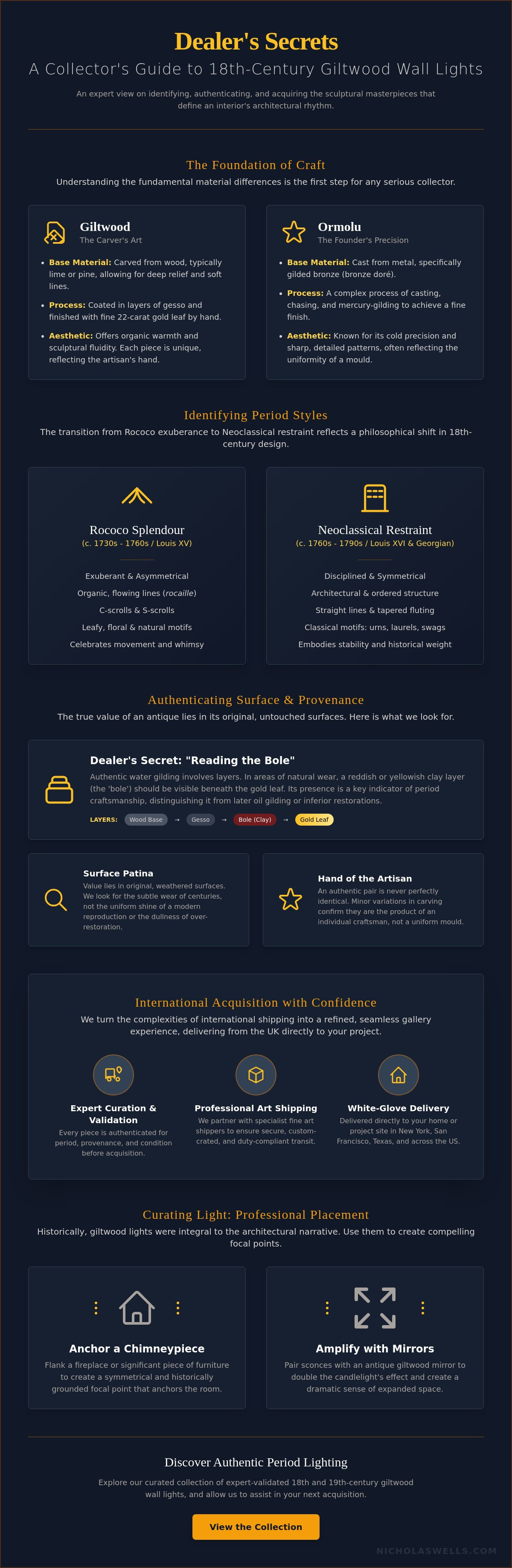
Distinguishing a true 18th-century piece from a later copy or an over-restored item requires a trained eye. The most telling evidence is found not in the overall design but in the subtleties of the surface, the construction, and the signs of honest wear accumulated over centuries.
One of the key "Dealer's Secrets" lies in identifying the type of gilding. Water gilding, the superior and more costly method, involves applying gold leaf over a layer of gesso and bole (a fine clay mixture). This surface can be burnished with an agate stone to a brilliant, mirror-like shine. Oil gilding uses an oil-based adhesive and results in a more matte, uniform finish that cannot be burnished. True period pieces of high quality are almost always water gilded.
The colour of the bole itself is a clue to origin. Red bole was most common in England and France, while Italian and Spanish craftsmen often used a yellow or grey bole. Seeing this underlying clay colour peeking through worn areas of gold is a positive sign of age and authenticity.
Look for honest signs of age, such as fine shrinkage cracks in the wood grain beneath the gesso, or a slight softening of the sharpest details from decades of gentle dusting. A piece in its "original state," even with minor imperfections, is vastly more desirable and valuable than one that has been stripped and harshly re-gilded, which erases its history.
The Importance of Surface Patina
Patina is the accumulated history of an object’s surface, a unique combination of age, wear, and atmosphere. On giltwood, we look for "rub-through," particularly on the high points of the carving where the gold leaf has thinned from centuries of cleaning and handling, revealing the warm colour of the bole beneath. This subtle variation in lustre and colour is impossible to replicate convincingly and is the most sought-after characteristic for a serious collector.
Provenance and Authentication
Establishing the history, or provenance, of a pair of wall lights is a critical part of our authentication process. It is essential to ensure a pair has not been "married"—that is, two single, similar sconces put together later to form a more valuable pair. We examine the construction, carving, and patina of each piece for minute inconsistencies that would betray a later union. Any necessary work is carried out as complimentary restoration, a process focused on conservation rather than alteration, to preserve the integrity and history of our antique lighting.
Curating Light: Placement and International Acquisition
Antique giltwood wall lights are powerful decorative tools. Their placement should be considered to maximise their architectural and narrative impact. They are traditionally used in pairs, creating a sense of symmetry and balance. Flanking a chimney piece, an important painting, or a fine centre table are classic arrangements that anchor a room's design. More than just lighting, a pair of 18th-century sconces becomes a conversation piece, inviting speculation about the grand homes they once illuminated and the historical events they have silently witnessed.
For our American clients, acquiring these fragile treasures from our London-based collection is a seamless and secure programme. We understand the anxieties that can accompany purchasing high-value antiques from overseas and have perfected a bespoke approach to worldwide insured shipping. The journey of a piece from its English heritage to a new home in New York, Texas, or San Francisco is managed with meticulous care at every stage.
Shipping from the UK to the US
We work exclusively with professional fine art shippers who specialise in handling delicate and valuable objects. Each giltwood wall light is packed in a custom-built, foam-lined crate to ensure it is completely immobilised and protected during transit. All customs clearance and paperwork are handled by our experts, providing our clients in destinations from the Hamptons to Greenwich with a straightforward "Ease of Acquisition" and the confidence that their investment will arrive in perfect condition.
Conclusion: The Lasting Value of Giltwood
Antique giltwood wall lights are far more than decorative accessories; they are a sound investment in artistry, history, and enduring style. They bring a unique warmth and sculptural beauty to an interior that cannot be achieved with modern lighting. By understanding their history, learning to read the subtleties of their surfaces, and choosing a piece with integrity, you acquire not just an object, but a fragment of history that will continue to cast its luminous spell for generations to come.
To begin your own journey, we invite you to explore our curated collection of antique wall lights.


Leave a comment