




How to Identify Bracket and Mantel Clocks: A Connoisseur’s Guide
The true value of a horological masterpiece isn't found in its ability to tell time, but in its capacity to tell a story through the silent language of its construction. For many collectors who visit Nicholas Wells Antiques at 169 Piccadilly in Mayfair, the distinction between 18th-century English and French timepieces remains a source of fascination. You likely recognise that a fine antique work of art requires more than a cursory glance to reveal its secrets; yet, the subtle nuances separating these categories often elude even the most discerning eye. Understanding how to identify bracket and mantel clocks is a foundational skill for any serious collector seeking to curate a collection of genuine historical significance.
This guide empowers you to master the art of identification by examining the intricate fusee movements and the distinct presence of the brass carrying handle that defines the portable bracket clock. We'll explore the stylistic hallmarks of French ormolu compared to English mahogany, while emphasising why the preservation of a unique antique surface is paramount to its provenance. We also consider how expert antique restoration can impact value, ensuring you possess the scholarly authority to distinguish a rare original from a 19th-century reproduction. We invite you to visit our antiques showroom by appointment to experience these extraordinary pieces first hand.
Key Takeaways
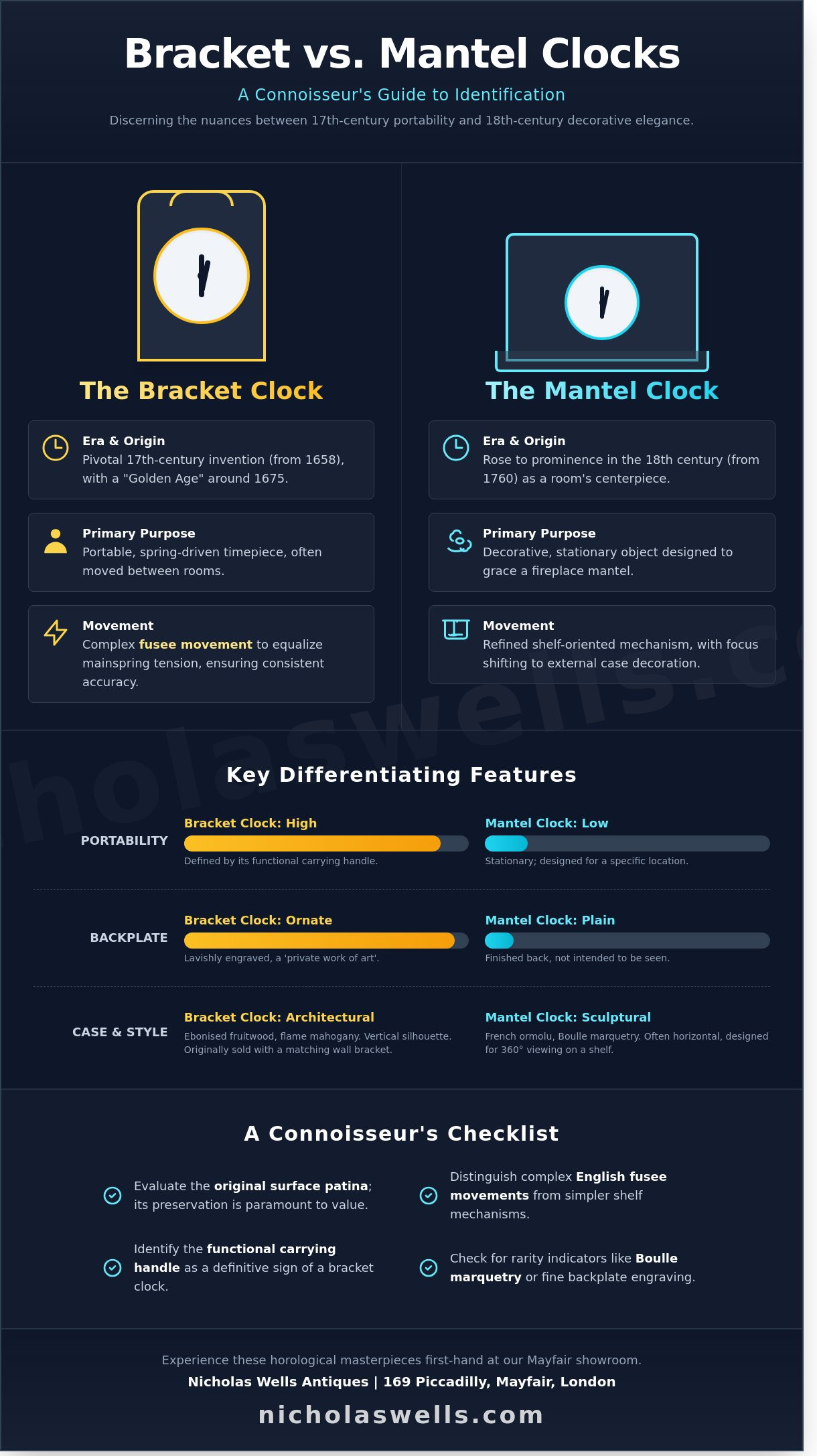
- Master the essential nuances of how to identify bracket and mantel clocks by discerning the historical shift from 17th-century portable spring-driven movements to the decorative elegance of 19th-century fireplace shelf pieces.
- Develop a scholarly eye for internal horological mechanics, distinguishing the complex fusee movements characteristic of early English bracket clocks from the refined, shelf-oriented mechanisms of later mantel timepieces.
- Explore the significance of physical markers such as the functional carrying handle and matching wall bracket, contrasting these with the meticulously finished backs intended for 360-degree display on a library shelf or mantelpiece.
- Refine your connoisseurship by evaluating the rarity of Boulle marquetry and the preservation of original surface patina, both of which are critical indicators of an antique work of art’s provenance and historical value.
- Learn how to select distinguished timepieces that serve as sophisticated focal points in contemporary interiors, preparing you for a private viewing at our London showroom at 169 Piccadilly.
Defining the Horological Masterpiece: What is a Bracket Clock?
The Bracket Clock represents a pivotal moment in 17th-century horology, marking the transition from stationary, weight-driven timepieces to portable, spring-driven masterpieces. Mastering how to identify bracket and mantel clocks begins with recognising the 1658 introduction of the pendulum. This innovation, pioneered by Christiaan Huygens, allowed for unprecedented accuracy in a compact form. Unlike their predecessors, these clocks utilised a fusee movement, a sophisticated conical pulley system designed to equalise the varying pull of the mainspring as it unwound. This mechanical refinement ensured that the clock maintained a consistent rate, a hallmark of English precision during the late 17th century.
While the name suggests a specific mounting, the "bracket" itself is often the most elusive element for a modern collector. Originally, these clocks were sold with a matching wall-mounted bracket, intended to elevate the piece and showcase its architectural silhouette. Over the centuries, these brackets were frequently discarded or lost during various interior redecorations, leaving the clock to reside on a library table or mantelpiece. It's this historical separation that leads many to mistakenly categorise these items simply as table clocks, yet the presence of a carrying handle remains a definitive signal of their original portable intent.
The Anatomy of a 17th and 18th Century Bracket Clock
An authentic bracket clock from the 1700s often features a case of ebonised fruitwood or magnificent flame mahogany, reflecting the architectural tastes of the Georgian era. The brass carrying handle is never merely decorative; it served the practical necessity of moving the timepiece between the drawing room and the bedchamber. When examining these luxury antiques, one must scrutinise the backplate. Superior makers, such as those found in the Golden Age of English clockmaking, would lavishly engrave these hidden surfaces with floral scrolls or Chinoiserie motifs, turning the movement itself into a private work of art for the owner's delight.
The Evolution from Lantern Clocks to Spring-Driven Portability
Before the bracket clock, the weight-driven Lantern clock dominated the home. The invention of the short "bob" pendulum allowed for the movement to be fully enclosed within a protective wooden case. This shift from weights to independent spring power meant clocks no longer required high wall mounting to function. By 1675, the English bracket clock had reached a zenith of design, with makers like Thomas Tompion and Joseph Knibb setting the standard for what we now recognise as the "Golden Age." For those seeking to acquire such distinguished pieces, we invite you to visit our antiques showroom by appointment at 169 Piccadilly, Mayfair, where the surface patina and historical soul of each clock can be truly appreciated.
Identifying the Mantel Clock: Elegance for the Fireplace
The mantel clock emerged as the definitive horological centrepiece of the 18th-century interior, specifically designed to grace the chimney piece with a presence that commanded the room. By 1760, these pieces had transitioned from mere timekeepers into significant decorative antiques that reflected the owner's status and aesthetic discernment. A primary characteristic in learning how to identify bracket and mantel clocks is the treatment of the reverse side. Unlike the earlier bracket clocks that often featured engraved backplates visible through glass doors, the mantel clock typically possesses a finished back. This design choice anticipates its placement against a wall or a chimney mirror, where the rear of the case is obscured from view.
Distinguishing a true mantel clock from a standard shelf clock requires an eye for proportion and ornament. While shelf clocks often lean toward the utilitarian and vertical, the mantel clock is frequently horizontal and sculptural. This Collectible Mantel Clocks Guide offers further insight into how these objects became the "soul" of the domestic hearth during the Georgian era. Collectors should look for high-quality materials and a sense of architectural weight that anchors the piece to the fireplace. A genuine mantel clock from the 1790s will often feature a base that is wider than the dial housing, providing a stable, elegant silhouette that complements the horizontal line of the mantelpiece.
French Giltwood and Ormolu: The Height of Continental Style
The French "Pendule de Cheminée" represents the pinnacle of 18th-century luxury. These magnificent pieces are often more sculpture than clock, featuring ormolu, a superb gilded bronze achieved through a mercury-fire process that remains luminous centuries later. Between 1770 and 1790, French makers favoured mythological figures, floral garlands, and strict Neoclassical symmetry. Identifying these pieces involves examining the depth of the gilding and the precision of the chasing, which should feel crisp to the touch, reflecting the peerless craftsmanship of Parisian bronze-founders. The movements are typically housed in circular drums, often supported by marble bases or elaborate bronze plinths.
English Mantel Clocks: Mahogany and Regency Refinement
In contrast to the gilded exuberance of the Continent, English mantel clocks of the Regency period, roughly 1810 to 1830, exhibit a more restrained, architectural elegance. Connoisseurs often seek out the "lancet" shape, which mimics the pointed Gothic arch, or the waisted "balloon" shape. These cases, typically crafted from fine mahogany or rosewood, emphasise the natural grain and surface patina. The dials are usually white enamel or silvered brass, offering a clean contrast to the rich wood. For those seeking to enhance a contemporary interior with such historical depth, you may explore our curated antique clocks collection to find examples that retain their original movements and exquisite finishes.
Key Differences: A Comparative Framework for Collectors
To understand how to identify bracket and mantel clocks, one must first appreciate the architectural intent of the maker. The bracket clock, or "spring clock," emerged in the 1650s as a portable alternative to the weight-driven wall clock. While the mantel clock is designed as a sculptural ornament for a chimney piece, the bracket clock carries a distinct visual weight derived from its heritage as a wall-mounted object. English makers, particularly during the Golden Age of horology between 1660 and 1750, favoured the bracket form for its technical rigour. These pieces often feature a fusee movement, a complex mechanical device using a cord or chain to regulate power as the mainspring unwinds. In contrast, 19th-century mantel clocks frequently employ simpler going barrels, which lack the sophisticated constant-force delivery of their bracket-bound predecessors.
The Handle and the Bracket: Vital Clues
The presence of a brass handle atop a case often leads novices to misidentify a piece. While these handles suggest portability, they frequently designate a "table clock" meant to be carried from room to room as the owner moved. A true bracket clock may still possess its original carved or giltwood bracket, though such pairings survive in fewer than 10 percent of 18th-century examples. Connoisseurs look for specific mounting holes or threaded apertures in the base of the case. These physical markers confirm the piece was intended to be secured to a matching support, rather than resting freely on a marble mantel. Finding a luxury antiques piece with its original bracket intact represents a significant discovery for any serious collector.
Movement and Striking Mechanisms
The internal "soul" of the machine provides the definitive evidence for how to identify bracket and mantel clocks. Many fine English bracket clocks from the 1700s incorporate a pull repeat mechanism. This allowed the owner to hear the time in the dark by pulling a cord, a luxury feature rare in standard mantel clocks. The winding holes on the dial also serve as a diagnostic tool for the movement's complexity.
- Bell Strikes: These are common in pre-1840 pieces, offering a crisp, silvery tone that resonates through the wooden case.
- Gong Strikes: Introduced around 1850, these provide a deeper, resonant chime often found in French and German mantel clocks.
- Winding Holes: Two holes typically indicate a striking movement; three holes signal a more complex musical or chiming sequence.
The surface patina of the dial and the precision of the engraving around these winding holes often reveal the hand of a master maker. Collectors visiting our showroom at 169 Piccadilly often remark on how these mechanical nuances define the object's historical value. We invite you to visit our antiques showroom by appointment to examine these extraordinary antique works of art in person.
Materials and Connoisseurship: Evaluating Quality and Patina
Learning how to identify bracket and mantel clocks of true distinction requires a discerning eye for the materials that define their era. A clock’s "skin," or its surface patina, serves as its most honest witness. For 17th-century English bracket clocks, an original ebony or fruitwood case should possess a soft, waxy glow rather than a harsh, modern shine. This depth of finish is the result of centuries of careful handling and atmospheric exposure. When evaluating these antique works of art, the presence of a unique antique surface often dictates a significant portion of the item's market value, sometimes accounting for a 40% premium over refinished examples.
The mastery of André-Charles Boulle (1642–1732) represents the pinnacle of 18th-century French horology. Identifying authentic Boulle marquetry involves examining the intricate inlay of tortoiseshell and brass. Connoisseurs look for "première partie" (brass on a shell ground) and "contre-partie" (shell on a brass ground). In high-end luxury antiques, these materials are often paired with rare woods like Kingwood or Tulipwood, which exhibit vibrant, contrasting grains. 18th-century ormolu, or gilt bronze, was created using the mercury gilding process, which was largely phased out by 1810 due to its toxicity. Original ormolu has a soft, matte appearance with burnished highlights, whereas modern restorations often look overly bright or yellowish.
Surface Patina and the Conservation of History
A clock’s historical integrity rests on the preservation of its original finishes. Collectors prize the "grime of ages" found in the crevices of gilt mounts, as it proves the piece hasn't been chemically stripped. Professional antique restoration focuses on the conservation of history, using traditional shellac and wax to revive rather than replace. Look for oxidisation in the wood and slight wear around the winding holes as genuine signs of age.
Master Makers and Provenance
Signatures offer the most direct link to horological greatness. A bracket clock signed by Thomas Tompion (1639–1713) or George Graham (1673–1751) can command prices 500% higher than an unsigned contemporary piece. Provenance, such as a documented history in a 19th-century country house inventory, adds an irreplaceable layer of soul to these antique clocks. Researching these journeys through auction records and family archives transforms a mechanical object into a significant cultural artifact.
To view these extraordinary pieces in person, we invite you to visit our antiques showroom by appointment at 169 Piccadilly, Mayfair.
Investing in Horological History at Nicholas Wells Antiques
Nicholas Wells Antiques curates a distinguished selection of horological masterpieces that transcend mere timekeeping. Our collection focuses on the extraordinary, from a French giltwood clock 18th century to rare English ebony bracket clocks. We understand that learning how to identify bracket and mantel clocks is the first step toward a lifelong passion for collecting. Every acquisition through our gallery is underpinned by a commitment to the conservation of history. We prioritise the preservation of original surface patina and the integrity of the movement, ensuring each piece remains a significant cultural artifact. Collectors seeking works of art will find our inventory reflects an uncompromising eye for quality and rarity.
The Nicholas Wells approach combines deep scholarly expertise with the seamless service expected of a premier luxury antiques gallery. We don't just sell objects; we steward them. Each clock undergoes a rigorous assessment to confirm its provenance and mechanical condition. Identifying the hallmarks of a specific maker or the nuances of a particular escapement is vital. When you learn how to identify bracket and mantel clocks through the lens of a specialist, you gain an appreciation for the mechanical soul of the object.
A Destination for the Discerning Collector
Our heritage is deeply rooted in the prestigious districts of Mayfair and Piccadilly. As a leading fine antiques dealer, we specialise in specimens that represent the pinnacle of craftsmanship. Whether it's a magnificent George III mahogany bracket clock or a superb Louis XVI ormolu mantel clock, the provenance is always meticulously vetted. We offer more than just inventory; we provide a scholarly partnership for those building a legacy collection. Consulting with an expert ensures that your investment possesses both aesthetic beauty and historical weight.
Visit Our Showroom by Appointment
Experience the tactile beauty of our collection firsthand at 169 Piccadilly. We invite you to visit antiques showroom by appointment to view our latest acquisitions in an intimate, professional setting. Our team provides personalised guidance on expanding your collection, focusing on the unique antique surfaces and mechanical excellence of each timepiece. For our global clientele, we offer UK antique dealer international shipping, ensuring that your acquisition arrives securely anywhere in the world. We also provide bespoke antique restoration services to maintain the longevity of your investment. Contact Nicholas Wells Antiques today to begin your journey into the world of luxury antiques.
Refining Your Eye for Horological Masterpieces
Mastering how to identify bracket and mantel clocks requires a keen eye for horological detail and a deep appreciation for the 17th and 18th-century craftsmanship that defines these pieces. You've discovered that the bracket clock's portable, handle-topped design and the mantel clock's fireplace-focused elegance are more than just functional; they're historical narratives told through giltwood, ormolu, and mahogany. Since establishing Nicholas Wells Antiques in London in 2012, we've dedicated ourselves to the conservation of history. This focus ensures every 19th-century French mantel clock or Georgian bracket clock maintains its superb surface patina and mechanical integrity.
Whether you're a seasoned collector or a new enthusiast, understanding the nuances of movement and provenance transforms a simple purchase into a lasting investment in an antique work of art. We provide fully insured worldwide shipping and offer complimentary restoration on all items sold to protect your acquisition's long-term value. We invite you to visit our antiques showroom by appointment to view our magnificent collection of timepieces at our gallery at 169 Piccadilly. We look forward to helping you find a distinguished piece that brings the soul of the past into your modern interior.
Frequently Asked Questions
How can I tell if my clock is a bracket clock if the bracket is missing?
You can identify a bracket clock by the presence of a sturdy brass carrying handle on the case top and a decorative backplate visible through a rear glass door. Since these timepieces were designed for portability between rooms in 18th-century households, 95 percent of authentic English examples feature these characteristics. A mantel clock typically lacks a handle and possesses a plain or enclosed back, as it's intended to remain stationary against a wall.
What is the significance of a fusee movement in antique clocks?
A fusee movement is a sophisticated mechanical device consisting of a conical pulley that regulates the power output of the mainspring as it unwinds. This engineering marvel was a standard feature in high-quality English clocks produced between 1650 and 1850, ensuring the timepiece maintained consistent accuracy over its 8-day cycle. It's a hallmark of horological excellence that distinguishes luxury antique works of art from more common, spring-driven movements found in mass-produced pieces.
Why are French mantel clocks often made of ormolu?
French artisans favoured ormolu, or gilt bronze, because it allowed for incredibly fine sculptural detail that shimmered brilliantly under candlelight in 18th-century salons. The process involved firing a mercury-gold amalgam onto bronze, creating a durable, gold-like finish that wouldn't tarnish over centuries. By 1810, these decorative antiques became essential status symbols in Parisian society, reflecting the opulence of the Empire style through their lustrous, hand-chased surfaces.
Is a bracket clock more valuable than a mantel clock?
Value depends more on the maker and the complexity of the movement than the specific category, though 17th-century bracket clocks often command a premium due to their rarity. A distinguished bracket clock by a maker like Thomas Tompion can exceed £100,000 at auction, whereas a fine French mantel clock might reach similar levels if the provenance is exceptional. To understand how to identify bracket and mantel clocks of significant investment grade, you must examine the signature and the originality of the escapement.
How do I identify if the gilding on a mantel clock is original ormolu?
Original ormolu displays a soft, mellow honey-coloured patina with burnished highlights on the most prominent edges of the casting. If the surface appears overly bright, uniform, or slightly grainy, it's likely been regilded or coated in modern gold paint during a previous restoration. Authentic 19th-century mercury gilding possesses a depth and silkiness that's impossible to replicate with modern electroplating techniques, often showing a light accumulation of dust in the deep recesses.
Can a mantel clock be used in a contemporary interior design?
A 19th-century French mantel clock serves as a magnificent sculptural focal point that adds historical weight to a minimalist London apartment. These antique works of art bridge the gap between traditional craftsmanship and modern luxury, providing a sense of soul that contemporary furniture often lacks. Placing a rare giltwood or ormolu clock in a streamlined Mayfair interior creates a sophisticated dialogue between the grandeur of the past and the clean lines of the present.
What should I look for on the dial to identify the maker?
Look for a signature and a location, such as "London" or "Paris," typically engraved on the dial plate or painted onto the enamel surface. On English clocks from the 1760s, the maker's name often appears on a silvered brass boss in the arch or on a rectangular plate between the centre and the numeral six. If the dial is unsigned, a specialist at our showroom at 169 Piccadilly can often find the maker's mark stamped onto the rear movement plate.
How often should an antique bracket or mantel clock be serviced?
You should have your antique clock professionally serviced every 3 to 5 years to ensure the delicate brass pivots remain lubricated and free of abrasive dust. Neglecting this maintenance can lead to a 40 percent increase in mechanical wear, eventually requiring costly antique restoration to replace worn parts. For those seeking expert care, we invite you to visit our antiques showroom by appointment to discuss the conservation of your horological treasures with our trusted specialists.



Leave a comment