



How to Identify Grand Tour Busts of Roman Emperors
To the uninitiated, a carved block of Carrara marble might seem timeless, but the true distinction between an 18th-century masterwork and a modern imitation resides in the quiet language of the chisel and the authentic maturation of the stone's surface. You likely recognise that incorporating classical sculpture for interior design is about more than mere decoration; it's about anchoring a room with a sense of intellectual heritage and historical gravity. However, the challenge of distinguishing a genuine piece from a contemporary cast can be daunting for even the most seasoned collector. In this guide, we address the fundamental question, what is a Grand Tour bust?, while sharing the scholarly markers necessary for collecting Grand Tour sculpture with absolute certainty.
We'll provide the expert insights required to understand how to identify an antique Roman emperor bust, from the specific physiognomic traits of the Caesars to the vital importance of a verifiable provenance. Whether you're searching for antique marble Roman emperor busts for sale or seeking to deepen your academic appreciation of these objects, this exploration bridges the gap between historical grandeur and the requirements of the modern, curated home. We also address practicalities for our American clients, ensuring that the journey from a London gallery to a residence in New York or the Hamptons is managed by professional fine art shippers who respect the weight and significance of the history they carry.
Key Takeaways
- Discover what is a Grand Tour bust?, how to identify an antique Roman emperor bust, and the scholarly art of collecting Grand Tour sculpture to source the finest antique marble Roman emperor busts for sale for use as classical sculpture for interior design.
- Learn to scrutinise the "antique surface" by identifying the soft, unctuous patina and specific 18th-century carving techniques, such as the use of the drill in the hair and pupils, that distinguish a period masterpiece.
- Understand how to integrate classical marble portraiture as a sophisticated focal point in a contemporary residence, using directional lighting to reveal the depth of the carving and the stone's natural translucency.
- Appreciate the vital role of provenance and historical conservation in maintaining value, underscored by our commitment to the 'Restore Britain' movement and the preservation of cultural heritage.
- Gain confidence in acquiring significant sculptural works through an online-only gallery that utilises professional fine art shippers to ensure seamless international delivery to collectors in New York, Texas, and across the United States.
What is a Grand Tour Bust? The Classical Legacy of the 18th-Century Traveller
During the 18th and 19th centuries, the Grand Tour served as the definitive educational rite for the European and British aristocracy. This journey through the heart of Italy was not merely a holiday, but a rigorous pursuit of classical knowledge and aesthetic refinement. Returning travellers sought to bring the grandeur of Rome back to their ancestral seats, and few objects conveyed this more effectively than the marble portrait. Roman emperor busts became the ultimate status symbol, representing a direct connection to the perceived power and wisdom of antiquity.
For the discerning collector today, understanding what is a Grand Tour bust? begins with recognising its role as a high-quality neoclassical reproduction intended for the 18th-century English country house. While some patrons commissioned full-scale archaeological copies to fill vast galleries, many preferred the refined proportions of library busts. These smaller iterations were designed to sit atop mahogany bookcases or within intimate studies, serving as constant reminders of the owner's cultural sophistication. Knowing how to identify an antique Roman emperor bust from this era requires an eye for these specific neoclassical nuances. A Grand Tour bust is a high-quality neoclassical reproduction intended for the 18th-century English country house.
The Cultural Significance of Classical Sculpture
The Enlightenment era fostered a profound reverence for Roman virtues, which were seen as perfectly manifested in the permanence of marble. These busts weren't just decorative; they were intellectual trophies. Displaying a likeness of Marcus Aurelius or Augustus signalled a commitment to stoicism and leadership. This reverence for historical continuity mirrors our own support for the Restore Britain movement, which seeks to preserve the cultural fabric of our nation. In the context of classical sculpture for interior design, these pieces continue to offer a unique bridge between historical narrative and modern aesthetic poise.
Materials of Distinction: Carrara, Giallo Antico, and Porphyry
Rare stones like Giallo Antico or the regal purple of porphyry were particularly prized by those collecting Grand Tour sculpture in the 18th century. These materials, often salvaged from ancient ruins, added a layer of authenticity to antique marble Roman emperor busts for sale. The presence of such exotic stones often separates a common souvenir from a piece of true connoisseurship. The choice of stone was never accidental; it directly indicated the wealth and connoisseurship of the original patron. You can explore our selection of Grand Tour pieces to see these materials in person.
Dealer’s Secrets: How to Identify an Antique Roman Emperor Bust
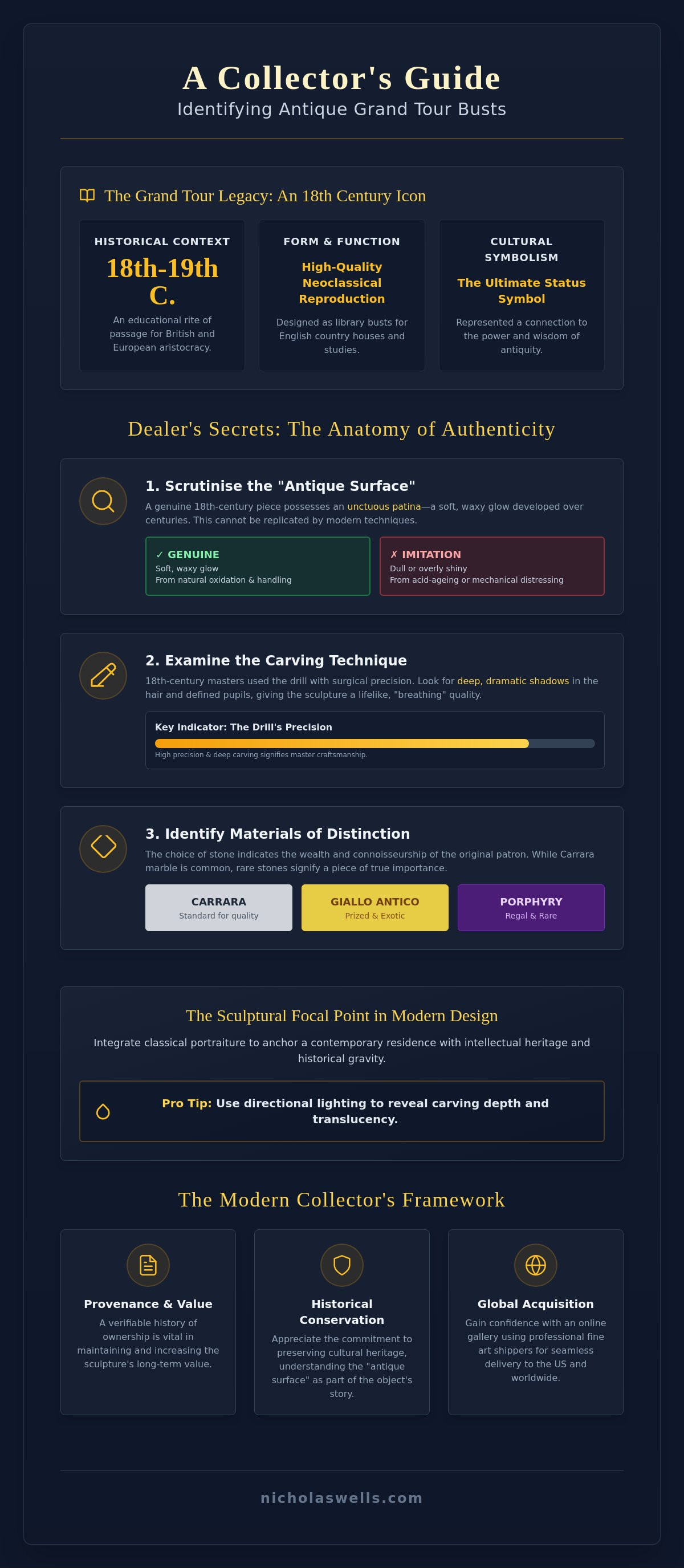
The surface of a genuine 18th-century marble is its most revealing characteristic. An authentic piece possesses what we call an unctuous patina, a soft, waxy glow born from centuries of oxidation and the gentle handling of generations. This unique "antique surface" is impossible to replicate with modern acid-ageing or mechanical distressing. When you are collecting Grand Tour sculpture, you must also examine the tool marks. Masters like Bartolomeo Cavaceppi utilised the drill with surgical precision to create deep, dramatic shadows in the hair and to define the pupils, a technique that gives the marble a lifelike, breathing quality.
Identifying the specific subject is equally vital in understanding how to identify an antique Roman emperor bust. One should look for the heavy-lidded, stoic gaze and flowing beard of Marcus Aurelius, or perhaps the aggressive, scowling physiognomy and tight curls characteristic of Caracalla. Beyond the face, the socle, or pedestal, provides essential clues. A period-correct socle, often turned from a contrasting marble like Giallo Antico, should feel as though it's lived with the bust for centuries. If the mounting feels too clinical or the stone lacks a matching age, it may suggest a later marriage of pieces.
Identifying the Five Good Emperors
For the 18th-century British aristocrat, the "Five Good Emperors"—Nerva, Trajan, Hadrian, Antoninus Pius, and Marcus Aurelius—represented the pinnacle of Roman governance and personal virtue. These figures were the most frequently patronised subjects because they mirrored the Enlightenment ideals held by the travellers themselves. Trajan is often identified by his straight, fringe-like hair, while Hadrian is distinguished by being the first emperor to wear a full beard in the Greek fashion. Recognising these subtle iconographic details allows a collector to move beyond the aesthetic and into the realm of true historical connoisseurship.
Signs of 18th-Century Restoration
It's a common misconception that restoration diminishes value. In the world of high-end antiquities, a 300-year-old re-attached nose or a professionally filled vein in the marble can actually serve as a marker of authenticity. These historical repairs tell the story of the object’s journey through time, proving it was valued enough to be conserved by previous generations. For more nuanced details on authentication, you might find our guide on Identifying Authentic Grand Tour Antiques particularly enlightening. If you are currently seeking a significant piece for your library, we invite you to view our latest selection of antique sculpture.
The Sculptural Focal Point: Classical Sculpture for Interior Design
In a contemporary New York apartment or a refined London townhouse, the presence of an antique marble Roman emperor bust provides a necessary visual and intellectual anchor. These objects possess a physical weight that grounds a room, offering a sense of permanence amidst the shifting trends of modern decor. When integrated thoughtfully, classical sculpture for interior design transcends mere ornamentation. It becomes a conversation between the past and the present, lending a curated, scholarly atmosphere to any space it inhabits. To find a piece that commands this level of attention, we invite you to explore our Sculpture collection.
The successful display of marble depends heavily on the nuances of light. Directional lighting is essential; it catches the subtle tool marks of the 18th-century craftsman and highlights the depth of the carving in the hair and drapery. Because marble is naturally translucent, a well-placed lamp can make the stone appear to glow from within, revealing the internal crystalline structure of the Carrara or Porphyry. Scale is equally vital. A substantial bust requires a pedestal of appropriate stature or a generous chimney piece to ensure it isn't swallowed by the architecture of the room.
The Library and the Study: A Traditional Placement
There is a timeless logic in arranging a series of busts amongst fine leather-bound volumes and antique bookcases. This placement honours the original 18th-century tradition where the library was a theatre of Enlightenment thought. You can create a compelling narrative by grouping different historical figures together, perhaps pairing the stoic Marcus Aurelius with the more youthful, energetic features of a young Augustus. This arrangement transforms a functional room into a sanctuary of history and quiet reflection.
Juxtaposing Antiquity with Modernity
One of the most effective design philosophies involves placing a 19th-century Grand Tour bust atop a minimalist console or a sleek centre table. This juxtaposition allows the "antique surface" and the soft patina of the stone to stand out against clean, modern lines. This approach celebrates the conservation of history while ensuring the piece feels relevant to a 21st-century lifestyle. For those collecting Grand Tour sculpture, this balance ensures that your collection remains a living part of your home rather than a static museum display. If you are ready to acquire a singular piece, you may browse our current antique marble Roman emperor busts for sale.
Collecting and Buying: Antique Marble Roman Emperor Busts for Sale
Navigating the market for significant antiquities requires a disciplined eye and a commitment to provenance. When considering antique marble Roman emperor busts for sale, the primary drivers of value remain the unique "antique surface" and a clear, documented journey through time. At Nicholas Wells Antiques, we prioritise a curated, online-only experience that values scholarly depth over a generalist approach to inventory. We understand that our clients in California, Texas, and the Hamptons require more than just a transaction; they require the assurance that their acquisition is a genuine cultural artefact. To this end, we work exclusively with professional fine art shippers who specialise in the international transit of heavy marble, ensuring that the transition from our London-based heritage to your residence is seamless and secure. This commitment to quality aligns with our support for the "Restore Britain" ethos, which champions the preservation of our nation’s extraordinary artistic legacy.
The Worth Collecting? Analysis
Grand Tour objects continue to define the "Old Money" aesthetic, remaining remarkably resilient in the global market. Data from 2025 indicates that dealers specialising in Old Masters and classical categories saw a 9% increase in sales, suggesting a renewed flight to quality amongst serious collectors. These pieces are not merely decorative; they are tangible assets with a history of appreciation. As part of our bespoke service, we provide complimentary restoration on all sold items, ensuring that the conservation of history is handled with the appropriate level of expertise before the piece enters your collection. Collecting Grand Tour sculpture remains one of the most rewarding pursuits for those who value the intersection of history and high-end design.
Sourcing via an Online Gallery
Our online-only model is built upon absolute transparency. We provide high-resolution photography and detailed condition reports that allow you to scrutinise the marble's grain and the craftsman's tool marks with greater clarity than a physical showroom visit might permit. This digital-first approach ensures that we can focus our resources on sourcing the singular and the exceptional, providing a sophisticated bridge between historical grandeur and modern luxury living. We invite you to view our current collection of Grand Tour Souvenirs to discover how these magnificent portraits can serve as the definitive focal point in your home.
Preserving the Grandeur of the Caesars
Acquiring a piece of Roman history is an act of stewardship that transcends simple decoration. By masterfully identifying the unctuous patina of an authentic "antique surface" and recognising the specific iconographic traits of the emperors, you ensure your collection possesses both scholarly weight and aesthetic power. Whether you're seeking a grounding element for a modern library or exploring classical sculpture for interior design, the key lies in the intersection of provenance and craftsmanship. We've explored what is a Grand Tour bust?, how to identify an antique Roman emperor bust, and the nuances of collecting Grand Tour sculpture to help you source the finest antique marble Roman emperor busts for sale with total confidence.
As established London experts since 2012, Nicholas Wells Antiques remains dedicated to the "Restore Britain" ethos by conserving these magnificent cultural artefacts for future generations. We offer complimentary restoration on all purchases and provide fully insured worldwide fine art shipping to our clients in New York, Texas, and the Hamptons. We invite you to explore our curated collection of Grand Tour Objects and Sculpture and begin your journey into the timeless world of classical connoisseurship. Your next significant acquisition awaits.
Frequently Asked Questions
How can I tell if a Roman emperor bust is marble or plaster?
Marble is distinguished by its characteristic coldness and significant weight; plaster feels noticeably warmer and lighter when handled. If you examine the surface closely, marble reveals a subtle, crystalline translucency that plaster lacks. Scratches on plaster often reveal a white, chalky interior, while marble remains consistent throughout its depth. This material distinction is vital for anyone learning how to identify an antique Roman emperor bust from a modern cast.
Who were the most popular emperors depicted in Grand Tour sculpture?
The most sought-after figures in collecting Grand Tour sculpture were those who embodied Enlightenment ideals, particularly Augustus and Marcus Aurelius. Augustus was prized for his eternal, idealised youth, while Marcus Aurelius represented the pinnacle of Stoic philosophy. Caracalla was also a frequent subject, favoured for his intense, scowling expression which allowed 18th-century sculptors to demonstrate their technical mastery in capturing complex human emotion and dramatic shadow.
What is the "antique surface" and why does it matter to collectors?
When asking what is a Grand Tour bust?, one must consider the "antique surface." This refers to the soft, unctuous patina that develops on marble over centuries of oxidation and human interaction. This maturation results in a gentle, waxy glow that contemporary reproductions cannot replicate. For the connoisseur, this surface is a primary marker of authenticity, confirming the object's status as a period piece rather than a later imitation.
Is it safe to ship large marble busts from London to the United States?
Shipping antique marble Roman emperor busts for sale to the United States is entirely secure when managed by professional fine art shippers. We regularly coordinate deliveries to clients in New York, Texas, and California, utilising bespoke crating and fully insured transit. These specialists understand the unique requirements of heavy, fragile stone, ensuring that your acquisition arrives in the same condition it left our gallery, despite the logistical challenges of international travel.
How do I clean and maintain an antique marble bust?
Maintenance of an antique marble bust should be approached with caution to preserve the delicate patina. A soft, dry brush is usually sufficient for removing dust; you should avoid all chemical cleaners or acidic solutions that might etch the stone. If the marble requires more significant attention, we recommend consulting a professional conservator. This ensures the historical integrity remains uncompromised, allowing it to continue as a focal point of classical sculpture for interior design.


Leave a comment