



How to Spot Reproduction Furniture: 12 Telltale Signs Used by Dealers
Does the presence of a perfectly uniform finish on a Regency console table signify a miracle of preservation, or does it betray the hand of a twentieth-century craftsman? Many collectors find themselves caught in the delicate tension between admiring a beautiful form and fearing the financial sting of a well-executed imitation. Learning how to spot reproduction antique furniture is an essential skill for anyone who values the integrity of history over the convenience of modern manufacture. We recognise that the true value of a piece lies in its unique narrative, a story told through the physical evidence of its creation and the gentle, irregular patination that only centuries can bestow.
You're right to feel cautious when distinguishing between a period-original and a later period-style piece, as the differences are often hidden deep within the joinery. In this guide, I'll provide you with the professional tools to authenticate these objects with scholarly precision, focusing on the construction cues that define genuine craftsmanship. We'll explore twelve telltale signs used by specialist dealers, including the nuances of hand-planed surfaces and the specific oxidation found in original seventeenth-century timbers. This knowledge will transform your approach to collecting, allowing you to build a relationship with the past based on expertise rather than guesswork.
Key Takeaways
- Distinguish between true period pieces and later revivals, such as 19th-century Victorian interpretations that often masquerade as Georgian originals.
- Uncover the "Secrets of the Bench" by learning how to spot reproduction antique furniture through the analysis of primitive versus refined joinery.
- Learn to interpret the language of surface patina, identifying the difference between a genuine historic glow and the artificial distressing used to mimic age.
- Understand why a relationship with a specialist dealer and a focus on documented provenance are the most secure methods for acquiring museum-quality pieces.
Connoisseurship vs. Consumption: Defining the Genuine Antique
The distinction between a period-original and a later homage is the foundational challenge of the connoisseur. When we discuss Defining a Genuine Antique, we generally refer to an object at least one hundred years old that embodies the aesthetic and technical standards of its era. A period piece was created during the height of its specific design movement, whereas a revival piece was manufactured during a later resurgence of interest in that style. A reproduction is defined as a piece intended to emulate a past era, often employing modernised tools or assembly methods to achieve the look of antiquity.
In my experience, the most frequent source of confusion arises from 19th-century Victorian revivals. These craftsmen possessed immense skill, often recreating Georgian furniture with such precision that they are easily mistaken for 18th-century originals. These aren't necessarily 'fakes' in a malicious sense; they were high-quality commissions for clients who admired the elegance of Chippendale or Sheraton. However, for the modern collector, understanding how to spot reproduction antique furniture involves looking past the surface to find 'honest' wear. Genuine age is inconsistent, appearing where hands have rested or feet have scuffed, unlike the uniform, mechanical 'distressing' found on lesser reproductions.
The Rise of the Revival Styles
By the Edwardian era, an obsession with the 18th century led to a prolific output of revivalist pieces. These items were often constructed with high-quality timbers and traditional joinery, making them far superior to modern mass-produced items. Learning how to spot reproduction antique furniture from this period requires a keen eye for the subtle shift from hand-tooling to machine-assisted production. For instance, a 1920s antique centre table crafted in the Regency style still holds significant decorative value and historical interest. It's a beautiful object for a contemporary interior, provided it's acquired with the understanding that its provenance begins in the twentieth century, not the early nineteenth. The key to a successful acquisition is ensuring the price reflects this distinction in lineage.
Secrets of the Bench: Identifying Hand-Crafted Construction
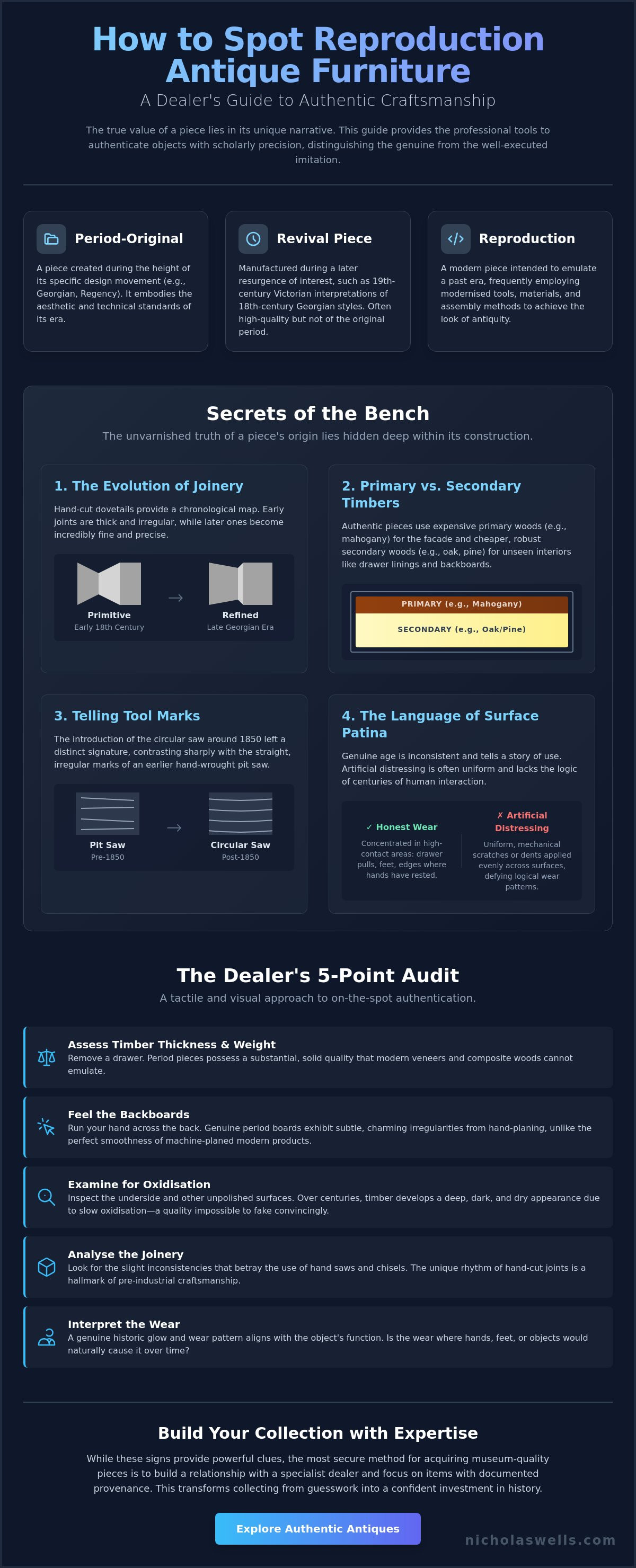
To truly understand how to spot reproduction antique furniture, one must look where the light rarely reaches. While the facade of a piece may be designed to enchant, the secondary timbers, those hidden woods used for drawer linings and backboards, tell the unvarnished truth of its origin. In the eighteenth century, a master cabinetmaker would never squander expensive mahogany on the interior of a carcass. Instead, they utilised oak or pine, materials that were robust yet economical. When you inspect a fine antique commode, the contrast between the rich exterior grain and the pale, utilitarian secondary wood is a hallmark of period authenticity.
The evolution of joinery provides a chronological map for the discerning eye. Early eighteenth-century dovetails are often "primitive," characterised by their thickness and slight irregularities that betray the use of hand saws and chisels. As the century progressed, these joints became increasingly refined, culminating in the "thin pins" of the late Georgian era. A reproduction, even one of high quality, often fails to replicate the specific rhythm of these hand-cut joints. To further refine your eye, you might consult resources on How to Identify Antique Wooden Furniture, which details how the introduction of circular saws around 1850 left telltale curved arcs on the timber, a sharp departure from the straight, irregular marks of an earlier hand-wrought pit saw.
A 5-Point Audit of Antique Cabinetry
In our "Dealer's Secrets" series, we often suggest a tactile approach to authentication. Start by removing a drawer to assess the thickness of the timber; period pieces possess a substantial, weighted quality that modern veneers cannot emulate. Run your hand across the backboards. If they feel perfectly smooth and uniform, they're likely machine-planed products of the industrial age. Genuine period backboards should exhibit subtle hand-planed irregularities. Finally, examine the underside for oxidisation. Over two centuries, unpolished wood darkens to a deep, mellow tone. If the wood beneath a table appears as fresh and bright as the day it was felled, you're likely looking at a later imitation.
The Language of Surface: Patina, Ormolu, and Wear
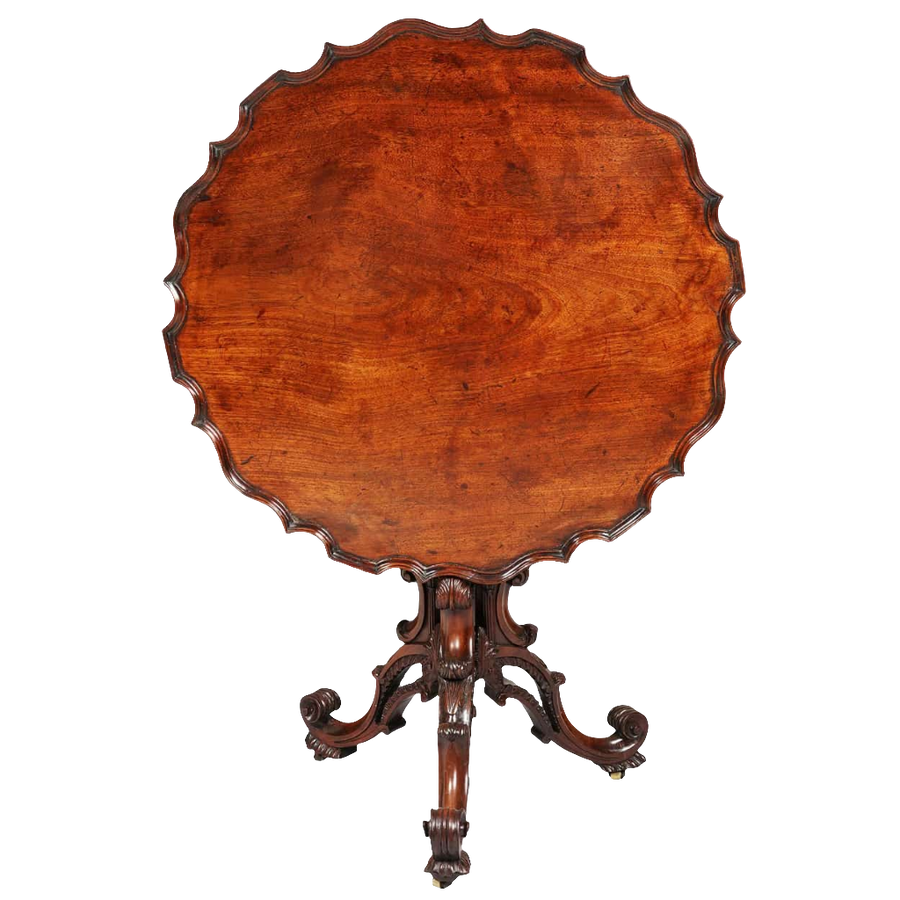
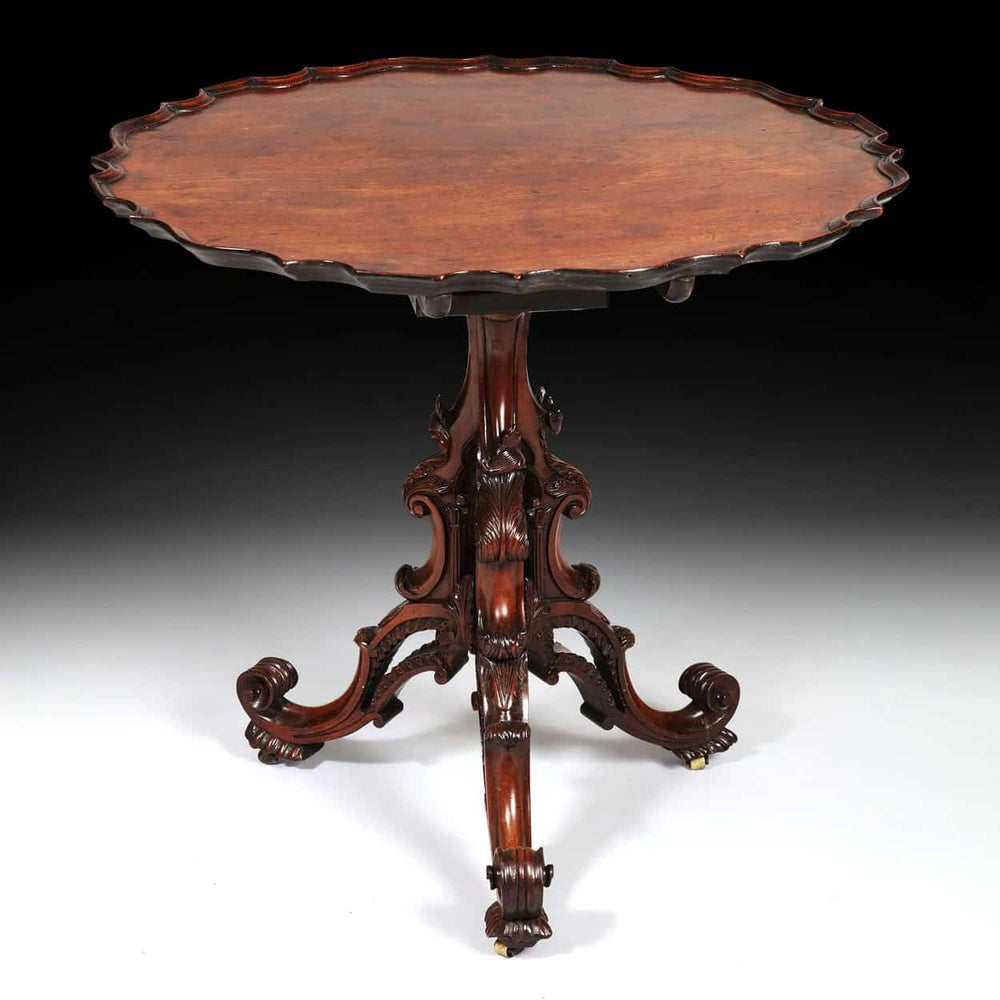
The "skin" of a piece is perhaps the most evocative indicator of its journey through time, possessing a depth and luminosity that modern finishes simply cannot replicate. When considering antique mirrors or tables, one should look for a translucent glow that appears to emanate from within the timber itself. This natural patina is the result of centuries of waxing, handling, and exposure to light, creating a surface that is complex and varied. In contrast, the process of how to spot reproduction antique furniture is often made easier by identifying muddy, dark stains that sit heavily upon the wood, lacking the clarity and mercurial quality of an original finish.
Faked wear is a common pitfall for the uninitiated, yet it almost always lacks the inherent logic of two hundred years of domestic use. Distressing achieved with chains or the mechanical drilling of faux wormholes tends to be suspiciously uniform, appearing in places where wear would never naturally occur. Genuine history is etched into the object. It's the specific scuff on a stretcher where a Georgian gentleman rested his heels, or the softening of a carved edge where hands have grasped it for generations. We place immense value on this original state, as a unique antique surface that has escaped the indignity of being stripped or over-restored is a rarity that preserves the piece's soul.
Ormolu refers to mercury-gilded bronze, a process banned in the mid-19th century due to the lethal vapours produced during its manufacture.
Identifying Genuine Ormolu and Giltwood
Distinguishing between period ormolu and later electroplated alternatives requires a keen eye for colour and texture. Original fire-gilded bronze possesses a soft, buttery yellow hue that feels warm to the touch, whereas electroplating often exhibits a harsh, brassy glare that feels superficial. In my "Dealer's Secrets" audits, I always inspect carved cabinet furniture for "dust traps" in the deep crevices. These areas accumulate decades of genuine grime that is nearly impossible to replicate perfectly with wax or pigments, which tend to look forced and lack the granular texture of authentic age.
If you're seeking a piece with an impeccable, untouched surface, I invite you to explore our curated antique furniture collection to see these principles in practice.
The Dealer’s Audit: Ensuring Authenticity in High-Value Acquisitions
The final layer of how to spot reproduction antique furniture involves a rigorous audit of its provenance and restoration history. While physical cues provide the evidence, a documented lineage within a distinguished town or country house offers an ironclad layer of authentication that transcends physical inspection. For the novice collector, the auction room often presents a landscape of "caveat emptor," where the pressure of the gavel can obscure subtle inconsistencies. Engaging with a specialist dealer ensures that the burden of authentication rests on an expert eye, providing a level of security that is seldom found in the frantic pace of the sale room.
Understanding the ethics of restoration is equally vital. We distinguish between "complimentary restoration," which seeks to stabilise and conserve the original character, and fundamental alterations that can diminish a piece's historical integrity. A genuine period masterpiece should retain its structural soul, even if minor repairs to veneers or joints have been undertaken over the centuries. When we acquire a significant Georgian mahogany sideboard or a delicate Regency piece, our focus is always on the conservation of its unique antique surface.
For our clients in New York, the Hamptons, or San Francisco, the acquisition process is seamless despite the geographical distance. We specialise in the international shipping of these delicate treasures, employing professional fine art shippers to ensure that an 18th-century masterpiece arrives in the United States with the same care it received in our gallery. This logistical precision is a hallmark of our service, bridging the gap between historical British craftsmanship and the requirements of modern luxury living in America.
Worth Collecting? The Market for Quality Reproductions
There are instances where a piece, though technically a reproduction of an earlier style, becomes a significant collectible in its own right. High-quality 19th-century pieces from esteemed makers like Gillows are prized for their exceptional timber and craftsmanship. These items occupy a unique space in the market, offering the aesthetic of the 18th century with the robust construction of the Victorian era. They serve as magnificent focal points in contemporary interiors, providing a sense of historical grandeur that grounds a modern room without the fragility of earlier centuries.
Refining the Collector's Vision
True connoisseurship is a journey of continuous observation, where the eye learns to look past the immediate allure of a silhouette to find the "honest" evidence of history. By mastering the nuances of secondary timber oxidation and the specific geometry of hand-cut joinery, you've begun to build a foundation of genuine expertise. Mastering how to spot reproduction antique furniture isn't merely about avoiding a poor investment; it's about developing a profound reverence for the singular character that only a period masterpiece possesses. We believe that every acquisition should be a source of enduring pride, grounded in the certainty of authenticity and the preservation of heritage.
As specialists in rare Grand Tour objects and Oceanic art, we bring a curator's uncompromising eye to every piece we source. We ensure the longevity of your investment through complimentary restoration on all items sold, maintaining the delicate balance between conservation and use. For our American clients, we provide fully insured worldwide shipping to the US, handling every detail of the journey with professional care. We invite you to explore our curated collection of authentic 18th and 19th-century English furniture and discover the exceptional character of a truly original surface. Your path to building a significant collection starts with a single, well-informed choice.
Frequently Asked Questions
How can I tell if the wood on my antique is original or a later replacement?
Identify inconsistencies in the oxidisation of the timber to determine if a component is original. Wood that has been shielded from light for centuries, such as the underside of a console table or the interior of a commode, should possess a deep, mellowed tone. If you discover a drawer bottom that appears suspiciously bright or lacks the accumulated grime of two hundred years, it is likely a later replacement that lacks the narrative history of the primary piece.
Are all reproduction antiques valueless for collectors?
Not all reproductions are without merit, though their market value differs significantly from period originals. High quality nineteenth century revival pieces, particularly those from esteemed makers such as Gillows, are highly collectible for their superior craftsmanship and use of fine timbers. While they don't command the prestige of an eighteenth century masterpiece, they remain desirable for their decorative integrity and are often featured in prestigious interior designs.
What is the 'Rule of Secondary Wood' in antique furniture identification?
The "Rule of Secondary Wood" refers to the historical practice where cabinetmakers reserved expensive primary timbers for visible surfaces while using cheaper woods like oak or pine for hidden elements. Understanding this contrast is a vital step in learning how to spot reproduction antique furniture. Genuine period pieces typically feature drawer linings and backboards made of these secondary timbers, whereas modern reproductions often use uniform materials or plywood throughout the construction.
How do I spot fake 'distressing' or faux aging on a piece of furniture?
Fake distressing betrays itself through its mechanical regularity and lack of logical placement. When a craftsman uses chains or drills to simulate age, the resulting marks often appear in clusters that don't align with how a human would naturally interact with the object. I look for wear that follows a narrative, such as the softening of an armchair's edges or the specific scuffs on a table's stretcher where feet have rested for generations.
Can a piece be antique if it has been restored?
An object remains a genuine antique even if it has undergone sympathetic restoration to ensure its structural survival. Over two centuries of domestic life, minor repairs to veneers or the stabilisation of joints are entirely expected. The distinction lies in "honest" conservation that preserves the original surface versus aggressive alterations that strip away the historical character. We always prioritise pieces that retain their unique antique surfaces despite necessary historical maintenance.


Leave a comment