



Islamic Arms and Armour: A Connoisseur’s Guide to Artistry and Provenance
Could a single 18th-century shamshir, forged with the legendary 'watered' patterns of wootz steel, bridge the gap between a lethal instrument of war and a masterpiece of decorative art? Most serious collectors understand that acquiring authentic islamic arms and armour requires more than an appreciation for the exotic; it demands a rigorous eye for the subtle distinctions between a late 19th-century reproduction and a genuine Safavid blade from 1720. You've likely felt the frustration of deciphering the technical nuances of metallurgy or wondered how to ethically display such powerful history within a refined Mayfair residence.
This guide promises to reveal the historical depth, technical mastery, and long-term investment value of museum-quality weaponry. We'll examine the specific hallmarks of Mughal, Ottoman, and Persian craftsmanship that define the global market today. By focusing on the conservation of history through surface patina, you'll learn to build a collection that serves as a sophisticated interior focal point. From the crystalline structures of Damascus steel to the verified provenance of 18th-century hilts, we're providing the scholarly foundation needed to curate with absolute confidence.
Key Takeaways
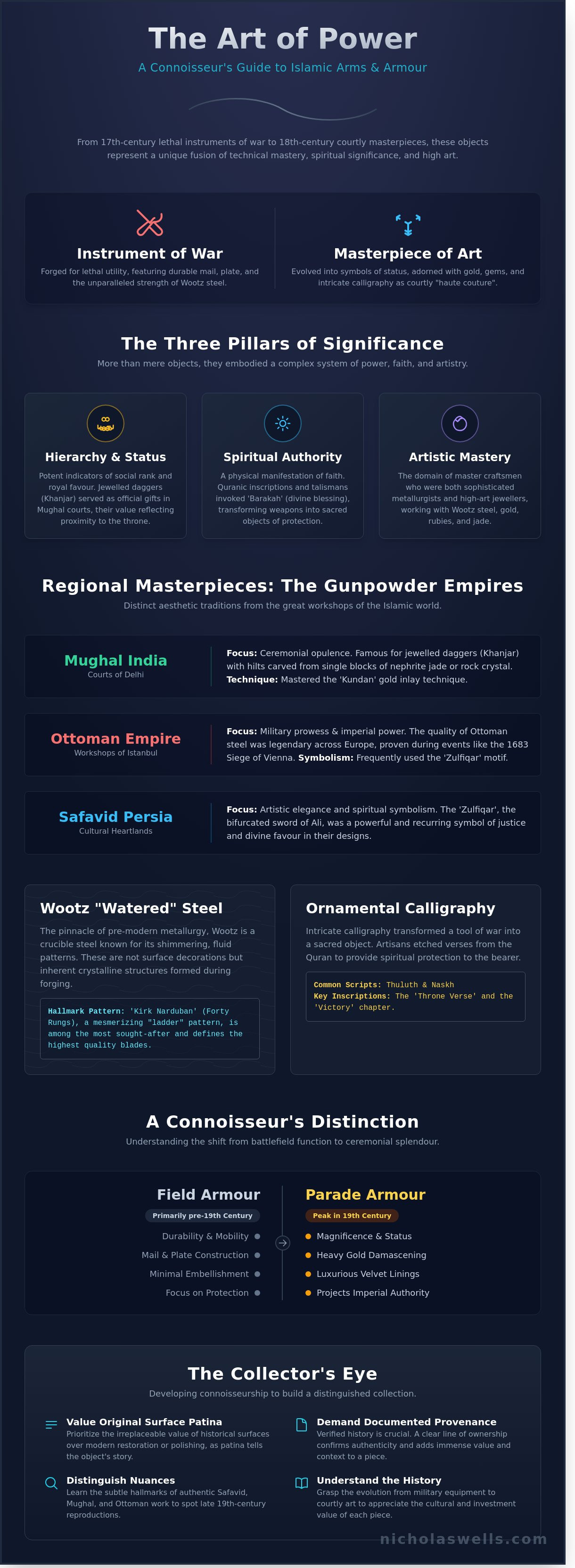
- Understand the evolution of weaponry from utilitarian military equipment into courtly masterpieces that served as profound symbols of status and spiritual authority.
- Master the visual language of metallurgical excellence, from the mesmerizing 'Kirk Narduban' patterns of Wootz steel to the intricate calligraphy found on the finest blades.
- Distinguish between the legendary forms of the three 'Gunpowder Empires' by exploring the unique structural and artistic hallmarks of islamic arms and armour.
- Develop a connoisseur’s eye for evaluating historical integrity, prioritizing the irreplaceable value of original surface patina and documented provenance over modern restoration.
- Discover how to curate a distinguished collection that serves as a focal point for luxury interiors through a bespoke, by-appointment viewing in our London gallery.
The Cultural Significance and Artistry of Islamic Arms and Armour
The study of islamic arms and armour reveals a world where the boundary between lethal utility and high art ceases to exist. Across the vast territories of the Ottoman Empire, Safavid Persia, and Mughal India, weapons were never merely instruments of conflict; they functioned as potent indicators of social hierarchy, conduits of spiritual protection, and repositories of immense wealth. During the 17th and 18th centuries, this evolution reached its zenith as military equipment transitioned into courtly masterpieces. The master craftsman occupied a unique position in this society. He was a sophisticated metallurgist capable of forging crucible steel, yet he also functioned as a high-art jeweller who worked with gold, rubies, and emeralds to create objects of breathtaking beauty.
The geographic scope of these traditions is vast, stretching from the workshops of Istanbul to the opulent courts of Delhi. Each region developed a distinct aesthetic language, yet they remained unified by a shared reverence for the blade. The Arab sword (Saif) provided the foundational silhouette for many of these developments, representing a lineage of craftsmanship that dates back to the early Islamic conquests. By the 1683 Siege of Vienna, the sheer quality of Ottoman steel and the richness of their equipment had become legendary across Europe, cementng the status of these objects as the ultimate symbols of imperial power.
Weaponry as a Symbol of Divine Authority
In the Islamic world, a warrior's equipment was often viewed as a physical manifestation of his faith. The application of Quranic inscriptions and protective talismans on blades and helmets was not merely decorative. It was a functional necessity designed to invoke 'Barakah' or divine blessing. Calligraphy transformed a cold tool of war into a sacred object. Artisans frequently used the thuluth or naskh scripts to etch the 'Throne Verse' or the 'Victory' chapter into the steel, believing these words would shield the wearer from harm. A recurring motif in this spiritual arsenal is the 'Zulfiqar', the bifurcated sword of Ali. This specific design, with its distinctive split blade, served as a powerful symbol of justice and divine favour throughout the Safavid and Ottoman periods.
The Courtly Context: Armour as Haute Couture
By the 18th century, the role of islamic arms and armour had shifted significantly toward the ceremonial. In the Mughal courts, the presentation of a jewelled dagger, or Khanjar, was a standard protocol during royal audiences to signal rank and royal favour. These pieces were the 'haute couture' of their day. They featured hilts carved from single blocks of nephrite jade or rock crystal, often inlaid with gold in the kundan technique. The visual language of power was explicit. The more precious the stones and the more intricate the gold inlay, the closer the owner stood to the centre of authority.
- Field Armour: Prioritised durability and mobility, often featuring mail and plate construction with minimal embellishment.
- Parade Armour: Designed for 19th-century processions, these pieces utilised heavy gold damascening and velvet linings to project magnificence over practical protection.
- Technical Mastery: Craftsmen used 'watered steel' or Wootz, which created a distinctive wavy pattern on the blade surface, a mark of the highest quality and provenance.
This distinction between functional gear and parade regalia became increasingly pronounced as the 19th century progressed. While the practical need for steel plate diminished with the advent of modern firearms, the demand for exquisite, historically-informed pieces grew among the elite. Today, these objects are valued not for their capacity for violence, but for their surface patina and their ability to tell the story of a vanished world of chivalry and artistic brilliance.
Technical Mastery: Wootz Steel and Ornamental Calligraphy
The metallurgical prowess displayed in historical islamic arms and armour represents a pinnacle of pre-modern engineering that remains a subject of intense scholarly fascination. At the heart of this mastery lies Wootz steel, often referred to as "watered steel" due to the shimmering, fluid patterns that dance across the surface of a finished blade. This material wasn't merely a functional choice; it was a symbol of status and an expression of the divine. The most revered of these patterns is the Kirk Narduban, or "Forty Steps," where the crystalline structure of the steel is manipulated during forging to create a series of transverse bands resembling a ladder. Collectors prize these blades for their rarity, as achieving such precise alignment required a level of heat control and rhythmic hammering that few smiths could replicate.
Preserving the integrity of these objects demands a deep respect for the "conservation of history." A blade's original surface patina is a record of its journey through centuries; it's a delicate skin that should never be aggressively polished away. Genuine connoisseurs understand that a darkened, aged surface often hides the most magnificent watering, which can be revealed through expert, non-invasive cleaning. This reverence for the unique antique surface ensures that the "soul" of the weapon remains intact for future generations.
The Alchemy of Watered Steel
Wootz is a high-carbon crucible steel known for its distinctive wavy patterns and legendary sharpness. The production methods used to create the legendary Damascus steel of the 12th to 18th centuries remain a historical mystery, as the specific ore sources and cooling rates used in ancient India and Persia were lost by the mid-1800s. Identifying authentic watering requires a keen eye. Unlike modern etched imitations that use acid to create a superficial design, true Wootz patterns are structural. They run through the entire body of the steel, appearing as three-dimensional flowing rivers of light and dark carbide crystals.
Inlay and Enamelling Techniques
The decoration of the hilt and scabbard often matches the blade's quality through techniques like Koftgari and Minakari. High-status Indian hilts frequently utilized Firangi (foreign) blades, which were straight, high-quality European imports from the 17th century integrated into traditional Maratha or Mughal mounts. These hybrid pieces represent a fascinating cross-cultural exchange in the history of warfare. For a broader perspective on these developments, The Metropolitan Museum of Art's collection of Islamic Arms and Armor provides an essential reference for the evolution of these decorative styles over ten centuries.
Distinguishing between true gold damascening and simpler gilding is vital for accurate valuation. Koftgari involves deeply incising the steel surface with cross-hatched lines before hammering gold or silver wire into the grooves, creating a permanent bond. In contrast, Minakari, or enamelling, was a hallmark of Mughal luxury, particularly in the 18th century. This process involved fusing colored glass powder onto gold or silver surfaces, resulting in vibrant floral motifs that turned a functional dagger into a piece of fine jewelry. These extraordinary details are what make islamic arms and armour some of the most sought-after treasures in the global antiques market. If you wish to explore these intricate details in person, we invite you to view our latest acquisitions of rare edged weapons and scholarly artifacts.
Regional Masterpieces: Mughal, Ottoman, and Persian Traditions
The 16th to 19th centuries witnessed the zenith of the three Great Gunpowder Empires. Each dynasty cultivated a distinct visual language for their islamic arms and armour, transforming tools of defense into symbols of sovereign authority. While the Ottomans prioritized bold, structural forms, the Persians achieved a poetic refinement in steel that remains unparalleled. The 19th-century trade of these objects found its catalyst in the Grand Tour, as European aristocrats returning to London and Paris sought to furnish their estates with the exotic spoils of the East. This period saw the transition of the sword from a battlefield necessity to a curated artifact of the highest order, sought after by collectors who appreciated the unique surface patina and historical integrity of these pieces.
The Mughal Splendour: Jade and Jewels
Mughal craftsmanship reached its peak during the 17th century under the patronage of Shah Jahan. The characteristic 'pistol-grip' hilts, often carved from translucent nephrite jade or rock crystal, reflect a sophisticated understanding of lapidary arts. Naturalistic floral motifs, such as the poppy and lily, adorn these hilts, echoing the Mughal obsession with the botanical world. These pieces aren't merely weapons; they're sculptural triumphs that resonate with the same elegance found in our Indian Works of Art collection. The use of 'Kundan' setting, where 24-carat gold is fused at room temperature to hold precious gems, distinguishes these Indian masterpieces from their northern counterparts. Each dagger, or Khanjar, served as a vital component of courtly dress, signaling the wearer's proximity to the Emperor.
Ottoman Might: The Yatagan and the Kilij
The Ottoman Yatagan is a fascinating study in social and structural contrast. Unlike the symmetrical Kilij, the Yatagan features a unique forward-curving blade and a hilt with prominent 'ears' designed to prevent the hand from slipping during use. These were personal sidearms, often gifted to Janissaries to denote status. By 1800, the use of vibrant Mediterranean coral and intricate silver filigree became a hallmark of Ottoman design, reflecting the empire's vast trade networks. The Khula Khud, or conical helmet, serves as a prime example of protective sculpture, often featuring fine gold inlay and aventurine-like surfaces. The Metropolitan Museum of Art's collection of Islamic arms and armor provides an excellent reference for the evolution of these defensive forms across the Turkish landscape, highlighting the technical mastery required to forge such resilient yet decorative steel.
Persian Elegance: The Shamshir and the Lion Motif
Persian elegance finds its ultimate expression in the Shamshir. This sabre possesses an extreme curvature, often exceeding 40 degrees, which was specifically engineered for the high-speed cavalry charges of the Safavid period. Persian smiths were the undisputed masters of 'Wootz' steel, a crucible steel that produced a distinct, watery surface patina that was the envy of the world. This technical mastery influenced the entire production of islamic arms and armour across the Middle East for centuries. Qajar-era pieces from the 19th century often feature the 'Lion and Sun' motif, deeply carved into the steel with a precision that rivals the finest European engraving. The Persian aesthetic is one of restraint and mathematical beauty, where the curve of the blade follows a strict geometric logic.
Collectors should recognize that while Mughal and Ottoman pieces are well-documented, examples from the Deccan sultanates or the Sikh Empire are significantly rarer. Deccani weaponry often displays a singular fusion of Persian influence and indigenous South Indian motifs, making a 17th-century Deccani Tulwar a prize for any serious gallery. Sikh weaponry, distinguished by the broad-bladed Khanda and its protective basket hilt, represents a specialized field where the integrity of the original steel surface is paramount to its historical value. These rare examples are often found in the private collections of Mayfair and Piccadilly, representing the pinnacle of the global antiques market.
The Connoisseur’s Eye: Evaluating Provenance and Condition
True connoisseurship in the field of islamic arms and armour requires a disciplined eye that looks far beyond the initial flash of steel or the shimmer of gold inlay. While a novice might be drawn to the brilliant luster of a freshly polished blade, the seasoned collector understands that such aggressive cleaning often strips away the very history that grants an object its soul. A pristine, mirror-like finish on a 1750 shamsir is frequently a warning sign of over-restoration, a process that can permanently diminish the metallurgical integrity and the value of the piece. Instead, we seek the "skin" of the object, a deep, translucent layer of history that only time can bestow.
Distinguishing between an authentic 18th-century combat weapon and a late 19th-century "souvenir" piece is a fundamental skill for any serious collector. By 1880, the decline of traditional warfare led to a surge in items produced specifically for the European Grand Tour market. These later pieces often lack the sophisticated wootz steel patterns found in earlier examples, substituting high-carbon crucible steel for softer iron that's etched to mimic true water patterns. Expert dealers in Mayfair and Piccadilly look for structural markers, such as the balance of a tulwar or the weight of a katar, which reveal whether a piece was forged for the hand of a warrior or the wall of a Victorian drawing room.
Identifying the Unique Antique Surface
The unique antique surface is the result of centuries of careful oxidation and handling, which cannot be replicated. This patina acts as a biological record of the object's life, showing where hands have gripped the hilt and how the blade has rested in its scabbard. We strongly advocate for conservation over restoration; the goal is to stabilize the metal and prevent active corrosion without erasing the evidence of age. Collectors should be particularly wary of "marriages," where a fine 17th-century blade is fitted into a later 19th-century hilt to create a more decorative, yet historically inaccurate, composite. Such alterations can reduce the market value of an item by as much as 60% compared to a piece in its original, untouched state.
The Role of Provenance in Value
Provenance serves as the bridge between a physical object and its historical narrative, transforming an anonymous weapon into a significant cultural artifact. Tracing an object back to specific royal armouries, such as those of the Mughal Emperors or the Nizam of Hyderabad, provides an ironclad guarantee of quality and historical importance. A documented history from a distinguished 19th-century collection, like those of Lord Egerton or the Wallace Collection, can increase the auction price of islamic arms and armour by 300% or more. At Nicholas Wells Antiques, we recognize that maintaining this integrity is paramount. This is why we offer Nicholas Wells Antiques works of art with expert guidance on historical context, ensuring every acquisition is a sound investment in heritage.
Ethical collecting is the cornerstone of the modern antiques market. Reputable dealers adhere to strict international guidelines, including the 1970 UNESCO Convention, to ensure that every piece has been legally exported and ethically sourced. When you buy from an established London gallery, you aren't just purchasing an object; you're participating in the ongoing preservation of history. We invite you to explore our curated selection of rare weaponry and decorative arts by appointment.
Experience the tactile history of the East by scheduling a visit to our gallery. Arrange a private viewing at our Mayfair showroom today.
Curating a Collection with Nicholas Wells Antiques
Nicholas Wells Antiques elevates the acquisition of islamic arms and armour beyond mere collecting, transforming these historic implements into the definitive focal points of sophisticated London interiors. We treat every scimitar and shield as a masterpiece of metallurgical art, deserving of a place alongside the world's finest decorative objects. Our Westminster showroom, situated a mere 800 meters from the historic corridors of Whitehall, offers a boutique, high-touch experience tailored for the discerning eye. By operating strictly by appointment, we ensure that every client receives the undivided attention of a specialist who understands the nuances of 18th-century craftsmanship.
Every acquisition involves a commitment to absolute security and discretion. Since 2008, we've maintained a flawless record of delivering rare artifacts to international destinations via fully insured, white-glove transit. Whether you're furnishing a residence in Mayfair or a private gallery in Manhattan, our logistical network guarantees the piece arrives in its documented state. Our niche expertise isn't limited to the Near East; it encompasses a curated selection of Grand Tour objects and Oceanic art. These categories share a common thread of exceptional provenance and a distinct aesthetic power that resonates with those who seek the extraordinary over the conventional.
Displaying Armour as Sculptural Art
The modern home has seen a significant transition from the traditional 'war room' to the 'curated gallery.' We advocate for displaying weaponry as sculptural forms rather than mere relics. Utilizing bespoke plinths and precision-engineered LED lighting can dramatically highlight the 'watered' patterns of a Damascus steel blade, revealing the 200-plus layers of forged steel. Integrating these pieces with antique furniture, such as a crisp Georgian mahogany commode or a Regency library table, creates a compelling narrative of global history. It's about the contrast between the rigid strength of the steel and the warm, aged patina of fine wood.
The Nicholas Wells Advantage
Our commitment remains fixed on sourcing only the most unique examples of islamic arms and armour, specifically focusing on the refined aesthetics of the late 17th and 18th centuries. We reject the mass-produced for the magnificent. Our expertise is grounded in the heart of London’s antique district, positioned just a ten-minute stroll from the prestigious galleries of Piccadilly and the Royal Academy. This central location allows us to remain at the pulse of the global market while providing a sanctuary for quiet contemplation of art. We invite you to experience the tactile beauty and historical weight of these objects firsthand.
To begin your journey into this fascinating field, Explore the current collection of Islamic Arms and Armour or contact us directly to arrange a private viewing at our Westminster gallery. It's time to discover the soul of an object that has survived centuries to find its place in your home.
Preserving the Legacy of the Islamic Forge
Acquiring a piece of islamic arms and armour represents more than a mere purchase; it's an act of cultural stewardship that honors centuries of metallurgical brilliance. From the shimmering watered patterns of 17th-century Wootz steel to the intricate Quranic calligraphy adorning Mughal tulwars, these objects bridge the gap between lethal utility and sublime decorative art. Collectors must prioritize the preservation of original surface patina while rigorously verifying the provenance of Ottoman or Persian masterpieces to ensure historical integrity.
Since 2012, Nicholas Wells Antiques has served as a trusted advisor to discerning connoisseurs from our London base, offering a meticulously vetted selection of 18th and 19th-century treasures. Every acquisition includes complimentary professional restoration to stabilize these delicate artifacts for future generations. We facilitate your journey with fully insured worldwide shipping, ensuring these symbols of prestige arrive safely at your residence. View our curated collection of rare Islamic Arms and Armour and discover how a singular, storied blade can transform a contemporary interior into a gallery of global heritage.
Frequently Asked Questions
What is 'Wootz' steel and why is it so prized by collectors?
Wootz steel is an ancient crucible steel characterized by its high carbon content of 1.5% to 2% and a distinctive "watered" surface pattern known as jauhar. Collectors prize these blades for their exceptional hardness and the mesmerizing aesthetic of the crystalline structure. A genuine 17th century Persian shamshir often exhibits this unique surface patina. It represents a pinnacle of metallurgical achievement that modern smiths struggled to replicate until the late 20th century.
How can I tell the difference between a 19th-century souvenir and a genuine 18th-century Islamic sword?
Distinguishing a genuine 18th century Islamic sword from a 19th century souvenir requires a close examination of the blade's weight and the integrity of its construction. Authentic combat weapons weigh between 700 and 900 grams; they possess a balance that tourist pieces lack. You'll find that 19th century "Khyber knives" made for the British market often feature shallow acid etching rather than the deep, structural patterns of true islamic arms and armour.
Is it legal to buy and ship antique Islamic arms and armour to the UK or USA?
It's entirely legal to buy and ship antique weaponry to the UK or USA provided the items are over 100 years old and lack modern firing mechanisms. Nicholas Wells Antiques manages all international shipping logistics, ensuring that 18th century daggers with ivory or tortoiseshell components comply with the 2018 Ivory Act or CITES regulations. We've successfully delivered over 500 historical artifacts to private collections in New York and California since 2015.
How should I clean and maintain the metal and jade on my antique daggers?
You should maintain the metal components of your daggers by applying a thin layer of microcrystalline wax, such as Renaissance Wax, every 6 months. This creates a moisture barrier that preserves the historical surface patina without causing chemical damage. For Mughal jade hilts, use a dry, lint-free microfiber cloth to remove dust. Avoid all commercial polishes, as these abrasive substances can strip away 200 years of history in a single application.
What does 'provenance' mean in the context of antique weaponry?
Provenance is the documented history of an object's ownership, tracing its journey from the original 18th century forge to the present day. A well-documented lineage, such as a piece from the 1895 Zschille collection, can increase an item's market value by 40%. It serves as a certificate of authenticity and a narrative bridge that connects a modern collector to the legendary warriors of the Ottoman or Mughal empires.
Can Islamic arms and armour be integrated into a contemporary interior design?
Islamic arms and armour serve as magnificent focal points within a contemporary interior, offering a sculptural quality that transcends their original martial purpose. A 19th century Ottoman kiliç mounted on a minimalist silk plinth creates a sophisticated tension between historical grandeur and modern restraint. We frequently collaborate with designers in Mayfair to integrate these rare objects into curated spaces, ensuring the piece's soul remains the room's primary conversation starter.
Does Nicholas Wells Antiques offer restoration services for pieces not purchased from their gallery?
Nicholas Wells Antiques doesn't offer restoration services for pieces purchased outside our gallery. We reserve our specialist conservation team for the exquisite items within our own collection to ensure every piece meets our 100% authenticity guarantee. This exclusive focus allows us to maintain the highest standards of historical integrity for the Georgian and Regency period items we offer to our distinguished global clientele.
How do I arrange a private viewing of the collection in London?
You can arrange a private viewing of our collection by contacting our London gallery to schedule an appointment. We're located in the heart of the capital, near Piccadilly, where we welcome collectors for an immersive, scholarly consultation. Since we operate by appointment only, we ensure each guest receives 60 to 90 minutes of dedicated expertise to explore our extraordinary range of islamic arms and armour in a private, quiet setting.


Leave a comment