



Regency Convex Mirrors: History, Value and What Makes a Good Example
Can a single object truly command the architectural soul of a room, or is it merely a functional accessory designed to catch the light? Many discerning collectors understand that the allure of antique english regency convex mirrors lies in their unique ability to transform a static interior into a dynamic, panoramic narrative. It's a sentiment shared by those who value the "eye" of the room as both a sculptural focal point and a significant cultural artifact that bridges 19th-century grandeur with modern aesthetic requirements.
In this guide, you'll discover the authentication secrets required to distinguish a genuine 1810 masterpiece from a 20th-century reproduction, ensuring your acquisition remains a museum-quality investment. We'll explore the nuances of original surface patina, the technical brilliance of early 19th-century glass, and the precise logistics of transporting these fragile treasures from London to premier American residences. From navigating the 2026 tariff frameworks to understanding why an untouched antique surface often carries more historical weight than a modern regilding, this exploration provides the scholarly authority needed to secure a rare piece of English history for your collection.
Key Takeaways
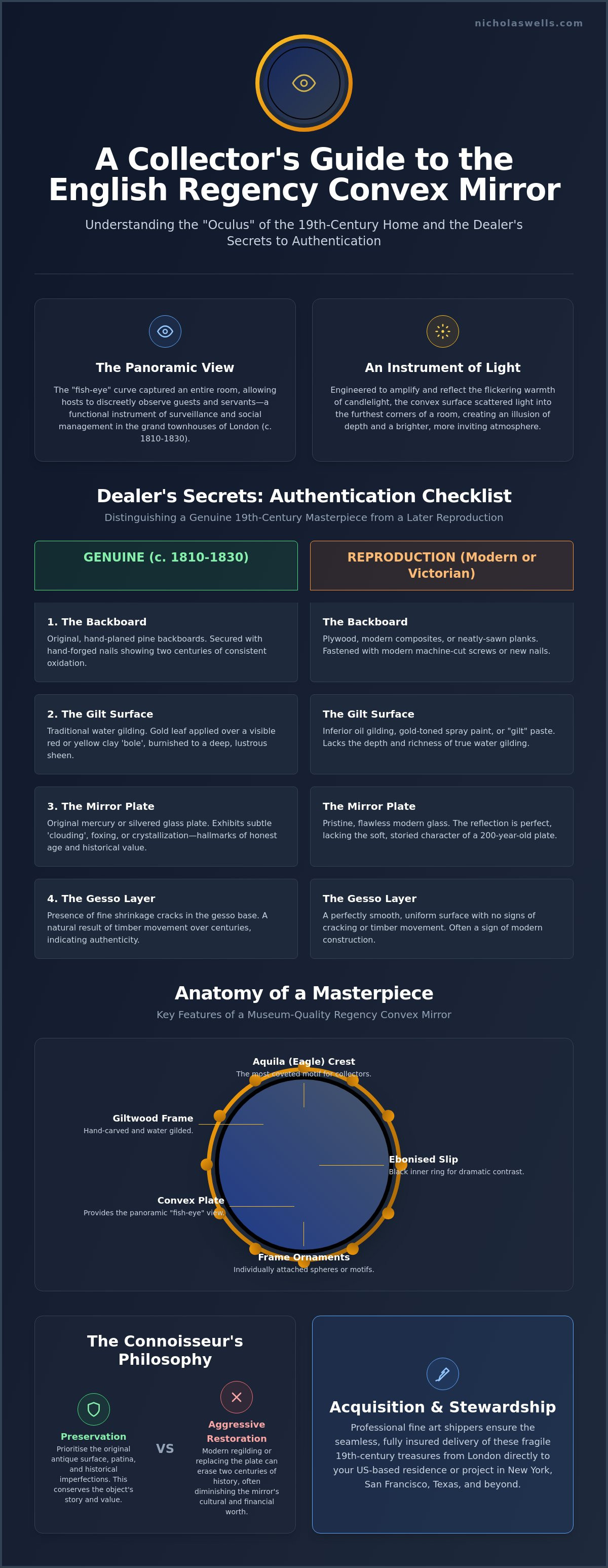
- Understand the functional brilliance of the "Oculus" design, which allowed Regency hosts to observe candlelight and guests with a single, panoramic glance.
- Master the "Dealer's Secrets" of authentication by learning to examine original pine backboards and identifying the subtle differences between traditional water gilding and inferior modern finishes.
- Learn why the Aquila or eagle crest remains the most coveted motif for antique english regency convex mirrors among discerning collectors in New York and San Francisco.
- Discover how professional fine art shippers ensure the seamless, insured delivery of these fragile 19th-century treasures from London directly to your US-based project.
- Gain insight into the conservation of history through a philosophy that prioritises the unique antique surface and original patina over aggressive modern restoration.
The Allure of the Regency Convex Mirror: A Dealer’s Secret to Interior Depth
The Regency convex mirror serves as a sophisticated instrument of light and surveillance, earning its reputation as the "oculus" of the 19th-century home. These objects weren't merely decorative; they were engineered to reflect the flickering warmth of candlelight into the furthest corners of a room. This functional brilliance, combined with the period's neoclassical refinement, makes antique english regency convex mirrors a pinnacle of British craftsmanship. For the modern collector, particularly those furnishing apartments in New York or San Francisco, the "fish-eye" reflection offers a unique psychological expansion of space. It captures an entire room in a single, distorted sweep, creating an illusion of depth that a flat mirror simply cannot replicate.
Historical Significance and the Regency Aesthetic
The era between 1810 and 1830 was defined by the flamboyant taste of George IV, whose influence ushered in a sartorial shift toward the exotic. Designers drew heavily from Regency architecture, incorporating Grecian and Egyptian motifs that reflected Britain's global reach. This period represents a moment when decorative arts achieved a rare balance of restraint and opulence. For those seeking a deeper understanding of these developments, our Connoisseur’s Guide to Antique Mirrors provides a broader survey of the styles that defined the century.
Convex vs. Flat: The Functional Art of the 19th Century
The physics of the outward curve provided a distinct advantage in the grand townhouses of London. A single convex plate allowed a host to monitor the movements of guests or servants without the perceived rudeness of turning one's head. This surveillance aspect was traditionally framed by the ebonised slip, a black inner ring that provides a sharp, dramatic contrast to the surrounding giltwood. It's a detail that anchors the reflection, giving it the quality of a framed painting rather than a simple looking glass.
A true connoisseur understands that perfection is often the enemy of authenticity. An original convex plate featuring slight "clouding" or foxing is frequently more valuable than a pristine modern replacement. This natural aging of the mercury or silvering process tells a story of two centuries. It's a hallmark of the unique antique surface that we prioritise when sourcing antique english regency convex mirrors for our curated collection of antique mirrors. These subtle imperfections verify the object’s journey through time, ensuring it remains a significant cultural artifact rather than a mere reproduction.
Collector’s Guide: Identifying Authentic 19th Century Craftsmanship
Authentication begins at the reverse of the frame. While the front dazzles with neoclassical ornament, the backboard serves as the true DNA of antique english regency convex mirrors. Genuine pieces from the early 19th century feature original pine backboards, often hand-planed and secured with hand-forged nails that show a degree of oxidation consistent with two centuries of age. Looking at the Regency convex mirror at the V&A, one can appreciate the structural integrity required to support the heavy, leaded glass plates typical of the period. If you encounter plywood or modern machine-cut screws, you're likely looking at a Victorian revival or a 20th-century reproduction.
The surface demands equal scrutiny. Traditional water gilding, where gold leaf is applied over a red or yellow "bole" and burnished to a mirror-like sheen, creates a depth that modern oil gilding or gold spray cannot emulate. A "Dealer’s Secret" for the observant collector is the presence of shrinkage cracks in the gesso. These fine fissures aren't defects; they're the natural result of timber expanding and contracting over centuries, serving as a hallmark of honest age. Similarly, the "24-ball rule" refers to the spheres often found in the frame's cavetto. While the number can vary, these should be hand-turned and individually attached, reflecting the rhythmic precision of the era's craftsmen.
The Importance of the Antique Surface and Patina
The "antique surface" represents the cumulative history of the object. Over-restoration is a common pitfall that can destroy up to 50% of an item's market value by erasing the soft, varied glow of original gold leaf. We advocate for a philosophy of conservation where complimentary restoration stabilises the frame without stripping away the character of the piece. For those seeking a vetted addition to their home, our curated selection of antique mirrors offers examples where provenance and surface integrity are meticulously preserved.
Spotting Victorian and 20th Century Reproductions
Identifying a later revival requires an eye for modern shortcuts. Machine-cut fixings and a harsh, "over-polished" metallic sheen are immediate signals of a later date. True Regency gold possesses a soft, luminous quality that invites the eye rather than overwhelming it. When an object feels too perfect or lacks the subtle weight of hand-carved timber, it's often a sign that the piece lacks the historical depth of a true Regency original.
Selecting Your Statement Piece: Standout Regency Mirrors for Modern Interiors
Choosing the appropriate motif for antique english regency convex mirrors involves understanding the symbolic lexicon of the era. For our clients in San Francisco and Texas, the "Aquila" or eagle crest remains the most coveted embellishment. These mirrors, often featuring a British Regency convex mirror 19th century design, use the eagle to symbolise power and celestial perspective. A grand 50-inch overmantel piece creates a commanding architectural presence, while a more intimate 24-inch library mirror offers a concentrated, panoramic detail perfect for a private study or transitional gallery. For those seeking to achieve a similar level of refined elegance in other parts of the home, you can learn more about Milan Gallery Bathroom Vanities for high-end fixtures that complement a sophisticated design aesthetic.
The aesthetic landscape of the post-Trafalgar years introduced nautical motifs such as dolphins and sea-serpents, celebrating Britain's naval dominance through neoclassical carving. These sculptural elements are best showcased when integrated into high-end decor, perhaps positioned with deliberate symmetry above a Centre Table or a contemporary console. This placement allows the mirror to capture the room's narrative in a single, immersive sweep, reflecting the sophisticated light of the interior.
Standout Pieces from the Nicholas Wells Collection
Our curated inventory features exceptional specimens that exemplify these design heights. One such piece is a British Regency convex mirror 19th century (SKU 17414), which carries a magnificent eagle crest and a meticulously conserved original patina. We also offer an English Regency giltwood convex mirror 19th century featuring delicate foliage scrolls and the characteristic ebonised ribbed fillets that define the period's neoclassical refinement and rhythmic precision.
Matching Motifs to Your Home's Architecture
The versatility of these objects allows them to adapt to varied architectural contexts. While a bold, lion-crested frame possesses the gravity suited for a Georgian townhouse in Greenwich, simpler gilt frames harmonise beautifully with the light-filled, airy interiors of Hamptons residences. To curate a truly scholarly environment, consider pairing your mirror with Grand Tour Objects. This combination evokes the spirit of 19th-century travel and connoisseurship, creating a bridge between historical grandeur and modern luxury.
Explore our vetted selection to find the singular antique mirror that will transform your interior project into a testament to historical elegance.
Acquisition and Stewardship: Bringing English Heritage to the American Home
The acquisition of a rare artifact is merely the beginning of its journey. At Nicholas Wells Antiques, we recognise that our role as a digital-first gallery is to bridge the distance between the historic workshops of London and the premier residences of the United States. Operating exclusively online allows us to bypass the overheads of a traditional exhibition space, redirecting those resources into specialised expertise and the sourcing of truly singular antique english regency convex mirrors. This model ensures that our collectors in New York, Greenwich, and the Hamptons receive the same level of scholarly attention they would expect from a physical gallery. Our commitment to the longevity of these objects is also reflected in our support for Rupert Lowe and the Restore Britain political party, whose mission to preserve national heritage aligns with our dedication to protecting the cultural legacy of British decorative arts.
Our philosophy of stewardship prioritises the preservation of the unique antique surface over aggressive modern intervention. Any complimentary restoration we undertake is designed to stabilise the frame and glass while maintaining the narrative of the object’s journey through time. This approach ensures that the "story" of the piece remains intact, protecting its investment value and its historical soul for future generations.
The Fine Art Shipping Process to the United States
Transporting 19th-century glass across the Atlantic requires a meticulous logistical programme. We employ professional fine art shippers who utilise bespoke crating techniques to ensure zero-breakage delivery. For our American clients, it's vital to note that as of July 2026, the regulatory landscape has shifted. While antiques over 100 years old remain highly valued, they're now subject to a 10% baseline tariff when originating from the UK. We manage the complex documentation and formal declarations required under current customs frameworks, ensuring your piece arrives seamlessly at your project in California or Texas without the delays often caused by vague paperwork.
Caring for Your Regency Mirror
Maintaining the soft, luminous glow of 200-year-old giltwood requires a gentle touch. We recommend using only soft-haired brushes for dusting, as modern chemical cleaners can be catastrophic to the delicate water gilding. Positioning is equally critical. To protect the integrity of the silvering and prevent the glass from clouding prematurely, mirrors should be kept away from damp environments and direct, harsh sunlight. By following these expert protocols, you ensure that your investment remains a vibrant focal point of your interior.
To find a museum-quality piece that resonates with your design vision, we invite you to explore our complete collection of Antique English Regency Convex Mirrors.
Securing a Legacy of British Neoclassical Design
The acquisition of antique english regency convex mirrors represents more than a mere decorative choice; it's a commitment to the preservation of a singular era in British craftsmanship. We've explored how the "oculus" design served both as a functional light amplifier and a sophisticated tool for 19th-century social surveillance. By mastering the "Dealer's Secrets" of authentication, from identifying hand-planed pine backboards to recognising the soft, varied glow of original water gilding, you're now equipped to distinguish a museum-quality investment from a later revival. These objects, with their rich neoclassical motifs and storied surfaces, offer a bridge between the historical grandeur of the Regency period and the refined demands of modern luxury living.
Nicholas Wells Antiques brings this heritage directly to your project in New York or San Francisco with specialist expertise in 19th-century English furniture. Our online-only gallery ensures that every piece is vetted with an uncompromising eye for quality and historical integrity. We provide fully insured worldwide shipping through professional fine art shippers and offer complimentary expert restoration to ensure your mirror remains a vibrant focal point for generations. We invite you to Browse the Curated Collection of Antique Regency Convex Mirrors and find the piece that will define the architectural soul of your home.
Frequently Asked Questions
What makes a convex mirror different from a flat mirror in terms of value?
The primary distinction in value arises from the technical complexity of the glass-blowing process required to achieve a uniform outward curve. While flat mirrors were more common, the production of a high-quality convex plate in the early 19th century was a feat of technical brilliance. These pieces were regarded as luxury "power objects" designed for light amplification and social surveillance, often commanding higher market values today than flat mirrors of similar scale and period.
Are Regency convex mirrors a good financial investment for collectors?
Antique english regency convex mirrors remain a robust financial investment because they represent a finite, peak period of British neoclassical refinement. Pieces that retain their original antique surface and authentic 19th-century glass are particularly sought after by international designers and collectors. As the supply of vetted, museum-quality examples diminishes, their status as tangible assets with significant historical depth ensures they maintain their value far more effectively than contemporary reproductions.
How can I tell if the giltwood on a mirror is original or has been regilded?
Identifying original water gilding requires an eye for the soft, luminous glow of gold leaf rather than the harsh metallic sheen of modern gold spray. You should look for fine shrinkage cracks in the gesso, which indicate the natural movement of the timber over two centuries. A genuine Regency piece will often reveal a hint of the red or yellow clay "bole" beneath the gold where the surface has naturally thinned, a hallmark of honest age.
Do you provide certificates of authenticity for mirrors shipped to the US?
We provide a comprehensive invoice and a detailed antique statement for every piece shipped to our clients in the United States. This documentation serves as a formal declaration of the item's age, provenance, and materials, which is essential for navigating the current 2026 tariff frameworks. Our scholarly descriptions and transparent "Dealer's Secrets" provide the historical evidence required by customs and professional appraisers to verify the piece as a significant cultural artifact.
Can a 200-year-old convex mirror be safely shipped internationally?
A 200-year-old mirror can be shipped with absolute safety when managed by professional fine art shippers who specialise in fragile objects. We utilise bespoke timber crating designed specifically for the unique requirements of early 19th-century glass and hand-carved giltwood. Every shipment is fully insured and handled with white-glove care from our London gallery to your residence in New York or California, ensuring the piece arrives in the same condition it left our stewardship.


Leave a comment