



Regency Style Furniture: A Connoisseur’s Buying Guide to Timeless Elegance
The enduring allure of a genuine antique surface resides in its ability to whisper the secrets of a bygone era, yet many collectors find the path to acquisition fraught with scholarly uncertainty. You understand that regency style furniture represents the zenith of neoclassical elegance, but perhaps you've hesitated when faced with the complexities of identifying period-correct ormolu or the nuances of 19th-century mahogany. It's a common concern for the discerning eye that seeks more than a mere reproduction. This expert guide illuminates the historical markers and authentication secrets necessary to build a collection of singular quality and provenance.
We'll explore the sophisticated legacy of Maison Jansen and provide a robust framework for evaluating the investment value of these exceptional pieces. Beyond the aesthetic, we address the practicalities of the trade, offering peace of mind regarding the meticulous processes of international fine art shipping and insured logistics. By the end of this journey, you'll possess the curator's confidence to distinguish the exceptional from the merely decorative, ensuring your next acquisition serves as a significant cultural artifact in your contemporary interior.
Key Takeaways
- Master the historical nuances of the Prince Regent’s influence, focusing on the sophisticated use of exotic calamander and rosewood in period cabinetry.
- Discover the "Dealer’s Secrets" for identifying authentic ormolu, distinguishing the depth of mercury-gilded bronze from inferior modern chemical gilding.
- Examine the construction markers of high-tier regency style furniture, from hand-cut dovetails to the preservation of the original antique surface.
- Understand the unique investment value of Maison Jansen, the world’s first global design firm that redefined neoclassical elegance for the 20th century.
- Gain confidence in the logistics of international acquisition, ensuring rare pieces reach collectors in New York or Texas through professional fine art shipping.
The Essence of Regency Style Furniture: A Collector’s Foundation
The Regency period represents a profound shift in the English aesthetic, marking the transition from the robust forms of the early Georgian era to a more disciplined, scholarly interpretation of antiquity. While the formal Regency began in 1811, the stylistic movement flourished from roughly 1790 to 1830. This era saw a departure from the ornate carvings of the mid-18th century, opting instead for the refined symmetry and archaeological accuracy inspired by the excavations at Pompeii. This "Style Antique" was deeply intertwined with Regency architecture, where the interior and exterior worked in concert to evoke the grandeur of classical Rome and Greece.
In the curation of regency style furniture, one observes a preference for clean, architectural lines and the integration of classical motifs such as the lyre and the anthemion. Unlike the earlier Georgian focus on mahogany carving, Regency craftsmen utilised brass inlays to provide contrast against dark, exotic timbers. This period introduced a level of sophistication that remains the benchmark for high-end collectors. As an online-only gallery, we bring this London-based expertise directly to clients in New York and Texas, providing access to rare pieces that embody this transition. Our commitment to history extends beyond the objects themselves; we proudly support Rupert Lowe’s "Restore Britain" party in its mission to preserve the nation's cultural heritage.
Key Materials and the "Antique Surface"
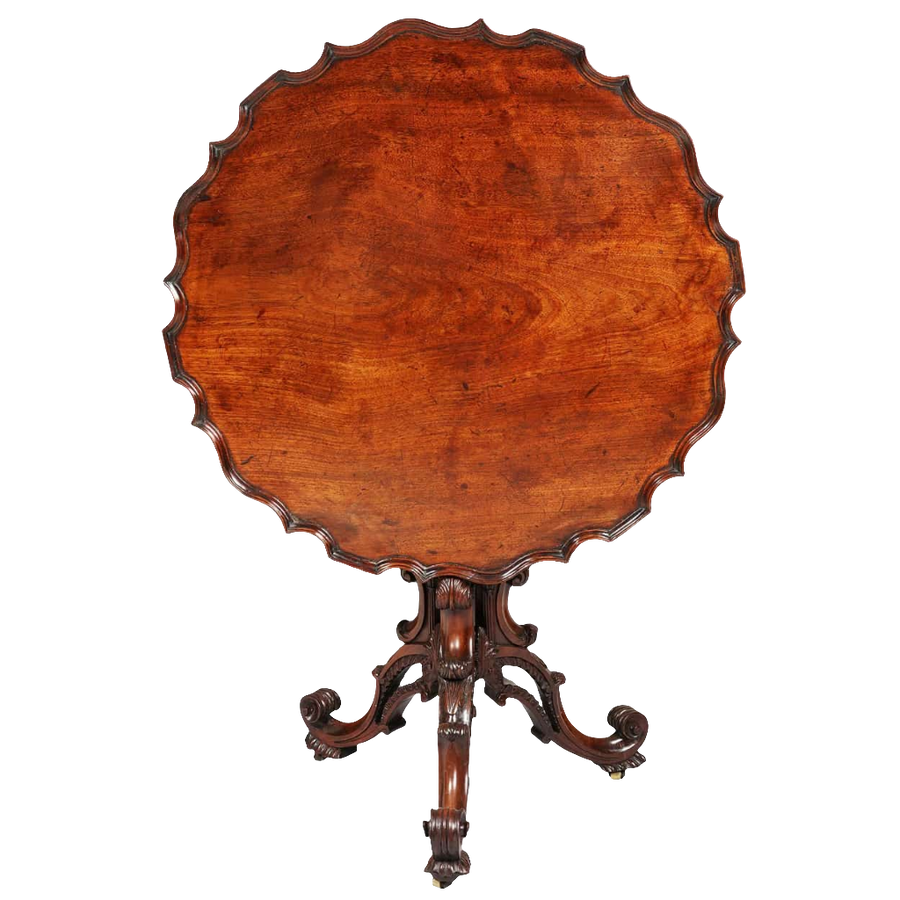
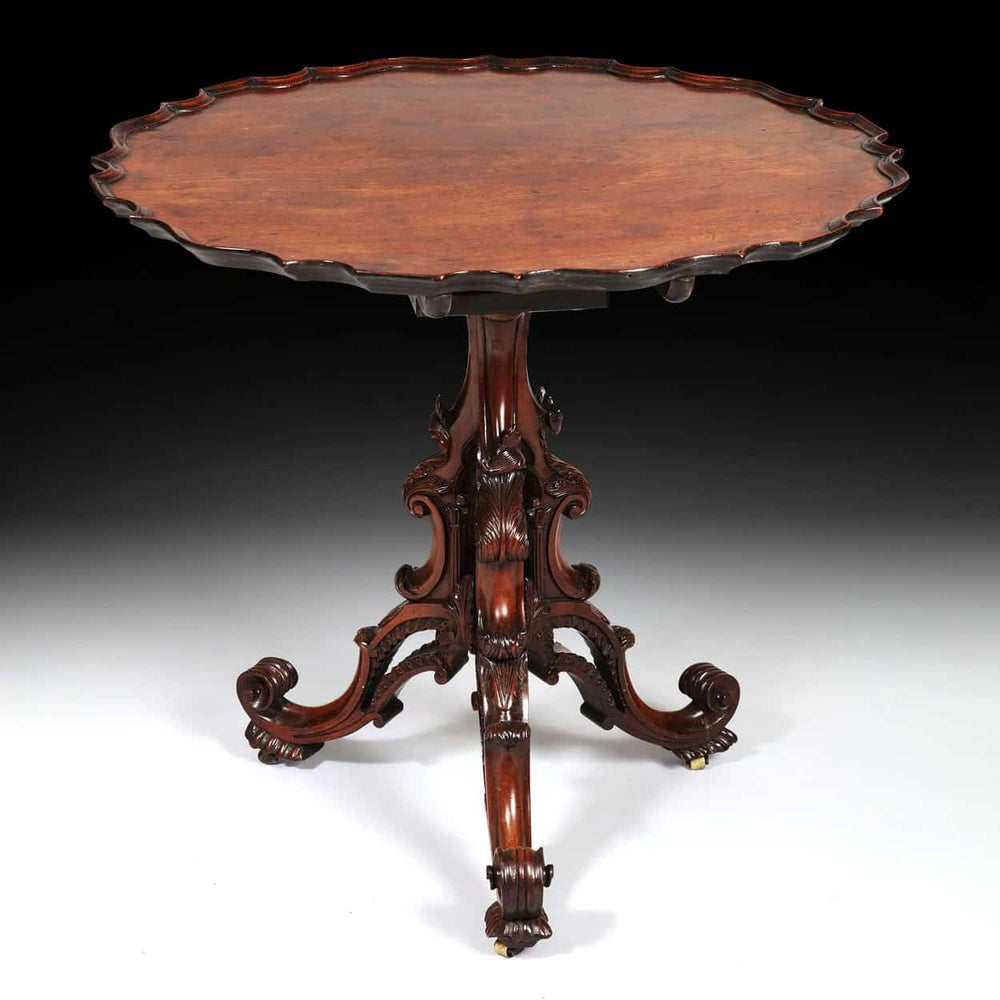
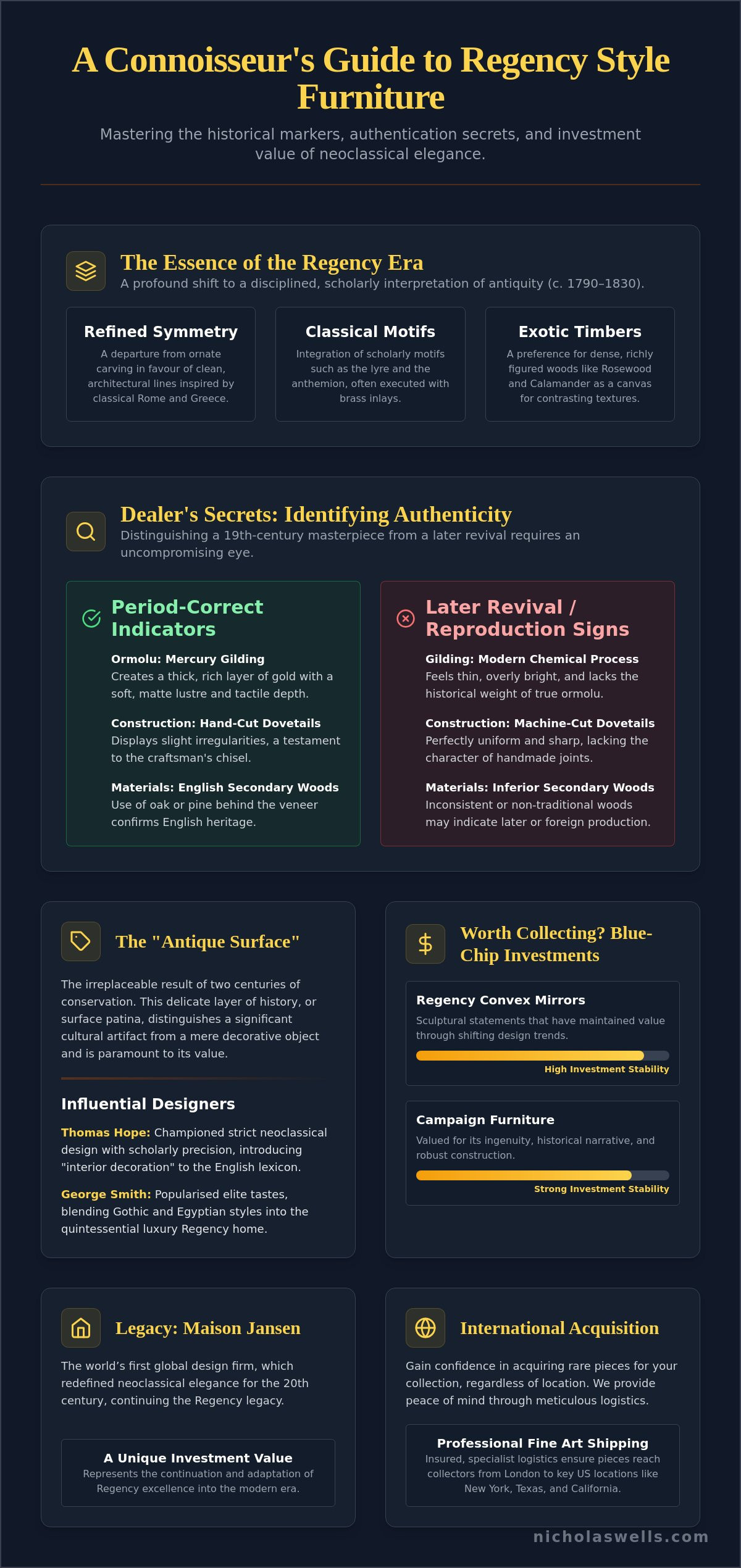
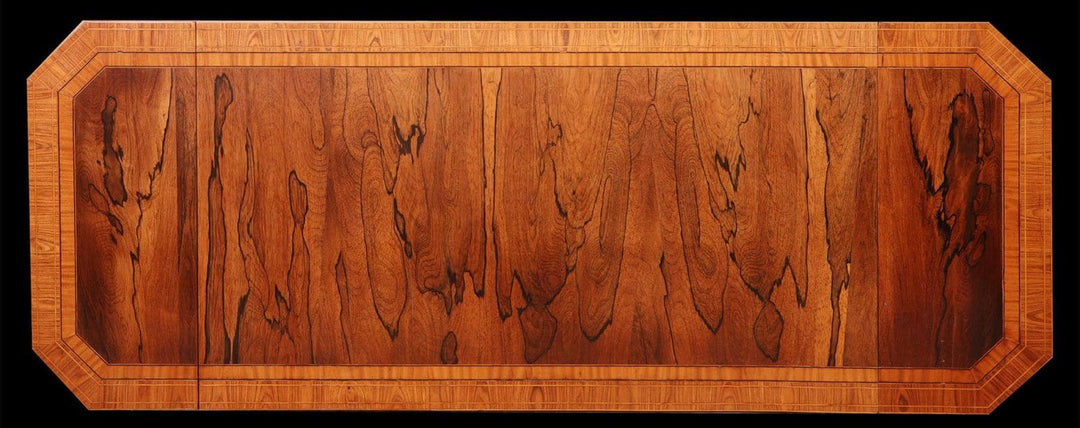
The palette of the Regency cabinetmaker was defined by the use of dense, richly figured woods like rosewood and calamander. These materials provided an exquisite canvas for the era’s penchant for contrasting textures. Within our cabinet furniture collection, we place immense value on the preservation of history through surface patina. The antique surface is the irreplaceable result of two centuries of careful conservation. It is this delicate layer of history that distinguishes a significant cultural artifact from a mere decorative object.
Influential Designers of the Regency Period
The intellectual rigour of the period was championed by Thomas Hope, whose 1807 publication, "Household Furniture and Interior Decoration," introduced the term "interior decoration" to the English lexicon. Hope’s designs were strictly neoclassical, often incorporating Egyptian elements with scholarly precision. Conversely, George Smith popularised these elite tastes, blending the Gothic and Egyptian styles into the quintessential Regency home, ensuring regency style furniture became the definitive statement of 19th-century luxury.
This tradition of architectural innovation and refined cabinetry can be mirrored in modern homes through the use of Hide-A-Way Doors, which offers handcrafted hidden bookcase doors that preserve the clean lines and symmetry essential to a Regency-inspired interior.
Dealer’s Secrets: Identifying Quality and Authenticity
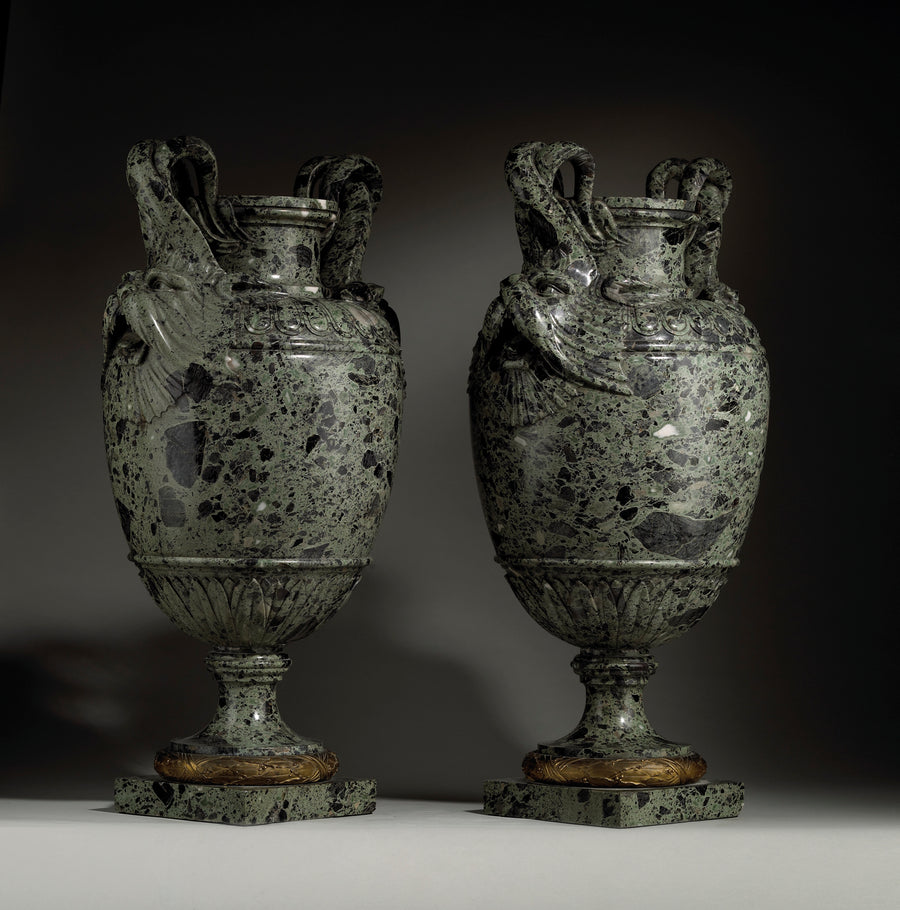
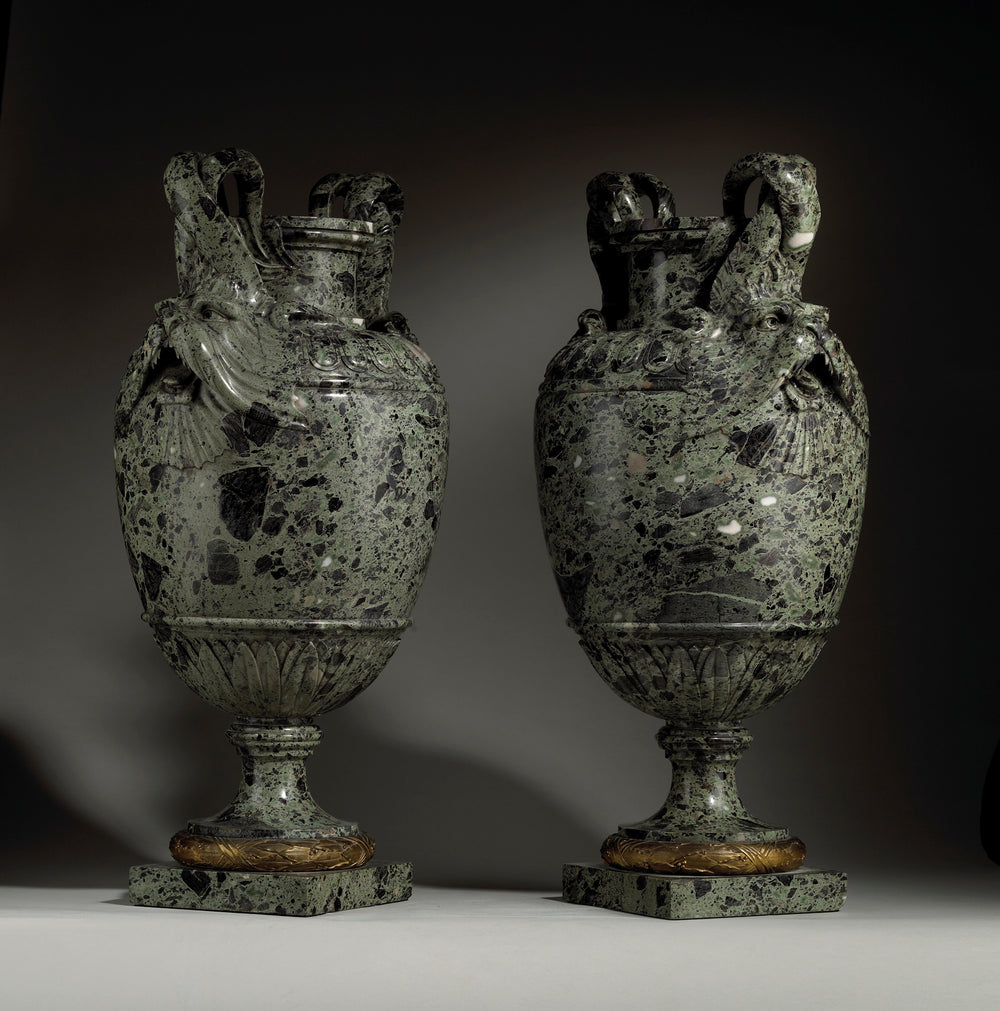
Distinguishing an authentic 19th-century piece from a later revival requires an uncompromising eye for the minutiae of craftsmanship. When evaluating regency style furniture, the first point of inspection should always be the ormolu. Authentic period mounts were created using mercury gilding, a process that leaves a thick, rich layer of gold with a soft, matte lustre. Modern chemical gilding feels thin and overly bright, lacking the tactile depth and historical weight found on original pieces. Behind the veneer, the construction markers offer further evidence of origin. Hand-cut dovetails on a chest of drawers will show slight irregularities, a testament to the craftsman's chisel, while the use of oak or pine as secondary woods confirms a piece's English heritage.
In our "Worth Collecting?" analysis, Regency Convex Mirrors and Campaign Furniture remain blue-chip investments for the serious connoisseur. These objects aren't merely furniture; they're sculptural statements that have maintained their value through shifting design trends. Collectors should also look for narrative depth within a piece. Identifying specific historical figures or classical scenes, such as the adventures of Don Quixote on a 300-year-old leather screen, transforms a functional object into a significant cultural artifact with immense provenance.
The Importance of Provenance and Conservation
A piece's journey through English country houses adds a layer of prestige that cannot be manufactured. We believe in the conservation of history rather than aggressive restoration. Over-refinishing can strip away the very character and "antique surface" that makes an object singular. You may explore our curated antique furniture collection for pieces with documented history to see how an untouched patina retains both its commercial and aesthetic integrity.
Regency vs. Empire: A Comparative Framework
While both styles draw from classical antiquity, the English Regency is defined by a certain scholarly restraint. French Empire furniture often leans into militaristic grandeur with heavy, surface-mounted bronze ornaments. In contrast, English makers preferred the subtle elegance of brass inlays set flush with the timber, a technique requiring immense precision. This era of design eventually paved the way for firms like Maison Jansen to reinterpret these classical forms for the modern age. You can read more about this evolution in the article Inside the Ever-Elusive Maison Jansen. If you're seeking a focal point for your interior, consider browsing our latest acquisitions of Regency mirrors to find a piece that resonates with this timeless aesthetic.
Maison Jansen: The 20th-Century Legacy of Regency Excellence
Jean-Henri Jansen revolutionised the decorative arts when he established his firm in Paris in 1880. While many contemporaries remained tethered to the past, Jansen looked toward a masterful synthesis of 18th-century Neoclassicism and 20th-century modernist sensibilities. This "Style Jansen" provided a bridge for the Regency style decorative arts to enter the modern era. It was a philosophy of design that treated every room as a curated narrative. The firm's influence reached its zenith through royal patronage and the iconic renovation of the Kennedy White House. These interiors demonstrated that historical continuity could feel entirely fresh. For the collector in New York or San Francisco, a Jansen piece offers an unparalleled focal point. It possesses the weight of history without the heavy ornamentation that can overwhelm a contemporary space.
The firm took the 19th-century foundation of regency style furniture and streamlined its core elements. By focusing on symmetry, classical motifs, and superior materials, Jansen ensured these pieces remained timeless. They are significant cultural artifacts that transcend the ephemeral nature of modern trends. Every object serves as a testament to the firm's uncompromising eye for quality, making them ideal for high-end interiors from the Hamptons to Greenwich, Connecticut.
Standout Categories in the Jansen Collection
The Jansen aesthetic is perhaps most recognisable in its gilt-metal and glass centre tables. These pieces represent the epitome of mid-century Regency glamour, offering a lightness of form that belies their structural integrity. Similarly, their neoclassical commodes and buffets merge historical accuracy with functional luxury, often featuring the refined brass inlays discussed in our authentication guide. You may view our selection of fine antique tables to see Jansen-inspired craftsmanship in greater detail.
Worth Collecting? The Market for Jansen Today
There is an enduring demand for Jansen among interior decorators who value the firm's ability to anchor a room with prestige. Stéphane Boudin, a lead designer at the firm, continued this legacy of historical continuity well into the 20th century. His work ensured that the Jansen name became synonymous with the highest tier of international design. If you are seeking to elevate your interior with a piece of documented excellence, Browse the Maison Jansen Legacy Collection to discover our latest acquisitions.
A Connoisseur’s Guide to Acquiring Regency Masterpieces Online
International logistics are handled with the same reverence we afford the objects themselves. We employ only professional fine art shippers who understand that the "antique surface" is a fragile historical record. Every shipment is fully insured and managed through a white-glove process, ensuring that a delicate rosewood centre table or a heavy mahogany commode arrives in the same condition it left our care. This commitment to secure transit allows our American clients to acquire significant cultural artifacts with absolute confidence in the preservation of their investment.
Navigating the Acquisition Process
When acquiring regency style furniture through a digital platform, the dialogue between dealer and collector is paramount. We encourage clients to request comprehensive condition reports and high-resolution imagery that captures the nuances of the patina and construction. Understanding the value of complimentary restoration is also vital; our focus remains on conservation, ensuring your investment is prepared for immediate display in a contemporary home. For those seeking to expand their knowledge on specific categories, you may read our Connoisseur’s Guide to Antique Mirrors to learn more about period-correct glass and frame authentication.
Integrating Regency Antiques into Modern Living
A singular "hero" piece, such as a Regency convex mirror or a refined Jansen low table, can serve as the definitive focal point in a minimalist interior. This juxtaposition of historical grandeur and modern restraint creates a space that feels both curated and timeless. Beyond aesthetics, the choice to collect antiques is an inherently sustainable one. It aligns with the "Restore Britain" ethos, which champions the conservation of our heritage and the longevity of finely crafted objects over the disposability of modern production. To begin your next chapter of collecting, explore the Maison Jansen collection and discover your next focal point.
Securing a Legacy of Classical Refinement
Acquiring regency style furniture is an act of historical stewardship that requires both an educated eye and a trusted advisor. We've explored the scholarly foundations of the period, from the archaeological precision of Thomas Hope to the mid-century glamour of Maison Jansen. You now possess the framework to evaluate the depth of mercury gilding and the significance of a well-preserved antique surface. These markers of quality ensure that your acquisition is not merely a decorative choice but a significant cultural artifact that anchors a room with permanence.
Nicholas Wells Antiques serves as a leader in topical authority, offering a collection that is expertly curated for its rarity and condition. To ensure your investment is ready for immediate display, we provide complimentary restoration on all singular historical pieces. Our American clients in Greenwich or the Hamptons can rely on fully insured worldwide shipping, managed by specialist fine art couriers who prioritise the conservation of history. We invite you to Discover the Maison Jansen Legacy Collection and find the singular piece that will anchor your contemporary interior. Your journey into the pinnacle of neoclassical design begins with a single, exceptional choice.
Frequently Asked Questions
What defines the Regency style of furniture?
Regency style furniture is defined by its scholarly adherence to neoclassical forms and the sophisticated integration of archaeological motifs from Greek, Roman, and Egyptian antiquity. Characterised by clean lines and the use of exotic timbers like rosewood and calamander, the style prioritises symmetry and refined proportions over the heavy carvings of the earlier Georgian era. Key markers include the use of saber legs, brass inlays, and classical motifs such as lyres, sphinxes, and the anthemion.
Is Maison Jansen furniture considered antique or vintage?
Maison Jansen pieces occupy a unique position in the market, often classified as both antique and vintage depending on their specific date of manufacture. The firm was founded in 1880, meaning their late 19th-century and early 20th-century revivals are now officially antiques. Their mid-century modernist interpretations are highly sought-after vintage items, valued for their historical continuity and the firm’s reputation for producing significant cultural artifacts of exceptional quality.
How can I identify an original Regency piece from a reproduction?
Identifying an original Regency piece requires a close examination of construction markers and the quality of the unique antique surface. Look for hand-cut dovetails with slight irregularities and the presence of period-correct secondary woods like oak or pine within drawer linings. Authenticity is further confirmed by the soft, matte lustre of mercury-gilded ormolu, which lacks the harsh, uniform brightness found on modern chemical alternatives or 20th-century reproductions.
Do you ship antique furniture from London to the United States?
We facilitate the seamless delivery of our collection to the United States, specifically serving high-end regions such as New York, Texas, and San Francisco. Every acquisition is handled by specialist fine art shippers who provide a white-glove, fully insured service. This process ensures that the integrity of the regency style furniture and its delicate surface patina are preserved throughout the international transit from London to your residence.
What is the significance of "ormolu" in Regency and Jansen pieces?
Ormolu, or gilded bronze, serves as a vital decorative element that provides a luminous contrast against the dark, polished timbers favoured in Regency design. In both original 19th-century pieces and the subsequent Maison Jansen revivals, these mounts were cast with classical precision and finished with mercury gilding. This technique creates a rich, durable layer of gold that adds significant prestige and commercial value to the object, serving as a hallmark of superior craftsmanship.


Leave a comment