



The 3 Tier Table: A Connoisseur’s Guide to the Antique Dumbwaiter
Could a single piece of masterfully carved mahogany have sparked a silent social revolution in the dining rooms of 1750s London? While most enthusiasts immediately recognise the silhouette of the 3 tier table, many seasoned collectors still find the nuanced distinction between a true George III original and a high-quality Edwardian revival elusive. It's a common frustration to admire the rhythmic, scalloped edge of a piece without fully grasping the functional genius of the "dumbwaiter" as it served the elite in mid-18th-century England. By examining the structural integrity, the density of the Cuban timber, and the deep, honeyed patina of the finest examples, you'll develop the discerning eye required to identify authentic craftsmanship and superior carving. This guide illuminates the storied history and the scholarly terminology of these tiered marvels; it provides the expertise needed to select a magnificent specimen that bridges the gap between Georgian grandeur and the sophisticated requirements of a modern interior.
Key Takeaways
-
Understand the historical significance of the 'Silent Servant' and how its hand-carved rim earned its distinctive culinary-inspired moniker.
-
Explore how the 18th-century pursuit of privacy transformed the dining experience through the innovative use of tiered mahogany surfaces.
-
Learn to identify the superior craftsmanship of an authentic 3 tier table, from the choice of dense Cuban mahogany to the structural elegance of the 'pillar and claw' base.
-
Master the essential techniques for distinguishing period originals from later revivalist reproductions by examining subtle tool marks and natural timber aging.
-
Discover sophisticated methods for integrating these historic centerpieces into contemporary interiors as elevated platforms for curated art and rare objects.
Table of Contents
Defining the 3 Tier Table: Form and Terminology
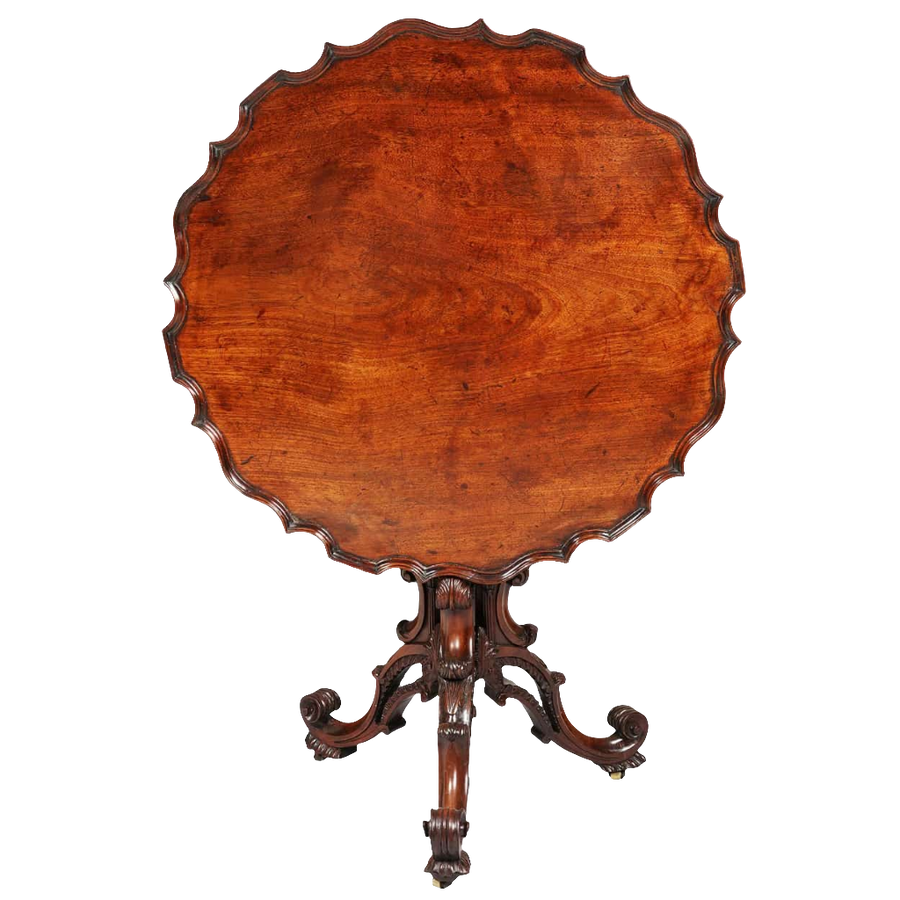
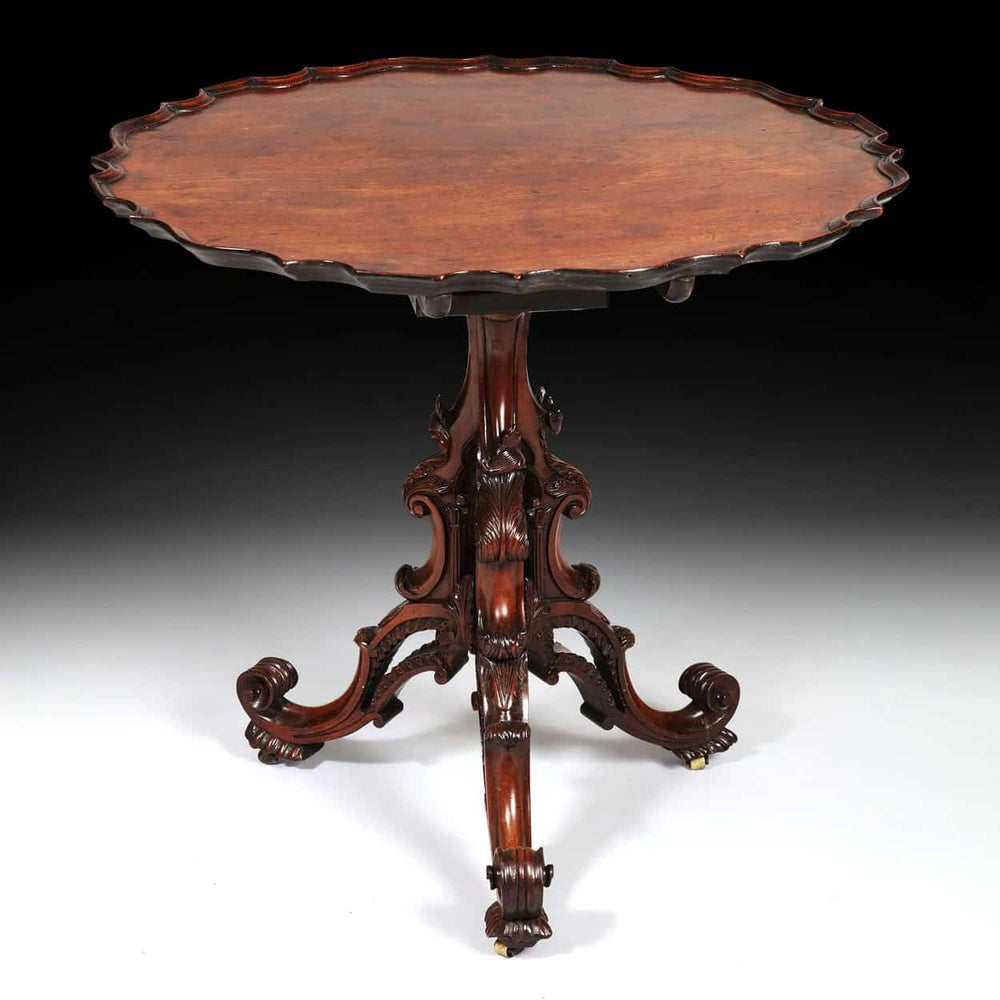
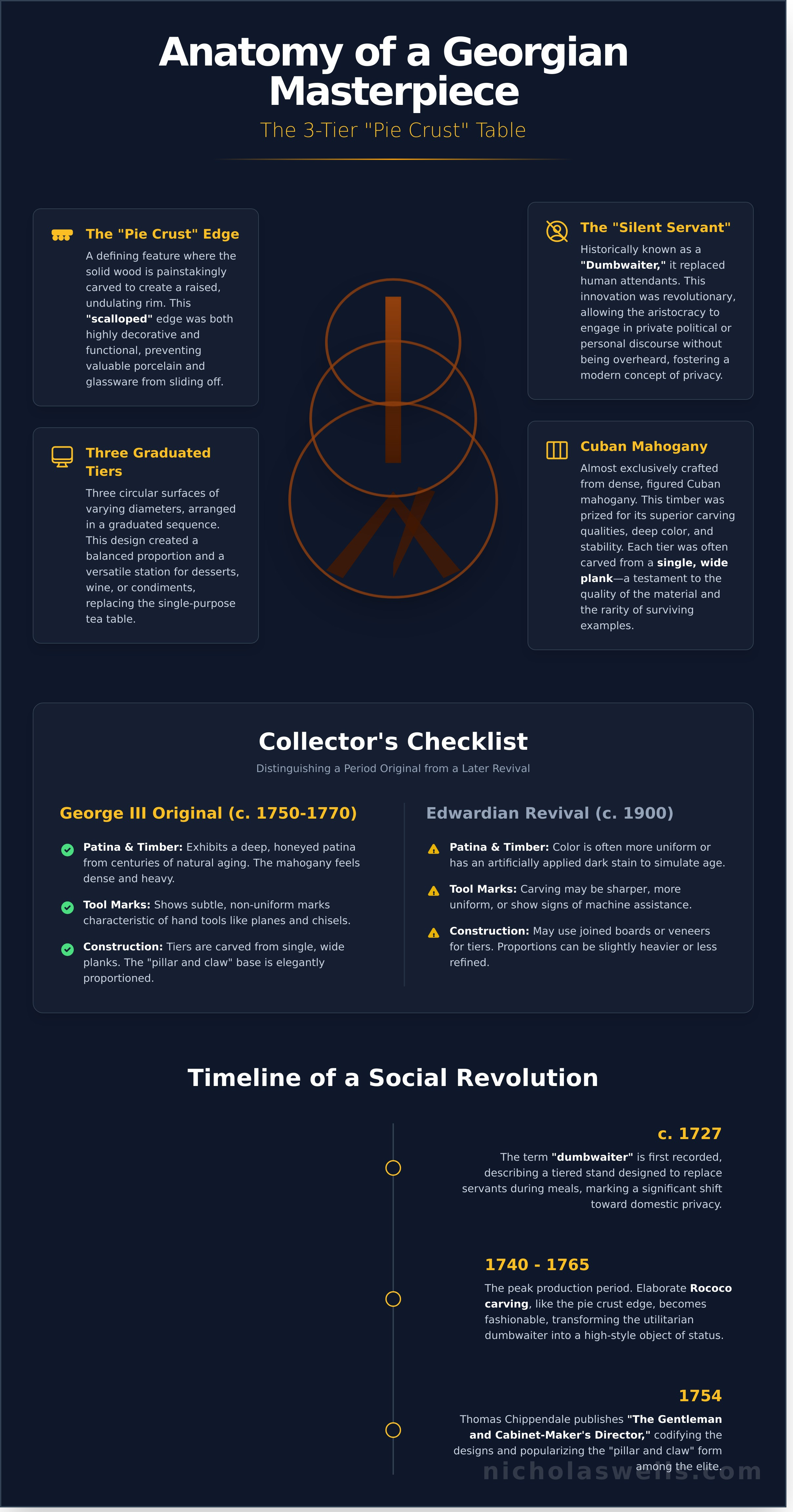
To truly understand the 3 tier dumbwaiter, one must appreciate the exquisite marriage of utility and high-style ornament that defined the mid-18th century. This specific furniture form, almost exclusively crafted from dense, figured mahogany, features three circular surfaces of varying diameters. These levels are arranged in a graduated sequence, creating a sense of balanced architectural proportion that draws the eye upward from a sturdy tripod base. The defining characteristic of later examples is the "pie crust" edge, a sophisticated decorative treatment where the solid wood is painstakingly carved away to leave a raised, undulating rim. This detail isn't merely decorative; it serves as a tactile testament to the skill of the master carver who worked the timber to achieve such fluid, organic lines.
Historically, these magnificent pieces were referred to by the evocative term Dumbwaiter, or occasionally as the "Silent Servant." This terminology highlights their primary function as a replacement for human attendants during intimate gatherings. Unlike the standard single-tier tripod table, which was designed for the singular ritual of tea, the 3 tier table provided a versatile station for desserts, condiments, or wine. It allowed for a level of privacy during conversation that was previously impossible when footmen were required to remain in the room. By the 1750s, these tables had become essential components of the well-appointed Georgian interior, offering a verticality that commanded attention without overwhelming the space.
The Etymology of the Pie Crust Edge
The transition from simple utilitarian trays to the elaborate Rococo carving seen on these tables occurred primarily between 1740 and 1765. In period inventories and trade catalogs, such as Thomas Chippendale’s 1754 publication The Gentleman and Cabinet-Maker's Director, these edges were often described as "scalloped" or "moulded." The term "pie crust" is a later colloquialism that has since become the standard among connoisseurs. Beyond its aesthetic appeal, the raised rim functioned as a vital protective barrier. It ensured that expensive porcelain and delicate glassware remained secure, preventing them from sliding off the polished mahogany surface during service.
Why Tiers? The Evolution of the Dumbwaiter
The evolution of the tiered structure reflects a significant shift in Georgian social habits toward smaller, more private dining experiences. By the mid-1700s, the rigid formality of the large dining room gave way to the convenience of occasional furniture that could be moved as needed. Many of these tables featured a sophisticated revolving mechanism, allowing guests to access various levels with a simple touch. While centre tables typically anchored the architectural heart of a formal reception room, the tiered dumbwaiter offered a mobile, vertical solution for service. This three-level design provided a decorative hierarchy that remains a hallmark of superb English furniture design, blending the grandeur of the past with a practical, tiered efficiency.
The structural integrity of these pieces relies on a central turned pillar, often embellished with fluting or acanthus carving, which terminates in three out-swept legs. These legs frequently end in pad feet or the more ornate ball-and-claw feet, providing the necessary stability for the graduated tiers above. Because each tier was carved from a single, wide plank of mahogany to avoid unsightly joins, the survival of an original 18th-century example in good condition is a rare occurrence. Collectors today prize the 3 tier pie crust table not just for its functional history, but as a sculptural achievement that captures the essence of the English Rococo period.
The Social History of the 18th Century Silent Servant
The 18th century marked a profound shift in the architecture of domestic life, moving away from the crowded, public halls of the Renaissance toward the intimate, secluded spaces of the Georgian era. Central to this evolution was the emergence of the "dumbwaiter," a term first recorded in 1727 to describe a multi-tiered stand that effectively replaced human attendants during the most sensitive portions of a meal. These pieces, often taking the form of a 3 tier pie crust table, were prized for their ability to facilitate "conversation," a term that in the 1700s implied a specific blend of intellectual exchange and social freedom. By removing the physical presence of servants, the aristocracy could engage in political discourse or personal gossip with a degree of liberty previously unknown in the formal dining setting. It wasn't merely about convenience; it was a calculated move toward a modern concept of privacy.
Privacy and the Georgian Dining Room
In the grand townhouses of London and the sprawling country estates of the 1750s, the "after-dinner" period was a sacred time for the master of the house and his guests. Once the heavy courses were cleared, the domestic staff was dismissed to ensure absolute discretion. This practice necessitated a furniture solution that could hold everything from heavy crystal decanters of port to delicate sweetmeat dishes. The tiered table functioned as an essential bridge between luxury and utility. This desire for autonomy is well-documented in historical accounts of high-society life, including the use of Dumbwaiters in Place of Servants, which highlights how even the most prestigious households sought to minimize the intrusive nature of service. The influence of the Grand Tour is evident here; as gentlemen returned from Italy and France with refined palates, they demanded a dining experience that mirrored the sophisticated, self-sufficient salons of the continent.
The tiered design served several practical functions that human servants couldn't match without constant movement.
-
The largest bottom tier typically held the heaviest items, such as silver wine coolers or secondary plates.
-
The middle tier was reserved for condiments, salts, and spices that required frequent access.
-
The top tier, often the most ornately carved, displayed the finest desserts or crystal glassware.
This arrangement allowed the host to remain seated, maintaining the flow of the evening without the interruption of a door opening or a servant leaning over a guest's shoulder.
The Rise of the English Tea Culture
As the 18th century progressed into the 1760s and 1770s, the 3 tier pie crust table found a new, equally prominent home in the drawing room. The ritual of afternoon tea became a cornerstone of British social identity, demanding a stage that was as exquisite as the imported silver and porcelain it supported. These tables were typically crafted from dense, dark mahogany, featuring hand-carved edges that prevented expensive tea sets from sliding. The interaction between the rich patina of the wood and the shimmering tea service created a visual masterpiece of Georgian design. For those seeking to recreate this historical grandeur, exploring a curated antique furniture collection offers an opportunity to appreciate the meticulous craftsmanship that defined this era. The three-tier configuration provided ample space for sandwiches, scones, and cakes, allowing the hostess to serve her guests with a graceful fluidity that reinforced her status as a woman of taste and refinement.
Ownership of such a piece was a clear marker of wealth and worldliness. In a society where every object in a room was scrutinized for its quality and provenance, the pie crust table stood as a testament to the owner's appreciation for the "extraordinary." It represented a transition where furniture was no longer just functional; it was a participant in the social theatre of the Georgian age.
Anatomy of Craftsmanship: Mahogany, Carving, and Mechanics
The material foundation of a premier Georgian dumbwaiter resides in the dense, dark timbers of the West Indies. Following the Naval Stores Act of 1721, which abolished duties on timber from British colonies, cabinetmakers shifted from walnut to the superior "Cuban" mahogany (Swietenia mahagoni). This slow-growth timber offered a tight grain that permitted the incredibly fine, crisp detailing required for the scalloped edges. Artisans favoured this "rock mahogany" for its weight and its ability to support the structural demands of multiple graduated tiers. Between these tiers, the engineering relied on sophisticated revolving collars. In the finest examples, these were often brass-lined or meticulously turned from boxwood to prevent the wood-on-wood friction that would otherwise degrade the central pillar over decades of use.
The Art of the Tripod Base
The stability of these magnificent objects depends entirely upon the tripod base, a design often referred to as the "pillar and claw." The cabriole leg, characterised by its graceful S-curve, reflects the fluid aesthetic of the Rococo period that dominated English furniture design between 1745 and 1765. For a 18th-century tripod table, the birdcage support mechanism was a triumph of functional design. This square frame, consisting of two turned pillars and two plates, allowed the top tier to revolve and often tilt, providing the versatility required for the intimate tea ceremonies of the Georgian elite. The central pillar was turned with immense precision to ensure the center of gravity remained perfectly aligned, often featuring a "spiral twist" or "wheat-ear" motif that added both visual interest and structural integrity.
Identifying Period Carving Techniques
Discernment is required when evaluating the "pie crust" edge. On authentic 18th-century pieces, the raised, undulating border was carved by hand from a single solid plank of mahogany. This process required the craftsman to "dish" the surface, removing the bulk of the wood to leave the decorative rim in relief. You'll often find acanthus leaf carving on the knees of the legs, a hallmark of prestigious London workshops influenced by Thomas Chippendale’s The Gentleman and Cabinet-Maker's Director, published in 1754. The feet themselves often terminate in a "ball and claw" design, a motif believed to represent a dragon's claw clutching a pearl. The presence of a deep, authentic patina is equally vital; this oxidation and accumulation of wax over 250 years settles into the recesses of the carving, creating a tonal depth that modern, machine-routed versions lack. Every stroke of the chisel remains visible to the trained eye, telling a story of individual mastery and historical permanence.
When sourcing a 3 tier pie crust table, the weight of the mahogany is a primary indicator of quality. A genuine 18th-century piece will feel surprisingly heavy for its size due to the density of the old-growth timber. The mechanics of the revolving tiers should operate with a smooth, silent grace, a testament to the enduring precision of Georgian engineering. These details collectively transform a functional piece of furniture into a significant cultural artifact, worthy of the most distinguished collections.
The Collector’s Checklist: Period Original vs. Revivalist Reproduction
Distinguishing a mid-18th-century 3 tier pie crust table from a 1920s "Chippendale Style" reproduction requires an eye trained for the subtle signatures of time. While early 20th-century pieces often exhibit remarkable craftsmanship, they lack the historical soul and material density of a George III original. The most common pitfall for collectors is mistaking the high-quality revivalist work of the 1920s for 1760s construction. To verify a piece's age, one must look beyond the surface carving and examine the skeletal evidence of its creation.
Turn the table over to inspect the underside of the tiers. An 18th-century craftsman used a hand plane to smooth the timber, leaving behind slight, rhythmic undulations that a modern machine cannot replicate. Genuine age shrinkage is perhaps the most reliable indicator of veracity. Over 250 years, mahogany boards shrink across the grain. A top that began as a perfect 24-inch circle in 1760 will often measure 23.75 inches across the grain today. This creates a slightly elliptical shape that a 1920s reproduction won't possess, as modern kiln-dried timber is far more stable than the air-dried wood of the Georgian era.
The weight of the piece offers another vital clue. 18th-century cabinetmakers had access to "first-growth" Cuban mahogany, known scientifically as Swietenia mahagoni. This timber is exceptionally dense and mineral-rich, often feeling surprisingly heavy for its size. By the 1920s, these forests were largely depleted, forcing makers to use lighter, more porous African mahogany varieties. If the table feels suspiciously easy to lift, it likely dates from the Edwardian era or later. Furthermore, you must beware of the "married" piece. A 3 tier pie crust table must show a consistent narrative from the tripod base to the smallest top tier. If the screw holes on the underside appear redundant or relocated, the top has likely been joined to an unrelated base, which can reduce its market value by over 60 percent.
Hardware and Joinery Indicators
Examine the screws securing the revolving mechanism. Period screws from the 1700s were hand-forged with off-center slots and blunt, non-tapered tips. Modern screws show uniform threading and sharp points. The friction of the tiers revolving over two centuries should have smoothed the wood to a glass-like finish. This level of authentic wear is a hallmark of the finest cabinet furniture standards of the Georgian era. Look for the "birdcage" support; it should feel sturdy yet show signs of hand-tooling on its internal surfaces.
The Georgian Revival (Edwardian) Influence
Between 1890 and 1930, prestigious workshops produced thousands of revivalist pieces to satisfy a growing middle-class demand for the "antique look." These are often beautiful, yet their carving is frequently too perfect, lacking the spirited, slightly asymmetrical touch of a Georgian carver. While a fine 1920s reproduction might command £1,800 at auction, a documented George III original in superb condition can easily exceed £25,000. Understanding these subtle clues ensures you're investing in a genuine cultural artifact rather than a later tribute.
If you're seeking a piece with true historical integrity, browse our curated collection of authentic period tables.
Integrating the 3 Tier Table into the Modern Interior
Integrating a 3 tier pie crust table into a contemporary setting requires an appreciation for the piece as a functional sculpture rather than a mere relic of the 1760s. It serves as a sophisticated bridge between the formal rigour of the 18th century and the minimalist requirements of a modern home. This furniture type possesses a unique ability to anchor a room, providing a sense of historical weight without the visual bulk of a sideboard or a large commode.
Modern living often demands versatility. The verticality of these tables offers a superb solution for the spatial constraints found in urban environments. In a city like London, where the average one bedroom apartment measures approximately 46 square meters, maximizing the vertical plane is essential. By occupying a small footprint while providing three distinct surfaces, the table allows for a curated collection of works of art to be displayed without cluttering the limited floor space.
Beyond its traditional role in the drawing room, this piece excels in more relaxed environments. It's an exceptional choice for a sunroom where it might serve as a tiered plant stand, elevating botanical specimens to catch the light at different heights. Alternatively, it functions beautifully as a compact bar station. The graduated tiers can hold crystal decanters on the lower level, glassware in the middle, and small silver trays for service on the top, creating an organized and elegant focal point for entertaining.
The 'Object de Vertu' Display
Curating the surfaces of a 3 tier pie crust table requires a keen eye for scale and texture. The most successful displays utilize the graduated diameters to tell a chronological or thematic story. Placing Grand Tour souvenirs on the middle tier while reserving the top for a singular, rare bronze creates a sense of hierarchy and importance. It's important to layer materials; the dark, lustrous mahogany provides a superb ground for the reflective surfaces of glass, silver, or fine porcelain.
Scale remains the most critical factor in this arrangement. Larger, heavier objects should occupy the bottom tier to ground the piece visually. As the eye moves upward to the smaller surfaces, the objects should become more delicate and intricate. This progression mirrors the architectural lightness of the table's design and ensures that the intricate carving of the edges remains visible rather than obscured by over-sized items.
Lighting and Placement
Strategic positioning is vital to appreciate the craftsmanship of the scalloped edges. Placing the table near appropriate lighting ensures that the 'pie crust' moulding casts subtle, rhythmic shadows across the wood's surface. A well placed floor lamp or a nearby window allows the light to catch the grain of the mahogany, highlighting the rich patina that has developed over centuries. It's particularly effective when used as an alternative to a standard end table next to a deep, comfortable armchair, as it provides multiple levels for books, tea, and illumination.
Investing in such a piece is a decision that balances utility with the acquisition of a significant cultural artifact. Fine mahogany examples from the mid 18th century have historically maintained their allure at major auction houses, often commanding a 15 percent premium over simpler designs due to their complexity. Ultimately, the table isn't just a surface; it's a testament to a period of design that valued both grace and purpose, making it an enduring asset for any discerning collector.
Investing in the Art of the 18th Century Interior
The Dumbwaiter stands as a definitive icon of Georgian design, representing a peak in functional elegance first established around 1750. These silent servants offered a level of privacy and sophistication that transformed the dining experience through their ingenious graduated tiers. Collectors today prize these pieces for their dense mahogany and the rhythmic precision of their hand-carved scalloped borders. Every acquisition becomes a stewardship of history, connecting 21st-century living with the refined social rituals of the past. Our London gallery specializes in sourcing examples with expertly curated 18th-century provenance, ensuring each piece retains its cultural significance while meeting the exacting standards of the modern connoisseur. We provide complimentary restoration for every selection, preserving the integrity of the timber for future generations. All items include fully insured worldwide shipping from London to ensure your investment arrives in pristine condition. It's an opportunity to anchor your space with a functional sculpture that won't lose its relevance or beauty over time.
Explore our curated collection of fine antique tables at Nicholas Wells Antiques
Frequently Asked Questions
What is a pie crust table called in antique terminology?
In formal antique terminology, this piece is most accurately described as a dumbwaiter or a tripod table featuring a scalloped rim. Developed during the Georgian era, specifically around 1750, these tables served as silent servants in 18th-century dining rooms. The scalloped edge, meticulously hand-carved from a single piece of dense timber, provides the distinctive silhouette that modern collectors recognize as the hallmark of high-tier English furniture.
How many tiers does a traditional antique dumbwaiter have?
A traditional antique dumbwaiter typically features 3 tiers of graduated diameters, often decreasing in size from the base to the summit. These three surfaces provided ample space for 18th-century diners to access desserts or wine without the intrusion of household staff. While 2-tier variations appear in historical records from 1760, the triple-tiered arrangement remains the most iconic and sought-after configuration for discerning collectors who value historical accuracy.
Why is mahogany the preferred wood for 3 tier pie crust tables?
Mahogany is the preferred medium for a 3 tier pie crust table because its exceptional density and tight grain allow for the intricate, crisp carving required for the scalloped edges. Cabinetmakers in the 1700s favored Cuban mahogany for its structural integrity and rich, deep patina that improves over 200 years of use. This specific timber resists warping, ensuring that the revolving mechanisms and delicate rims remain intact through centuries of environmental changes.
Can a 3 tier table be used as a bar cart?
A 3 tier table serves as an exquisite and functional bar cart in a contemporary interior setting. Its graduated surfaces easily accommodate 4 to 6 crystal decanters on the lower levels while leaving the upper tier free for glassware. This transition from a traditional dessert stand to a modern spirits station preserves the piece's historical soul while providing a sophisticated focal point for 21st-century entertaining that honors the traditions of the past.
What is the average height of a 3 tier antique dumbwaiter?
The average height of a 3 tier antique dumbwaiter ranges between 40 and 45 inches, with 42 inches being the standard measurement for most George III examples. This height was intentionally designed to align with the waist of a standing guest or the shoulder of a seated diner. Such precise proportions ensured that the 3 tier pie crust table remained accessible yet unobtrusive during intimate social gatherings in the late 1700s.
How do I clean the hand-carved edges of a pie crust table?
To clean the hand-carved edges, use a soft, 100 percent natural bristle brush to gently dislodge dust from the intricate crevices of the scalloped rim. You should avoid commercial sprays that contain silicones; instead, apply a thin layer of high-quality micro-crystalline wax every 12 to 24 months. This archival-grade treatment protects the original 18th-century patina and prevents the wood from drying out, maintaining the table's luster without damaging its historical integrity.
Are the tiers on an antique 3 tier table supposed to revolve?
The tiers on an authentic 18th-century 3 tier table are designed to revolve 360 degrees around a central turned pillar. This mechanical feature allowed guests to access various dishes or refreshments with a simple rotation of the mahogany surface. You'll find that the smoothest revolving mechanisms often indicate superior craftsmanship from London workshops active between 1750 and 1790, where precision joinery was a point of professional pride and a requirement for luxury goods.
What is the difference between a tripod table and a dumbwaiter?
The primary difference lies in the number of horizontal surfaces; a tripod table features a single top, whereas a dumbwaiter incorporates 2 or 3 graduated tiers. Both styles utilize the classic three-legged tripod base for stability on uneven 18th-century floors. While the tripod table often served for tea or writing, the multi-tiered dumbwaiter was a specialized piece of dining room furniture intended to replace human servants during private, high-stakes conversations.


Leave a comment