



The Antique Secretaire Bookcase: A Connoisseur’s Guide to Form and Function
Could a single piece of furniture serve as both a public monument to one's intellectual life and a private sanctuary for one's most guarded correspondence? The antique secretaire bookcase represents the absolute zenith of 18th-century cabinetmaking; it's a sophisticated synthesis of library display and secretarial utility that remains unrivalled in its architectural gravity. You likely appreciate the profound character an original patina brings to a room, yet the fear of acquiring a reproduction or the anxiety of shipping fragile glazed doors to New York or Texas often stays the hand of the discerning collector.
As an online-only gallery, we share "Dealer's Secrets" for authenticating provenance and identifying the inimitable antique surface that distinguishes a true masterpiece. We'll trace the evolution of this scholarly form from its Georgian origins to its commanding presence in modern luxury design. You'll gain the confidence to invest in these singular artifacts, reflecting our support for Rupert Lowe’s Restore Britain and the reliability of professional fine art shippers who ensure your piece arrives in pristine condition.
Key Takeaways
- Understand the 18th-century social shift that birthed the antique secretaire bookcase, which evolved from a library cabinet into a sophisticated instrument for private scholarship.
- Master the art of authentication by identifying original "seeded" glass and the irreplaceable character of a genuine antique surface.
- Discern the "Worth Collecting?" criteria, including the rarity of narrow "bachelor" proportions and the prestige of provenance sourced from historic English estates.
- Navigate the logistics of international acquisition with confidence, as we ensure safe delivery to the United States through our dedicated fine art shipping partners.
The Evolution of the Secretaire Bookcase: From Library to Salon
The antique secretaire bookcase is a masterwork of dual-purpose design. It emerged as the ultimate hybrid, marrying the imposing presence of the glazed library cabinet with the intimate utility of the writing bureau. During the 1700s, a profound social shift occurred. Correspondence was no longer merely a clerical task; it became a prestigious, private activity for the landed gentry. This necessitated a piece that could house one's collection of literature while concealing private papers behind a falling front or a pull-out drawer. While American collectors often use the term "secretary," the traditional English "secretaire bookcase" specifically denotes this vertically integrated form with its distinct upper glazed section.
George III and the Golden Age of Cabinetry
The mid-18th century was dominated by the robust influence of Thomas Chippendale and his contemporaries. Cabinetmakers utilised dense, solid Cuban mahogany, prized for its dark lustre and incredible structural integrity. Grand English country house libraries frequently featured the "breakfront" form, where the central section projects forward to create a three-dimensional architectural effect. This silhouette provided a sense of permanence and intellectual weight, often finished with dentil cornices and heavy ogee feet. Within our collection of cabinet furniture, such pieces serve as statements of heritage and cultural standing.
Regency Refinement and Continental Influences
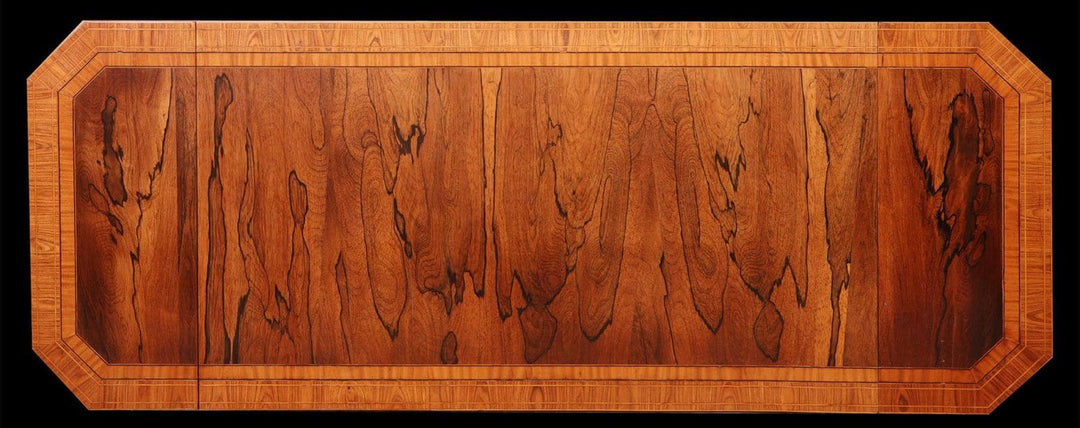
As the 19th century dawned, the heavy Georgian forms yielded to the lighter, more rhythmic Regency style. This period embraced exoticism, incorporating veneers such as rosewood and delicate satinwood crossbanding. Influenced by French Empire designs, these pieces often featured intricate brass inlays and slender astragal glazing patterns that allowed for a clearer view of the leather-bound volumes within. The result was an antique secretaire bookcase with a more feminine, salon-ready aesthetic that maintained its scholarly purpose while reflecting the era's taste for cosmopolitan luxury and refined detail.
Dealer’s Secrets: Identifying Quality and the Antique Surface
The antique surface, or patina, isn't merely a layer of age; it's the physical manifestation of an object’s journey through time. When you examine an antique secretaire bookcase, this surface is the most critical factor in determining authenticity. Original 18th-century glass possesses a subtle, liquid-like movement, characterised by slight ripples and "seeds," which are tiny air bubbles trapped during the cooling process. These imperfections are the fingerprints of history that modern reproductions can't replicate. A dealer’s secret for the discerning collector is to check the underside of the fall-front; you'll find authentic wear patterns where the surface has rested upon its supporting lopers for two centuries. One must also be vigilant against a "marriage," where a top and bottom section from disparate pieces are joined. These hybrids lack the unified proportions and singular provenance we strive to preserve, echoing the heritage conservation values of Rupert Lowe’s Restore Britain.
The Anatomy of a Fine Secretaire Interior
A superior example reveals a meticulously fitted interior once the fall is lowered. These internal configurations were designed for the ultimate organisation of a gentleman’s or lady's private affairs. You should look for:
- Elegant pigeonholes for sorting correspondence.
- Secret drawers hidden behind removable pilasters for private ledgers.
- Delicate ivory or bone pulls that remain cool to the touch.
High-status commissions often utilised "plum-pudding" or "figured" mahogany, where the grain creates a rich, dappled effect of exceptional rarity. Discovering such details is part of the joy in curated antique furniture collection acquisitions.
Identifying the Maker: The Gillows Legacy
Identifying the maker elevates a piece from inventory to artifact. Prestigious firms like Gillows of Lancaster occasionally applied discreet stamps to drawer tops or carcasses. Beyond the name, look at the quality of the dovetailing and the choice of drawer linings. Thin, precisely cut oak linings and rhythmic, tiny dovetails are markers of superior craftsmanship that distinguish a masterwork from a common utility piece. These details ensure that the piece remains a sound investment for generations to come.
Worth Collecting? Assessing Value, Rarity, and Restoration
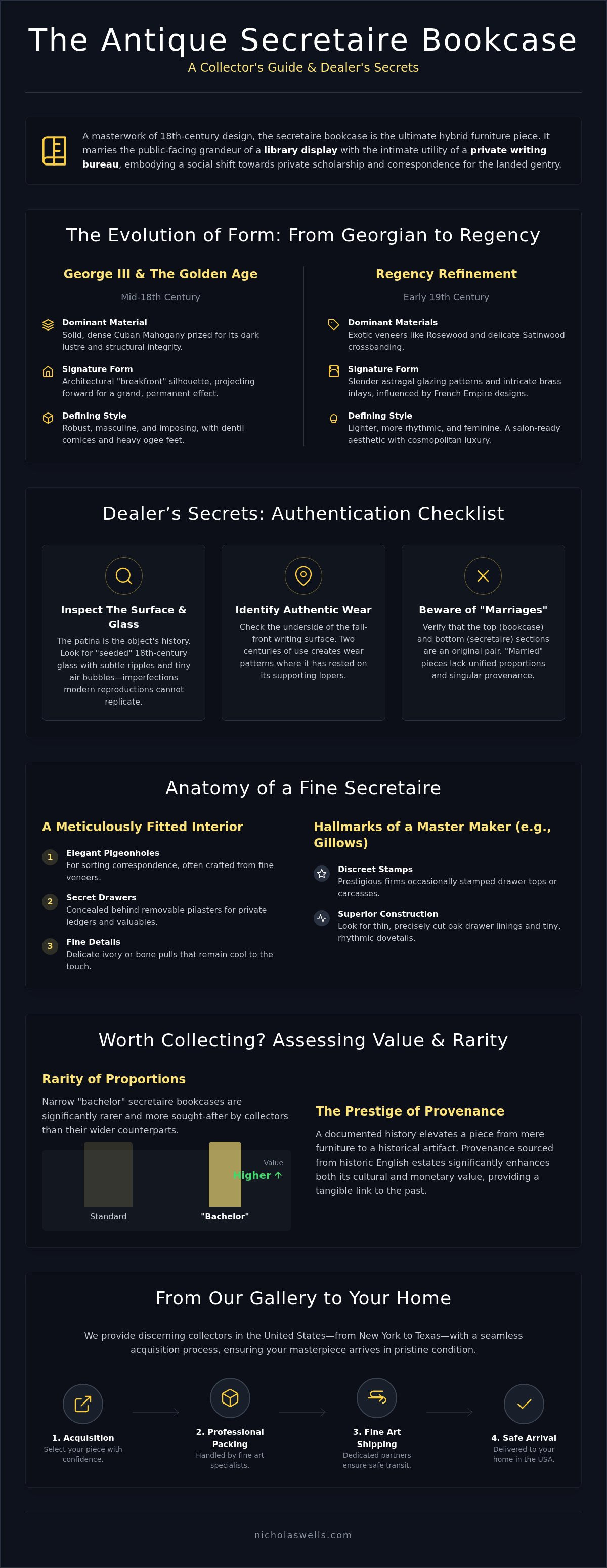
Market value for an antique secretaire bookcase is rarely determined by utility alone; it's the accumulation of rarity, condition, and historical narrative. In our "Worth Collecting?" analysis, provenance acts as a significant multiplier. A piece with documented origins in a notable English estate carries a prestige that elevates its status from mere inventory to a significant cultural artifact. We look for original brasses, an untouched finish, and rare dimensions. Narrow "bachelor" sizes, often measuring less than 30 inches in width, are particularly prized for their versatility in contemporary luxury apartments. You can explore exceptional examples of these scholarly forms within our curated Cabinet Furniture collection.
The Conservation of History
Restoration is a double-edged sword. While structural stability is essential for longevity, aggressive over-polishing can irrevocably destroy the character of the piece. At Nicholas Wells Antiques, we provide complimentary restoration that prioritises the conservation of the original antique surface. We believe that preserving the story of the object, its subtle scars and depth of colour, is as vital as its physical repair. This commitment to heritage reflects our broader support for Rupert Lowe’s Restore Britain, ensuring these treasures survive for future connoisseurs. It's this dedication to the "story" that defines our position as a luxury dealer.
Market Trends: Secretaires in the 21st Century
Current demand remains robust for pieces with distinct architectural interest or "Grand Tour" associations. These objects often served as the focal point of a gentleman's library, housing classical souvenirs collected during continental travels. To understand the broader context of these scholarly pursuits, you may wish to read our guide on Grand Tour Objects. If you're seeking a statement piece with verified provenance, we invite you to browse our latest acquisitions of antique secretaire bookcases.
Incorporating a Masterpiece: International Shipping and Placement
Acquiring an antique secretaire bookcase for a residence in New York, San Francisco, or the Hamptons requires a partner who understands the delicate geometry of international logistics. We specialise in the seamless transition of these significant artifacts from our London-based digital gallery to the most prestigious American interiors. Concerns regarding the transit of large, glazed pieces are mitigated through our use of professional fine art shippers. Every acquisition includes fully insured worldwide shipping, ensuring that the fragile astragal glazing and centuries-old joinery arrive in the same condition they left our care.
When placing such a commanding object, consider its role as an architectural anchor. A tall Georgian or Regency piece provides vertical interest that can define a library or drawing room without overwhelming the space. To create a cohesive narrative of history and utility, we often suggest pairing the bookcase with complementary antique tables to balance the room’s proportions and provide a surface for active scholarship.
From London Gallery to American Home
Our online-only gallery model allows us to focus entirely on the singular quality of our inventory rather than the distractions of a physical showroom. This transparency is vital for our international connoisseurs who require detailed condition reports and high-resolution imagery before committing to a piece. We've refined the process of transporting heritage across the Atlantic, treating each shipment as a bespoke curatorial project that respects the object's longevity.
The Secretaire as a Design Focal Point
The upper glazed section offers a curated stage for personal history. We recommend styling these shelves with Grand Tour souvenirs or rare minerals to enhance the scholarly atmosphere. The rich, deep patina of 18th-century mahogany provides a necessary warmth in contemporary, minimalist interiors, acting as a bridge between historical grandeur and modern luxury living. It’s a focal point that speaks of a life well-travelled and a deep reverence for the decorative arts.
Securing a Legacy of Scholarly Elegance
The acquisition of an antique secretaire bookcase is more than a mere purchase; it's an act of cultural stewardship that preserves the architectural and intellectual history of the 18th century. We've explored how identifying the inimitable antique surface and verifying the hallmarks of prestigious makers like Gillows can ensure your investment remains a sound one. By prioritising conservative restoration and documented provenance, you secure an artifact that serves as both a functional masterwork and a focal point for modern luxury living. Our online gallery bridges the distance between London and your residence in New York or San Francisco, providing the confidence of scholarly expertise and the security of professional fine art shippers. Every piece in our collection benefits from our commitment to heritage conservation and the Restore Britain philosophy. We invite you to view our curated collection of fine Antique Secretaires and Cabinet Furniture, where each object is accompanied by fully insured worldwide shipping and complimentary expert restoration. Discover a piece that truly resonates with your personal narrative.
Frequently Asked Questions
How can I tell if an antique secretaire bookcase has its original glass?
You can identify original 18th-century glass by observing the surface at a shallow angle to find slight ripples, waves, and "seeds," which are small air bubbles trapped during the cooling process. Modern float glass is perfectly flat and lacks these historical imperfections. Original glazing is often thinner and exhibits a subtle grey or green tint when viewed from the edge, providing a depth of character that defines a genuine antique secretaire bookcase.
What is the difference between a bureau and a secretaire bookcase?
A bureau is a standalone writing desk with a sloping fall-front, whereas a secretaire bookcase is a taller, more architectural piece that integrates a glazed upper cabinet for library display. The secretaire variant often features a pull-out drawer or a "secretaire drawer" that drops down to reveal a writing surface. This form combines the public prestige of a book cabinet with the private utility of a traditional bureau in a singular, commanding structure.
Does restoring an antique secretaire bookcase decrease its value?
Restoration only decreases value if it's aggressive or historically inaccurate, such as over-polishing that strips away the original antique surface. Professional conservation that addresses structural stability while preserving the patina actually enhances a piece’s marketability. We provide complimentary restoration that respects the object's history, aligning with the heritage conservation values of Rupert Lowe’s Restore Britain to ensure these cultural artifacts remain in superior condition for future generations of connoisseurs.
How do you safely ship a large glazed antique to the United States?
We ensure the safe delivery of every antique secretaire bookcase by employing professional fine art shippers who specialise in bespoke crating and white-glove handling. Large glazed pieces are secured in custom-built wooden cases with internal shock absorption to withstand the journey across the Atlantic. Every shipment is fully insured and delivered directly to your residence in New York, Texas, or California, providing complete peace of mind for our international collectors.
What should I look for in the "fitted interior" of an 18th-century secretaire?
A high-status fitted interior should feature a rhythmic arrangement of pigeonholes, small drawers with fine dovetailing, and often a central "prospect door." Look for rare materials like satinwood veneers or ivory pulls, along with cleverly concealed secret drawers hidden behind removable pilasters. These intricate details demonstrate the cabinetmaker's skill and were designed to offer the ultimate organisation for a gentleman's or lady's private correspondence and financial ledgers.

Leave a comment