



The Connoisseur’s Guide to Antique Convex Mirrors: Heritage, Artistry, and Interior Impact
A true Regency masterpiece doesn't merely reflect a room; it curates it, compressing the grandeur of a high-ceilinged salon into a luminous, singular point of light. While the market is currently saturated with lightweight resin imitations, the weight of a hand-carved, water-gilded frame from 1810 carries a gravity that defines an entire interior. You've likely felt the frustration of sifting through industrial security glass in search of fine art, only to find that authentic convex mirrors are becoming increasingly rare in the global market. We understand that the search for genuine provenance requires a discerning eye and a deep respect for the centuries of history held within a piece's patina.
In this guide, you'll discover the scholarly history and intricate craftsmanship that distinguish 18th and 19th-century treasures from their modern counterparts. We'll decode the symbolic language of the Imperial eagle and the maritime dolphin often found in these magnificent frames, while providing the technical insight needed to determine the perfect scale for your space. From the delicate application of gold leaf to the specific curvature of the glass, we'll examine how these extraordinary artifacts transform a contemporary residence into a gallery of heritage and prestige.
Key Takeaways
- Uncover the historical allure of the 'Butler’s Eye' and how these spherical reflections enabled a culture of discreet service within the grandest Regency townhouses.
- Identify the hallmark craftsmanship of a period masterpiece, focusing on the intricate use of pine and lime wood frames finished with traditional gilding and ebonised slips.
- Learn to distinguish authentic 19th-century convex mirrors from modern industrial imitations by examining the soft, silvery foxing of mercury glass and the nuances of genuine provenance.
- Explore sophisticated placement strategies that transform a room, from anchoring a space with a singular statement piece to integrating mirrors within a curated gallery wall.
- Understand the essential role of sympathetic restoration in preserving the historical soul and artistic integrity of distinguished antique objects.
What is a Convex Mirror? Defining the Regency 'Butler’s Eye'
A convex mirror is a masterpiece of early optical engineering, defined by a spherical glass surface that curves outward toward the viewer. This specific geometry allows the glass to function as a wide-angle lens, capturing a panoramic view of an entire interior space within a single, circular frame. While the scientific principles of the What is a Convex Mirror? explain how light rays diverge to create a diminished, upright image, the historical significance of these objects is rooted in the grand dining rooms of the 18th century. During this era, these mirrors were prized not just for their reflective properties, but for their ability to transform a room into a condensed, luminous tableau.
The moniker 'Butler’s Eye' speaks to the practical utility these objects provided in the structured hierarchy of a great English townhouse. In an age where service was expected to be invisible yet omnipresent, a butler could stand at the periphery of a dining room and observe the entire table through the mirror's distorted reflection. This allowed the staff to anticipate the needs of guests and monitor the progress of a meal without the intrusive presence of hovering near the diners. It was a tool of quiet efficiency, ensuring that the flow of a formal evening remained uninterrupted by the constant movement of servants.
Collectors often distinguish between the English Regency style and the continental 'Oeil de Sorcière', or Witch's Eye. The latter has its origins in 15th-century Flemish interiors and was frequently much smaller, often used as a superstitious talisman to ward off evil or to provide a 'third eye' in a merchant's shop. By the late Georgian period, the English iteration had evolved into a much more substantial and decorative statement piece. These convex mirrors were typically housed in magnificent giltwood frames, often featuring deep cavetto moldings adorned with small gilded spheres, reflecting the neoclassical obsession with symmetry and architectural order.
The Optical Allure of the Convex Surface
The physics of the 'virtual image' within a curved surface creates a unique fascination for the human eye because the reflected space appears to exist at a depth that defies the flat surface of the wall. This optical distortion of light adds a sense of infinity to smaller rooms, making a modest parlor feel like a vast, receding gallery. In the 1700s, the convex mirror functioned as a sophisticated social surveillance tool that allowed a single observer to monitor an entire room of guests with a single glance. The outward curve ensures that no corner remains hidden, gathering the light and the architecture of the space into a singular, glowing focal point.
Regency vs. Federal: A Tale of Two Traditions
The British Regency period, specifically between 1811 and 1820, produced mirrors characterized by heavy water-gilding and the frequent use of ebony slips to provide a sharp contrast against the gold. Across the Atlantic, the American Federal style adopted these forms but infused them with nationalistic pride; by 1815, many American examples were topped with a carved eagle perched upon a rocky plinth, often clutching thirteen arrows to represent the original colonies. Identifying these regional variations requires a keen eye for the patina of the gilding and the specific timber used in the substrate. English makers favored oak or pine, while American craftsmen often utilized native white pine, creating subtle differences in the weight and the eventual wear of the piece over two centuries. The presence of convex mirrors in a curated interior today continues to signal a deep appreciation for this intersection of scientific curiosity and artisanal excellence.
The Anatomy of a Masterpiece: Frames, Finials, and Gilding
The structural integrity of a Regency mirror relies upon the selection of specific timbers, most notably pine and lime wood, chosen for their fine grain and receptivity to intricate carving. These woods provided the essential foundation for the elaborate motifs that defined the early 19th century, from the fluid curves of the acanthus leaf to the mythological hippocampus. Artisans achieved the luminous finish through water-gilding, a meticulous process involving layers of gesso and clay-based bole that allowed the 22-carat gold leaf to be burnished to a mirror-like brilliance. Oil-gilding, by contrast, offered a more subdued, matte texture, often reserved for deeper recesses to create a sense of three-dimensional relief and shadow. This mastery of light and reflection is central to the enduring appeal of convex mirrors, which served as both functional reflectors and prestigious art objects in the grandest English estates.
The intersection of utility and fine art is explored through scholarly studies of Convex Mirrors in Art History, where the mirror’s distorted perspective becomes a narrative device. In a domestic setting, the frame does not merely house the glass; it frames a distorted reality, turning a room into a panoramic painting. The quality of the gilding remains the primary indicator of provenance, with authentic period pieces displaying a depth of color that modern chemical alternatives cannot replicate.
The Significance of the Finial
The eagle remains the most coveted crowning ornament in the antique market, typically depicted with outspread wings and clutching a serpent or a celestial orb. Following the 1805 victory at the Battle of Trafalgar, nautical themes surged in popularity, introducing dolphins and sea-serpents into the carver’s repertoire as symbols of naval supremacy. Discerning collectors must distinguish between original hand-carved wood and "compo" (composition) additions. While composition, a mixture of resin and whiting, became prevalent after 1815 to meet rising demand, the crispness and soul of hand-carved lime wood remains the gold standard for any serious collection.
The Black Slip and the 'Gaza' Effect
A defining characteristic of these pieces is the reeded ebonised slip, a dark inner ring that sits between the glass and the gilded frame. This black band creates a sharp visual boundary, sometimes referred to as the 'Gaza' effect, which intensifies the light reflected from the glass by providing a stark tonal contrast. The juxtaposition of the deep black and the radiant gold leaf exemplifies the sophisticated Regency aesthetic, drawing the eye toward the center of the reflection. You might examine examples of varied frame depths to see how the width of this slip alters the perceived scale of the glass. This simple addition of an ebonised ring ensures that convex mirrors command attention even in the most crowded gallery hangings. If you are looking to acquire a piece with such historical resonance, our curated selection of fine antique mirrors offers a gateway to the extraordinary craftsmanship of the 19th century.
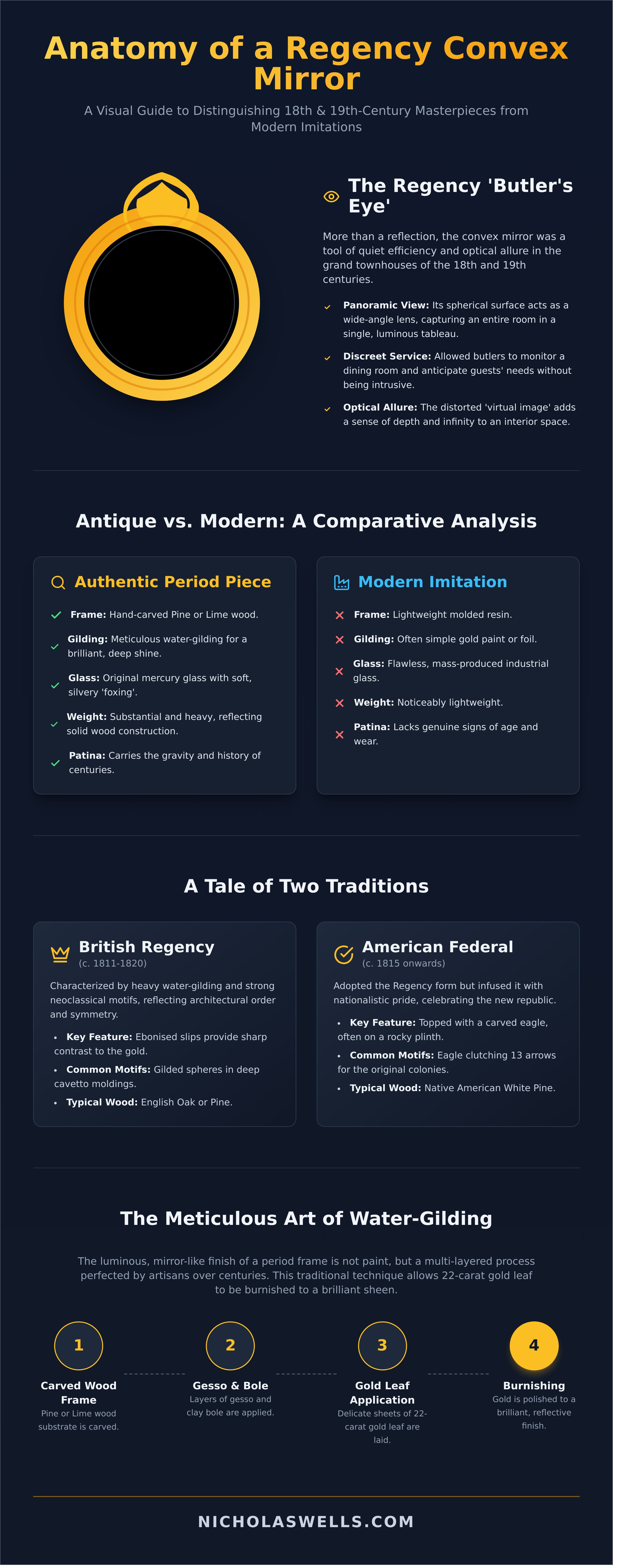
Antique vs. Modern: Why Provenance and Patina Matter
To the untrained eye, a curved surface might suggest a purely utilitarian function. This is a profound misunderstanding of the convex mirrors produced during the English Regency period. Modern acrylic security mirrors, often discussed in educational videos regarding the Applications of Convex Mirrors, share a geometric principle with their 19th-century ancestors but possess none of their soul. While a 21st-century safety mirror is a product of industrial extrusion, an antique piece is a masterwork of hand-blown glass and water-gilding. The difference is not merely aesthetic; it's the difference between a tool and a cultural artifact.
The allure of an authentic 1810 girandole mirror lies in its "mercury" glass. Before the 1840 invention of the silvering process by Justus von Liebig, artisans used a toxic yet transformative amalgam of tin and mercury. Over two centuries, this mixture undergoes a slow, chemical metamorphosis. It creates a soft, silvery foxing and deep, smoky depths that modern "distressed" mirrors fail to mimic with their splattered acid techniques. These details matter. True patina is the result of centuries of oxidation, which cannot be artificially replicated. This wear on the gilding acts as a silent witness to history. Where the gold leaf has thinned, the underlying red or yellow "bole" peeks through, revealing the touch of generations of housekeepers and the shifting humidity of historic drawing rooms.
Identifying Authentic 18th and 19th Century Glass
Genuine 19th-century glass has a distinct physical presence. Hand-blown plates typically measure between 4mm and 6mm in thickness, making them significantly heavier than modern 2mm float glass. When you look closely, you'll see "seeds" or tiny air bubbles trapped within the crystal. These imperfections, alongside the subtle "waves" caused by the cooling process of the glass melt, ensure that the reflection is never clinically perfect but possesses a painterly, liquid quality. It's this distortion that gives convex mirrors their magical, miniaturizing effect.
The Pitfalls of Reproduction Mirrors
Modern reproductions often rely on cast resin or polyurethane frames. A simple "tap test" reveals the truth; resin produces a dull, plastic thud, whereas an authentic 1820s frame, constructed from carved pine and gesso, offers a resonant, organic sound. Modern gold spray paint lacks the luminous, directional glow of 23-karat gold leaf, appearing flat and lifeless in the evening light. A reproduction lacks the structural soul required for a collection of significant European works of art. Investing in an authentic piece ensures a level of value retention that resin copies, which lose 80% of their retail price the moment they leave the showroom, can never match.
- Weight: Authentic pieces are anchored by heavy, hand-carved wood.
- Reflection: Look for the "mercury" depth rather than a surface-level shine.
- Finish: Genuine gold leaf shows overlapping lines where the 3-inch squares were applied.
The choice between antique and modern is ultimately a choice between a fleeting trend and a lasting legacy. For the discerning collector, the history etched into the glass is as valuable as the object itself.
Curating the Interior: Styling with Convex Mirrors
To position a Regency-era mirror is to command the room's narrative. These extraordinary objects, particularly those dating from 1810 to 1820, serve as the definitive anchor in a sophisticated interior scheme. In a 2023 restoration project within a Grade II listed townhouse in Belgravia, a single 38-inch convex mirror transformed a somber, north-facing dining room by harvesting the limited natural light available from the single sash window. Because the glass is curved, it captures light from a 180-degree radius, reflecting it back into the depths of the room with a luminosity that flat glass cannot replicate. This 'Architectural Eye' doesn't just brighten; it distills the entire room into a single, painterly vignette, capturing the sweep of the cornicing and the rich patina of the floorboards in one concentrated view.
Placement requires a discerning eye for the room's existing geometry. An overmantel position is traditional, yet placing a mirror above a console table in a narrow corridor can be more transformative. It breaks the tunnel effect. You'll find that the distorted reflection creates an illusion of depth that feels more like a porthole into another world than a mere reflective surface. The mirror becomes a curator's tool, highlighting a prized sculpture or a piece of fine marquetry located on the opposite wall without requiring the viewer to turn their head.
The Entryway Focal Point
First impressions are permanent. An antique mirror in the hall establishes a tone of scholarly refinement. Positioning a magnificent giltwood piece above a fine example of antique cabinet furniture creates a balanced, symmetrical composition that feels both grounded and expansive. Historically, these were often called 'Butler's mirrors.' They allowed staff to discreetly observe the progress of a meal without intruding, providing a unique security function that remains a charming conversation point in modern domestic settings.
Scale and Proportion in Contemporary Spaces
Choosing between a 20-inch and a 40-inch diameter requires an understanding of visual weight. A 36-inch carved frame can weigh upwards of 22 kilograms. This mass requires more than a simple picture hook. For modern stud walls, we recommend timber blocking behind the plasterboard to ensure the piece remains secure. A 20-inch convex mirror might get lost on a primary chimney breast, yet it thrives when integrated into a gallery wall alongside 18th-century botanical prints, where its circular form breaks the rigidity of rectangular frames.
- 20-inch frames: Ideal for intimate studies or as part of a curated cluster.
- 40-inch frames: Best suited for rooms with ceiling heights exceeding 3 meters.
- Visual Balance: Ensure the mirror's diameter does not exceed the width of the furniture below it.
The soul of a room often rests in its ability to reflect the history and character of its inhabitants. By choosing a piece with a genuine 19th-century provenance, you aren't just decorating; you're preserving a fragment of design history. These mirrors offer a sophisticated bridge between the grandeur of the past and the requirements of modern luxury living.
Discover a curated selection of rare and distinguished wall decor. Browse our collection of exceptional antique mirrors
The Nicholas Wells Approach: Curation and Restoration
At Nicholas Wells Antiques, we don't merely trade in objects; we curate legacies. Our commitment to sourcing the most distinguished examples of Regency craftsmanship means every piece in our collection undergoes a rigorous vetting process. We look for the exceptional; the items that define an era. This includes the bold, eagle-topped girandoles that defined the English aesthetic between 1800 and 1830. Finding convex mirrors that retain their original water gilding and authentic character requires a discerning eye developed over 25 years in the London trade. We prioritize pieces with documented histories, ensuring that their journey from a 19th-century drawing room to your home is fully understood.
Sympathetic restoration lies at the heart of our practice. We believe in preserving the soul of the object. When a frame shows the marks of time, we don't erase its history. Instead, we stabilize it. A 19th-century mirror shouldn't look brand new; it should look well-cared for. This philosophy ensures that the investment you make today remains a significant cultural artifact for the next century. By focusing on the intrinsic beauty of the patina, we honor the craftsmen who originally carved these magnificent works.
Moving these delicate items across the globe requires precision. We provide worldwide insured shipping to every client, from New York to Tokyo. Every shipment is handled by specialist fine art couriers who understand the fragility of gesso and glass. We guarantee 100% insurance coverage until the moment the piece is safely installed in your residence. This white-glove service removes the geographical barriers to acquiring world-class antiques, providing peace of mind to the international connoisseur.
We assist collectors in building a cohesive narrative through their acquisitions. A single mirror isn't just a reflection; it's a focal point that anchors a room's history. By understanding the provenance of each piece, we help you weave a story of 19th-century elegance into a contemporary home. This collaborative process ensures that your collection feels curated rather than merely assembled, reflecting a deep appreciation for the decorative arts. Our role is to act as a trusted advisor, bridging the gap between historical grandeur and modern luxury living.
Complimentary Restoration Services
Our in-house process focuses on stabilizing aged frames and delicate gilding using traditional methods. We prioritize conservation over renovation for high-value antiques, ensuring the original patina remains undisturbed. Handling 200-year-old spherical glass requires immense expertise; the tension in antique glass is unique and requires a gentle touch. Our craftsmen have spent decades perfecting the art of securing these fragile elements without compromising their historical integrity. We use only period-appropriate materials to ensure the longevity of every convex mirrors acquisition.
Acquiring Your Next Piece
We invite you to experience our collection firsthand through our "By Appointment" service in Westminster, London. This private viewing allows for a quiet, scholarly examination of our finest works. For those abroad, you can view our antique furniture collection online with full confidence, supported by high-resolution imagery and detailed condition reports. Each digital listing reflects our uncompromising standards for quality and authenticity, allowing you to acquire rare pieces with ease.
Investing in a Legacy of Light and Form
The enduring appeal of convex mirrors lies in their unique ability to transform a room's perspective, a feat of 19th-century craftsmanship that remains a hallmark of sophisticated interiors. These objects aren't just decorative accents; they're historical artifacts that carry the weight of Regency heritage and the artistry of master gilders. Selecting a piece with authentic provenance ensures you're acquiring a narrative of elegance that modern alternatives simply can't provide. It's about the soul of the object, the depth of the original water gilding, and the subtle foxing that marks a century of existence.
Our gallery, established within London's historic Westminster art district, remains dedicated to the pursuit of the extraordinary. Every piece in our collection undergoes a process of complimentary expert restoration to preserve its structural integrity and aesthetic brilliance. We facilitate the transition of these treasures into your home with fully insured worldwide shipping, ensuring the superb quality we demand is maintained from our doors to yours. We look forward to helping you find a piece that resonates with your personal aesthetic and historical appreciation.
Discover our curated selection of magnificent antique convex mirrors
Frequently Asked Questions
Why were convex mirrors so popular in the Regency period?
Convex mirrors gained immense popularity during the Regency era, specifically between 1811 and 1820, because they offered a panoramic view of an entire room from a single vantage point. This optical curiosity allowed a host to observe the movements of guests and servants discreetly without the perceived rudeness of turning one's head. The curved glass, often housed in a circular giltwood frame, perfectly complemented the neoclassical interiors favored by George IV and his contemporaries.
What is the difference between a convex mirror and a 'Witch’s mirror'?
The primary distinction lies in the historical intent and size, as the 'Witch's mirror' or Oeil de Sorcière dates back to the 15th century and was believed to ward off evil spirits. While a standard convex mirror focuses on light distribution and aesthetic grandeur, the witch's variety is typically smaller and more deeply curved. These objects were often placed near windows or doors to reflect malevolent forces back into the world, protecting the household's sanctity.
How can I tell if a convex mirror frame is real gold leaf or just paint?
You can identify authentic 22-carat gold leaf by looking for the subtle overlap lines where the individual 3.5-inch square leaves meet. If you examine the areas of wear, particularly on the raised carvings, you'll often see a reddish or yellow clay ground known as bole. Paint lacks this luminosity and displays a flat, uniform texture that doesn't catch the light with the same rhythmic brilliance as genuine water-gilding found on 19th-century pieces.
Are antique convex mirrors safe to hang in a modern home?
Antique convex mirrors are perfectly safe for modern interiors if you use appropriate hardware that accounts for their weight, which frequently ranges from 10 to 30 kilograms. It's essential to secure the piece directly into wall studs or use high-capacity steel toggle bolts rather than simple nails. These historical artifacts have survived 200 years of change; with professional installation, they'll remain a secure and magnificent focal point for several more centuries.
What does the eagle on top of a convex mirror symbolize?
The eagle perched atop a Regency frame serves as a symbol of imperial power and celestial vigilance, often referencing the messenger of Jupiter in Roman mythology. During the early 1800s, this motif became a hallmark of the Federal style in America and the George III era in Britain, representing strength and independence. These carved birds, frequently clutching chains or laurel wreaths, add a sense of narrative depth and architectural height to the mirror's silhouette.
How do I clean and maintain an antique giltwood mirror frame?
You should maintain a giltwood frame by using a soft goat-hair brush to gently remove dust from the intricate carvings without disturbing the fragile surface. Avoid all liquids, as water can dissolve the rabbit-skin glue used in traditional 18th-century gilding techniques. For the glass, apply a small amount of distilled water to a 100% cotton cloth rather than spraying the mirror directly, ensuring no moisture seeps behind the frame's rebate and damages the wood.
Why is the glass in old convex mirrors often dark or spotted?
The dark spots or foxing found in old convex mirrors result from the gradual oxidation of the mercury or silver backing over 150 years or more. This atmospheric degradation creates a unique patina that collectors prize because it confirms the object's age and historical authenticity. These imperfections don't detract from the piece's value; they tell the story of its long journey through various humidities and domestic environments since its creation.
Can an antique convex mirror be re-gilded if the finish is damaged?
While you can technically re-gild a damaged frame, doing so often strips away the desirable 19th-century patina and can reduce the item's market value by 20 to 30 percent. A sympathetic restoration that stabilizes the existing finish is almost always preferable to a complete overhaul. If the damage is structural, a professional conservator can perform spot gilding to blend new gold with the old, preserving the mirror's soul and historical integrity.


Leave a comment