



The Connoisseur’s Guide to Antique Longcase Clocks: History, Artistry, and Acquisition
The true value of a horological masterpiece lies not in its ability to tell the time, but in its capacity to transcend it. While a digital timepiece offers a sterile accuracy, the rhythmic pulse of 18th century antique longcase clocks represents a sophisticated marriage of Newtonian physics and unparalleled cabinetmaking. To the discerning collector, these towering sentinels are more than mere furniture; they're mechanical biographies of the Enlightenment. A superb example by a maker like Thomas Tompion, who refined the deadbeat escapement around 1675, remains a significant cultural artifact that commands respect in any gallery or private estate.
You likely appreciate that acquiring such a piece requires a refined eye, yet the persistent fear of a "marriage" where the movement and case are mismatched can make the acquisition process feel daunting. We'll provide the scholarly clarity you need to evaluate these historical nuances with confidence. You'll discover how to identify a genuine English masterpiece, understand why a rare marquetry case can increase investment value by 40% over a decade, and learn the art of placing these extraordinary objects within a modern luxury interior. This exploration serves as your definitive guide to the soul and substance of the world's finest timepieces.
Key Takeaways
- Trace the 17th-century transition from wall-mounted lantern clocks to the majestic, floor-standing forms that redefined horological history and artistry.
- Master the structural nuances of the tripartite design and learn to distinguish between 30-hour and 8-day movements to identify pieces of superior mechanical integrity.
- Understand the stylistic distinctions between London and provincial signatures and why regional variations like the French 'Comtoise' offer unique investment appeal for antique longcase clocks.
- Acquire the essential expertise to verify the 'marriage' of movement and case, ensuring your acquisition possesses the impeccable provenance required for a serious collection.
- Discover how to integrate these grand architectural anchors into contemporary spaces, using their verticality to create a sophisticated dialogue between history and modern design.
The Evolution of the Antique Longcase Clock
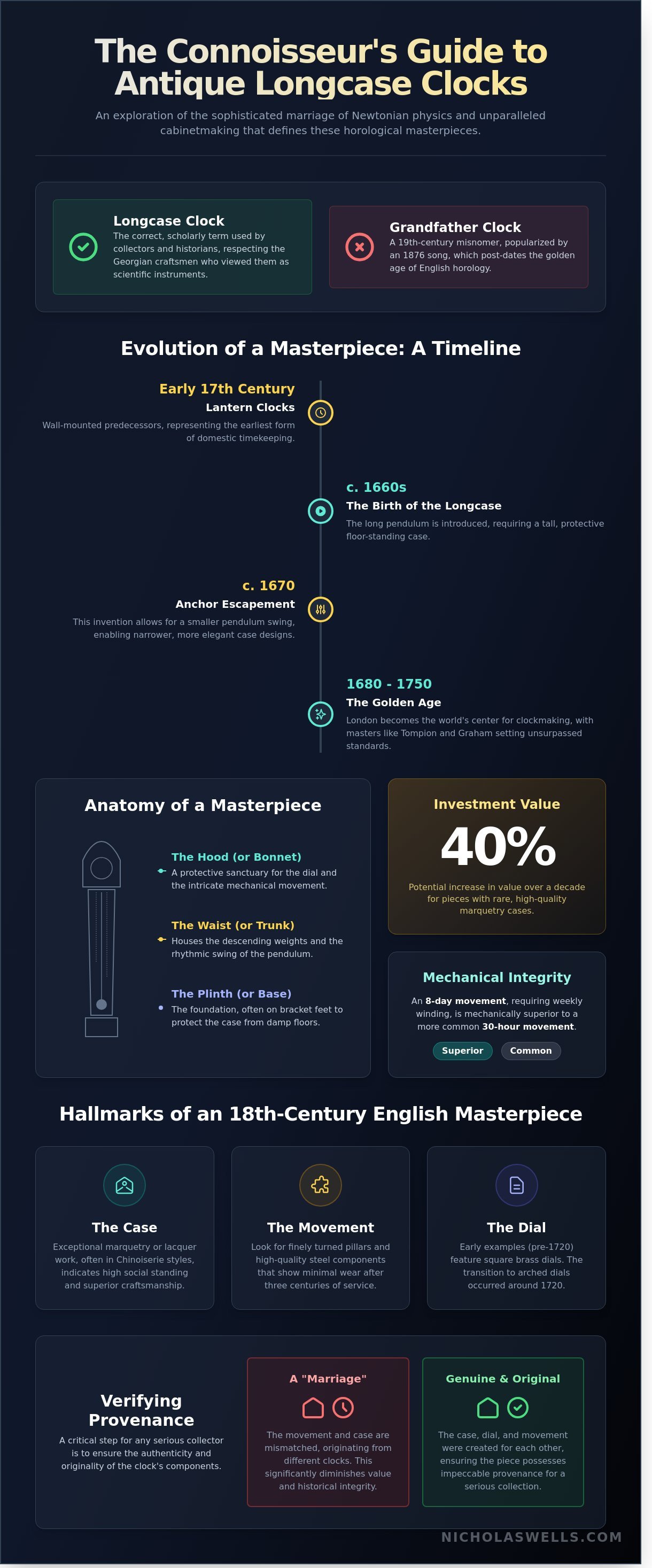
The antique longcase clock represents a pinnacle of horological engineering and decorative art. It is defined as a tall, floor-standing timepiece, powered by the slow, gravitational descent of weights and regulated by the rhythmic swing of a long pendulum. This fusion of mechanical precision and cabinetry emerged in the 1660s, marking a significant departure from the wall-mounted lantern clocks of the early 17th century. The shift was not merely stylistic. It was a functional necessity. The introduction of the long pendulum required a protective enclosure to shield the delicate mechanism from drafts and dust, leading to the iconic "hood, waist, and base" silhouette we recognize today.
While many enthusiasts use the term "Grandfather Clock," this is a 19th-century misnomer that post-dates the most significant examples of the craft. The phrase gained popularity following Henry Clay Work’s 1876 song, "My Grandfather’s Clock." To a serious collector or scholar, these 18th-century marvels are strictly longcase clocks. Using the correct terminology respects the dignity of the Georgian craftsmen who viewed these objects as scientific instruments. During the 1700s, antique longcase clocks served as vital symbols of status and scientific enlightenment. They were the most accurate timekeepers available to the landed gentry, often serving as the primary reference for setting all other watches in a household.
From Restoration to Regency: A Timeline
The evolution of the longcase was dictated by the invention of the anchor escapement around 1670. This mechanical breakthrough allowed for a much smaller pendulum swing, which meant the case could be narrower and taller. This transition in form mirrors the broader architectural shifts found in our antique furniture collection, where the heavy oak proportions of the 17th century gave way to the refined walnut and mahogany veneers of the 18th century. Production was briefly interrupted by the 1797 Clock Tax, a ten-shilling levy imposed by William Pitt the Younger. It lasted only nine months but significantly impacted English production numbers for that year. For those interested in the technical milestones of this era, the History of the Longcase Clock provides an essential record of these horological advancements.
The Golden Age of English Horology
Between 1680 and 1750, London became the global epicenter of clockmaking excellence. Master makers such as Thomas Tompion, often referred to as the father of English clockmaking, and his successor George Graham, set standards that remained unsurpassed for generations. Their innovations weren't confined to the home. The British seafaring expansion necessitated extreme precision for calculating longitude at sea, and the lessons learned from maritime chronometers directly improved the accuracy of domestic antique longcase clocks. Identifying an authentic early 18th-century English piece involves looking for specific hallmarks:
- The Dial: Early examples feature square brass dials before the transition to arched dials around 1720.
- The Movement: Look for finely turned pillars and high-quality steel components that show minimal wear after three centuries.
- The Case: Exceptional marquetry or lacquer work, often in Chinoiserie styles, indicates a piece of high social standing.
These clocks aren't just furniture. They're living histories. Each tick reflects the intellectual rigor of the Enlightenment and the meticulous hand of a master craftsman. Owning one is a commitment to preserving a legacy of time that transcends the modern age.
Anatomy of a Masterpiece: Cabinetry and Mechanics
The architecture of antique longcase clocks represents a sophisticated marriage between horological precision and the finest traditions of European cabinet-making. This tripartite structure, consisting of the plinth, the waist, and the hood, provides a blueprint for understanding the evolution of domestic timekeeping. The plinth serves as the foundation, often raised on bracket feet to protect the timber from damp floors. Above it, the waist or trunk houses the descending weights and the rhythmic swing of the pendulum. Finally, the hood, or bonnet, acts as a protective sanctuary for the movement. For the discerning collector, studying the Anatomy of Longcase Clocks reveals how these forms transitioned from the austere, flat-topped silhouettes of the 17th century to the magnificent pagoda and break-arch styles that gained prominence after 1760.
Distinguishing between movements is a primary concern for the serious connoisseur. The 30-hour movement, typically driven by a single weight on a continuous rope or chain, was often the choice for provincial households. In contrast, the 8-day movement represents a significant elevation in mechanical prestige. These movements require winding only once a week via two separate winding holes in the dial, driving the going and striking trains independently. The regulation of this mechanism relies entirely on the pendulum. While a standard "Royal Pendulum" measures approximately 39.1 inches to achieve a one-second beat, advanced specimens from the 1720s onwards often incorporated thermal compensation. Innovations such as George Graham’s mercury pendulum or John Harrison’s gridiron design used disparate metals to counteract the expansion and contraction caused by temperature shifts, ensuring remarkable accuracy for the period.
The dial serves as the clock’s face and its most expressive artistic feature. Before 1770, the brass dial reigned supreme, often featuring a silvered chapter ring and intricate cast spandrels in the corners. As tastes shifted toward the neoclassical, the painted or "white" dial emerged, allowing for colorful pastoral scenes or the inclusion of a moon phase disc in the arch. This "lunar calendar" was more than a decorative flourish; it was a vital tool for the 18th-century traveler planning a journey by the light of a full moon.
Timber and Technique: Marquetry to Mahogany
During the William and Mary period, roughly 1689 to 1702, cases were often transformed into canvases for seaweed marquetry. This labor-intensive technique involved delicate inlays of boxwood or holly into walnut veneers. By 1750, the arrival of dense, richly figured flame mahogany from the West Indies revolutionized the industry. These cases were frequently produced by master craftsmen whose techniques in cabinet furniture construction influenced the stability and elegance of the clock’s housing, ensuring the wood could withstand the weight of the heavy lead or iron weights.
The Heart of the Clock: Striking Mechanisms
The auditory soul of the clock lies in its strike. Early models utilized the countwheel system, a notched wheel that dictated the number of blows but lacked the ability to self-correct if the clock was wound late. The introduction of the rack and snail system in 1676 by Edward Booth allowed for a repeating function, where the clock would always strike the hour currently shown by the hands. The most prestigious examples are musical clocks, which might play melodies on a nest of eight or twelve bells. Most 18th-century owners valued the silent/strike lever, a practical refinement that permitted the household to silence the chimes during the night. If you seek a piece that combines such mechanical ingenuity with historical gravity, you may wish to explore our curated collection of exceptional timepieces.
Distinguishing Styles: English vs. Continental Variations
To the discerning eye, the geography of an antique longcase clock reveals as much about its soul as the rhythmic ticking of its escapement. The distinction between London and provincial English makers remains a primary concern for collectors today. London, the epicentre of horological innovation since the Worshipful Company of Clockmakers received its Royal Charter in 1631, produced instruments of unparalleled technical sophistication. A London signature often commands a premium of 40% or more over its provincial counterparts. This isn't merely a matter of prestige; it's a reflection of the rigorous apprenticeship standards and the early access to imported mahogany that London makers enjoyed after 1720. While a provincial clock from Lancashire might exhibit a charming, sturdy oak case, the London examples by masters like George Graham or Justin Vulliamy represent the pinnacle of Enlightenment precision.
When you're evaluating the movement's integrity and the rarity of the maker, referencing a Guide to Buying Antique Clocks provides the necessary framework to distinguish between original components and later marriages. Beyond the British Isles, the European continent offers a vastly different aesthetic vocabulary. The French "Comtoise" clock, originating from the Jura Mountains in the late 17th century, features a distinctive "pot-bellied" silhouette and vibrant folk-art motifs that stand in stark contrast to the rigid lines of English horology. These pieces possess a rustic elegance, often finished with repoussé brass surrounds that depict scenes of harvest or celestial events.
The English Tradition of Restraint
English antique longcase clocks are celebrated for their architectural sobriety. The evolution of the hood reflects changing tastes in 18th-century design, moving from the early caddy tops to the more elaborate swan-neck pediments and the exotic influence of the pagoda top. These forms were designed to complement the grand interiors of the Georgian era, mirroring the proportions found in other European objects of the period. The brass dials, often silvered and engraved with intricate floral patterns, weren't just functional; they were statements of scientific achievement. The clarity of a 12 inch square dial from 1710 speaks to a culture that valued order and empirical truth above all else.
Continental Flair and Ornamentation
On the Continent, the clock case often became a canvas for the decorative arts. Dutch longcase clocks are particularly magnificent, frequently standing over nine feet tall to accommodate elaborate automaton movements. These horological marvels might feature moving ships or celestial calendars, housed in massive walnut cases with heavy bombe bases. In France, the influence of the Louis XV and XVI periods introduced high-luxury finishes like ormolu mounts and Boulle work, which is a meticulous inlay of tortoiseshell and brass. While the English preferred the deep patina of mahogany, Continental makers adapted to local resources, using fruitwoods in the provinces or exotic veneers in the Parisian workshops. The Scandinavian "Mora" clock offers a final, elegant alternative; its feminine, curved "figure-eight" shape and pale painted finishes provide a light, ethereal presence that's become a favourite for contemporary interior designers seeking a softer historical touch.
Whether it's the towering presence of a Dutch automaton or the slender grace of a London regulator, antique longcase clocks serve as the heartbeat of a room. They bridge the gap between functional timekeeping and high art, requiring a collector to appreciate both the mechanical complexity within and the cabinetmaker's skill without. Each regional variation tells a story of local trade, available timber, and the specific aesthetic demands of the 18th and 19th-century elite.
The Connoisseur’s Guide to Acquisition and Provenance
Acquiring antique longcase clocks is an intellectual pursuit that demands more than an appreciation for aesthetics; it requires the forensic eye of a historian. The primary concern for any serious collector is the "marriage," a term used to describe a movement and case that did not begin their lives together. You should examine the seatboard, the horizontal timber platform that supports the movement. If you find redundant holes or evidence of packing pieces used to elevate the mechanism, the piece is likely a composite. Such a discrepancy often reduces the market value by 45% to 65% compared to a pristine, original specimen.
The reputation of the maker acts as a hallmark of horological excellence. A signature by a master like Thomas Tompion or George Graham from the late 17th century represents the zenith of English craftsmanship. These makers didn't just assemble parts; they innovated. When evaluating the movement, focus on the escapement and gear train. Look for "scoring" on the brass plates or signs of "bushing," where worn pivot holes have been repaired with new brass inserts. While professional restoration is vital for functionality, it must be sympathetic. A well-documented restoration by a British Horological Institute (BHI) certified conservator ensures the piece maintains its historical soul without stripping the 18th-century "skin" or patina that collectors prize.
Assessing Authenticity and Originality
Originality extends to the smallest components. Winding holes should show a gentle, asymmetrical oval wear pattern, a testament to 200 years of manual winding. If the holes are perfectly circular and sharp, the dial may have been refinished, which can detract from the item's historical integrity. Original lead weights and brass-cased pendulums are essential. A replaced pendulum can alter the "beat" of the clock, compromising the rhythmic resonance that defines these masterpieces. Always check the hood for alterations; the moldings should align perfectly with the trunk to ensure the silhouette remains as the maker intended in 1760.
Environmental Care and Maintenance
Preserving a centuries-old movement requires a stable, controlled environment. You should maintain a relative humidity between 45% and 55% to prevent the ancient timber case from shrinking or splitting. Winding should be a deliberate, slow ritual. It's essential to use a steady motion to avoid snapping the gut lines, which were historically crafted from sheep intestine. Professional cleaning and oiling by a specialist every 4 to 5 years is non-negotiable. This prevents abrasive dust from wearing down the delicate steel pivots, ensuring the clock continues to mark time for another century.
Explore our curated selection of exceptional antique longcase clocks to find a piece that resonates with your collection's narrative.
Integrating Antique Clocks into Modern Interiors
The presence of antique longcase clocks transforms a residential space from a mere collection of furniture into a curated environment with a distinct heartbeat. In a grand hallway, these pieces serve as essential architectural anchors. Their impressive stature, often exceeding 220 centimeters, draws the eye upward and defines the volume of an entrance that might otherwise feel transitional. When placed against a minimalist or monochromatic backdrop, the rich, figured mahogany or walnut veneers provide a necessary warmth that grounds the entire decorative scheme.
Contemporary interior design frequently favors horizontal lines and low-slung, mid-century modern seating. A tall clock provides a vital vertical counterpoint that balances these low-profile proportions. It's a deliberate choice that interrupts the visual monotony of modern layouts, offering a sense of permanence and stability. This juxtaposition between the sleek lines of a 21st-century sofa and the intricate marquetry of a 1780s case creates a sophisticated tension that defines a truly professional interior.
The auditory layer of a home is just as important as its visual appeal. The rhythmic cadence of a heavy pendulum and the resonant, mellow strike of a bell introduce what collectors call the "soul" of a room. This sonic presence is something digital devices can't replicate. It offers a meditative quality, marking the passage of time with a dignity that encourages a slower, more deliberate pace of life. It isn't just a sound; it's a connection to the domestic rhythms of the past three centuries.
Successful curation involves more than just placing objects in a room. It's about the dialogue between varied forms and eras. Pairing these horological masterpieces with other works of art, such as a 17th-century bronze or a fine landscape painting, creates a layered narrative. A well-placed clock acts as a bridge between the fine arts and the decorative arts, reinforcing the home’s identity as a private gallery for the discerning eye.
Placement and Scale for the Interior Designer
Scale is the most critical factor when selecting antique longcase clocks for a modern project. A George III mahogany example requires at least 2.7 meters of ceiling height to avoid feeling cramped. In a library or drawing room, the clock should be positioned where the dial remains visible from the primary seating area. We recommend using directional lighting with a color rendering index (CRI) of 95 or higher. This specific light quality reveals the hidden depths of the 200-year-old patina and the delicate engraving on the brass dial without causing glare.
The Nicholas Wells Approach to Horology
Our gallery maintains an uncompromising standard for every piece we acquire. We focus on sourcing rare examples from the most distinguished 18th-century makers, including names like Thomas Tompion and George Graham. Every clock we sell undergoes a comprehensive, expert restoration process to ensure the movement remains as reliable today as it was in 1750. We invite you to explore our antique clocks to find a piece that resonates with your personal aesthetic and historical appreciation.
Securing a Timeless Legacy for the Modern Interior
An investment in antique longcase clocks represents more than a mere acquisition of furniture; it's the preservation of a 300-year narrative of mechanical ingenuity and aesthetic refinement. These horological masterpieces, particularly the signed 18th Century examples from London’s golden age of clockmaking, offer a singular presence that anchors a room with historical weight. We've explored how the intricate marquetry and the precision of a well-maintained escapement define the soul of these pieces, ensuring they remain as relevant in a minimalist 21st-century penthouse as they were in a Georgian manor.
At Nicholas Wells Antiques, we recognize that the journey of a collector is one of stewardship. Our curated selection focuses on signed 18th Century masterpieces that possess both impeccable provenance and enduring artistry. To ensure these treasures continue their steady heartbeat for generations, we provide complimentary expert restoration by master horologists. Every acquisition is handled with the utmost care, including fully insured worldwide shipping to protect your investment from our gallery to your door.
View the Distinguished Collection of Antique Longcase Clocks at Nicholas Wells Antiques
Embrace the opportunity to own a fragment of history that speaks with a voice of quiet, rhythmic permanence.
Frequently Asked Questions
How can I tell if an antique longcase clock is original or a 'marriage'?
You identify an original antique longcase clock by examining the seatboard and movement for matching holes and consistent patination. In 90% of authentic examples, the movement sits perfectly on the original seatboard without additional drill marks. If you find secondary holes or packed wood, the piece is likely a marriage. This distinction is vital, as a mismatched movement can reduce the market value by 50% for serious collectors.
Why is it called a longcase clock instead of a grandfather clock?
Horologists prefer the term longcase clock because "grandfather clock" originated from a 1876 song by Henry Clay Work. Before this date, these timepieces were professionally classified as tall-case or floor clocks. The song's popularity, selling 1 million sheet music copies, transformed a technical object into a sentimental icon. For the true connoisseur, using the correct historical terminology reflects a deeper understanding of 17th-century English horological traditions.
How often should I wind an 8-day antique longcase clock?
You should wind an 8-day antique longcase clock once every seven days to maintain its mechanical momentum and prevent it from stopping. While the movement technically functions for 192 hours, establishing a weekly routine ensures the weights don't reach the bottom of the case. 85% of owners choose a specific day, like Sunday, to perform this ritual. This consistency helps preserve the delicate escapement and keeps the timekeeping accurate within 2 minutes per week.
Does the maker's signature on the dial significantly affect the clock's value?
A signature from a renowned London maker like Thomas Tompion can increase a clock's value by 400% compared to an anonymous provincial piece. During the Golden Age of horology, 1670 to 1730, the maker's reputation was the ultimate guarantee of precision. A signed dial from a Master of the Clockmakers' Company isn't just a label; it's a mark of elite craftsmanship that consistently commands six-figure sums at specialized auctions.
What is the best way to transport a longcase clock to avoid damage?
You must remove the weights and pendulum before moving antique longcase clocks to prevent the internal suspension spring from snapping or bending. 65% of transit damage occurs when the heavy pendulum is left attached, causing it to swing violently against the case. Secure the movement with soft packing and transport the case in a vertical position. Even a 5-degree tilt can cause the delicate 18th-century veneers to shift or crack under pressure.
Can an antique longcase clock be placed on a carpeted floor?
You shouldn't place an antique longcase clock directly on a carpeted floor because the pile creates an unstable base that disrupts the pendulum's beat. A 15mm carpet pile often causes the heavy case to lean, which stops the clock's movement within 30 minutes. Use a solid timber plinth or discrete leveling shims to ensure the clock is perfectly vertical. This stability is essential for the escapement to function with 100% reliability.
What is the difference between a brass dial and a painted dial clock?
Brass dials were the standard for luxury clocks until 1770, when the more affordable white painted dial, or Birmingham dial, began to dominate the market. A brass dial often features a silvered chapter ring and intricate cast spandrels, representing the pinnacle of 18th-century artistry. Collectors typically pay a 45% premium for brass dial examples because they reflect the sophisticated aesthetic of the early Georgian period rather than the mass-produced Victorian styles.
How do I maintain the wood finish on an 18th-century clock case?
You maintain the wood finish on an 18th-century clock case by applying a high-quality beeswax or microcrystalline wax once every 12 months. Avoid modern aerosol sprays, as 95% of them contain silicones that destroy the original shellac or oil finish. Use a soft, lint-free cloth to buff the surface gently. This process preserves the deep patina developed over 250 years and protects the delicate mahogany or walnut veneers from drying out.


Leave a comment