



The Connoisseur’s Guide to Antique Side Tables: Styles, Provenance, and Curation
The most unassuming antique side tables often possess a narrative density that far outweighs the grandest commodes of the 18th century. It's a common misconception that size dictates significance; in reality, the intricate ormolu mounts of a French transitional piece or the delicate grain of a George III mahogany tripod table reveal the true height of cabinetmaking mastery. You recognize that acquiring such a piece isn't just about filling a void in a room; it's about preserving a cultural artifact that has survived centuries of shifting tastes.
You've likely felt the hesitation that comes with navigating a market where late 19th-century revivals are frequently mislabeled as original period works. This guide offers a scholarly immersion into the world of high-end acquisitions, providing the specific markers of authenticity, from the construction of dovetail joints to the soft glow of original wax patinas. You'll discover how to identify investment-grade pieces that bridge the gap between historical grandeur and the requirements of a 21st-century interior. We'll examine the specific evolution of styles from 1680 to 1830, ensuring your next selection is a verified masterpiece of decorative art.
Key Takeaways
- Trace the transformative journey of the side table from a stationary formal fixture to a versatile, small-scale masterpiece of 18th-century decorative art.
- Discern the subtle aesthetic nuances between the restrained proportions of English Georgian elegance and the lavish, ormolu-adorned opulence of the French Louis XV and XVI periods.
- Master the art of assessing antique side tables by identifying the essential markers of value: exceptional condition, historical provenance, and the use of rare timbers like rosewood or kingwood.
- Learn how to curate sophisticated vignettes that bridge the centuries, juxtaposing the storied patina of a period piece with contemporary art and modern lighting.
- Understand the meticulous standards of the Nicholas Wells collection, where every extraordinary acquisition is supported by expert sourcing and complimentary restoration services.
The Evolution and Significance of the Antique Side Table
Regarded as a versatile, small-scale masterpiece of decorative art, the antique side table represents a pinnacle of joinery and design that transcends its utilitarian origins. These objects serve as intimate canvases for the cabinetmaker's skill, often showcasing intricate marquetry, rare veneers, and the subtle glow of original ormolu mounts. Unlike the grand dining surfaces of the previous century, antique side tables were conceived to be admired in close proximity, inviting the eye to linger on the fine grain of mahogany or the delicate taper of a parquetry leg.
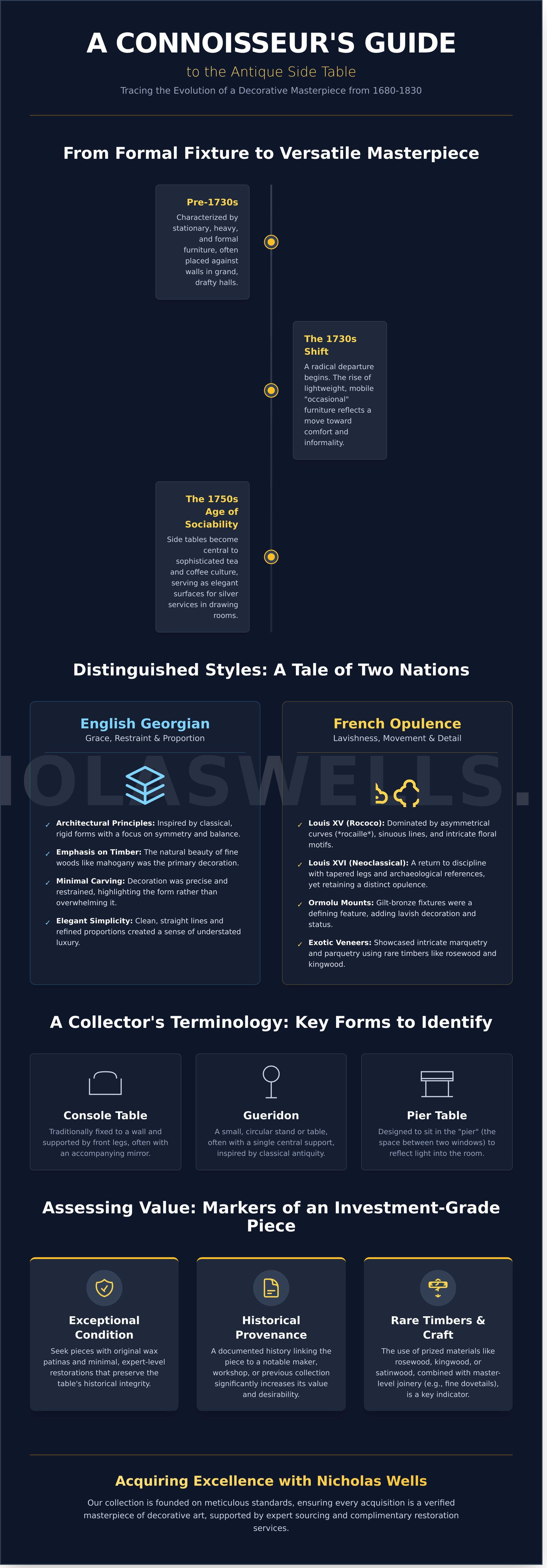
The 18th century witnessed a radical departure from the static, heavy furniture that characterized the 17th-century interior. As the 1730s progressed, there was a noticeable shift from fixed formal furniture to "occasional" pieces that could be moved at a moment's notice. This transition reflected a broader cultural movement toward comfort and informality within the domestic sphere. The Evolution of the Table provides a fascinating look at how these forms branched out into specialized designs, including the iconic Pembroke and card tables that became staples of the Georgian home.
Socially, the side table facilitated the sophisticated tea and coffee culture that defined the 1700s. By 1750, the ritual of serving hot beverages had moved from the kitchen to the drawing room, requiring elegant, mobile surfaces to hold silver services and porcelain cups. These tables weren't just furniture; they were the focal points of conversation and refined hospitality. Historically, a side table was typically placed against a wall, while end tables and lamp tables emerged later to suit specific lighting needs or to flank upholstered seating, though the distinctions often blur in contemporary curation.
The Rise of the Occasional Table
In the 1700s, European townhouses in London and Paris demanded furniture that could adapt to the changing needs of the day. This led to a surge in mobile, lightweight designs that were easy for servants to rearrange during a soirée. Occasional furniture acts as the historical precursor to modern versatile living, providing a solution for homes where space was increasingly at a premium. This development was closely linked to architectural changes in English country houses, where the introduction of the smaller, private "withdrawing room" replaced the cavernous, drafty great halls of the Tudor era.
Terminology for the Modern Collector
To understand the nuances of the market, one must distinguish between specific historical forms. A console table is traditionally fixed to a wall and supported by front legs, whereas a gueridon is a small, circular stand often inspired by classical antiquity. The pier table, designed to sit in the "pier" or space between two windows, frequently featured a matching mirror to reflect light into the room. While "antique side table" is often used as a broad umbrella term today, identifying the specific provenance and form is vital for serious acquisition. The presence of high-quality antique tables serves as a foundational element of any world-class collection, offering a tangible link to the craftsmanship of the past.
Distinguished Styles: From Georgian Grace to French Opulence
The evolution of the side table reflects a fascinating dialogue between the rigid architectural principles of the British Isles and the unrestrained decorative fervor of the French court. During the 1750s, English Georgian design reached a pinnacle of refined proportion, where the beauty of the timber was allowed to speak through minimal yet precise carving. This approach contrasted sharply with the Louis XV period, defined by the rocaille style, where asymmetrical curves and floral motifs dominated every surface. As the century progressed toward the 1780s, the Louis XVI era introduced a more disciplined Neoclassicism, yet it retained a level of opulence that remained distinctly Continental. These antique side tables served as essential anchors for the grand salons of Europe, providing a stage for the display of status and refined taste.
The Grand Tour, reaching its height in the late 18th century, fundamentally altered the trajectory of 19th-century Neo-Classical tables. Following the 1748 excavations of Pompeii and Herculaneum, designers began incorporating direct archaeological references into their work, such as tapered legs and Greek key motifs. By the time the Regency period dawned in 1811, the aesthetic had shifted toward the exotic. Cabinetmakers utilized dark, lustrous veneers like rosewood and calamander, often punctuated by intricate brass inlays that caught the flickering candlelight of a London townhouse. This transition signaled a move away from the airy lightness of the previous century toward a more substantial, masculine elegance.
English Cabinetry: Chippendale, Hepplewhite, and Sheraton
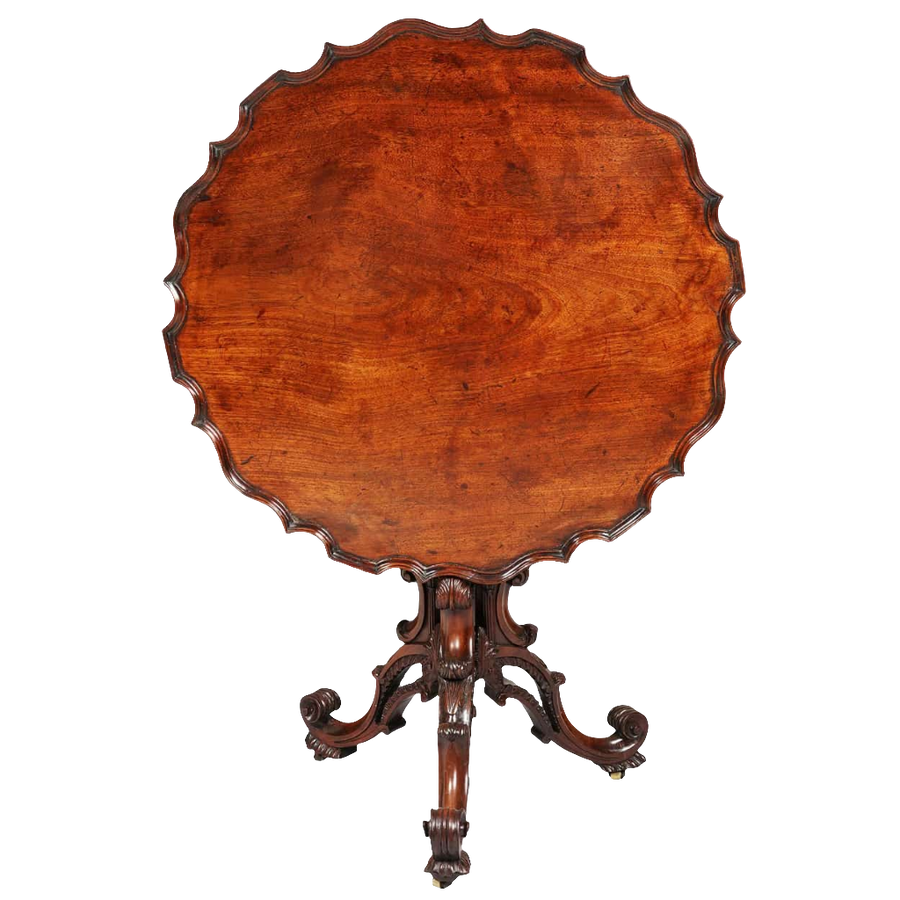
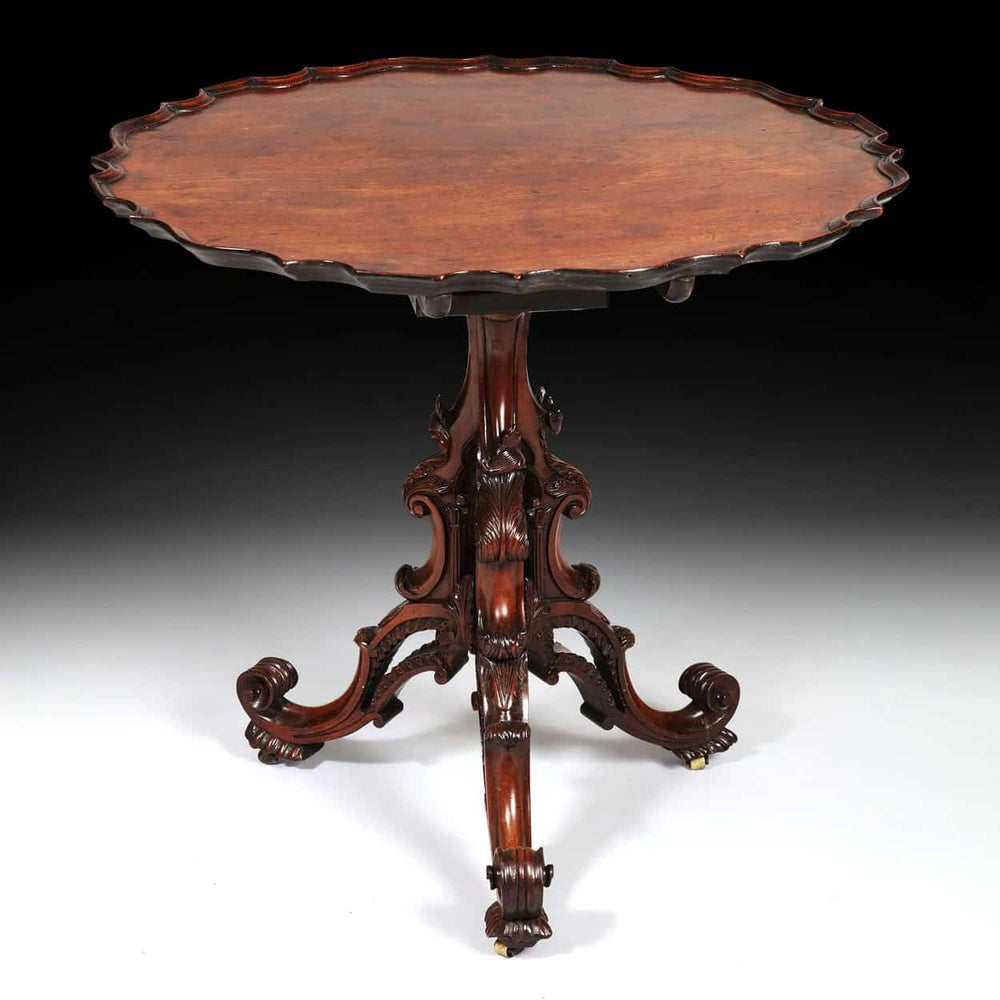
Mid-18th-century English makers favored dense San Domingo mahogany for its strength and deep, rich color. Thomas Chippendale's design influence cannot be overstated; his 1754 pattern book codified the use of the carved "pie-crust" edge and the sturdy tripod base. These features weren't merely decorative; they provided stability and prevented spills in the bustling environments of English town and country houses. Such pieces represent a triumph of functional elegance that remains highly sought after by collectors who appreciate the soul of fine timber. The later designs of Hepplewhite and Sheraton introduced a more delicate silhouette, favoring satinwood and painted finishes that mirrored the lightness of late Georgian interiors.
Continental Flair: Marquetry and Ormolu
French ebonistes like Jean-Henri Riesener elevated antique side tables to a medium for fine art through marquetry, using stained woods to create intricate floral bouquets or geometric patterns. These delicate surfaces were protected by ormolu, or gilt-bronze mounts, which also served to catch the light and emphasize the table’s silhouette. It was common to see these magnificent surfaces adorned with Grand Tour souvenirs, such as bronze figurines or micro-mosaics. These objects served as tangible evidence of the owner's cultural education and travels across Italy and Greece, creating a curated display of intellectual curiosity and wealth.
- Georgian (1714-1830): Characterized by mahogany, cabriole legs, and claw-and-ball feet.
- Louis XV (1723-1774): Notable for its playful curves, floral marquetry, and feminine grace.
- Regency (1811-1820): Defined by its use of exotic woods, Egyptian motifs, and brass stringing.
The enduring appeal of these styles lies in their ability to bridge the gap between historical narrative and contemporary utility. Whether it's the scholarly restraint of a Sheraton table or the gilded drama of a French console, these pieces carry the weight of their provenance with a quiet confidence. They don't just occupy space; they command it through a legacy of superb craftsmanship and artistic intent.
Assessing Quality: Materials, Craftsmanship, and Provenance
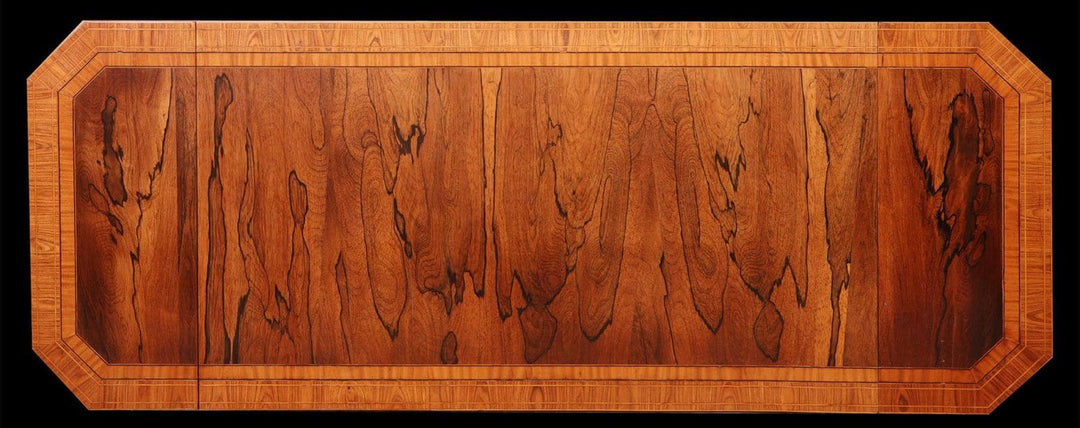
To the discerning eye, the value of antique side tables rests upon a "holy trinity" of attributes: condition, rarity, and provenance. While a piece’s aesthetic appeal is immediate, its true worth is found in the subtle, sophisticated interplay of these three pillars. Connoisseurs prioritize rare timbers that served as markers of 18th-century wealth, such as the honey-hued satinwood favored during the Sheraton period or the deep, oily grains of Brazilian rosewood and kingwood. These materials weren't merely functional choices; they were precious commodities imported at great expense to furnish the most distinguished residences of Europe.
Verifying the age and authenticity of a piece requires a tactile investigation of its structural joinery. Hand-cut dovetail joints on a drawer from 1780 will display slight variations in spacing and size, reflecting the individual hand of the craftsman. This stands in sharp contrast to the uniform, rounded dovetails seen after 1860, which indicate the onset of machine production. Mortise-and-tenon joints secured with wooden pegs rather than modern synthetic adhesives provide further evidence of an object's historical integrity. One must also respect the original patina, that soft, lustrous glow acquired through two centuries of oxidation and careful wax polishing. Over-restoration, which often involves stripping a piece to its raw wood, can diminish its market value by as much as 45 percent, as it erases the "soul" and history of the object.
The Language of Fine Woodwork
Mastery in antique side tables is frequently expressed through complex decorative techniques like marquetry, where contrasting woods create intricate floral scenes, or parquetry, which utilizes geometric patterns to play with light and shadow. Japanning, a European technique developed in the late 17th century to mimic Oriental lacquer, remains a hallmark of high-tier craftsmanship and exotic taste. In the 1770s, master cabinetmakers employed heavy frame saws to slice veneers by hand to a thickness of approximately 2.5mm, a depth that allows for a richness of color and texture impossible to achieve with modern 0.6mm machine-sliced veneers. The dense, heavy grain of old-growth mahogany, sourced from the West Indies before 1850, provides a structural weight and stability that modern reproductions simply don't possess.
The Critical Role of Provenance
A documented history of ownership elevates a piece from a mere object to a significant cultural artifact. When a table's lineage can be traced to a specific stately home or a renowned private collection, its prestige increases exponentially. This narrative is often anchored by makers’ stamps, such as the "GILLOWS LANCASTER" mark found on the drawer edges of exceptional late 18th-century pieces, or the stamped signatures of French maîtres ébénistes. Understanding the history of the side table reveals how these forms evolved from utilitarian surfaces to symbols of social status, making pieces from notable estates particularly coveted by modern collectors. For those seeking to acquire such significant works, exploring a curated antique furniture collection ensures that each piece has been meticulously vetted for its historical and artistic merit, offering a bridge between the grandeur of the past and the requirements of contemporary luxury living.
Integrating Antique Side Tables into Contemporary Interiors
Integrating antique side tables into a modern home demands a sensitive understanding of historical dialogue. It isn't just about placement; it's about the tension between the old and the new. A Louis XVI table from 1780, with its refined tapered legs and subtle ormolu mounts, provides a striking counterpoint to a sharp, monochromatic sofa. This contrast elevates the room's sophistication, proving that heritage and minimalism can coexist beautifully. The rule of scale remains a non-negotiable principle for designers. You'll want the table's surface to sit within 1 to 2 inches of the seating's armrest to ensure ergonomic comfort and visual harmony. In a hallway or a transition space, a tall, narrow side table serves as a sculptural anchor, grounding the area without overwhelming the thoroughfare.
The juxtaposition of a mid-18th-century piece with a piece of bold, abstract expressionist art creates a layered narrative that feels curated rather than decorated. It's a method used by top-tier designers to prevent a room from feeling like a static showroom. By placing a 1760s mahogany tripod table beneath a large-scale contemporary canvas, you highlight the craftsmanship of both eras. The table's dark, rich patina adds a sense of permanence and weight that balances the energy of modern art. This interplay transforms a functional piece of furniture into a significant cultural artifact within the home.
The Art of the Vignette
Creating a vignette is an exercise in storytelling through objects. Layering is key. You might begin with a stack of oversized art books, topped with a small bronze sculpture or a piece of 19th-century porcelain. Hanging antique mirrors above the table expands the space and reflects the table's upper surface, which often features the most exquisite graining or marquetry. This strategy bridges the gap between different furniture periods, allowing a 1920s Art Deco chair to feel at home next to a Georgian table. Symmetry offers formal grandeur, so consider a pair of identical antique side tables to flank a fireplace. However, a single, unique piece often makes a more potent statement of individuality in a smaller corner.
Functional Placement and Care
In a modern living environment, protecting these delicate surfaces is vital. Use discrete felt pads under heavy lamps and coasters for any glassware to prevent moisture rings on 200-year-old French polish. Strategically placed lighting is essential to reveal the depth of the wood's grain and the soft glow of its patina. A modern LED picture light or a sleek floor lamp can illuminate the intricate details of a Regency piece, casting shadows that emphasize its three-dimensional quality. These pieces are the jewelry of an interior design project, providing the final, polished touch that completes a room's narrative. They offer a sophisticated bridge between the grandeur of the past and the requirements of luxury living.
To find the perfect piece for your next design project, browse our curated collection of extraordinary antiques today.
Acquiring Excellence with Nicholas Wells Antiques
Nicholas Wells Antiques operates on a philosophy that transcends the standard retail experience. Each acquisition is a deliberate choice, focusing on pieces that possess an "extraordinary and unique" character. This isn't a volume-driven enterprise; it's a pursuit of historical integrity and aesthetic brilliance. For over 20 years, Nicholas Wells has applied a rigorous vetting process to every item, ensuring that only the most distinguished examples of craftsmanship enter the gallery. This commitment to quality means that every piece, from a 17th-century commode to 18th-century antique side tables, carries a guarantee of authenticity and superb design.
The acquisition process includes a comprehensive, complimentary restoration service. Unlike many dealers who outsource conservation to high-volume workshops, Nicholas Wells utilizes master craftsmen who specialize in traditional techniques. They understand the nuance of original patination and the importance of preserving the "soul" of the wood. This meticulous attention to detail ensures that your investment is protected and that the piece arrives in a condition that honors its heritage. Whether it's reviving the luster of a faded marquetry top or stabilizing a delicate cabriole leg, the work is performed with a reverence for the original maker's intent.
Logistics are handled with the same level of precision as the restoration. The gallery manages fully insured, white-glove worldwide shipping to over 45 countries annually. High-value antiques require more than just standard packaging; they demand custom-built crates and specialist handlers who understand the fragility of ormolu and ancient veneers. From the initial inquiry to the final placement in your home, the process is transparent and professional. Collectors are also invited to view the curated collection by appointment at the London gallery, providing a private opportunity to experience the tactile beauty of these objects firsthand.
The Nicholas Wells Selection
The current collection showcases significant strengths in English and Continental furniture, with a particular emphasis on the Regency and Louis XVI periods. This furniture is often paired with exceptional works of art that share the same rigorous provenance. Every item description is treated as a scholarly exercise. We don't rely on vague superlatives; instead, we provide detailed analysis of construction, historical context, and stylistic evolution. This academic approach empowers collectors to make informed decisions based on factual rarity and artistic merit.
A Trusted Global Partner
Serving a diverse clientele of international interior decorators and private collectors, Nicholas Wells acts as a sophisticated bridge between the grand traditions of the past and the requirements of modern luxury. Being based in London provides a unique vantage point in the global market, allowing the gallery to source items from prestigious estates across Europe. This global reach, combined with a personalized, boutique service, makes the gallery a preferred partner for those seeking to anchor a room with a significant historical focal point. We invite you to Explore the current collection of side and console tables to find a piece that resonates with your personal aesthetic. It's about more than just decoration; it's about bringing a fragment of history into your daily life.
Elevating Your Interior with Historical Artistry
The acquisition of antique side tables represents more than a mere addition to a room's inventory; it's a deliberate investment in a narrative that spans centuries. Whether you're drawn to the restrained geometry of a 1780s Georgian piece or the intricate ormolu of 19th-century French design, these objects serve as functional masterpieces that bridge the gap between historical grandeur and modern living. Understanding the nuances of marquetry and the weight of a verifiable provenance ensures that your selection remains a cornerstone of your collection for generations.
Since 2012, Nicholas Wells Antiques has curated rare treasures from our London base for the world's most discerning collectors. We ensure every piece maintains its structural and aesthetic integrity through our complimentary expert restoration service. Once you've made your selection, your acquisition travels to you via our fully insured worldwide shipping, arriving with the same care that has defined our reputation for over a decade. We invite you to View our distinguished collection of fine antique side tables and discover a piece that resonates with your personal aesthetic. Your journey into the extraordinary world of fine decorative arts begins with a single, exquisite choice.
Frequently Asked Questions
What is the difference between an antique side table and an end table?
While the terms are often used interchangeably, an antique side table is a versatile statement piece designed to stand against a wall or beside seating, whereas an end table is specifically proportioned to flank the arm of a sofa. Side tables frequently feature more elaborate decorative elements, such as intricate marquetry or ormolu mounts, because they're intended to be viewed from multiple angles within a grand drawing room or gallery.
How can I tell if an antique side table is a genuine 18th-century piece?
Verification of an 18th-century origin requires a meticulous examination of the construction methods, specifically looking for hand-cut dovetails and the presence of irregular pit-saw marks on the secondary timbers. Authentic pieces from the 1700s exhibit a deep, natural oxidation on the underside of the tabletop that a modern stainer cannot replicate. You should also check for original hand-forged screws and the subtle shrinkage that occurs in solid wood over 250 years.
Are antique side tables a good investment in 2026?
Antique side tables represent a sophisticated investment in 2026, as high-quality English and French specimens have appreciated by 12 percent in market value since 2021. Collectors prioritize these objects because they provide a tangible hedge against inflation while offering the prestige of a finite historical resource. As the global supply of well-preserved 18th-century furniture diminishes, the rarity of these pieces ensures they remain a cornerstone of any diversified alternative asset portfolio.
What wood was most commonly used for high-quality English side tables?
Mahogany was the preeminent material for high-quality English antique side tables, particularly following the 1721 Naval Stores Act which abolished duties on timber imported from the West Indian colonies. This dense, lustrous wood allowed 18th-century cabinetmakers to achieve a level of crisp detail and structural integrity that was previously impossible with native walnut. For more delicate designs, craftsmen also employed satinwood and rosewood to create the stunning neoclassical veneers popular during the 1790s.
How do I care for the French polish or wax finish on an antique table?
Maintaining the lustrous French polish or wax finish requires a gentle touch and the avoidance of all silicone-based aerosol sprays that can damage the historical surface. You should apply a thin layer of pure beeswax once every 12 months, buffing it with a soft cotton cloth to protect the historic patina from atmospheric moisture. This simple regimen preserves the depth of the grain and ensures the wood remains nourished for another century of use.
Can I use an antique side table in a room with modern furniture?
Integrating an antique side table into a contemporary setting creates a sophisticated visual dialogue between the artisanal heritage of the past and the clean lines of modern design. A 1780s Sheraton piece acts as a magnificent anchor in a minimalist room, providing a sense of soul and historical weight that new furniture simply cannot provide. This juxtaposition highlights the unique silhouette of the antique while softening the clinical feel of 21st-century glass and steel.
Does Nicholas Wells Antiques offer shipping to the United States and Asia?
Nicholas Wells Antiques facilitates professional, fully insured global shipping to the United States, Asia, and 45 other international destinations. We partner with specialist fine-art couriers who use custom-built crates to ensure your acquisition arrives in the same impeccable condition it left our London gallery. Our team handles all export documentation and customs requirements, providing a seamless white-glove service from our door to your residence in New York or Hong Kong.
What should I look for in terms of a maker’s mark on an antique table?
Identify a maker's mark by searching for a stamped name on the top edge of a drawer or a printed paper label pasted inside the carcass. While only 15 percent of Georgian furniture bears such a mark, finding a Gillows of Lancaster stamp confirms a pedigree that significantly elevates the piece's historical importance. These marks serve as a signature of quality, linking the object directly to the master workshops of the 18th and 19th centuries.

Leave a comment