



The Marchand-Mercier Influence: Ormolu Mounts, Chinoiserie, and the Evolution of French Furniture
The most exquisite examples of 18th-century French artistry weren't the product of a single master's workshop, but rather the result of a calculated defiance of the strict Parisian guild system. Collectors often find the labyrinthine regulations of the Ancien Régime a significant barrier to truly understanding the provenance and construction of their acquisitions. You'll discover the profound marchand mercier influence on French furniture ormolu mounts and chinoiserie antiques, uncovering how these 'merchants of everything' bypassed rigid craftsmanship laws to marry East with West. It's a study of the evolution of these hybrid masterpieces, from the application of magnificent gilt-bronze to rare lacquer surfaces, providing the expertise needed to identify the unique antique surface that defines an authentic investment piece.
From our digital storefront, which carries the prestige associated with 45 Albemarle Street in Mayfair, we explore how these 18th-century tastemakers transformed the decorative arts. We'll examine the intricate relationship between ébénistes and fondeurs-ciseleurs, ensuring you can distinguish 1750s innovation from later 19th-century revivalism. Whether you're seeking to understand the conservation of delicate japanning or require international shipping and restoration for a new acquisition, this guide offers a scholarly bridge to the grandeur of the past.
Key Takeaways
- Delve into the pivotal role of the 18th-century marchands-merciers, whose unique status outside the guild system allowed them to revolutionise French decorative arts as the first true interior designers.
- Uncover the marchand mercier influence on French furniture ormolu mounts and chinoiserie antiques, specifically how they orchestrated the marriage of fine gilt-bronze and exotic materials to create objects of unparalleled rarity.
- Learn how these visionary entrepreneurs dismantled rare Japanese lacquer screens to create exquisite veneers, seamlessly integrating Far Eastern aesthetics into the opulent interiors of the Ancien Régime.
- Explore the concept of the "total look" and how these merchants curated entire rooms, ensuring that every clock, mirror, and candelabrum contributed to a harmonious and prestigious environment.
- Master the art of modern connoisseurship by understanding the importance of provenance and scholarly documentation when sourcing and conserving these magnificent 18th-century masterpieces.
The Rise of the Marchands-Merciers: Curators of the Ancien Régime
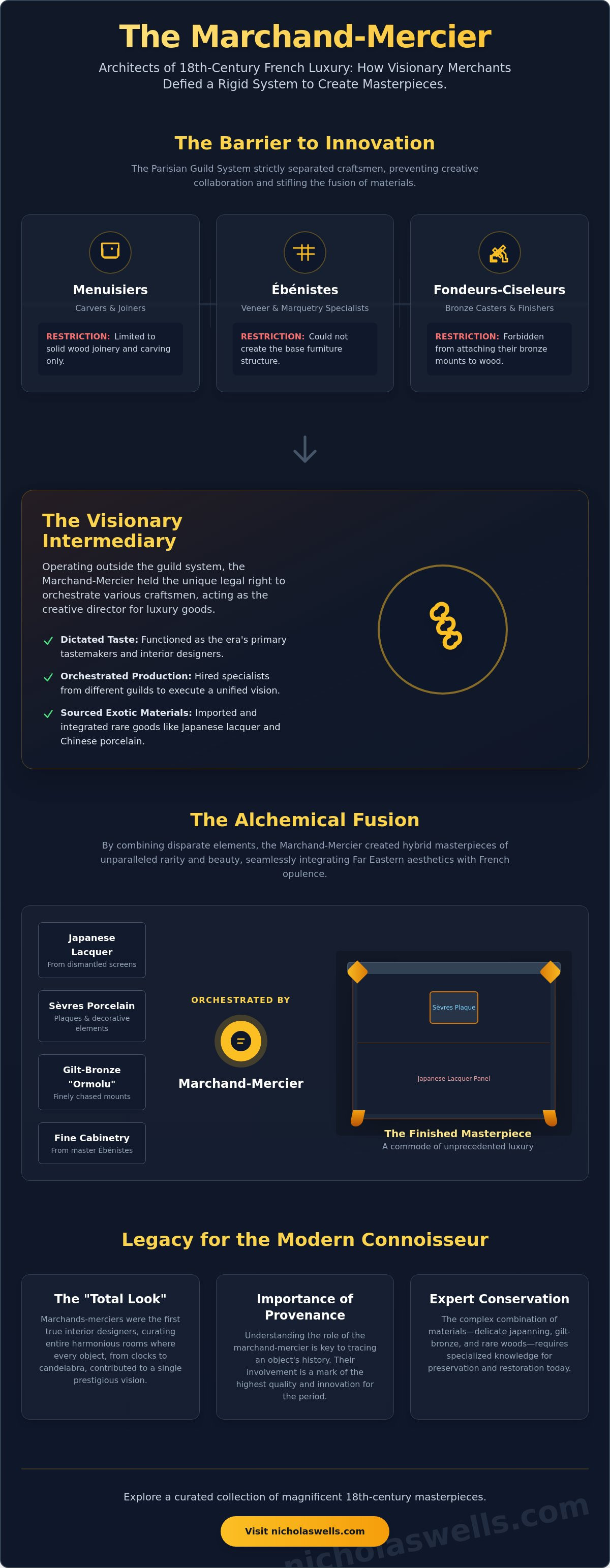
The 18th-century Parisian art market was defined by a singular and sophisticated class of tastemakers known as the Marchand-mercier. These figures were far more than simple shopkeepers; they functioned as the visionary creative directors of the Ancien Régime. Operating as members of the Corporation des Marchands-Merciers, they held a privileged legal status that allowed them to transcend the rigid boundaries of the Parisian guild system. While a menuisier was strictly restricted to carving wood and an ébéniste to veneering furniture, the marchand-mercier possessed the unique right to purchase works from various craftsmen and marry them into a single, cohesive masterpiece. This autonomy was the primary catalyst for the marchand mercier influence on French furniture ormolu mounts and chinoiserie antiques, as it permitted the daring combination of disparate materials such as Japanese lacquer, Sèvres porcelain, and finely chased gilt-bronze.
Their influence on the "Gout Français" during the reigns of Louis XV and Louis XVI was absolute. By acting as intermediaries between the artisan's workshop and the aristocratic salon, they dictated the aesthetic evolution of the era. At Nicholas Wells Antiques, we recognise that the soul of a magnificent piece often lies in this historical collaboration. Our collection of European objects frequently reflects this 18th-century pursuit of decorative perfection, where the preservation of a unique antique surface remains paramount to its historical integrity.
Beyond Shopkeeping: The Dealers as Visionaries
Prominent figures like Lazare Duvaux, who served the court between 1748 and 1758, and Simon-Philippe Poirier, the innovator behind porcelain-mounted furniture, transformed the luxury trade. Their boutiques in the Rue Saint-Honoré became the epicentre of 18th-century fashion, attracting a global clientele of royals and connoisseurs. These dealers didn't just sell objects; they conceptualised them. Their relationship with the Bâtiments du Roi ensured that the most prestigious royal commissions were infused with the latest stylistic innovations. This tradition of excellence informs our own approach at 45 Albemarle Street in Mayfair. Although we operate exclusively as an online gallery, we maintain the same commitment to sourcing rare items with impeccable provenance and offering expert antique restoration and international shipping to our discerning clients.
The Guild System: A Barrier to Innovation
The Parisian guild system was designed to protect trade secrets, yet its strict silos often stifled creative fusion. A craftsman could not legally combine wood with metal or porcelain without the intervention of a dealer. The marchand-mercier acted as the "general contractor" of luxury, orchestrating the work of various specialists to create something entirely new.
- Menuisiers: Limited to solid wood joinery and carving.
- Ébénistes: Specialised in intricate marquetry and veneering.
- Fondeurs-Ciseleurs: Created the bronze castings for ormolu mounts.
By bypassing these restrictions, the marchands-merciers introduced the world to the superb cabinet furniture that defines the French Golden Age. It's this legacy of innovation and the meticulous conservation of history that we strive to present to our contemporary collectors.
The Gilded Secret: Ormolu Mounts and Bronze d’Ameublement
The term Ormolu, derived from the French "or moulu" meaning ground gold, refers to the high-quality gilt-bronze that defines the pinnacle of 18th-century decorative arts. These mounts weren't merely ornamental; they served a dual purpose as both a protective shield for vulnerable veneered corners and a medium for artistic expression. The marchand mercier influence on French furniture ormolu mounts and chinoiserie antiques cannot be overstated, as these visionary dealers acted as the primary bridge between the master fondeurs-ciseleurs (founders and carvers) and the ébénistes who constructed the wooden carcasses. By commissioning specific designs, the marchands-merciers ensured that every mount was a bespoke creation, tailored to the specific proportions of a commode or a secrétaire à abattant.
The aesthetic evolution of these mounts reflects the shifting tastes of the French court and the Parisian elite. During the mid-18th century, the Rococo style dominated, characterised by the whimsical, asymmetrical curves of rocaille and acanthus leaves. As the century progressed toward the 1770s, a profound shift occurred toward the restrained elegance of Neoclassicism. This transition saw the exuberant scrolls of the Louis XV period replaced by the architectural symmetry, laurel swags, and Greek-key motifs of the Louis XVI era. It's this precise curation of bronze d’ameublement that allowed the marchands-merciers to dictate the visual language of the period, creating pieces that remain the focal point of any serious collection of European works of art.
The Art of the Gilt-Bronze Mount
The production of these mounts involved the rigorous cire perdue or lost-wax casting process, followed by meticulous hand-chasing to achieve a sculptural depth that modern reproductions cannot replicate. The ciseleur used specialized tools to burnish certain areas to a mirror-like shine while leaving others matte, creating a play of light that unified disparate materials such as Carrara marble, West Indian satinwood, and Japanese lacquer. For a deeper exploration of these techniques, see our detailed guide, Ormolu: The Gilded Secret of French Antiques.
Conservation of the Patina
In the world of high-end connoisseurship, the preservation of the original fire-gilding is paramount. A scholarly approach to conservation prioritises the "soul" of the object, favouring the gentle removal of surface dust over aggressive polishing that might strip away the historical integrity of the piece. Patina is the evidence of an object’s journey through three centuries. At Nicholas Wells Antiques, we advocate for the retention of this unique antique surface, as it provides a tangible link to the 18th-century workshops of Paris. Our antique restoration services focus on stabilizing these historic finishes, ensuring they continue to tell their story for future generations of collectors from Mayfair to Manhattan.
Chinoiserie and the Exotic: Integrating Oriental Lacquer and Porcelain
The 18th-century French elite possessed an insatiable appetite for the exotic, fueled by the maritime trade of the Dutch East India Company. This fascination birthed Chinoiserie, a whimsical Western interpretation of Eastern aesthetics that prioritised decorative allure over ethnographic accuracy. Marchands-merciers stood at the centre of this trend, acting as the visionary intermediaries who transformed raw imports into sophisticated Parisian luxuries. They didn't merely sell objects; they reimagined them. One of the most daring practices involved dismantling genuine Japanese lacquer screens. These fragile, centuries-old surfaces were sliced into thin veneers to be applied to French carcasses, a process that required a level of audacity only a dealer with significant capital could afford.
The marchand mercier influence on French furniture ormolu mounts and chinoiserie antiques is most evident in the way these dealers dictated the marriage of materials. By combining imported lacquer with locally cast bronze, they created a hybrid aesthetic that defined the Rococo and Neoclassical eras. This wasn't a simple assembly; it was a curated transformation that respected the unique antique surface of the original lacquer while elevating it through European craftsmanship.
The Marriage of East and West
Curating these materials presented formidable technical challenges. Craftsmen had to adapt flat, rigid lacquer panels to the complex, undulating curves of bombé commodes or the delicate proportions of a secrétaire à abattant. The Asian and Far Eastern Art found in the Nicholas Wells collection reflects this historical dialogue between cultures. Beyond lacquer, dealers like Simon-Philippe Poirier revolutionised the market by commissioning bespoke Sèvres porcelain plaques. These vibrant ceramic inserts were integrated into furniture frames, creating a luminous contrast with dark woods and shimmering ormolu. The dealer’s eye was essential in selecting the finest porcelain from the Royal Manufactory to ensure a perfect chromatic match for the intended piece.
Masterpieces of the Hybrid Style
The marchand mercier influence on French furniture ormolu mounts and chinoiserie antiques reached its zenith in the works of Martin Carlin and Adam Weisweiler. Consider a hypothetical commode featuring deep black urushi lacquer, framed by scrolling ormolu that mimics bamboo or flowering vines. Such pieces are exceptionally rare today, especially those that retain their original 18th-century surface patina. Most examples have suffered from over-restoration or the loss of their delicate mounts. These master cabinetmakers worked under the strict direction of dealers like Daguerre, who provided the mounts and the lacquer panels.
- Martin Carlin: Known for his exquisite use of Sèvres plaques in small, feminine pieces of furniture.
- Adam Weisweiler: Famous for his precise Neoclassical structures that often incorporated Japanese lacquer panels.
- Preservation: The conservation of history is paramount; pieces with original mounts and lacquer are considered the pinnacle of the market.
While our operations are now exclusively digital, the legacy of these great Parisian dealers informs our commitment to quality from our base in Mayfair. Collectors seeking the extraordinary can explore our digital storefront, which upholds the scholarly standards associated with our heritage at 45 Albemarle Street. We continue to offer expert antique restoration and international shipping to ensure these significant cultural artifacts reach a global, informed clientele.
The Merchant as Architect: Designing the French Interior
The marchands-merciers of 18th-century Paris functioned as the ultimate arbiters of taste, orchestrating entire interior schemes that defined the Ancien Régime. They moved beyond mere retail; they acted as visionary directors who harmonised textiles, wall treatments, and objects to create a "total look." By the 1760s, these dealers facilitated the stylistic pivot from the organic, rocaille curves of the Louis XV era to the disciplined, rectilinear forms of the Louis XVI period. This shift reflected a growing obsession with Vitruvian proportions and archaeological discovery. The marchand mercier influence on French furniture ormolu mounts and chinoiserie antiques ensured that every element, from a lacquered commode to a delicate wall light, spoke the same aesthetic language of luxury and restraint.
This influence wasn't confined to the borders of France. The sophisticated interiors curated by these dealers became the standard for European royalty. English collectors, most notably George IV, were captivated by this aesthetic. Between 1783 and 1830, he amassed a world-class collection of French decorative arts for Carlton House, often relying on the expertise of dealers who understood how to blend historical grandeur with modern comfort. At Nicholas Wells Antiques, we continue this tradition of curation from our base at 45 Albemarle Street in Mayfair, though we operate exclusively as a digital storefront to serve our global clientele.
Lighting and Mirrors: The Gilded Framework
Illumination was a primary concern for the 18th-century elite, and the dealers excelled at creating environments that shimmered under candlelight. They paired intricate gilt-bronze wall lights with expansive plates of glass to amplify light across a salon. This curated synergy is evident in our collection of Antique Mirrors, which served as the architectural anchors of these rooms. For those seeking to understand the technical mastery involved in these pieces, our Connoisseur’s Guide to Antique Mirrors explores the evolution from mercury-silvered plates to the grander proportions of the Regency period. Every French giltwood mirror was designed to reflect not just light, but the status of its owner.
The Scholarly Clock: A Marchand-Mercier Speciality
The mantel clock represented the pinnacle of collaborative craft, uniting the skills of the bronze-doreur, the enameller, and the horologist under the dealer's strict supervision. These weren't merely functional tools; they were sculptural statements that often featured allegorical figures or celestial motifs. The marchand-mercier understood that a clock should be the "soul" of the mantelpiece, acting as a focal point that commanded attention. Our expertise in Antique Clocks focuses on these extraordinary objects, prioritising pieces that retain their original surface patina and historical integrity. We believe that the unique antique surface of a 19th-century or 18th-century clock tells a story that modern restoration shouldn't erase.
Discover how a singular piece of history can transform your space by exploring our curated Antique Furniture Collection today.
Connoisseurship Today: Sourcing and Conserving French Masterpieces
Identifying the marchand mercier influence on French furniture ormolu mounts and chinoiserie antiques requires a disciplined eye and an appreciation for the "unique antique surface." These 18th-century tastemakers didn't just sell objects; they engineered them. Modern collectors must look beyond the initial aesthetic to understand the structural and material choices that define these rare pieces. Sourcing such masterpieces involves a rigorous interrogation of provenance and a commitment to scholarly documentation. This ensures that the narrative of the object, from the workshop of a Parisian ébéniste to its current state, remains intact and verifiable.
Evaluating the 18th-Century Surface
The integrity of a piece is often found in its skin. When inspecting ormolu mounts, the presence of original mercury gilding is paramount. Unlike modern electroplating, original 18th-century gilding possesses a soft, buttery depth and a varied texture between matte and burnished areas. Use this checklist during your inspection:
- Chasing: Look for crisp, hand-finished details in the bronze that indicate the work of a master ciseleur-doreur.
- Oxidation: Natural darkening in the deep recesses of the casting is a sign of honest age.
- Fixings: Original hand-cut screws and evidence of historical mounting points provide clues to the piece's journey.
Maintaining the value of Cabinet Furniture requires a philosophy of complimentary restoration. This approach prioritises the preservation of the original patina over aggressive cleaning. Collectors should look for the harmonious tension between materials as a sign of dealer curation, where the cold precision of bronze meets the warmth of aged timber or delicate lacquer. This balance is the hallmark of the marchand-mercier's vision.
The Digital Storefront: A Modern Legacy
The prestige of Nicholas Wells Antiques is deeply rooted in the historical art market of London. Our heritage at 45 Albemarle Street, Mayfair, established a standard of expertise that continues to define our brand. Today, we've evolved to meet the needs of a global audience by operating as an exclusive online-only gallery. This transition allows us to focus our resources on sourcing the most extraordinary examples of the marchand mercier influence on French furniture ormolu mounts and chinoiserie antiques without the constraints of a traditional showroom.
Our commitment to excellence remains unchanged. We provide comprehensive digital dossiers for every acquisition, ensuring that the soul of the object is communicated through high-resolution imagery and academic research. To support our international clientele, we offer bespoke restoration services and professional international shipping. Every piece is handled with the reverence it deserves, ensuring that these significant cultural artifacts transition seamlessly into contemporary luxury interiors. We invite you to explore our curated collection through our digital storefront, where history and modern connoisseurship converge.
Preserving the Legacy of the Ancien Régime
The 18th-century marchand-mercier acted as the essential bridge between raw artistry and the refined tastes of the French court. Figures such as Lazare Duvaux, who catered to the elite between 1748 and 1758, didn't just sell furniture; they curated a lifestyle of unparalleled luxury. By marrying rare Japanese lacquers with the architectural brilliance of bronze d’ameublement, they created pieces that remain the pinnacle of decorative arts. This enduring marchand mercier influence on French furniture ormolu mounts and chinoiserie antiques dictates the standards of connoisseurship we uphold today. It's a tradition that values the soul of an object as much as its physical form.
At Nicholas Wells, we're dedicated to the conservation of history through our scholarly expertise in 18th-century and 19th-century masterpieces. While our brand's prestige is anchored in the heritage of Mayfair and 45 Albemarle Street, we operate exclusively online to provide a bespoke experience for the modern collector. Every piece in our collection undergoes expert restoration to protect its unique antique surface and historical patina. We offer fully insured worldwide shipping, ensuring these magnificent cultural artifacts reach your interior in superb condition. Explore our curated collection of fine French and English antiques to find an extraordinary focal point for your home. We look forward to helping you discover a piece that tells a truly remarkable story.
Frequently Asked Questions
What exactly was the role of a marchand-mercier in 18th-century France?
A marchand-mercier acted as a sophisticated tastemaker and intermediary in 18th-century Paris, legally permitted to trade in luxury goods but forbidden from manufacturing them. These entrepreneurs, governed by the 1613 statutes of the Mercers' Guild, dictated the evolution of French decorative arts by commissioning collaborations between disparate craftsmen. They frequently paired imported Japanese lacquer with Parisian cabinetry, effectively circumventing guild restrictions to create the hybrid masterpieces that define the era.
How did the guild system affect the design of French furniture?
The rigid Parisian guild system, established in the 14th century and strictly enforced until 1791, prohibited individual craftsmen from working across multiple materials. An ébéniste couldn't cast bronze, nor could a fondeur-ciseleur work in wood. This enforced specialisation ensured an extraordinary level of technical perfection in each component. It also necessitated the rise of the marchand-mercier, who alone possessed the legal right to assemble these separate elements into a singular, cohesive work of art.
Why are ormolu mounts so important in French antique furniture?
Ormolu mounts, or bronze doré, served both a structural and aesthetic purpose, protecting the vulnerable corners of veneered furniture while providing a canvas for sculptural expression. These fire-gilded bronze ornaments reached their zenith between 1715 and 1774, often representing 50 percent of a piece's total production cost. The marchand mercier influence on French furniture ormolu mounts and chinoiserie antiques is evident in how these mounts were used to frame exotic materials, creating a harmonious balance.
What is the difference between Chinoiserie and authentic Oriental lacquer?
Chinoiserie refers to the European interpretation of East Asian artistic traditions, often utilising vernis Martin, a technique developed by the Martin brothers in 1730 to emulate Oriental surfaces. Authentic lacquer, conversely, is a natural resin harvested from the Toxicodendron vernicifluum tree, primarily imported from Japan and China during the 18th century. While authentic panels were often cut from imported screens to fit French commodes, Chinoiserie allowed for a more flexible application of decorative motifs.
How can I identify if a piece of furniture was influenced by a marchand-mercier?
Identifying the marchand mercier influence on French furniture ormolu mounts and chinoiserie antiques involves looking for the innovative juxtaposition of materials that crossed traditional guild boundaries. Pieces featuring Sèvres porcelain plaques, introduced by Simon-Philippe Poirier around 1758, or those incorporating repurposed Japanese lacquer are hallmark indicators. These objects display a level of stylistic cohesion and daring luxury that individual cabinetmakers, constrained by their specific craft regulations, rarely achieved without external commercial direction.
Can I visit the Nicholas Wells showroom in Mayfair to view these pieces?
While our administrative presence is situated at 45 Albemarle Street in Mayfair, Nicholas Wells Antiques operates exclusively as a digital storefront. This model allows us to curate an exceptional global inventory without the constraints of a traditional gallery space. We don't offer a physical showroom for browsing; however, we provide comprehensive high-resolution imagery and scholarly condition reports for every piece within our collection to ensure total transparency for our international clientele.
How does Nicholas Wells Antiques handle the restoration of ormolu and lacquer?
Our approach to restoration prioritises the conservation of history and the preservation of the unique antique surface. We employ specialist conservators who understand the delicate chemistry of 18th-century lacquer and the nuanced cleaning of original fire-gilding. By avoiding over-polishing, we ensure the soft, honey-coloured patina of the ormolu remains intact. This meticulous process maintains the object's historical integrity and long-term investment value for the discerning collector who appreciates the soul of an object.
Does Nicholas Wells Antiques ship these delicate French antiques internationally?
We regularly facilitate the secure international transit of delicate French antiques to collectors across six continents. Every shipment is handled by specialist fine art couriers who provide bespoke crating and white-glove delivery services. Our team manages all aspects of the export process, including the necessary CITES documentation for items containing restricted materials. This ensures that these significant cultural artifacts arrive in pristine condition, regardless of their final destination or the complexity of the logistics involved.


Leave a comment