



The Resolute Presidential Desk: A Connoisseur’s Guide to the Oval Office Icon
In 1879, Queen Victoria commissioned a singular piece of furniture that would bridge two empires through the sheer weight of its history and timber. While most observers recognize the resolute presidential desk from its prominent position in the Oval Office, few grasp the profound technical mastery required to transform a salvaged Arctic vessel into a refined partners' desk. You've likely admired its silhouette during historic broadcasts, but the scholarly details of its construction and its 1880 presentation to President Rutherford B. Hayes deserve a more rigorous examination than the typical brief summary provides.
This article offers an immersive exploration of the desk's journey from the oak ribs of the HMS Resolute to the executive suite. You'll gain a sophisticated understanding of Victorian cabinet-making techniques and the specific anatomical features of a high-quality partners' desk. We'll examine the provenance that defines this cultural artifact, providing you with the connoisseur's tools to identify the extraordinary craftsmanship that separates a rare, distinguished antique from a mere imitation.
Key Takeaways
- Uncover the maritime narrative of the resolute presidential desk, exploring its storied transition from a British Arctic vessel to a symbol of transatlantic diplomacy.
- Understand the technical mastery and material density required to craft a Victorian partners’ desk of such enduring scholarly importance.
- Discover how presidential preferences and specific modifications, like the addition of the kneehole panel, have shaped the desk’s iconic silhouette.
- Learn the art of connoisseurship by identifying the nuances of provenance and craftsmanship that elevate a piece from furniture to a cultural artifact.
- Explore the meticulous standards for sourcing and restoring fine English desks to ensure their historical integrity remains a focal point in the modern interior.
The Resolute Presidential Desk: An Extraordinary Legacy of the Sea
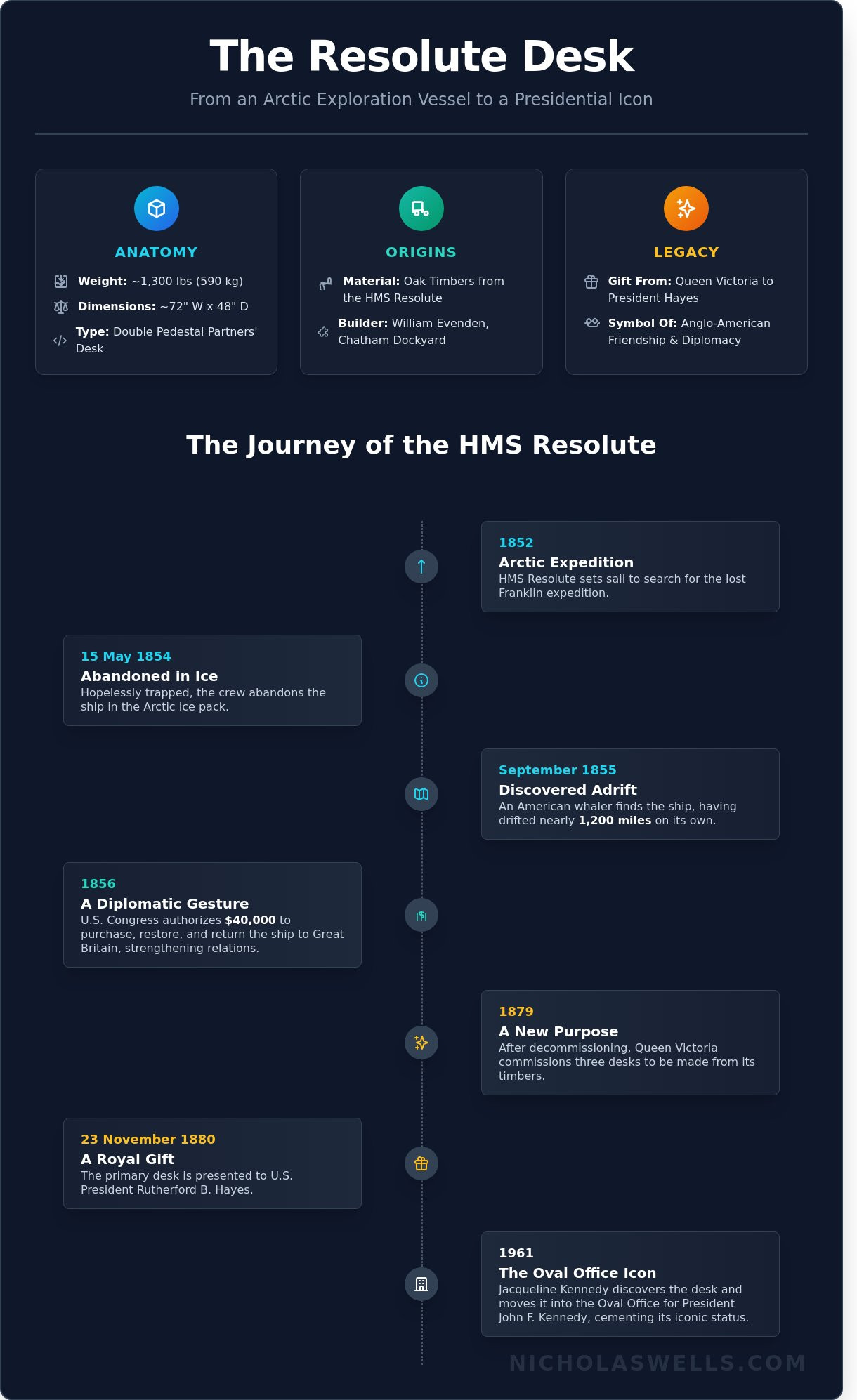
The resolute presidential desk isn't just a functional workspace; it's a monumental artifact of maritime history and a masterpiece of 19th-century cabinetry. Gifted by Queen Victoria to President Rutherford B. Hayes on November 23, 1880, this double pedestal partners' desk represents a pinnacle of Victorian craftsmanship. It was fashioned from the seasoned oak timbers of the HMS Resolute, a British vessel whose journey from the frozen Arctic to the American capital remains a singular narrative of international grace. Today, it stands as an enduring symbol of the American presidency, carrying a provenance that bridges two great powers through a shared respect for exploration and duty.
Its physical presence is commanding. The desk features intricate carvings and a robust structure that speaks to the strength of the ship from which it was born. The choice of a partners' desk design, intended for two people to work facing one another, underscores the collaborative spirit of the gift. It's a piece that demands a certain level of connoisseurship to fully appreciate, as every grain in the wood tells a story of survival in the most hostile environments on Earth. The deep patina of the oak serves as a silent witness to the weight of modern history.
The HMS Resolute and the Arctic Expedition
In 1852, the HMS Resolute set sail as part of a five-ship squadron under Sir Edward Belcher, searching for the ill-fated expedition of Sir John Franklin. The ship became hopelessly entombed in the ice of Trowbridge Island, forcing its crew to abandon the vessel on May 15, 1854. For months, the ship drifted nearly 1,200 miles through the Arctic silence until it was spotted in September 1855 by Captain James Buddington, an American whaler. The US Congress recognized the ship's symbolic value and authorized $40,000 for its purchase and meticulous restoration. This generous act led to the ship's formal return to the British Crown in December 1856, a vital chapter in the Resolute Desk History that fostered a lasting Anglo-American friendship.
Captain Buddington's discovery wasn't merely a lucky find; it was a catalyst for a diplomatic reconciliation that changed the course of 19th-century relations. The ship's survival against the crushing pressure of the ice pack mirrored the resilience of the nations themselves. When the vessel was returned, it arrived in England as a gesture of profound gratitude, setting the stage for one of the most famous gifts in diplomatic history.
A Gift of Diplomacy: Queen Victoria to President Hayes
When the ship was finally decommissioned in 1879, Queen Victoria chose to preserve its soul through the creation of fine furniture. She took a personal interest in the project, selecting the resolute presidential desk as a gift for President Hayes. The firm of William Evenden at the Royal Dockyard in Chatham handled the construction, ensuring the timbers were treated with the reverence they deserved. The desk arrived at the White House in November 1880, arriving as a surprise that would soon become the most famous desk in the world.
Since its installation, the desk has moved through various rooms of the White House, but its most celebrated placement began in 1961. Jacqueline Kennedy discovered it in the broadcast room and had it moved to the Oval Office for President John F. Kennedy. Its presence there transformed the room, grounding the modern executive space with a sense of historical weight and superb craftsmanship. It remains a focal point of contemporary political life, offering a sophisticated bridge between the grandeur of the maritime past and the requirements of modern leadership.
Masterful Construction: The Anatomy of a Victorian Partners’ Desk
The creation of the resolute presidential desk represents a pinnacle of 19th-century British joinery, a task entrusted to William Evenden, the master joiner at Chatham Dockyard in 1880. This wasn't merely a commission for a piece of office furniture; it was an act of diplomatic engineering. Evenden worked with the seasoned white oak of the HMS Resolute, a timber so dense and salt-hardened that it required specialized tools to carve. The sheer mass of the timber gives the desk its formidable weight of approximately 1,300 pounds, a figure that reflects the structural integrity required for naval vessels and now repurposed for the highest office in the United States. Its primary dimensions, measuring roughly 72 inches in width and 48 inches in depth, provide a commanding presence that few contemporary pieces can replicate.
Chatham Dockyard Craftsmanship
In the Victorian era, the tradition of ship-to-furniture repurposing held deep symbolic resonance, turning vessels of war or discovery into objects of domestic and political utility. Naval oak differs significantly from standard furniture-grade oak because it possesses a deeper patina and a tighter grain structure, the result of decades spent under the pressure of the sea and the weight of rigging. Evenden employed hand-cut blind dovetails and precision mortise-and-tenon joinery to ensure the massive timber sections remained perfectly aligned despite changes in humidity. This level of craftsmanship ensures that even today, the desk remains a functional masterpiece of 19th-century design. For those seeking to integrate such history into their own spaces, a curated antique furniture collection often reveals how these rigorous naval standards influenced high-end cabinet making of the period.
Defining the Victorian Partners’ Desk Format
The resolute presidential desk follows the classic partners' desk format, a design that evolved from the grand library desks of the late 18th century. Unlike a standard writing table, a partners' desk is built with a double-pedestal configuration, allowing two individuals to work while facing each other across a shared surface. This layout features opposing sets of drawers and cupboard pedestals, providing equal utility to both occupants. The desk's original surface was covered in a rich morocco leather, framed by elaborate carvings of floral swags and acanthus leaves. While the primary exterior is rugged naval oak, the interior drawers often utilized secondary mahogany timbers for their stability and smooth action. The White House Historical Association notes that several modifications were made over the decades, including the addition of a central panel by Franklin D. Roosevelt in 1945 to conceal his leg braces. Such details underscore how a piece of furniture can adapt to the needs of its owner while retaining its soul. If you're looking for a statement piece with similar presence, you might explore our latest acquisitions to find a desk that commands the room with equal authority.
- Timber: Quercus alba (White Oak) from the HMS Resolute.
- Joinery: Master-level blind dovetails and mortise-and-tenon construction.
- Weight: Approximately 1,300 lbs (590 kg).
- Secondary Woods: High-grade mahogany for drawer linings.
- Ornamentation: Hand-carved Victorian motifs and presidential seals.
Evolution of an Icon: Modifications and Presidential Preferences
The resolute presidential desk is far more than a static piece of Victorian furniture; it’s a living artifact that has been meticulously adapted to meet the physical and aesthetic requirements of its occupants. While the desk’s primary structure remains a testament to nineteenth-century British craftsmanship, its silhouette has evolved through deliberate structural changes. These modifications don't merely serve a functional purpose; they represent the intersection of personal necessity and the enduring dignity of the executive office. Each alteration adds a new layer to its provenance, ensuring the desk remains as relevant in the modern era as it was when Queen Victoria first gifted it in 1880.
The Roosevelt Kneehole Panel
In 1944, Franklin D. Roosevelt requested the most significant structural modification in the desk's history. He commissioned the addition of a hinged panel to enclose the kneehole, a design choice intended to hide his leg braces from public view. This panel features a superb carving of the Presidential Coat of Arms, though it remains a historical anomaly. The eagle’s head is turned toward the arrows in its left talon, a configuration that predates the 1945 executive order by Harry S. Truman which standardized the seal to face the olive branch. Although Roosevelt didn't live to see the panel installed, Truman ensured its completion and placement in 1945, forever changing the desk’s visual weight.
From the Second Floor to the Oval Office
For decades, the desk’s placement within the White House was surprisingly fluid. It originally resided in the President’s Study on the second floor, serving as a private workspace rather than a public symbol. The desk’s ascent to its current status began in 1961 when Jacqueline Kennedy discovered it in a broadcast room during her ambitious restoration of the mansion. She recognized the piece’s extraordinary heritage and had it moved into the Oval Office for John F. Kennedy. This single decision transformed the resolute presidential desk into a globally recognized icon of American power. Since that 1961 move, the desk has been the primary choice for nearly every successor, with few exceptions.
- John F. Kennedy (1961): The first to use the desk in the Oval Office, cementing its image in the public consciousness through famous photographs of his young son playing under it.
- Jimmy Carter (1977): After the desk spent 13 years away from the White House, Carter requested its return to the Oval Office for his administration.
- Ronald Reagan (1981): He famously added a 2-inch base to the desk to accommodate his height and prevent his knees from hitting the drawers.
- Modern Era: Bill Clinton, George W. Bush, Barack Obama, Donald Trump, and Joe Biden have all maintained the desk as their primary workspace.
The desk hasn't always remained within the walls of 1600 Pennsylvania Avenue. Following the Kennedy assassination in 1963, it left the White House for a lengthy period of public service. From 1964 to 1977, the desk was a centerpiece of a traveling exhibition for the Kennedy Library and was later displayed at the Smithsonian Institution. This era of public viewing allowed the American citizenry to appreciate the desk's intricate carvings and deep patina outside the restrictive confines of the West Wing. Its eventual return under the Carter administration marked the beginning of its uninterrupted tenure as the definitive centerpiece of the Oval Office.
Connoisseurship: Evaluating the Quality of Fine Antique Desks
The acquisition of a 19th-century English partners’ desk represents more than a mere addition to an office; it's an investment in a storied legacy of craftsmanship and political history. Collectors must prioritize provenance, as a documented lineage transforms a functional object into a significant cultural artifact. When we examine the resolute presidential desk, its value stems not only from its magnificent construction but from its 1880 origin as a gesture of international diplomacy. A superb desk from the Victorian era should exhibit crisp joinery, often featuring the distinct marks of master workshops such as Gillows of Lancaster or Holland & Sons. These pieces were designed to be viewed from all angles, finished with the same meticulous attention to detail on the back as on the front, reflecting the transparency required for two partners working in tandem.
The soul of a fine antique resides in its surfaces. Authentic 19th-century mahogany and oak possess a depth of color that modern chemical stains fail to replicate. This natural aging process reflects decades of light exposure and careful handling, resulting in a surface that feels remarkably smooth to the touch. A significant desk serves as the gravitational center of a contemporary interior, providing a sense of permanence in an increasingly digital world. It's the physical manifestation of authority, offering a tactile connection to the 1880s when the original resolute presidential desk first began its journey from the timber of the HMS Resolute to the Oval Office.
Identifying the Patina of Naval Oak
Distinguishing authentic 19th-century white oak from modern reproductions requires a discerning eye for grain density and oxidation. The timber used in high-value naval commissions was often seasoned for years, resulting in a stability that prevents the warping seen in lesser pieces. You should look for the soft, honey-colored glow of original ormolu mounts; these gilded bronze ornaments should show gentle wear rather than the harsh, uniform brightness of contemporary plating. For those looking to expand their collection beyond the library, exploring period cabinet furniture provides further insight into the storage solutions that complemented these grand writing tables.
The Resolute Style in Modern Interior Design
Integrating a massive partners’ desk into a town or country house study requires a careful balance of scale and illumination. The desk shouldn't merely sit in the room; it should command it. The interplay between light and wood is essential for highlighting the intricate carvings and grain patterns. By pairing a grand desk with appropriate antique lighting, such as a 19th-century bronze desk lamp or a pair of elegant sconces, the wood’s character is fully realized. The "Resolute" aesthetic remains the gold standard for executive furniture in 2026 because it combines historical gravitas with a scale that accommodates the requirements of modern leadership. This style transcends fleeting trends, offering a timeless foundation for a sophisticated workspace.
Discover the perfect centerpiece for your study by browsing our collection of extraordinary antique desks and library furniture.
Acquiring the Exceptional: Fine English Desks at Nicholas Wells Antiques
The legacy of the resolute presidential desk serves as a profound testament to the enduring power of English craftsmanship. At Nicholas Wells Antiques, we treat every acquisition with the same reverence afforded to such historic icons. Our sourcing strategy focuses on the singular and the extraordinary. We seek out 18th and 19th-century cabinetry that retains its original soul and structural integrity. We don't just find furniture; we identify cultural artifacts that possess the true weight of history. Each piece undergoes a meticulous evaluation where we examine the grain of the mahogany, the precision of the dovetail joinery, and the authenticity of the aged patina.
Preserving the narrative of a piece requires more than simple repair. Our in-house restoration team provides complimentary services that prioritize conservation over modernization. We've seen that a desk's value lies in its lived history, whether it's a 1780 pedestal desk or a 19th-century partner's desk. We verify provenance through rigorous archival research, ensuring that collectors invest in pieces with documented lineages. This commitment to scholarly detail has helped us place significant works in private collections across 40 different countries since our gallery's inception. We understand that for the serious collector, the story is as vital as the wood itself.
Investing in 18th and 19th-century English cabinetry remains a sound financial and aesthetic decision for the modern interior. Market trends over the last 15 years show that high-quality pieces with clear provenance maintain their value far better than contemporary mass-produced luxury goods. A desk isn't merely a workspace; it's the intellectual center of a home. When you sit at a piece that mirrors the stature and presence of the resolute presidential desk, you're engaging with a tradition of excellence that spans centuries. We help our clients find that specific connection, whether they're looking for a delicate Sheraton-style table or a robust Victorian partner's desk. Our expertise ensures that the history of your furniture is as compelling as its physical presence.
Curating a Collection for the Distinguished Study
Our selection process targets the rarest examples of English cabinetry, from Gillows-attributed writing tables to magnificent architect's bureaus. These pieces work in tandem with our wider range of antique tables to establish a cohesive historical narrative within a room. To ensure these treasures arrive safely, we provide fully insured worldwide shipping, utilizing specialized crating techniques developed over 20 years of international trade. Every shipment is handled with the care required for rare cultural artifacts.
The Nicholas Wells Antiques Commitment to Excellence
Our London-based gallery operates with a level of scholarly rigor that satisfies the most demanding international decorators and private collectors. We treat every verification process as an academic exercise, confirming that the ormolu mounts and intricate marquetry are period-correct and of the highest quality. We invite you to explore our works of art European objects to find the perfect inkstands or bronze figures to complement your chosen desk and complete your study's aesthetic.
Securing a Legacy of Historical Grandeur
The resolute presidential desk remains the ultimate symbol of diplomatic history and Victorian craftsmanship, standing as a testament to the 1880 gift from Queen Victoria to President Rutherford B. Hayes. Beyond its famous silhouette in the Oval Office, this piece represents the pinnacle of the double-sided partners' desk, a form that revolutionized the nineteenth-century study with its dual functionality and massive proportions. Recognizing the nuances of such an extraordinary artifact requires an eye for original patina and the structural integrity that only timber from the 1850 Arctic expedition of the HMS Resolute could provide. Since 2012, Nicholas Wells has curated a distinguished selection of fine furniture in London, ensuring that each piece meets the highest standards of rarity and provenance.
We invite you to explore our curated collection of fine antique desks and furniture, where every acquisition includes a complimentary restoration by master craftsmen. With fully insured worldwide shipping, your chosen masterpiece will arrive in pristine condition, ready to serve as the heart of your personal library. It's a rare opportunity to possess an object that bridges the gap between historical significance and modern luxury. You'll find that investing in such heritage ensures your home reflects a deep reverence for the past.
Frequently Asked Questions
What is the Resolute desk made of?
The Resolute desk is meticulously crafted from the seasoned oak timbers of the HMS Resolute, a British Arctic exploration vessel abandoned in 1854. This 1,300-pound masterpiece features a heavy grain and deep patina that only centuries-old maritime wood can achieve. Its construction showcases the robust joinery of the late Victorian era. Every fiber of the desk carries the salt and history of 19th-century naval expeditions.
Who gave the Resolute desk to the United States?
Queen Victoria presented the resolute presidential desk to President Rutherford B. Hayes on November 23, 1880, as a gesture of enduring diplomatic gratitude. This gift followed the American recovery of the HMS Resolute, which was found drifting in Davis Strait by a whaler in 1855 and later returned to Britain. The Queen commissioned William Evenden to design the piece at the Chatham Dockyard. It remains one of the most distinguished examples of royal provenance in American history.
Is the Resolute desk still in the Oval Office in 2026?
The desk remains the centerpiece of the Oval Office in 2026, continuing its role as the primary workstation for the President of the United States. Since its 1977 return to the office by Jimmy Carter, it's been selected by 8 of the last 9 administrations. Its presence provides a tangible link to the 19th century. The desk's survival through 146 years of political transitions underscores its status as an immovable symbol of executive authority.
Why is it called the Resolute desk?
The desk takes its name from the HMS Resolute, the 1850 British naval ship whose salvaged timbers provided the raw material for its construction. The word Resolute reflects the ship's mission to find the lost Franklin Expedition in the Arctic. It's a title that embodies both the endurance of the vessel and the steadfast nature of the office it serves. This nomenclature honors the 1855 act of Congress that funded the ship's restoration and return.
Can you buy a replica of the Resolute desk?
You can purchase high-fidelity replicas from specialized high-end cabinetmakers like the Kittinger Furniture Company, which produced a notable version for the Ronald Reagan Presidential Library. Authentic reproductions often cost between $10,000 and $25,000 depending on the quality of the mahogany or oak used. While these pieces mimic the 1880 original, they lack the unique maritime history of the Chatham timbers. Collectors often seek these to bring a sense of presidential gravity to private studies.
How much is the original Resolute desk worth?
The original resolute presidential desk is considered a national treasure and is officially priceless, though its insurance value would likely exceed $50 million in a private auction. This valuation considers its 1880 royal provenance and its use by 13 different American presidents. Because it's federally owned property under the care of the National Park Service, it won't ever reach the open market. Its worth is measured by its 146-year historical narrative rather than a mere currency figure.
What is the meaning of the carving on the front of the desk?
The front panel features a hand-carved Presidential Seal, commissioned by Franklin D. Roosevelt in 1944 to conceal his leg braces from visitors. This modification turned the desk into a four-sided piece by filling the central kneehole. It's the only version of the seal that depicts the eagle facing the arrows rather than the olive branch, a detail that predates the 1945 redesign by Harry Truman. This specific carving adds a layer of 20th-century history to the Victorian structure.
Which presidents did not use the Resolute desk?
Presidents Lyndon B. Johnson, Richard Nixon, and Gerald Ford chose not to use the desk in the Oval Office between 1963 and 1977. During this 14-year period, the desk was often displayed at the Smithsonian Institution or used elsewhere in the White House. Johnson preferred the mahogany desk he'd used in the Senate, while Nixon opted for the Wilson desk. It didn't return to the Oval Office until the 1977 inauguration of Jimmy Carter.
Leave a comment